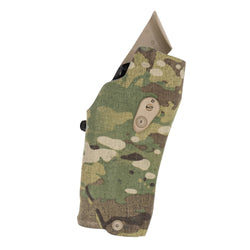

There has been a line drawn as long as I can remember separating target pistols from duty use. But what if that target pistol is not only insanely accurate, but also reliable and packed with features?
About Sport target pistol (STP)
Sport Target Pistol of Germany is relatively new to the US market. They have been imported and sold here for about five years. They command the competition market in Europe and Asia and are trying to expand their footprint in the United States.
All of the STP pistols are machined from bar stock and then fit by German-trained gunsmiths. They produce all of their parts in-house except items like wood grips and sights. They even make their own barrels! By having their hands on the product from start to finish, they can ensure they meet the highest quality standards.
quality
Their quality control shows up in the end result. Team STP members all report that the firearms are highly accurate and run well right out of the box. This quality does come with a decent price tag attached. These are priced right there with other top-shelf 1911s and 2011s.
High-end 1911 and 2011 may give you a little sticker shock in the beginning. But when you sit down and look at the more budget-friendly options and consider the upgrades you may want to do, it begins to balance out. Gunsmith work and parts add up quickly! Heck, I made a living for a couple of decades tuning guns for customers. With that career and cost knowledge in mind, picking up a gun out of the box that is perfect and ready to run is a breath of fresh air.
STP features
STP has a host of features that vary from model to model but they all have a few things in common.
Zero cast or MIM parts, which increases the lifespan of the parts and reduces maintenance.
Polygonal rifled barrels are easier to clean and withstand higher velocities than standard barrels.
Machined from barstock, which allows for tighter tolerances than other manufacturing methods.
Built by German-trained gunsmiths. Precision fit by skilled craftsmen, not assembly line built, ensures a quality product.
PVD finish on metal parts holds up to wear and allows for tight-tolerance fit parts.
Metal grip frames on 2011s, more durable and ridged (as in it doesn’t flex under pressure).
STP SWAT
When STP decided to enter the US market, they had all of the target pistol options covered. They were missing something, though, a tactical-focused handgun.
Now, you have to cut the Germans some slack for their gun names. They have attractive names for all of their other pistols but maybe they watched too many US shows when they named this one.
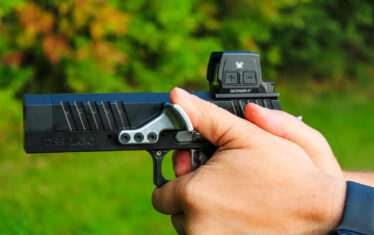
STP’s entry into the tactical 2011 market is the SWAT. Although I would have chosen a different name, it does pinpoint exactly what market this is designed for.
The STP SWAT has several features that the US consumer appreciates.
- Available in 5 and 4-inch barrels
- Optics ready
- Full-length accessory rail under the dust cover
- Mag well
- Slim thumb safeties
- Hex grip frame texture
- Crisp and smooth trigger
Optics, sights, & trigger
The SWAT shows up with a fixed rear sight that can be removed. With this sight removed, any number of STP accessories can be used. Optics plates, BOMAR-style sights, 3 position PPC type sights, and so on. Uniquely, the sight or optics plate slides in from the side and is held in place in two places. The front is retained by two screws, and the back is retained in a pocket. This makes for a very robust mounting option. It also allows the user to swap between an optics plate or iron sights with minimal zero shift.
Right out of the box, the trigger is tuned and set just the way a single-action trigger should be. At about 2.5 pounds, you need to do nothing to it except start putting rounds down range.
accuracy
To let the cat out of the bag, I compete with an STP pistol regularly. The accuracy is second to none, and their full-blown race guns are capable of winning a bullseye match. That’s no small feat for a production gun.
So when I went to set this gun up and test accuracy, I decided to do it with a more practical approach. I mounted a C&H green dot to the pistol and set out towards the range.
zeroing
If you have read any of my past hunting articles, you may have seen my preferred method for support with a handgun. Through a couple of decades of handgun hunting and pushing the accuracy limits, I have learned a trick.
A handgun should be supported just under the butt by a small field bag with down pressure not exceeding the weight of the gun. The zero will remain the same from that position to the standing, and everywhere in between. This technique has worked well with big-bore hunting revolvers and semi-autos alike.
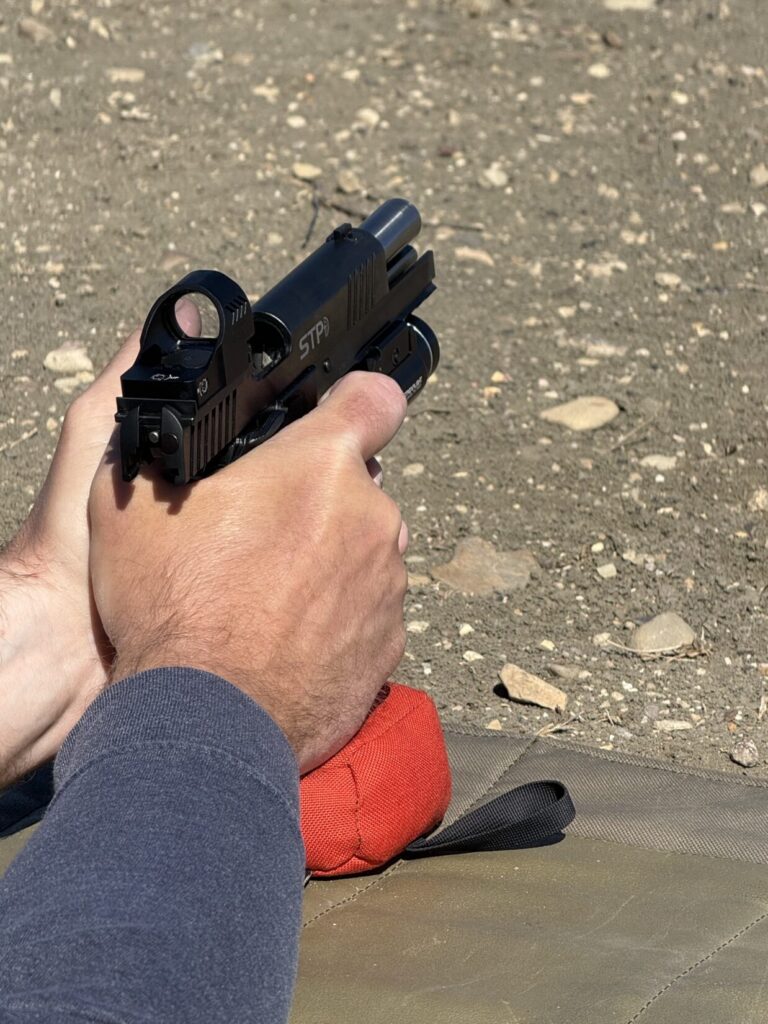
I used the above method when I zeroed the gun at 25 yards with bulk FMJ. After zeroing and a few more shots to confirm zero, I moved towards a more practical position.
break in?
Now I know what some of you are thinking; yes, we are going straight to accuracy testing. Unlike many high-end 1911 or 2011 this gun requires minimal break-in. You won’t see a section in the manual demanding that you fire 500 or more rounds before getting into serious use. The slide runs like it is on glass right out of the box, and stays that way.
Already knowing that these guns are highly accurate, which can be confirmed by competitors around the globe, I wanted to test accuracy in a more practical way. I also wanted to prove that these pistols are not only target pistols, but they can feed defensive ammunition without issue.
The green C&H dot gave me a little star burst that looked like a vertical dumb bell. For whatever reason, my eyes just don’t like green. But I pushed ahead and put the gun to work.
practical accuracy with the STP SWAT
I shot in the prone at 25 yards by just punching out. I let the handgun float above the ground just like you may do in a tactical scenario. If you had to place the most accurate shot possible with your duty pistol, this is quite an effective position, eliminating most of your body wobble.
test ammo
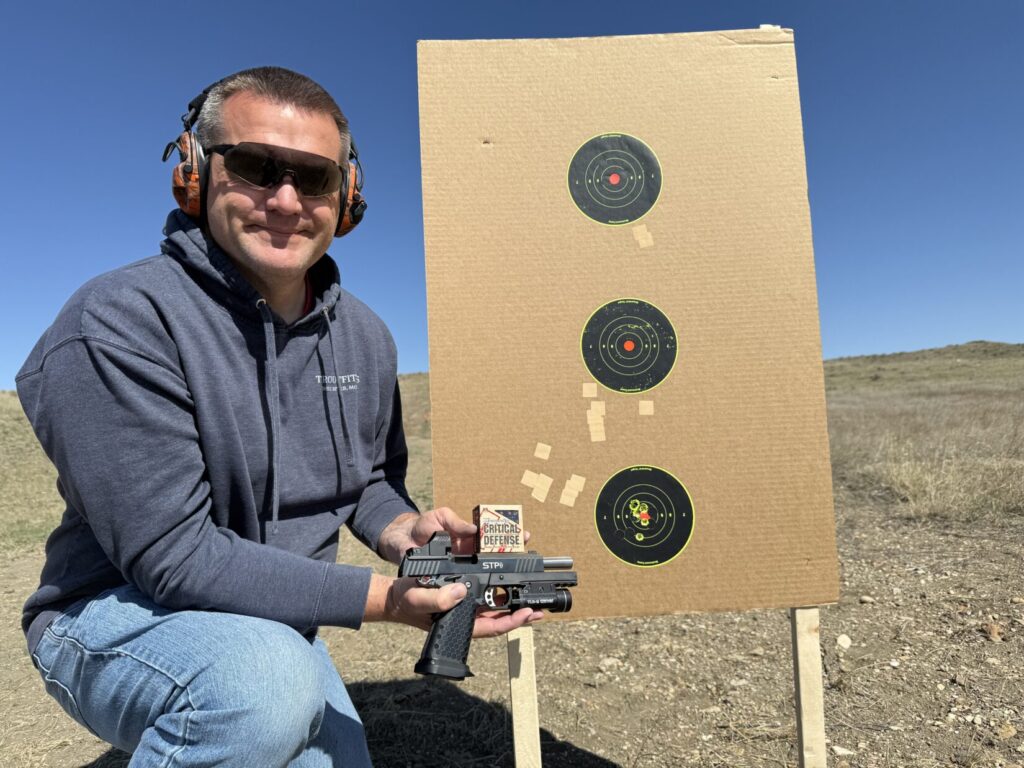
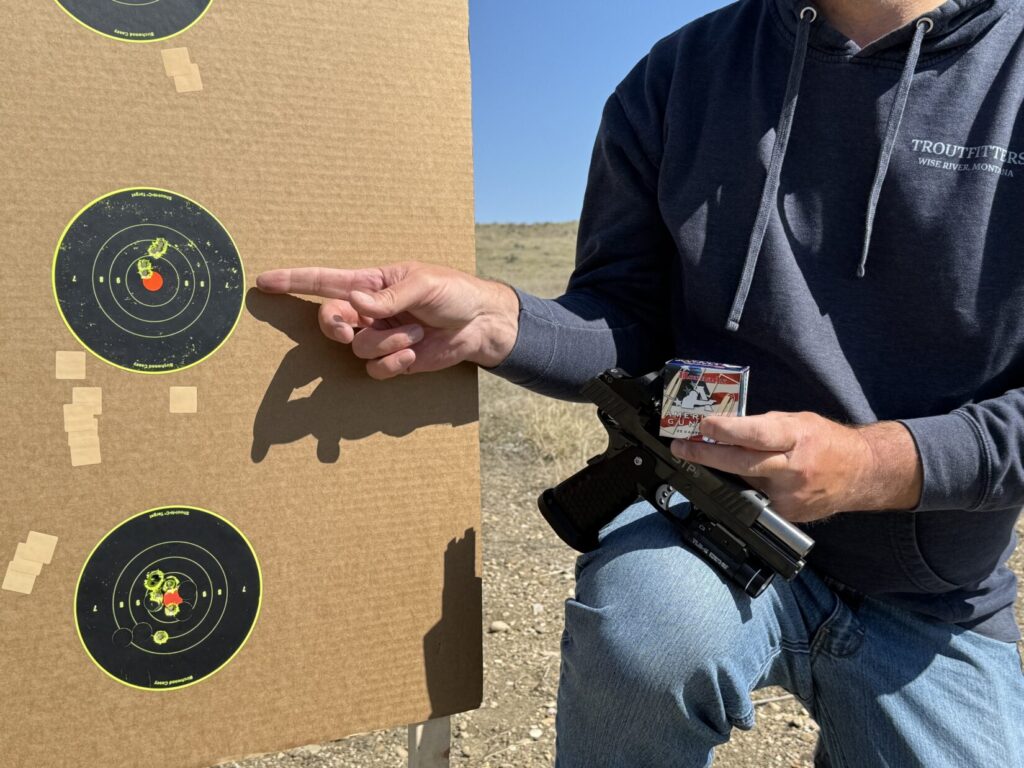
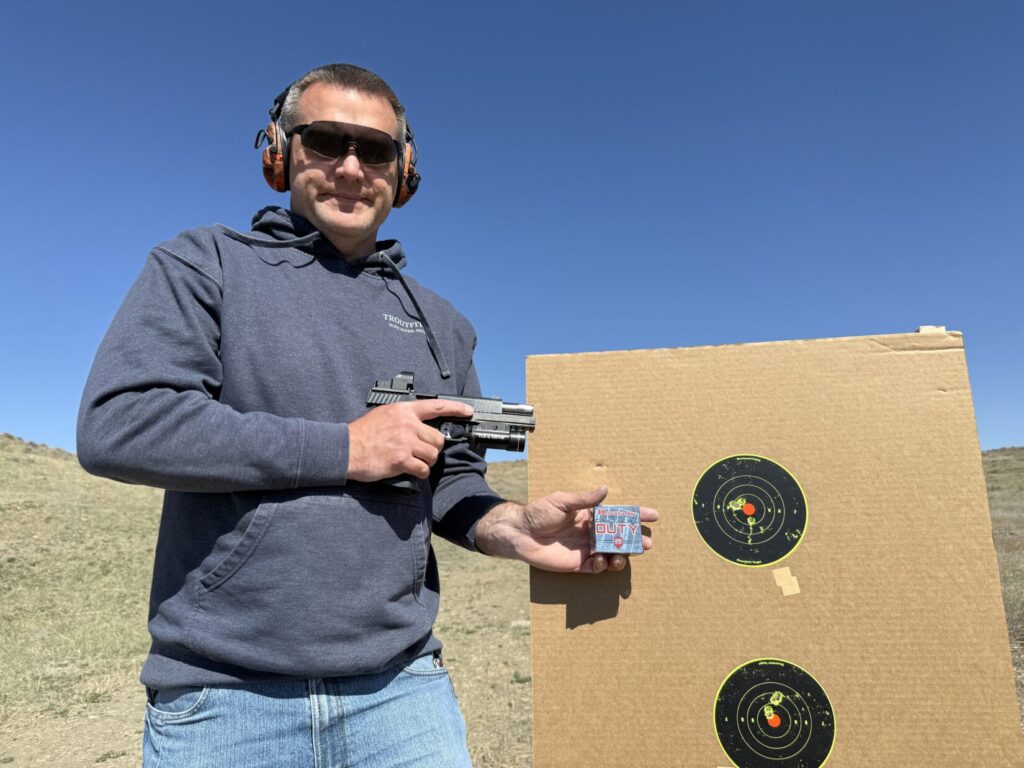
I proceeded to fire five-round groups from three different factory loadings from Hornady. During testing, I used Hornady American Gunner, Critical Defense, and Critical Duty. I fired the rounds for each group from the prone in rapid succession. Zero feeding issues or other malfunctions occurred.
Grouping with Hornady
The groups in the photos below are the first groups as they were fired from the STP SWAT. These are not cherry-picked wallet groups. I did fail to take a measuring device with me to the range, but you can clearly see that these groups are small! Fired from an actual field position and approximately under 2 inches; I’ll take it! If you cull my one bad trigger press from a couple of the groups, they get much smaller.
recoil
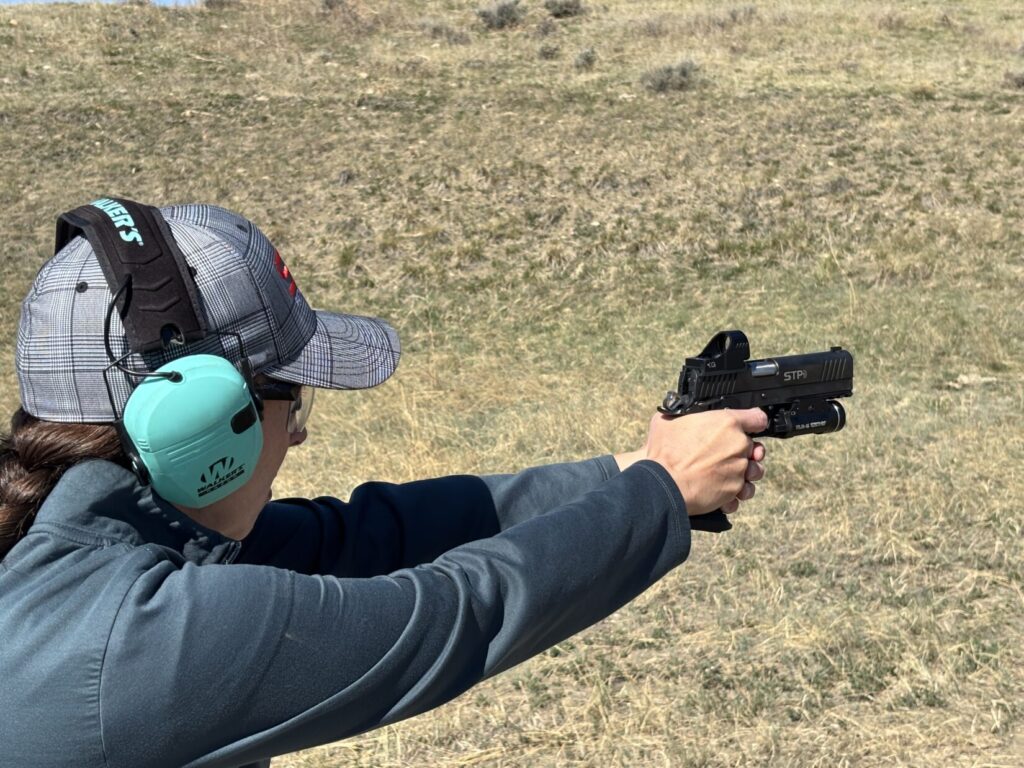
As with all 9mm 2011s, the STP SWAT shoots very softly. This aids in rapid return to target as the dot does not lift above the target in recoil. My wife, who is new to semi-auto pistols, put it to work as well on steel plates to about 35 yards.
Accessories
A pistol is about useless if you can’t accessorize it for the task at hand. As seen in the photos, a Streamlight TRL-1 mounts up without issue, as does an optic. STP produces optics plates for all of the common footprints.
Holsters
Holsters are always the next concern. If you are going to put a pistol to work, you need a serious holster.
It has been almost 20 years since my time in law enforcement. To date myself, I carried a Don Hume level 3 leather holster. With a little training, you could draw quickly, but re-holstering and locking it down took some effort. All of those snaps were not ideal when you were transitioning from a lethal situation to hands-on.
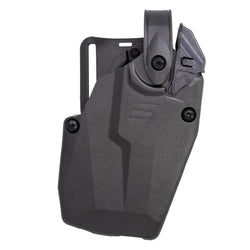
Prior to this article, I reached out to Safariland and begged for some modern technology. The STP fit perfectly in the ALS holster. It had a very positive engagement of the retention, and it was automatic. My first thought was, “This would have made my job easier.”
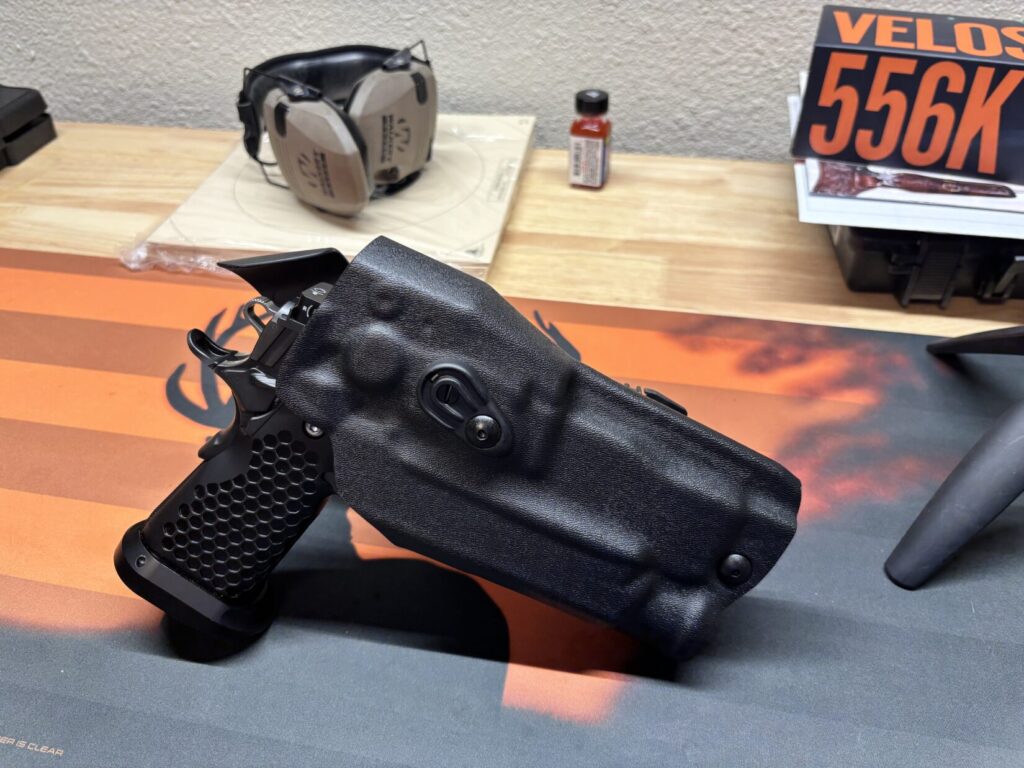
flash back to my LE days
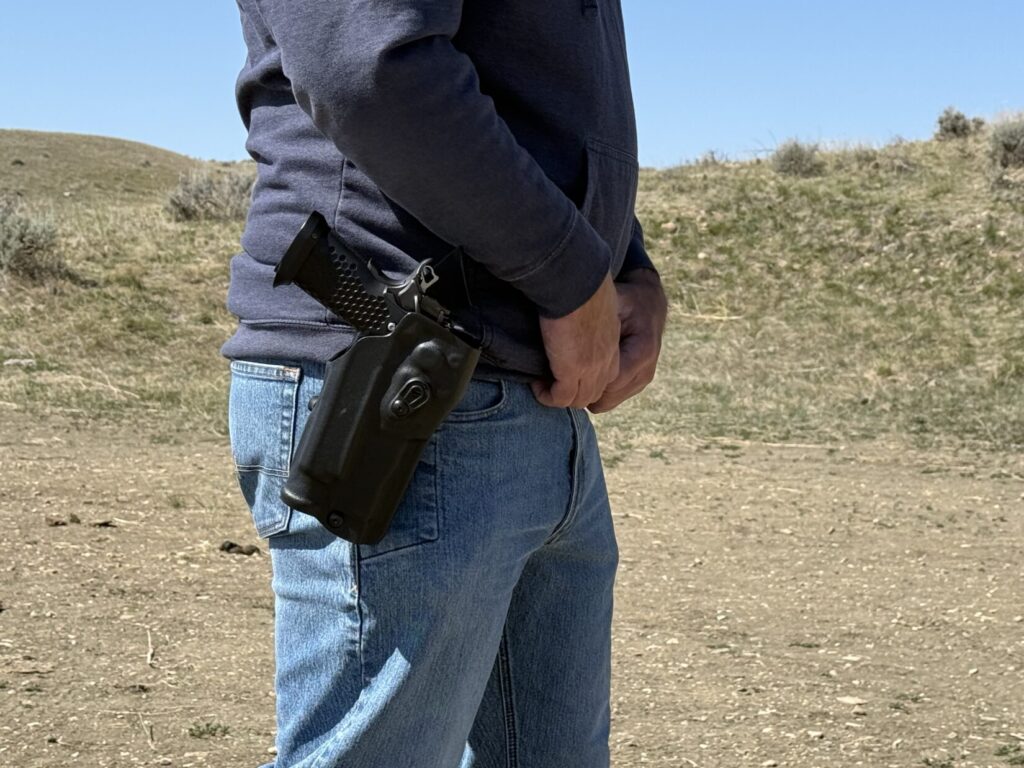
Now, it has been almost two decades since I drew a gun from a retention holster. I was able to slap this on a competition belt and instantly pick up the draw stroke. My thumb fell naturally on the release.
Replacing the gun in the holster was just as effortless. I can truly see an advantage to this over some of the other retention methods, even with just my limited exposure.
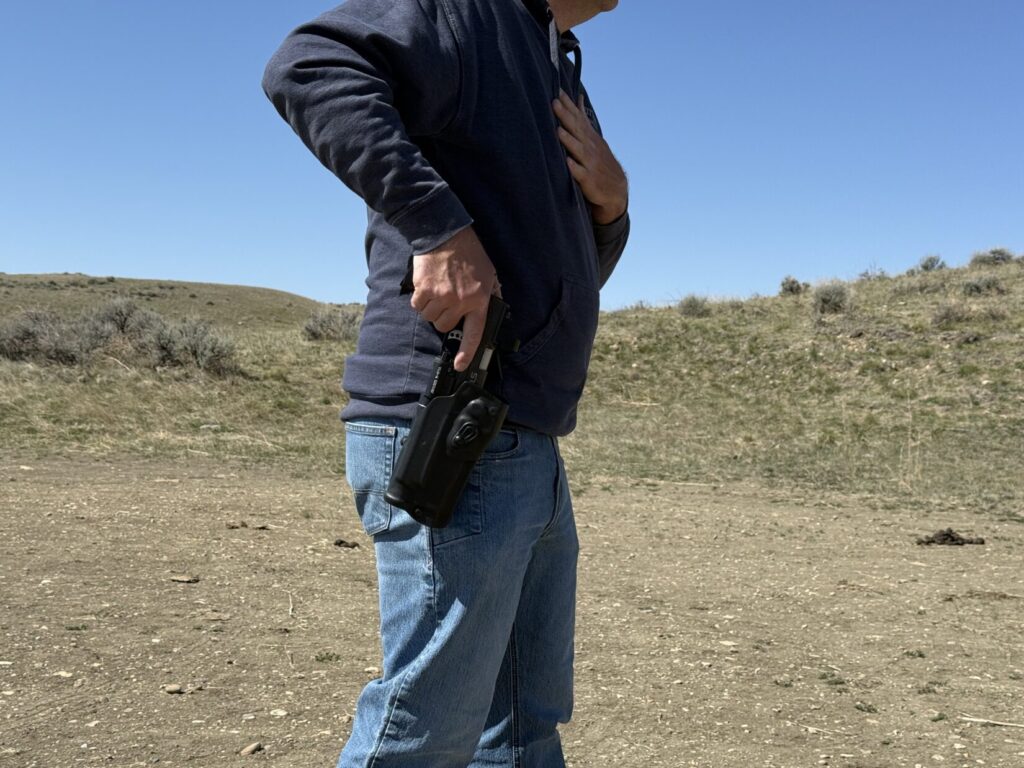
The ALS system would have been a great advantage in my LE days. I believe a recruit could have learned to work that style of holster more easily as well.
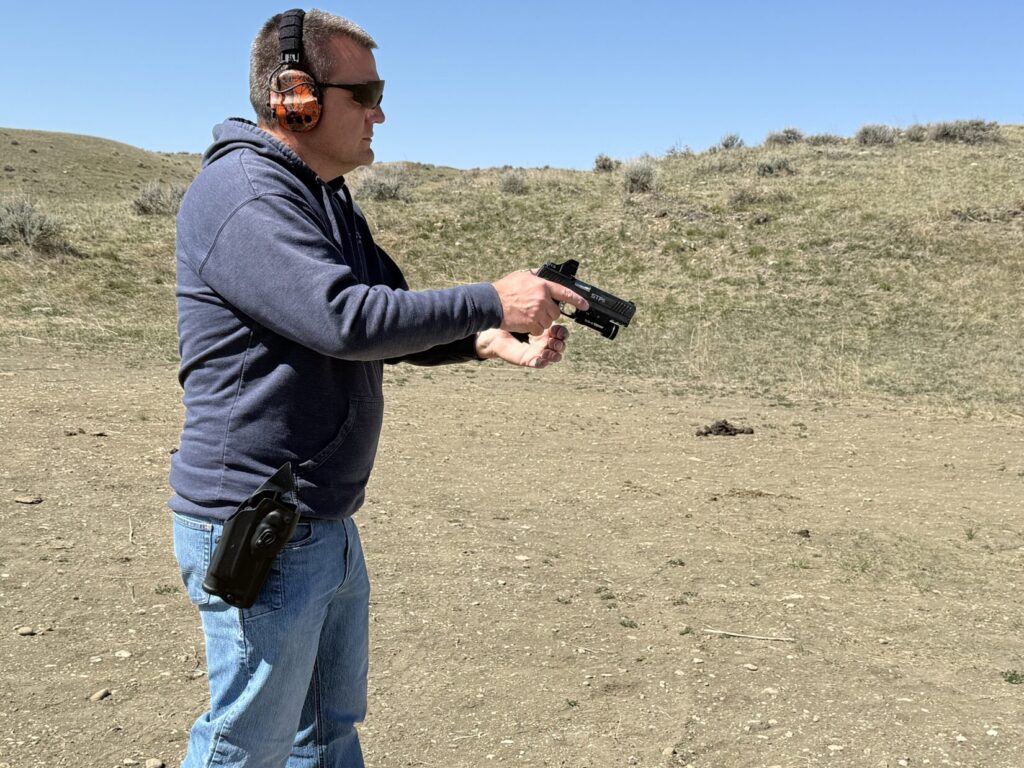
I worked with the Safariland ALS holster live fire as well. Drawing, engaging, and re-holstering were becoming fluid with only a few familiarization runs.
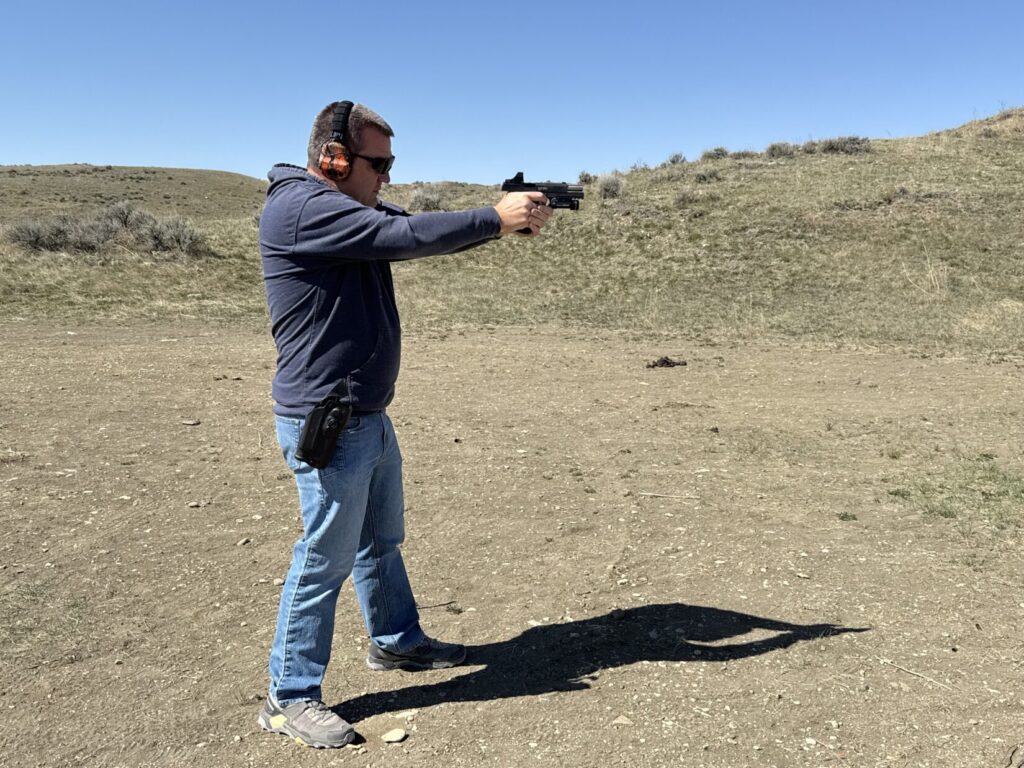
systems approach
I look at every product as a system. A good gun is nothing without good accessories. Pairing quality firearms with top-shelf ammunition, holsters, and other products completes the package.
I always want the most accurate firearm available, and I want the best products to support it. No matter what, at the end of the day, accuracy is final, and accuracy matters.