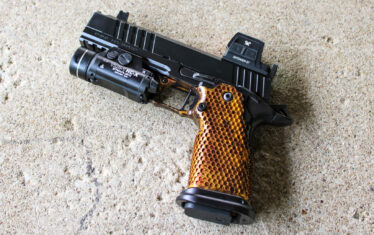


The original Steiner MPS was one of the early enclosed-emitter optics, and it’s an optic I’ve spent a lot of time on. In fact, I shot with it so much that eventually the screw sheered during recoil and smashed me in the head. With that in mind, it’s no surprise I was interested to see what the MPS-C was all about.
We are currently awash in enclosed emitter optics, especially in the micro optic space. Companies figured out that an enclosed emitter optic could fit the RMSc footprint with ease. Holosun led the way with the EPS Carry, and it’s currently the reigning champ of the mini enclosed emitter.
Can the Steiner MPS-C sweep in and unseat the Chinese king?
The MPS-C Under The Hood
Off the bat, Steiner has made some smart decisions, some odd decisions, and some pretty standard decisions. Let’s start with the good.
The Smart Decisions
First, the ocular window and objective lens are larger than the original Steiner MPS. The objective lens is 21 x 19 mm, and the ocular lens is 22 x 18 mm. The original Steiner MPS had an objective lens of 20×16 and an ocular lens of 21x16mm. The jump isn’t large, but I’d have been impressed if they kept the original window size.
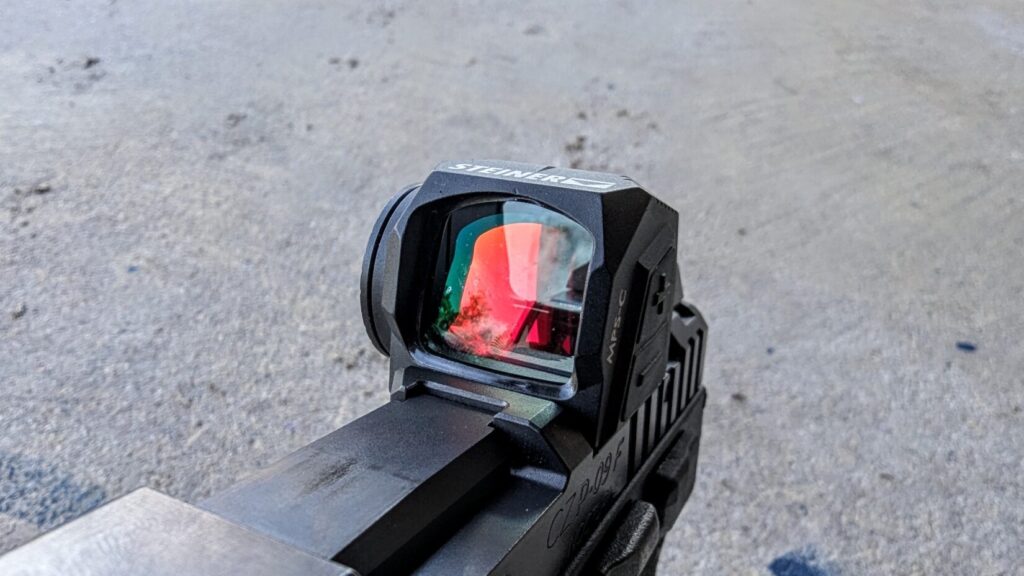
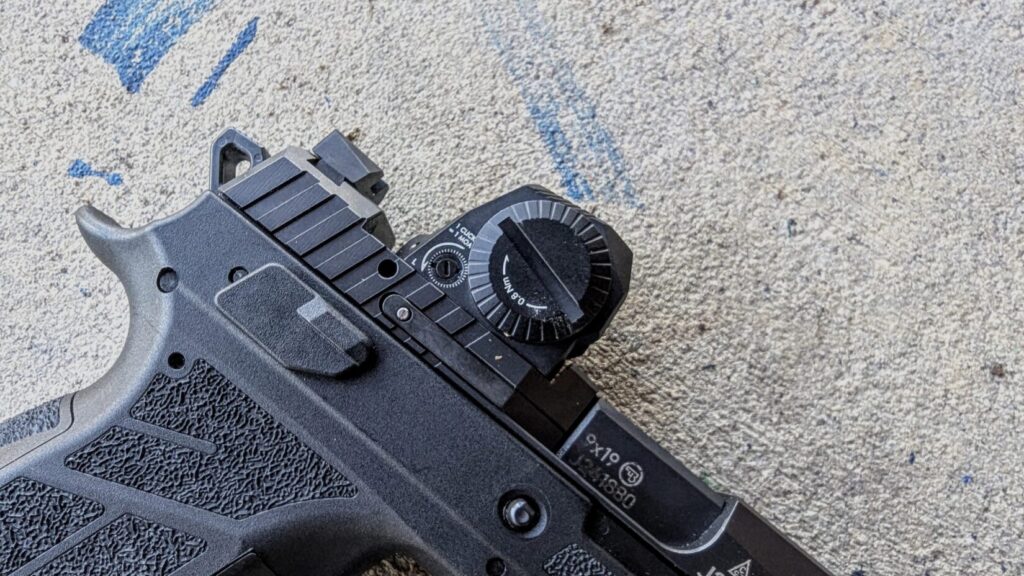
Next, the battery compartment is located on the side with a large threaded cap. It stands out more than other options, but is more robust. There is a reason why Holosun included replacement screws for their dinky little doors.
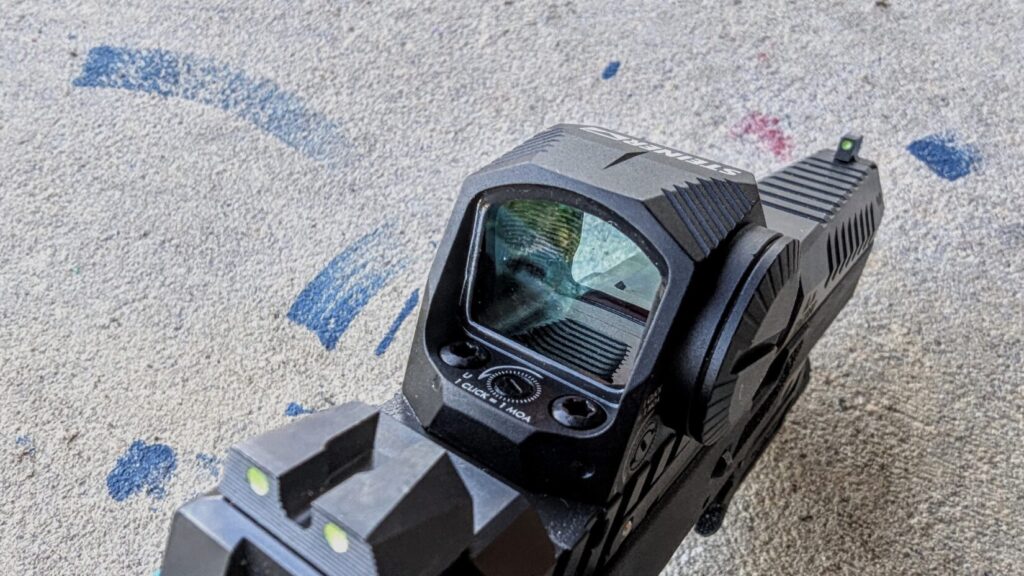
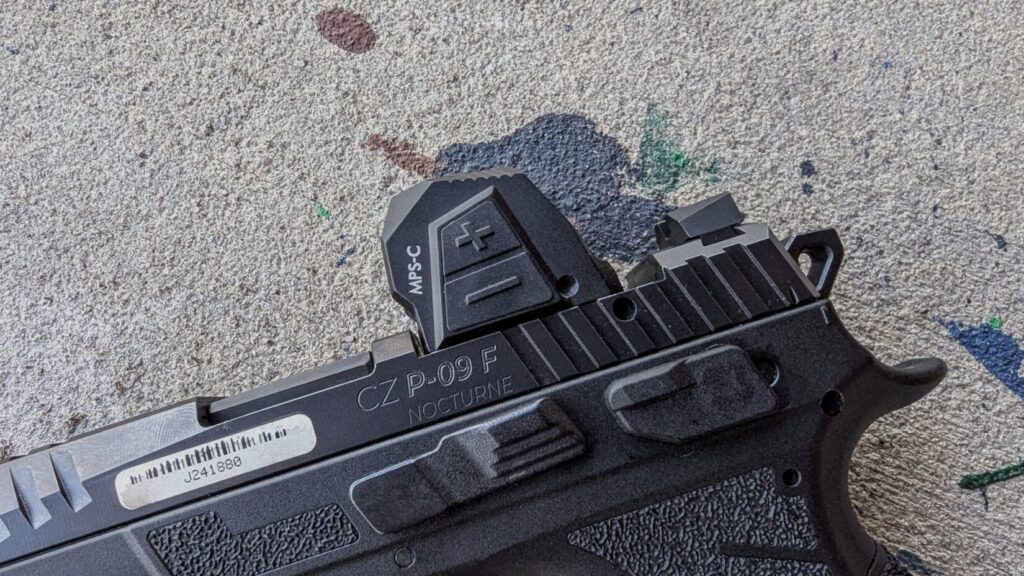
It also allows the deck height to be slightly lower, making it easily cowitness with my standard-height sights.
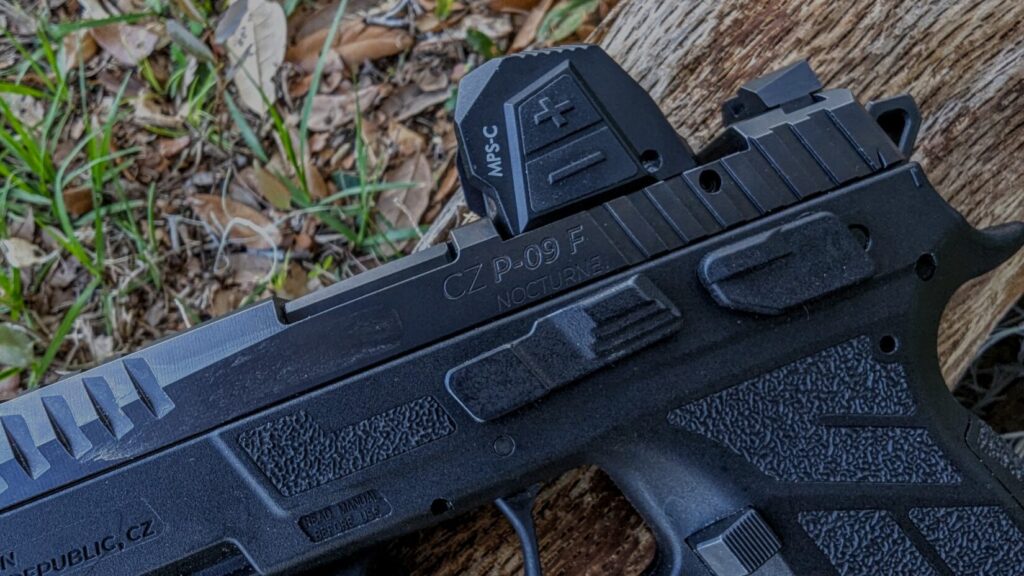
The MPS-C might be the lightest enclosed emitter RMSc optic, weighing just 1.13 ounces. The profile is quite nice and small, at least on the CZ P09 Nocturne. The front and rear lenses of the MPS-C are well protected by a protruding hood that keeps them from contacting the ground if dropped.
The optic also looks nice, which isn’t all that important, but I’ll take it. Finally, they include a ton of different screws to make this easy to attach to basically any gun. I used the M4 by 9mm on the Nocturne.
The Odd Decision
Let’s start with the odd decision. The optic has shake awake, which I really like because I forget to turn off my optics all the time. However, the optic doesn’t turn off until it’s been sitting still for 13 hours.
That means if this is on my carry gun, it’s never going off. I throw my gun on in the morning and take it off before I shower. There are not 13 hours between the time I shower and the time I wake up.
The shake awake is ultimately useless if this is on your carry gun.
Keeping Standard
Beyond the good and the odd, we get some fairly standard stuff. The optic has 11 brightness levels, with two being night vision modes. The optic uses a CR1632 battery to power it for 13,000 hours on a medium setting.
The battery life seems a bit short, but I often find that manufacturers flub their numbers a bit. Maybe Steiner is just being honest? A year and a half’s worth of battery isn’t terrible, but let’s hope Steiner isn’t inflating their numbers. My experience with the MPS says they don’t.
Adjustments are 1 MOA per click, the reticle is 1.6X, and it has two big buttons that are easy to engage and press.
Mounted Up
My CZ P09 Nocturne was the test weapon of choice for the MPS-C. The included screws made it easy to attach, especially since the Nocturne is a bit picky on screw length. Due to the slide design, there isn’t a lot of space between the top of the optic and the extractor, so the M4x9mm screw was perfect.
The combination of the optic’s design and height sight of the Nocturne gave me a perfect co-witness with iron sights. This made zeroing easy. I slaved to the sights, which got me on paper, then refined the adjustments from there.
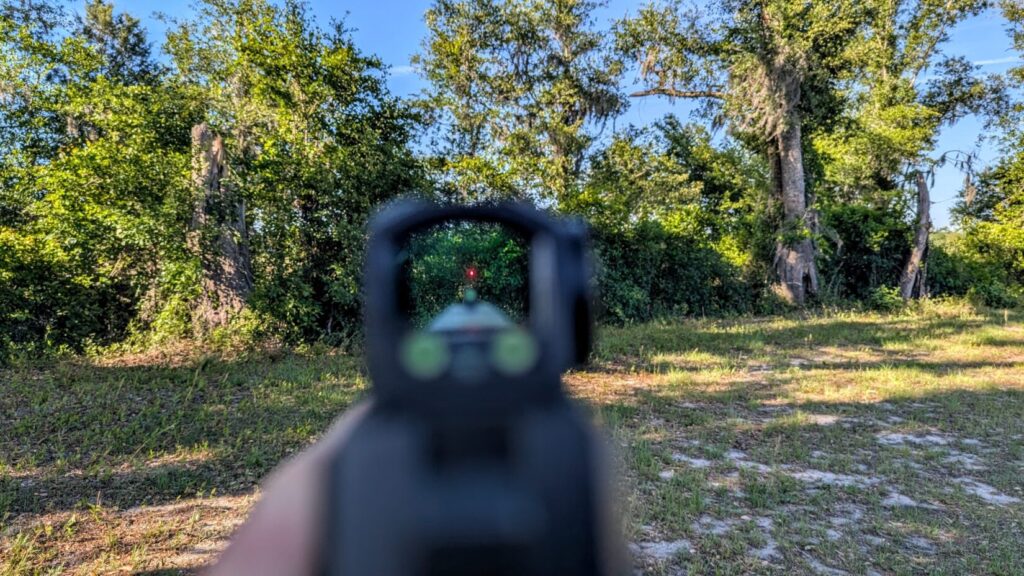
The 1 MOA clicks are nice, and the feedback is both audible and tactile. I zeroed at 15 yards, then refined it more to 25 yards. The 1.6 MOA dot is sized right for me, I can see it easily enough, and track it.
It’s an odd size, but still plenty usable. For a really small gun, I wouldn’t mind something a little bigger, but you can make 1.6 work. It’s not a perfectly crisp dot; there is some starbursting to the right on mine, but it’s not much more than an observation. It doesn’t impact performance.

From there, I worked on a variety of drills to test how well I could track the red dot, the refresh rate, transitions, and in a variety of lighting conditions.
Going Fast
Tracking the dot proved not to be all that difficult. A big, full-sized CZ does make recoil quite controllable. During firing, the dot would leave the optic, but just barely.
The red streak would disappear and reappear fast enough for me to make .19 splits on a series of double taps. The streak indicates a good refresh rate, and that’s backed up by the wave-it-around test.

A bad refresh rate would cause the dot to stagger when the optic is moved rapidly, and make multiple dots appear. A good refresh rate turns the dot into a red streak with movement. The MPS-C scores high in refresh rate.
Target transitions, or rapid transitions on the target, are smooth and easy to make. I’ve made target transitions, or indexes, a big part of my training recently, so having a smooth dot makes a big difference in my shooting.

My favorite Bill Drill was easy to shoot. Draw, see the dot, fire. As soon as the red streak returns to the target, I’d fire again. The dot made sight tracking easy and simple, keeping me on target and making follow-up shots easy.
Lights, Lights, Lights
With the sun starting to set, I had a good angle to see how the optic looked with sunlight from behind, in front, and from both sides. From the sides and from the rear, there is nothing noticeably different.
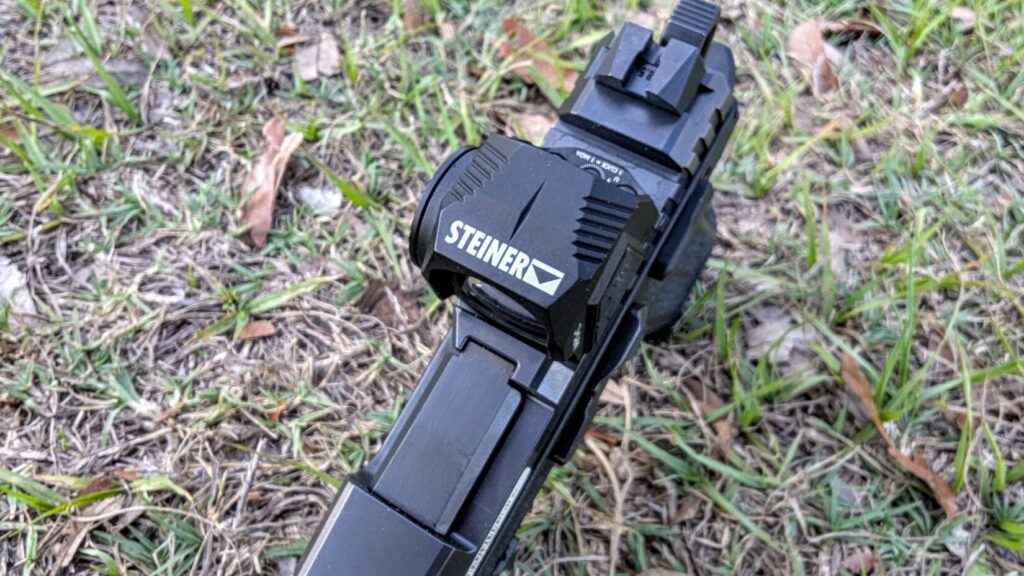
With the sun in front of you, things always get a little odd. With the MPS-C, there is some reflector reflection when it’s hit with direct light from the front, but that’s to be expected. It’s not overwhelming, and the dot is still usable.
The MPS-C – Mini and Mighty
The Steiner MPS-C is directly competing with the Holosun EPS Carry optic for king of the mini optics. In general, I find its range performance to be fantastic. Its profile is well done, and the build design is smart and refined.
The 13-hour shake awake is an oddity I can’t explain. They made an optic with a great window size, a great refresh rate, and lots of smart features, but ignored one of the more consumer-friendly features.
Overall, it’s a strong, durable, reliable optic that works well. In a lot of ways, the MPS-C is better than other optics in this size platform, but still, some odd choices are holding it back from near perfection.