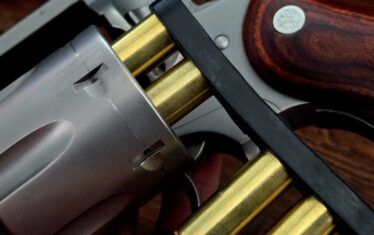

The five-shot .38 caliber snubnosed revolver is a classic concealed carry option and, among some, remains a mainstay backup gun to a duty pistol. The S&W Chief’s Special defined the type, and its lightweight descendants like the Model 637, 638, and 642 are likely what you think about when considering a small revolver. But Smith & Wesson never had a complete monopoly.
There are multiple options in the field, but the longest lived is the venerable Charter Arms Undercover. In this review, we will cover the history of the Undercover, the more recent developments of the type, and what to look for if you are considering one for carry.
The Charter Undercover: First and Best?
Former Ruger employee Doug McClanahan launched Charter Arms in 1964, and his inaugural product was the Undercover .38 revolver. This five-shot revolver was meant to compete with the Chief’s Special, which was growing in popularity with second-line police personnel and as an ankle gun for beat cops.
The Undercover has a one-piece frame and a transfer bar safety, which makes it unique among its type. These innovations helped lower the cost of a firearm that, otherwise, was not much of a game changer.
The Undercover, accompanied later by the Bulldog .44, were top-selling handguns for a few decades and remain Charter Arms’ best sellers in spite of the company’s ups and downs. Their first iteration is often considered to be their best, while the models made by Charter 2000 and Charco suffered immensely from quality control problems.
Today, Charter Arms continues to produce the Undercover in Shelton, Connecticut, and the line is as big as ever.
Which To Pick?
The Undercover is available as an all-steel revolver with a spur hammer and over-molded rubber grips. For a new revolver, this version is a compelling option for the sake of a comfortable shooting experience. The heavier steel frame soaks up more recoil, and the grips provide a full firing grip that is usually lacking in small revolvers.
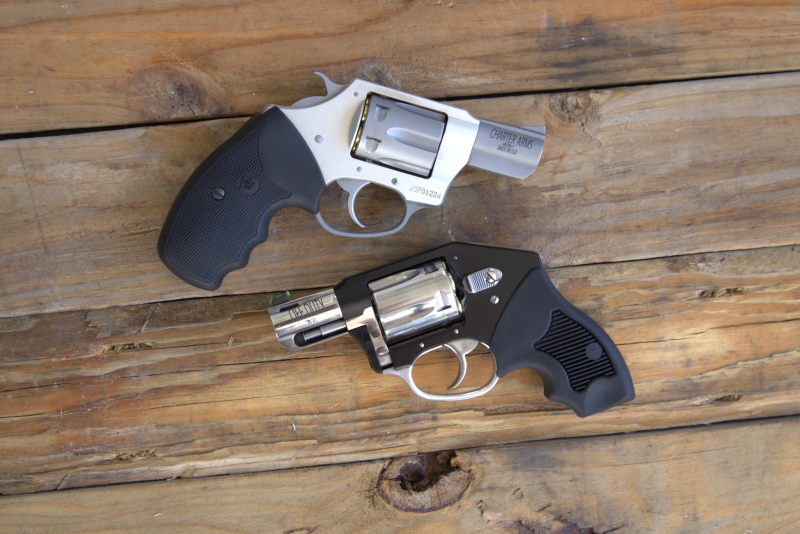
For a lighter option, the Undercover Lite with a 7075-series anodized aluminum frame and a choice of a polymer or aluminum grip frame is worth a look. In my experience, the polymer grip frame is on the thin side compared to other polymer revolvers like the Ruger LCR. For that reason, the all-aluminum or all-steel options are recommended.
The Undercover Lite is also available as a double-action-only hammerless revolver in the Off Duty line. It is also paired with shorter boot grips for ease of carry and drawing from a pocket or the waistband.
The Undercover line is a .38 Special revolver that comes with a two-inch bull barrel and typically wears fixed low-profile sights. They consist of a serrated front ramp and a square notch milled in the top strap of the frame. Some models, however, use a changeable fiber optic front sight.
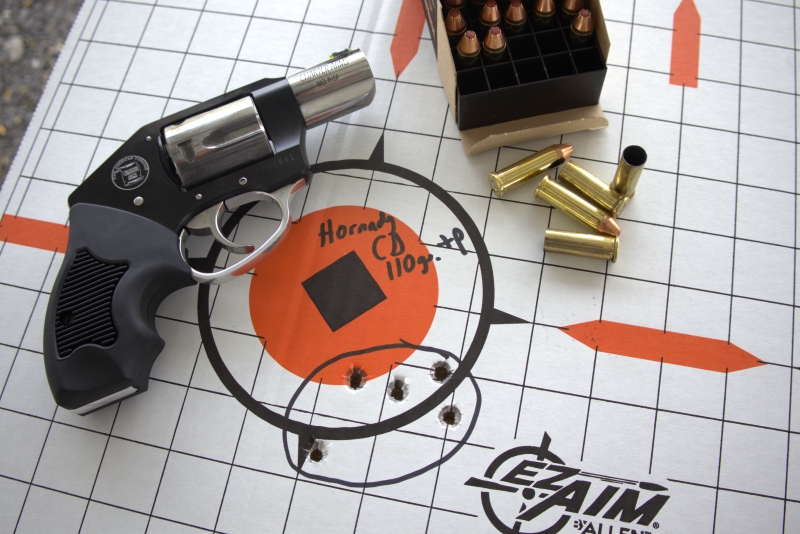
Perhaps the ultimate version of the Undercover is the Off Duty, which has the option for a fiber optic front sight and dual ports for recoil reduction.
To +P or Not +P: A Question of durability?
On close examination, it is easy to notice that Charter Arms revolvers are not as finely finished as their competition. In general, that is reflected in the lower price point. What is often not noticed is how thinly built they are. In the case of the Undercover .38, the bull barrel and cylinder are beefy and generally hold up. The cylinder frame and grip frame are another issue.
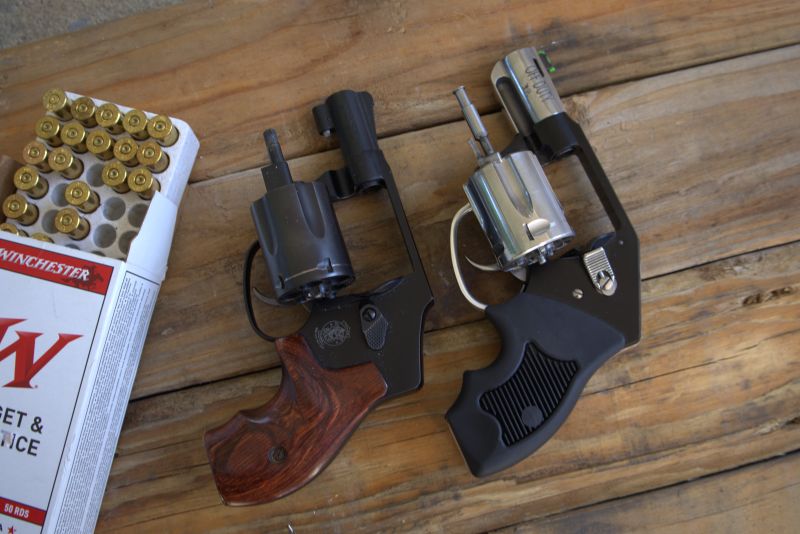
Although Charter Arms revolvers do not use a side plate on their frames, the cylinder frame and grip frame are thinner than those of a comparable Ruger and are assembled with pins and screws throughout the frame. Furthermore, the forcing cone is thinner than all of its competition. Reinforcing this perceived lack of long-term durability is the fact that modern Charters are not marked for +P ammunition.
+P ammunition, rated at 20,000 psi, is marginally more than standard pressure .38 Special, which runs at 17,000 psi. But that small difference is amplified by more recoil, more blast, and more velocity. Charter’s literature states that their revolvers are rated for +P ammunition, but generally warns against it due to recoil, blast, and the inefficiency of +P ammunition in 2-inch-barreled revolvers. While the former points are true, modern +P ammunition is built around small revolvers normally carried for personal protection. In years past, when full-sized revolvers were the norm, this was not the case.
In my own experience, some +P ammunition is okay, but based on the build of Charter’s guns, sticking with standard pressure ammunition is preferred for the sake of longevity.
Charter Arms Undercover: Shootin’ and Carryin’
In spite of its drawbacks, a Charter Undercover that passes an out-of-box inspection can be a serviceable personal protection piece. My particular favorite of the line is the Off Duty, Charter’s equivalent to a Smith & Wesson Centennial, Taurus 856 Ultralite, or a Ruger LCR.
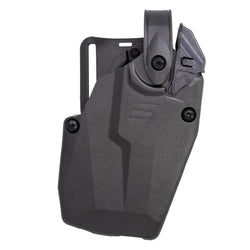
The Off Duty has an enclosed hammer for a snag-free draw and comes with an aluminum frame and grip frame, a five-shot capacity, and a fiber optic front sight. The fiber optic is hastily pinched in place, which is one of the few tells of this budget revolver. But on the range and in either a Safariland Model 25 pocket holster or a Bianchi Professional IWB, the Undercover plays its role as a discreet carry option.
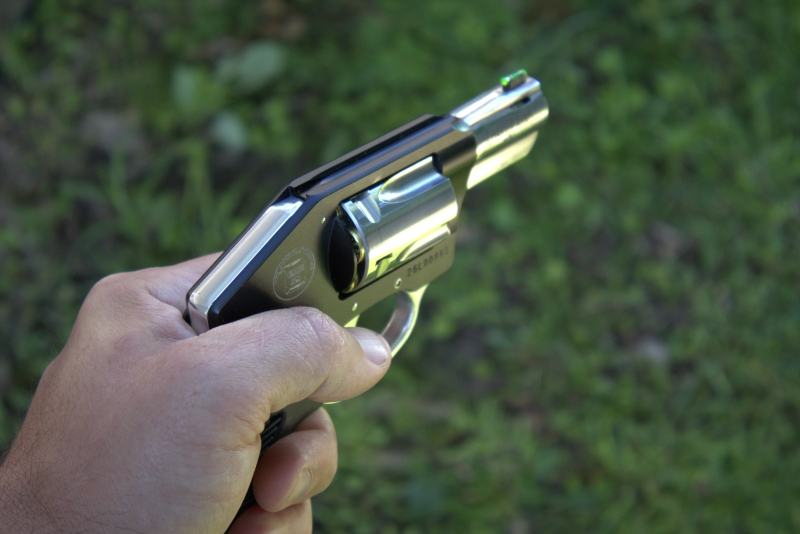
Small handguns live and die according to the utility of their controls in relation to the grip. The standard Undercover with the over-molded grip provides a generous full-firing grip, and the backstrap cushions recoil forces well. But the grips generally hang up on speed loaders and will need to be relieved. I prefer the Off Duty model as the grip is compact but takes up the space between the grip frame and the trigger guard, where fingers tend to hang and move.
The fixed sights on the standard model are grey on grey and can be tricky to pick up quickly. The Off Duty’s green fiber optic pops well and is easy to spot, even in lower light conditions. Recoil is sedate thanks to the two parallel ports at the end of the barrel, although the blast from +P ammunition can be felt on the face. More important is that the blast is felt on the face, rather than the hand.
The two primary controls remain unchanged, no matter what model you get. The Charter has a Smith & Wesson-like cylinder release latch that is activated by pushing it forward. It is intuitive to hit with the right-hand thumb while the left hand swings the cylinder out for loading.
Like other small snub-nosed revolvers, the Undercover has a short ejector rod that kicks the empty .38 cases out partially. A sharp slap to the rod generally throws the empties clear. One problem I have noticed with Charter revolvers over others is occasional failures to extract some types of ammunition.
In the case of my time with the Off Duty, it took a soft hammer to eject fired DoubleTap 148 grain wadcutters. I initially thought this was due to tool marks within the chambers, but I quickly ruled it out as the Off Duty ate every other type of ammunition, including +P rounds, and ejected the cases easily.
The Charter Undercover as an Alternative Bugout Gun
Historically, the little Charter .38 was a rock-solid revolver that filled the role as a primary carry gun or an ankle gun for those who could not spring for a Smith & Wesson J-Frame. The current rendition of the Charter Arms Undercover continues that mission, but the calculus has changed.
No gun writer can objectively say the Undercover is every bit as good as the competition. In fact, the Undercover is relatively lightly built. But as a last-ditch device meant to be carried often and shot sparingly, it is effectively as good as its competition.
The case for the Undercover is that much stronger at its price point, given the slide in quality control among the premium brands. For those who are looking for a five-and-forget hideout handgun that is both easy to shoot and to carry, take a look at a vetted Charter Undercover.