
Handguns chambered in the 10mm Auto cartridge offer some of the power of a magnum revolver cartridge with the advantages of higher capacity and greater customization in a semi-automatic pistol. Those attributes are particularly appealing in the realm of wilderness defense, where the 10 is growing in popularity for all things ranging from handgun hunting to bear defense.
For the 10mm Auto, there is no shortage of traditional hollow point and fluid-dispersing rounds for personal protection. But unlike most semi-auto rounds, there are plenty of purpose-built rounds built for the wild.
In this overview, we tested a sampling of these rounds to see how they perform.
Test Parameters: The How, What, and Why
Most 10mm loads marketed for hunting or wilderness defense take the form of a monolithic solid or full metal jacket bullet. The goal of these rounds is not expansion, but their ability to pierce thick hide and thick bone to hit vital organs. In a word, penetration.
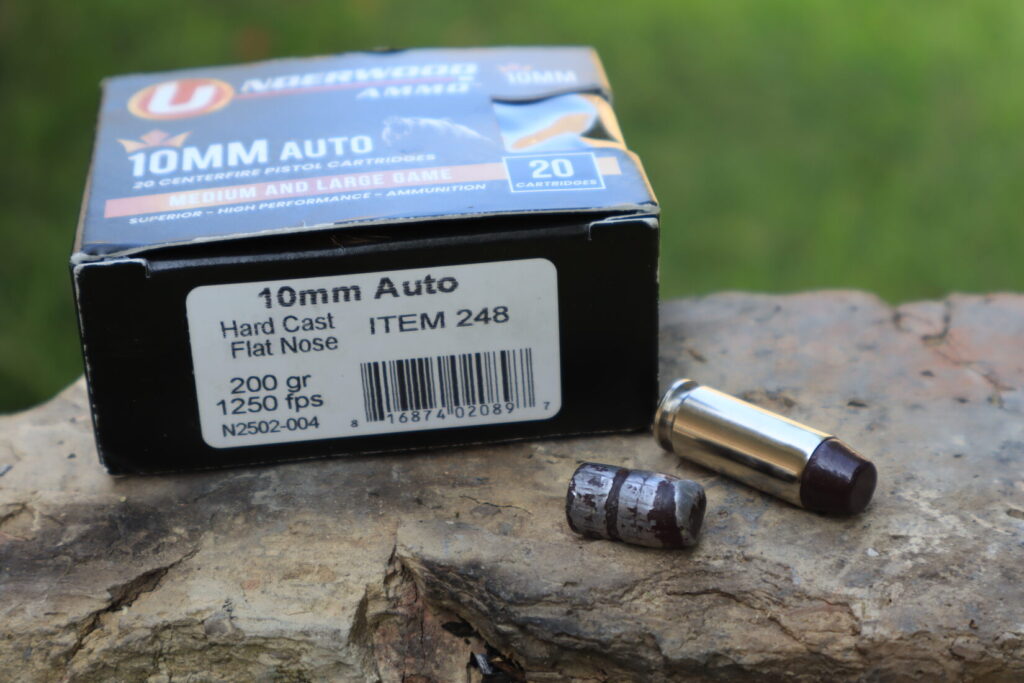
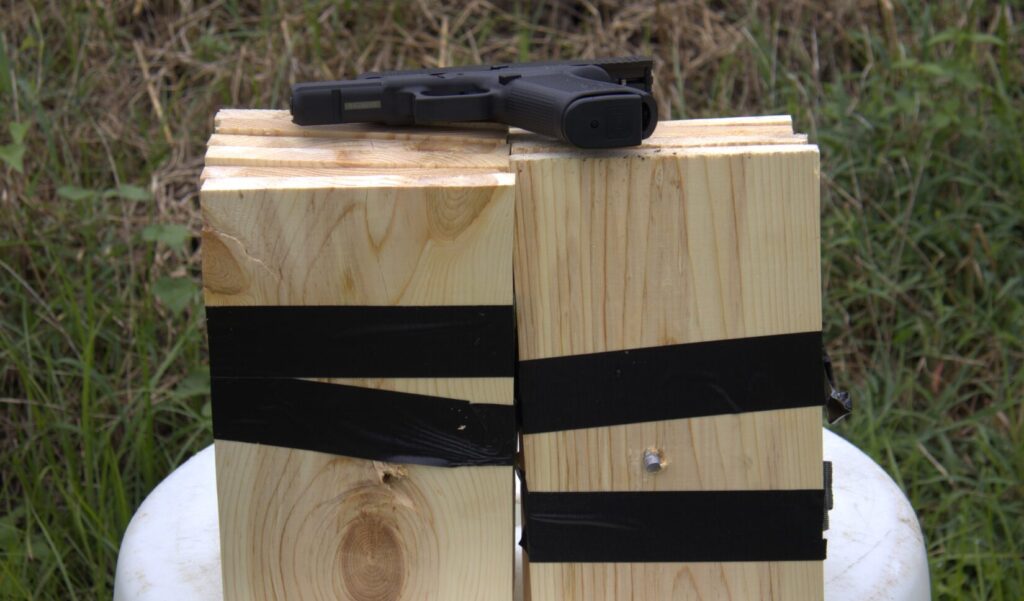
To that end, the penetration test medium will consist of 12 half-inch pine boards. This allows us a consistent material without needing several feet of ballistic gelatin.
Unlike gelatin, lumber more effectively simulates the torture a bullet endures when it hits bone. All ammunitions were tested twice from a distance of 10 feet. The test gun is a Glock 20 Gen. 5 with a 4.6-inch barrel.
Beyond terminal performance, there are also the factors of internal and external ballistics, or put simply, reliability and velocity.
Each bullet design has its merits, but their design can be detrimental to reliable feeding in some handguns. Likewise, the advertised velocities printed on the box are just that, advertisements.
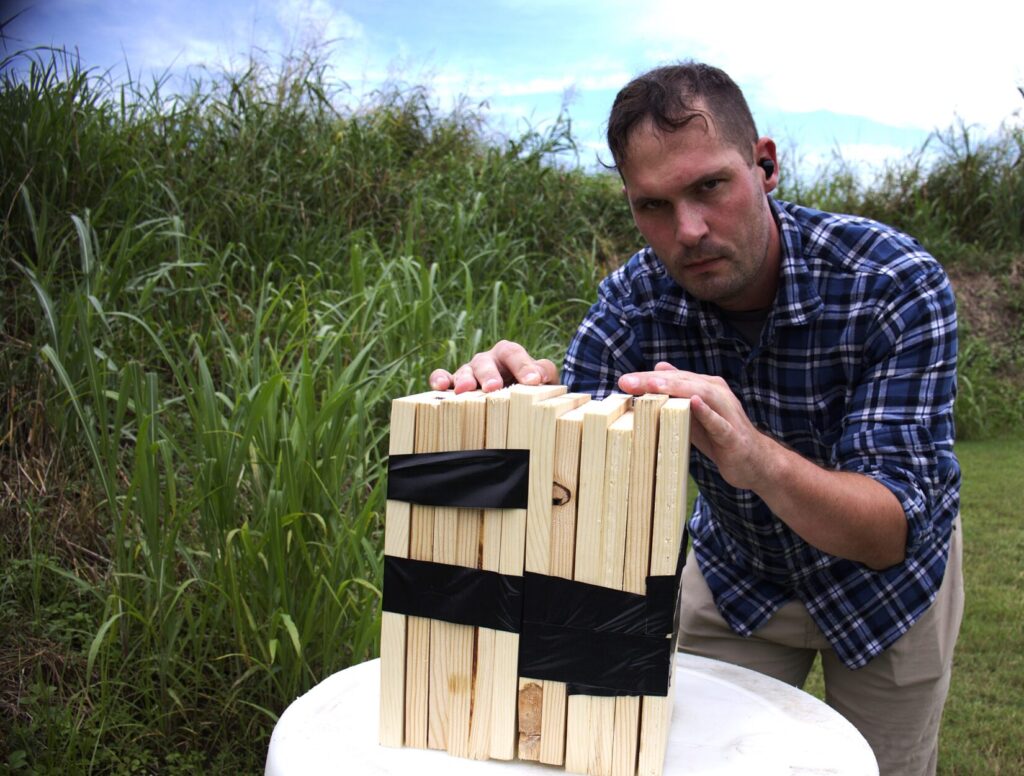
Velocity readings were taken as a five-shot average using a Caldwell chronograph from a distance of 10 feet. Reliability is more difficult to test in the short term, but particulars of bullet design will be elaborated upon.
The ammunition tested are as follows:
- Buffalo Bore 220 grain Hard Cast
- Federal Syntech 200 grain Solid Core
- Double Tap 200 grain Hard Cast
- Double Tap 230 grain Hard Cast
- Underwood 200 grain Hard Cast
Velocity
The original 10mm Auto load developed by Norma in 1983 used a 200 grain bullet traveling at about 1,250 feet per second. Due to the troubled history of its development, many 10mm loads out today are still loaded down to .40 S&W specifications with a ballpark velocity of about 950 feet per second.
None of the bear loads tested are underloaded, but I did test a standard FMJ load from Sellier & Belliot that features a 180-grain bullet with a five-shot average velocity of only 1,023 feet per second.
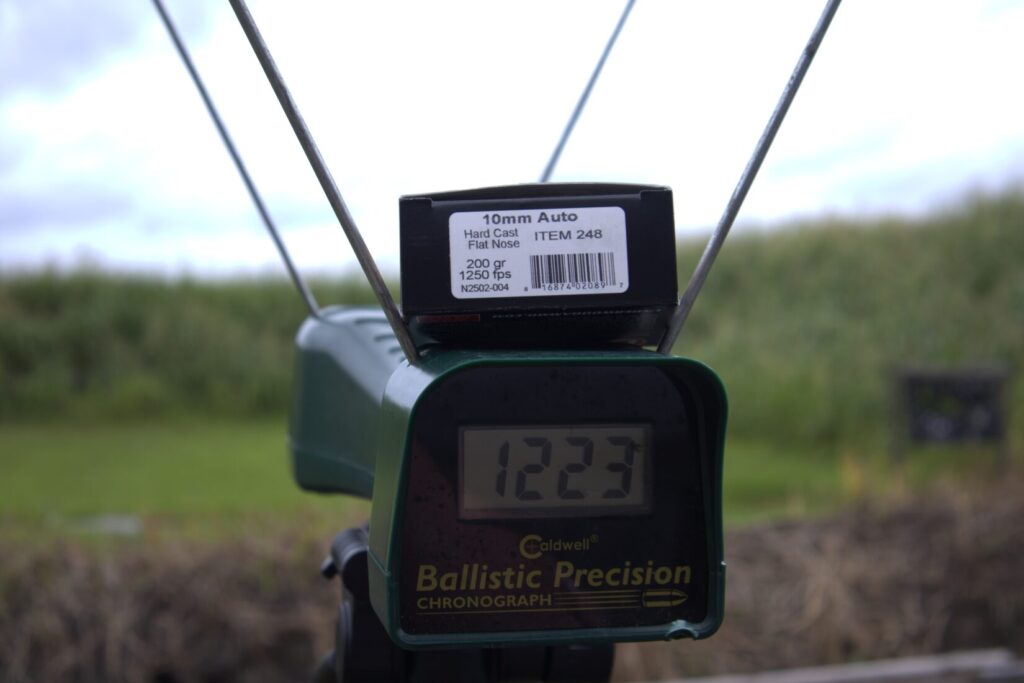
From a distance of 10 feet, I fired five rounds of each ammunition across the chronograph. The results are as follows:
| Type | Muzzle Velocity (ft. per sec.) | Muzzle Energy (ft. lbs.) |
| Buffalo Bore 220 gr. Hard Cast | 1,131 | 625 |
| Double Tap 200 gr. Hard Cast | 1,220 | 661 |
| Double Tap 230 gr. Hard Cast | 1,069 | 584 |
| Federal Syntech 200 gr. Solid | 1,171 | 609 |
| Underwood 200 gr. Hard Cast | 1,238 | 681 |
Penetration
Each ammunition was shot twice into two six-piece stacks of 1-inch pine boards. While board count can tell us something about overall penetration of the round, yawing of the bullet and weight retention are noteworthy.
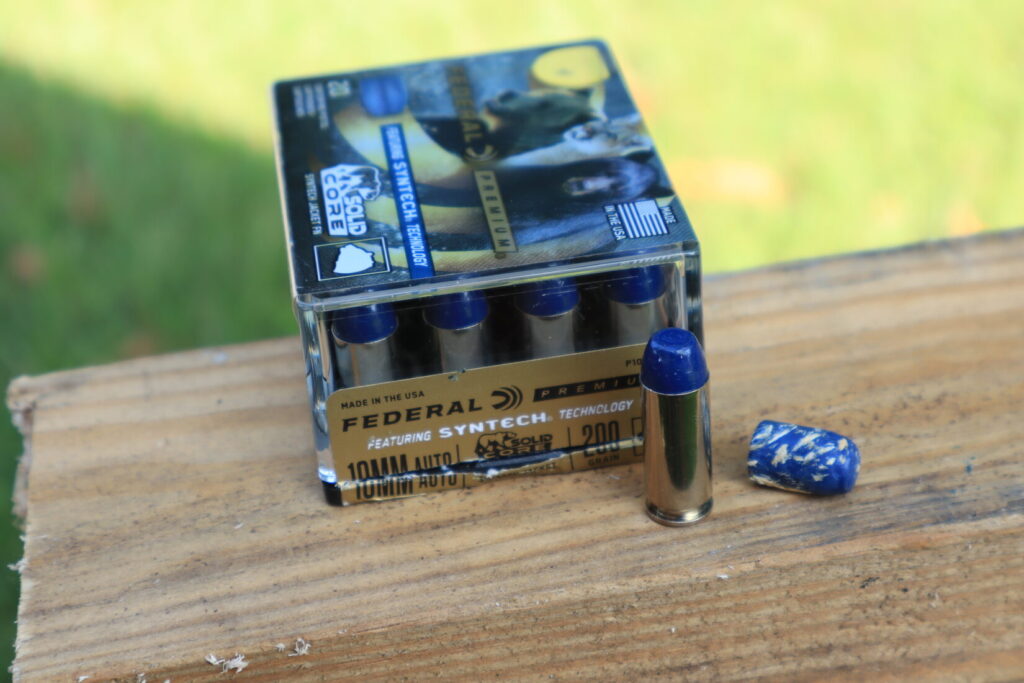
Federal Syntech 200 grain TSJ
The Federal Syntech 200 grain Solid uses a hardened lead core surrounded by a blue polymer jacket designed to cut down on leading.
Unlike other bullets, it does not have a gas check or lube rings. It has a generous flat point that covers 50 percent of its bullet diameter. This round produces moderate recoil and approaches its advertised muzzle velocity of 1,200 feet per second.
In lumber, the Syntech bullet was stopped inside the tenth board. Both bullets yawed to a 45-degree angle before stopping. Both retained their weight, and there was surprisingly little wear to the polymer jacket.
Underwood 200 grain Flat Nose
Underwood produces a similar product. Their offering is a 200 grain flat nose hard cast round with a Black Cherry Hi-Tek coating that accomplishes a similar job as the Syntech’s polymer jacket.
It also comes close to its 1,250 feet per second advertised velocity. It produces moderate recoil like the Syntech load and has a slightly wider flat point, which, in theory, should produce a straighter path of penetration.
Penetration was straighter, but overall penetration was less. Both rounds were stopped in the eighth board, denting the ninth. The coating did not survive, and the bullet noses deformed slightly. Weight retention was 92 percent.
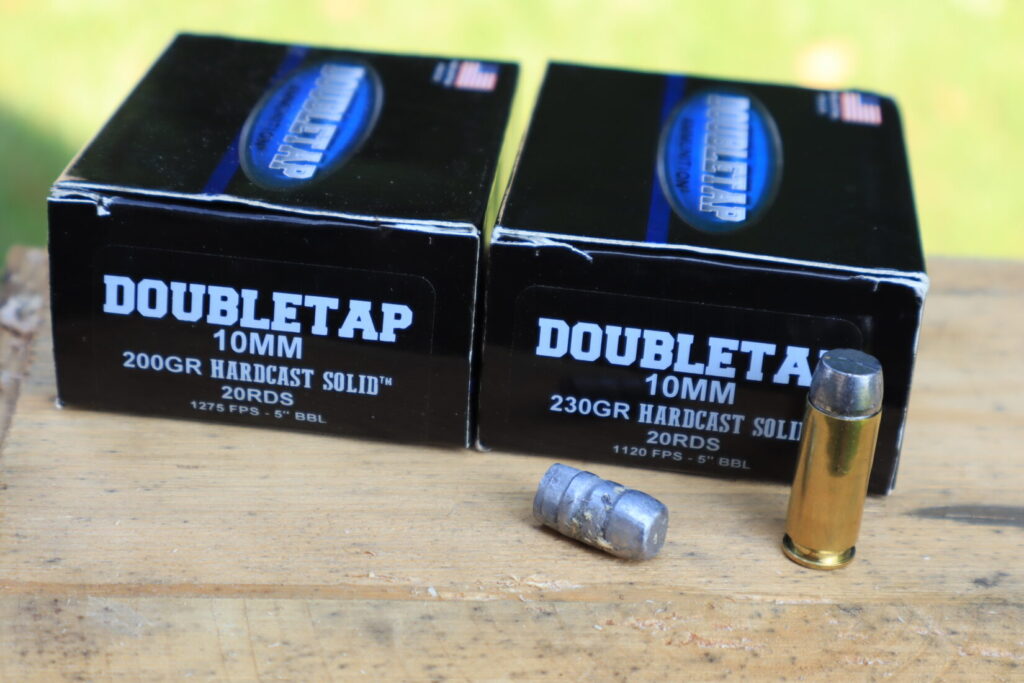
Double Tap 200 grain and 230 grain Hard Cast
Double Tap’s line of bear loads uses a traditional hard cast bullet with lube rings and gas checks to prevent bullet leading and enhance accuracy.
The 200 grain offering generates moderate recoil comparable to the previous loads, while the 230 grain load is more substantial but not uncomfortable. To my surprise, that heavier load is traveling at only 1,069 feet per second. It has an advertised velocity of 1,120 feet per second, so it does trade weight for velocity.
The 200 grain load runs out of the Glock 20 at a rate close to its 1,275 feet per second advertised velocity. Both rounds have an 80 percent meplat, the widest flat point in the industry.
The Double Tap 200 grain bullets were stopped in the eleventh board. The rounds began to yaw in the eighth board and finished their journey at a 30-degree cant. The gas check was lost on impact, but the bullets were barely damaged by the collision. Weight retention was 94 percent.
I expected the 230 grain slow pill to blow through my setup. Instead, both bullets fired lost their gas checks and yawed after the first three boards and stopped in the sixth board. Weight retention was on par with its 200 grain brother.
Buffalo Bore 10mm Outdoorsman
Buffalo Bore produces heavy ammunition for rounds ranging from .25 ACP to .500 Magnum and beyond. Their 10mm Outdoorsman load is a traditional gas checked 220 grain bullet. Buffalo Bore tests their loads through several common firearms. They list this load at 1,140 feet per second from a Glock 20 and a nominal 1,200 feet per second out of a 5-inch barrel.
This load has a meplat that lies between the Underwood and Double Tap loads. Recoil with this round is more substantial than the 200 grain loads but less than Double Tap’s 230 grain round.
The Buffalo Bore Outdoorsman rounds yawed in the eighth and ninth boards but were ultimately stopped in the eleventh. Both rounds had a retained weight of close to 100 percent, as neither lost their gas check.
Reliability
All ammunition tested has plenty of power as advertised. The Buffalo Bore, Double Tap, and Federal loads excelled in the penetration department. But performance on target has to be balanced with performance in the handgun itself. Ammunition that does not work well in a handgun is a liability, not an asset. In the context of 10mm outdoor loads, bullet design and leading are common points of contention.
Feeding and Function
10mm pistols operate under significantly higher slide velocities and utilize wide-meplat flat-nosed bullets, which can create feeding challenges on standard frame ramps compared to traditional round-nosed profiles.
A wide meplat keeps a given bullet from tumbling like a round-nosed bullet. This allows for more straight-line penetration. But depending on the handgun and the ammunition, some rounds may cause malfunctions.
All ammunition fed and fired with no issue in the test pistol, but your results may vary.
Leading and Glock Pistols
Most 10mm bear and hunting loads consist of a hard cast lead bullet. Those who have been shooting lead bullets long enough know the potential problems of leading.
At higher velocities, soft lead can leave traces of itself behind in the bore, filling up the rifling grooves and leading to inaccuracy. This is true for any pistol using bare lead slugs in any caliber. Lead bullets are not recommended with some pistols, particularly Glock pistols where the use of polygonal rifling can lead to dangerous overpressure situations. But with the 10mm, the problems of leading are overplayed.
The dangers of leading are grains of truth that have been expanded to myth in the decades since publication in forums and some well-meaning magazines. When Glock pistols grew in popularity in the competition circuit in the 1990s, lead bullets were a cheap option for those who burned through large sums of ammunition. Standard lead bullets would lead the bore, and with enough firing, reports of burst pistols were reported.
Today’s 10mm bear loads, at least those tested here, are anything but standard lead. Hard cast bullets look like lead bullets and they mostly are, but with a sizeable percentage of tin or antimony mixed in so the lead does not deform on target like pure lead would. This harder alloy is also more resistant to leading. Add in the gas checks, wax lubricants, and special coatings, and you have a round that leaves very little of itself behind.
In this test, the stock Glock 20 used was cleaned after 100 rounds fired and no lead was found. With all of that said, more due diligence in the maintenance process never hurt anyone, and if leading is a fear, lower round counts and more frequent cleanings are okay.
Conclusion
10mm Auto bear loads may not measure up to magnum revolver rounds in energy foot pounds, but they penetrate in excess of typical semi-automatic pistol cartridges. They also have the advantage of coming in handguns with shorter triggers, more customization, and a greater capacity over the revolver platform.
While all rounds shown here have their potential, their performance should be weighed against how your particular pistol feeds the ammunition and how you, as the shooter, can shoot them.