There is little question that Glock handguns are among the most used and copied handguns in the world. When Gaston Glock designed a handgun for the Austrian military, he probably didn’t know what it would become. A simple design with a polymer frame changed how we think about firearms design and became the foundation behind most modern guns.
Today, Glock clones are essentially handguns manufactured by a third party but use mostly the same specifications. While cosmetic variations exist, the integral parts are often the same. A fully cloned Glock handgun should have interchangeable parts with Glock’s original equipment manufacturer (OEM) components, including the magazines, sights, trigger, and more.
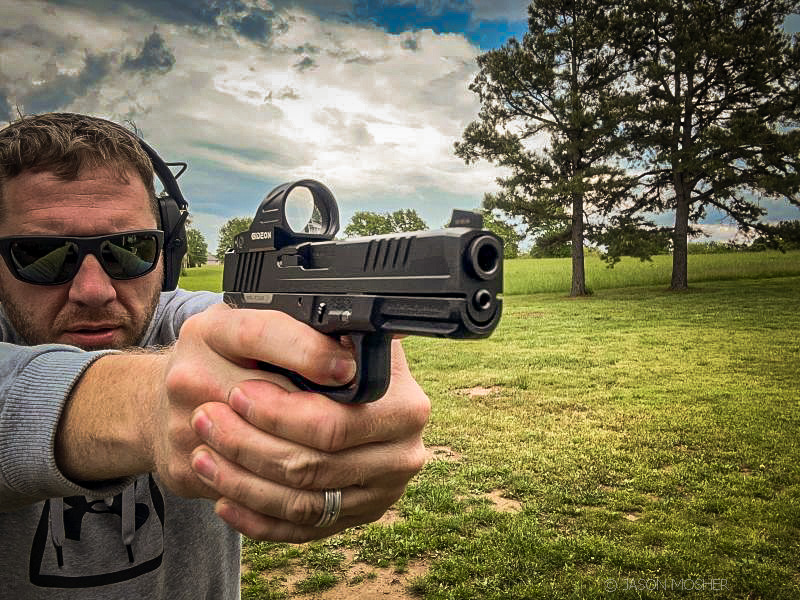
It’s important to note that not all Glock clones strictly adhere to Glock specifications, so it’s necessary to verify compatibility with OEM parts before making any modifications to the firearm. Many Glock-cloned handguns will accept the same magazine and work in the same holsters, but certain modifications might render them incompatible.
Generation is another factor to understand about Glock clones. The generation of a Glock is how the company identifies the version of a model, as updates and improvements are made over time. Some parts of earlier-generation guns may not fit a newer generation gun. Currently, Glock is on its sixth generation of handguns.
Most companies producing Glock clone handguns will specify which generation the parts are compatible with. For example, a company may offer a Glock clone labeled as “compatible” with Glock Gen 3, 4, or 5 parts.
History of Glock handguns
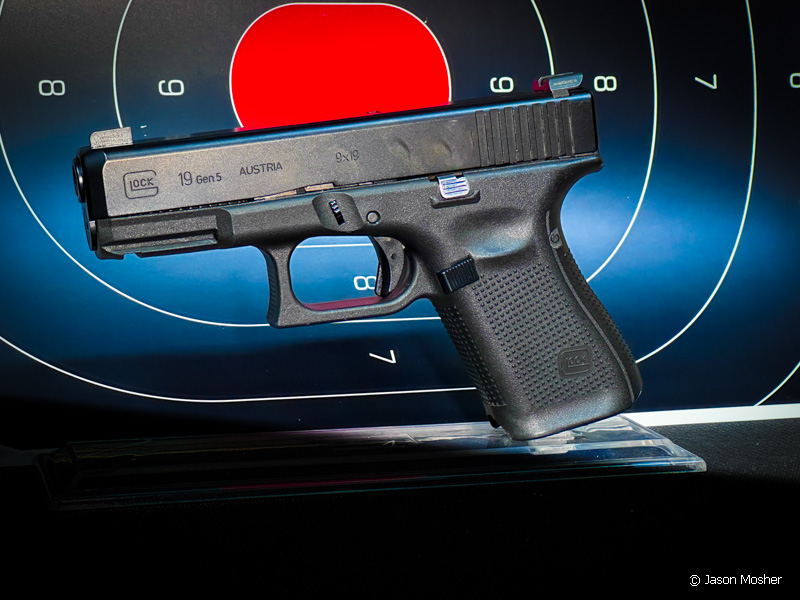
Introduced by Gaston Glock in Austria during the mid-1980s, the first successful model to be released was the Glock 17. Considered their flagship gun, the Model 17 was the first of its kind. The Glock 19 soon became just as popular, and today, it may very well be the most copied gun in history.
Because they were made of polymer and metal, Glock handguns were considered by many to be unreliable, cheap, and even dangerous when they were first released. Rumors about “plastic” guns that could pass through metal detectors without notice were rampant. Even members of Congress were calling for action to ban Glock handguns from the US.
However, Glock surpassed all expectations and outperformed most other guns on the market. After extensive testing, they proved to be more robust than the competition.
Today, Glock handguns are considered some of the most reliable and cloned guns in the world. They dominate the law enforcement industry and are the number one handgun selected by police in the US.
Glock handguns range in size and price depending on the model and a few other things. For example, a Glock 42 is chambered in .380 and is the smallest handgun made by Glock. It retails for around $400.
But other, larger models retail for much more. With the release of the Gen 6 models, it will only be a matter of time before the Gen 5 models start coming down in price. At least we hope…
Why buy a Glock Clone?
While a genuine Glock is hard to beat, there are several reasons why Glock clone handguns are so popular today. Customization and price are among the top reasons many turn to clones. Glock does not offer many upgrade choices in the area of cosmetic design or finished color. They have an extremely efficient system for manufacturing their guns, and too many options would no doubt alter that.
Glock clones, however, offer multiple choices such as color, frame material (like all-steel or aluminum), finger grooves, beaver tail, flared mag-well, and more. Also, with so many companies making Glock clones, the consumer has more choices available at varying price points. Some of these clones are much cheaper than Glock handguns and some are more expensive.
For someone looking for a Glock handgun on a limited budget, companies like Bear Creek Arsenal or Palmetto State Armory offer some good choices. I own a Grizzly BC-101 from Bear Creek Arsenal that retails for just $295. The quality and performance is unbelievable. I’ve never had a single issue with the gun.
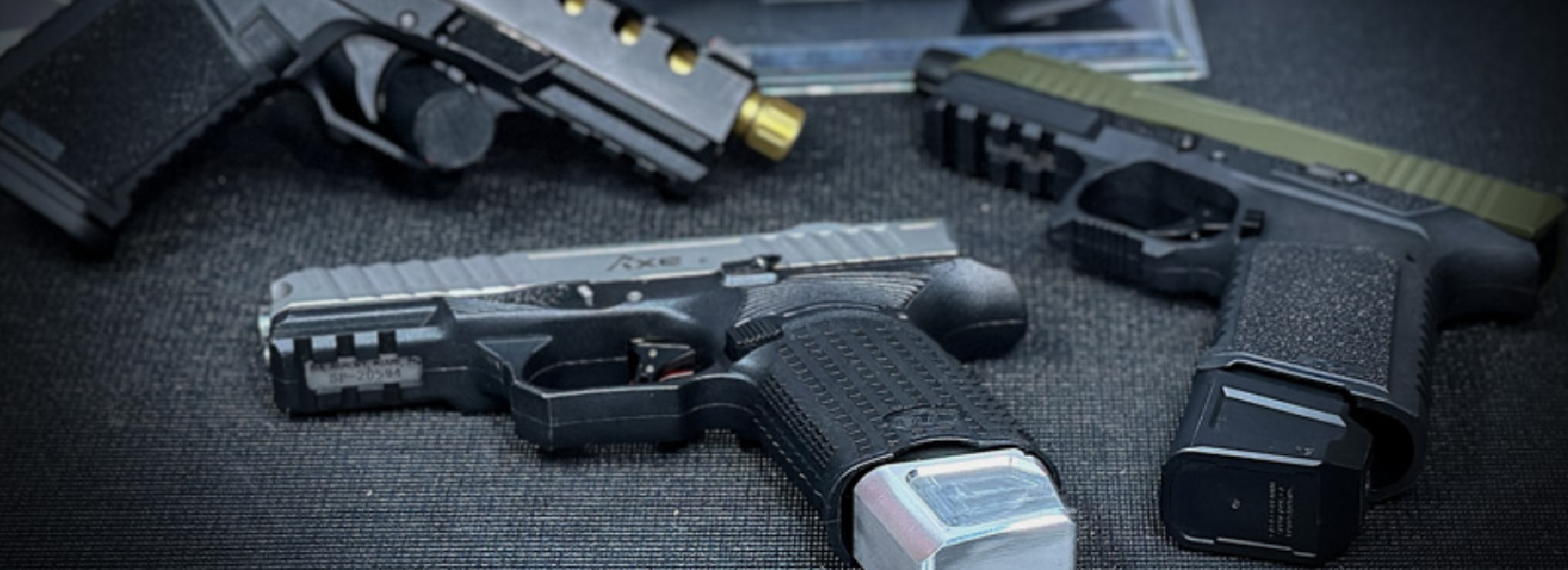
Bul Armory is another one of my favorites as well. The AXE (pictured below) is an Israeli take on the Glock 19. This one, however, retails for much more than a Glock handgun.
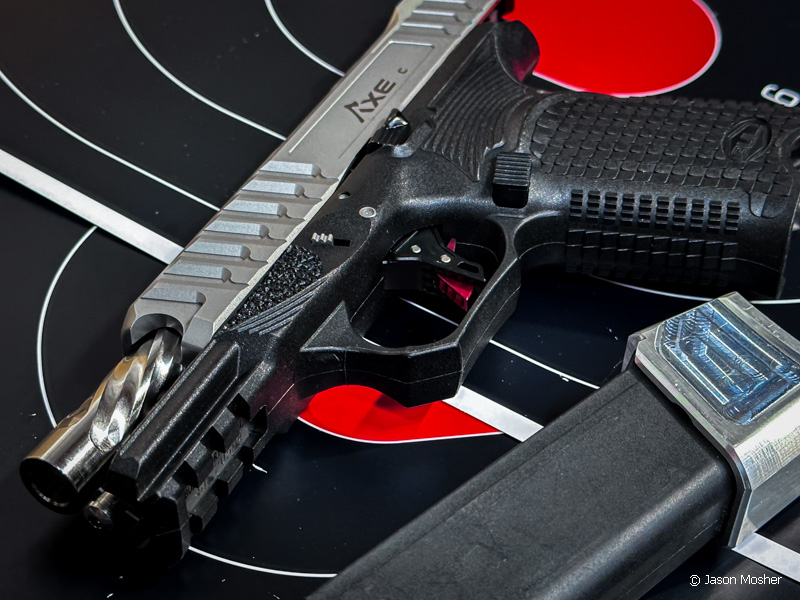
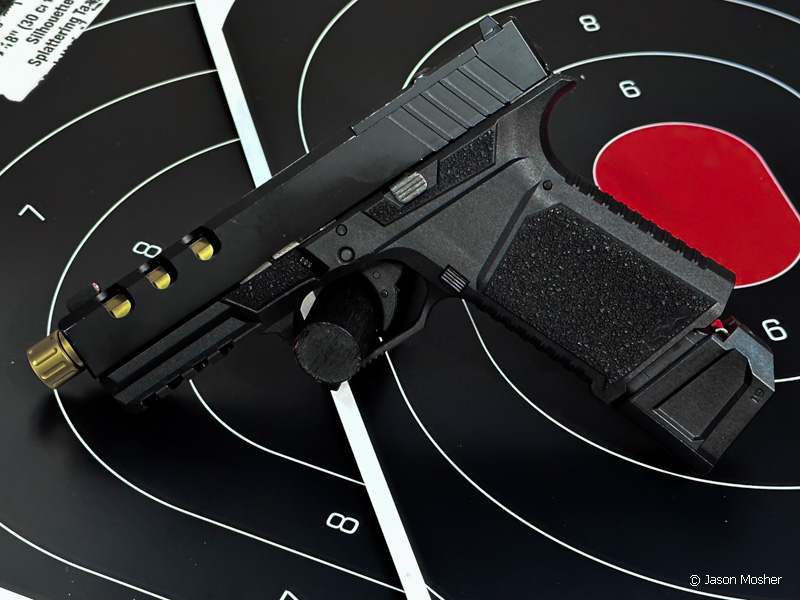
Besides Bull Armory, companies like Zev Technologies and others offer a wide range of handguns in various finishes, colors, and designs. The OZ 9 V2 Elite Compact is a combination of Gen 3 and Gen 5 compatible parts and retails for $1,800. Custom-looking designs on the slide with cutouts show off the gold barrel underneath.
Many refer to these types of Glock clones as “Gucci Glocks.” Shadow Systems, Faxon Firearms, Grey Ghost Precision, and more all make high-end Glock clone handguns.
Deciding if a Glock clone is worth it depends on several factors, with price being the most obvious. On a budget, some clones are much cheaper than OEM Glock handguns. For those who want Gucci Glocks or a Supreme Glock, high-end clones meet that need.
New Glock Clones
As companies continue to add their own designs and unique upgrades to their version of a Glock pistol, we are continuing to see some great outcomes. While most Glock clone handguns are based on the Gen 3 version, some models have started emerging that combine a few Gen 5 parts.
Here are some of the newest Glock clone models on the market:
Ruger RXM
In 2025, Ruger released its first Glock clone pistol, and it’s far from just another cloned handgun. While most of the parts are Gen 3 compatible with Glock EOM parts, they did something a little different.
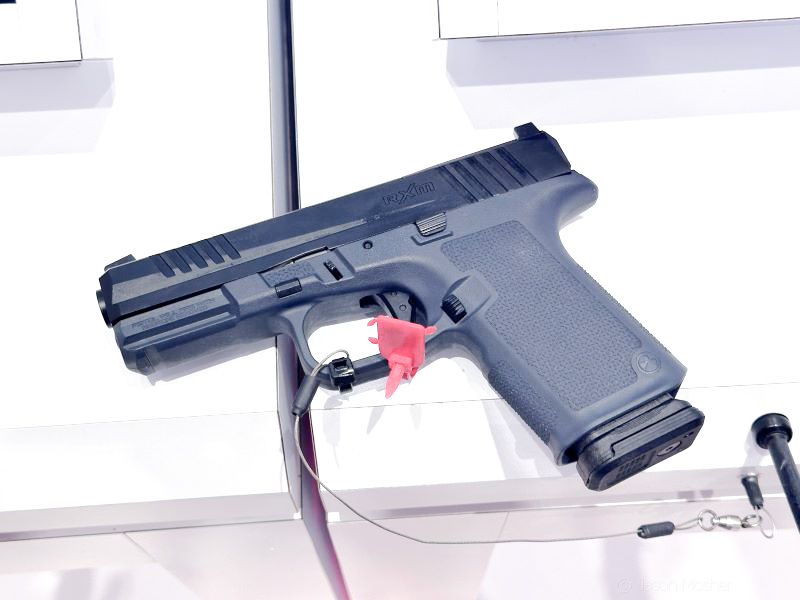
The first, and most noticeable, enhancement Ruger has made is a removable Fire Control Insert (FCI). This allows the user to swap it out for a different size or color of grip from MagPul. Ruger partnered with them to create the Enhanced Handgun Grip (EGH). This allows the person to customize the gun more than they would normally be able to do.
In late 2025, the full-size frame was released for the RXM, and during SHOT 2026, the sub-compact frame was introduced. This now gives us three choices in frame sizes and multiple colors to choose from. This means you can buy one RXM and purchase additional grip frames for about $40 from MagPul.
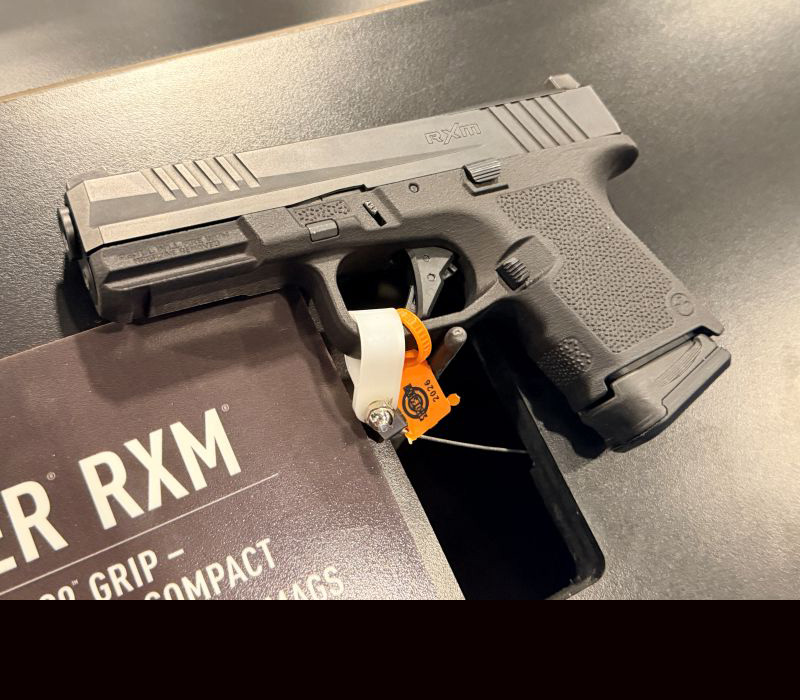
The RXM comes optics-ready and has some nice serrations on the slide, which provide a better grip.
Bear Creek Arsenal
I mentioned the Grizzly 101 from Bear Creek Arsenal. This gun catches your eye because of the great contrast of slide and barrel finishes. Most of the models have cutouts so you can see the barrel through the slide.
The Grizzly looks like a custom-ordered handgun, but it’s not. Out of the box, you get a threaded barrel, slide cutout, removable optics plate, and an extremely comfortable grip. They have customized the grip and made it just a little slimmer than what you would see on a Glock handgun.
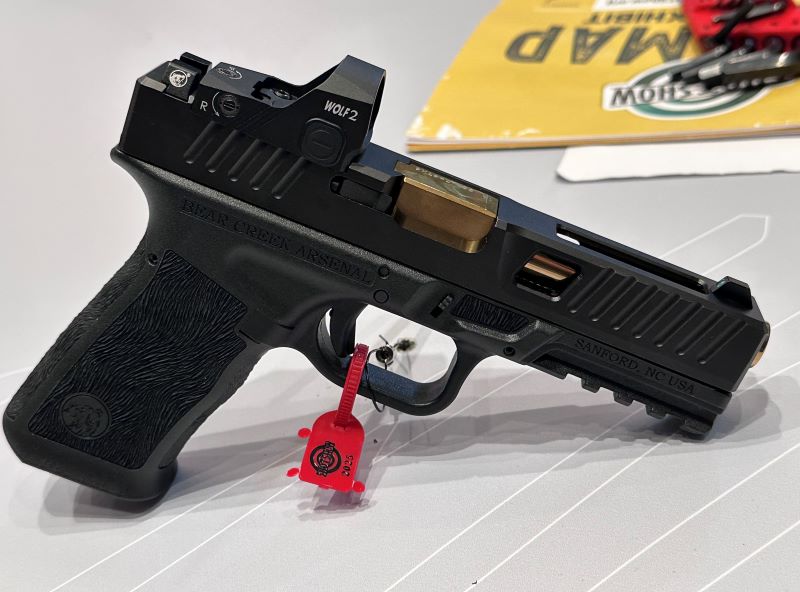
Besides the high-end look that comes with all the Grizzly models, they also upgraded the mag release to a Gen 5 version. This was an excellent choice as the Gen 3 mag releases are thin and harder to push. All other parts on the Grizzly are Gen 3 compatible.
For around $300, you can select from multiple custom-looking Grizzly models that all have different configurations of size and finish. This is an impressive handgun for such a bargain price.
Front Line from Black Rain Ordinance
Black Rain handguns are easy to spot because of their unique finishes and slide serrations. Based on the Gen 3 Glock, the Frontline is built in Neosho, Missouri, and comes with a lifetime customer warranty. This company likes to customize guns, so you can order their baseline models or ask for something special.
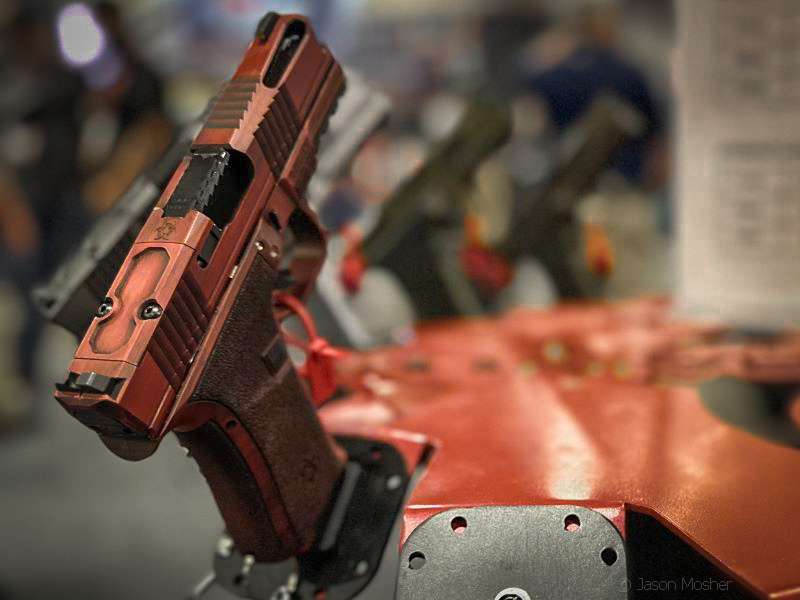
Black Rain Ordinance is the second-largest Cerakote applicator in the country. They have their own team of people who do nothing but paint colors, patterns, and finish designs. If there is a custom color or design you want, they can probably do it.
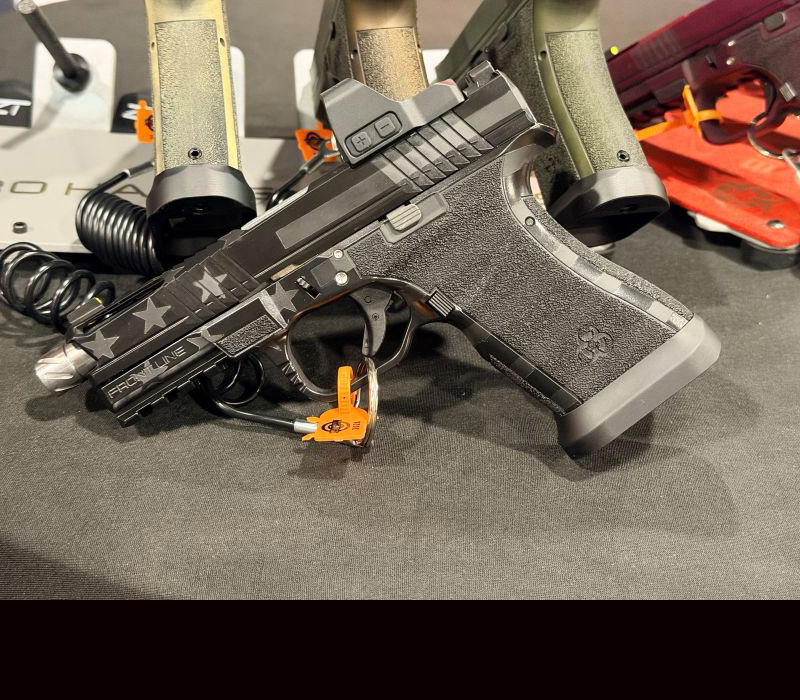
The Frontline handgun comes with a removable optics plate so you can mount the optic of your choice. They retail for about $640, so they are twice as much as a BCA handgun, but you can also have it customized when ordering.
Zev Technologies OZ9V2
On the higher end of the Glock clone scales is Zev Technologies. They are known for making high-quality guns and are often referred to as Gucci guns.
Their newest model is the OZ9V2, which is an updated model of the OZ9. Zev also offers some custom-looking features like slide serrations and different color grip frames, but they made some big changes with version two.
As we have mentioned several times, most Glock clone handguns are Gen 3 models. The OZ9V2, however, is based on the Gen 5 Glock. That means a double recoil spring, a larger mag release button, and more.
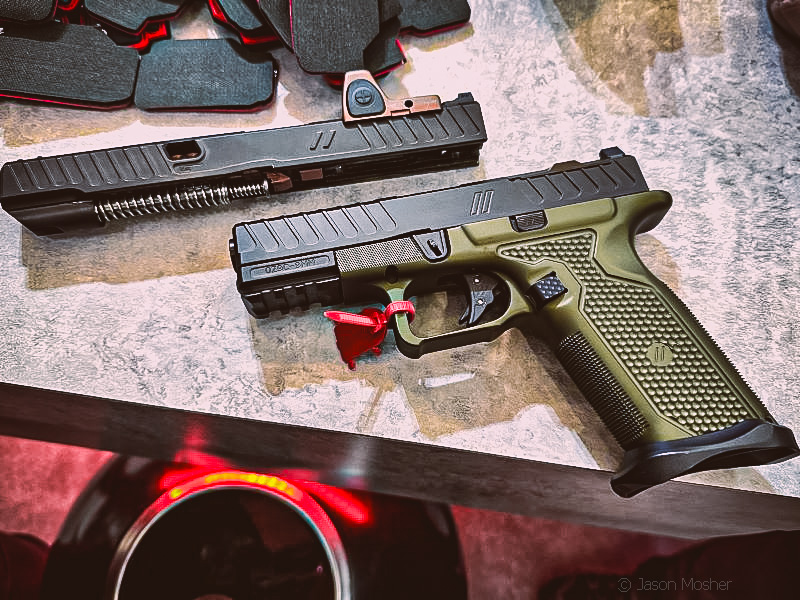
As you would expect, it comes optics-ready and includes their custom flared magwell and other unique finishes to the slide and frame. Zev Technologies is also releasing a model that will work directly with the ACRO mount for those who want to mount an Aimpoint ACRO.
When it comes to prices, this one is at the top of the list. Starting at $1,763, you can’t really call the OZ9V2 a bargain, but it’s a nice-looking gun that is made of high-quality parts.
Derya Arms
Derya Arms has produced one of the best-looking Glocks I’ve seen at one of the lowest prices. This DY9 Island can be found for less than $350 at some stores. The grip and extreme slide serrations really make it stand out. This model also has a ported barrel and comes optics-ready.
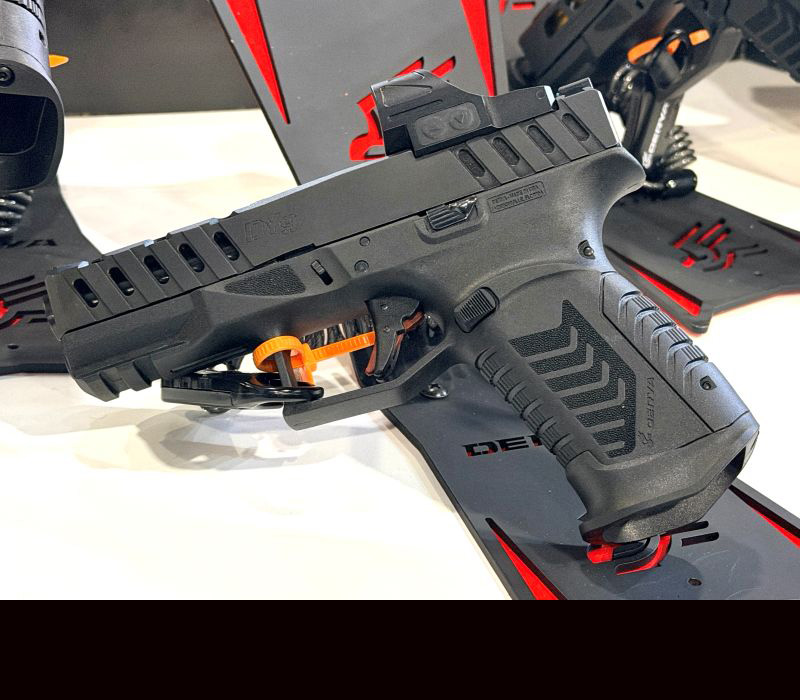
Except for the barrel and slide, everything on this gun is Glock compatible. Most parts are Gen 3, and the mag release is a Gen 4 version. For those wanting a Glock clone that has a look of its own, the Derya Arms DY9 is one to check out.
Saricam Arms
While the overall design is more “Glock” than what we are seeing from other companies, the finishes that Saricam Arms offers are kind of cool. The S-17 Red Spider was one I liked, and it’s based on the Glock 17, Gen 4. This is a little out of the “norm” as most Glock clones use Gen 3 compatible parts.
This particular gun has the finger grooves that I like, and a finish that almost gives it a “leather” look. They retail for about $299, following a popular trend of sub $300 Glock clones.
In the US, they are distributed by Atlantic Firearms. You get a carrying case and multiple mags with your purchase, making this a sweet deal.
Magazine and holster compatibility
Magazines are another factor in Glock’s popularity. Known for their durability and ruggedness, Glock OEM and Glock aftermarket magazines are the most handgun-compatible mags today.
Besides Glock clone handguns, many PCC rifles and sub-gun-size firearms are designed to use Glock-compatible magazines. When buying Glock and/or Glock clone guns, the buyer has the benefit of using the same magazines in their guns.
One exception is the 19X, which Glock introduced as their military-grade handgun, giving customers something a little more tactical than the norm. This handgun is limited to using extended magazines and is not compatible with flush-fitting 17-round magazines. With that exception, most other Glock and Glock-compatible magazines are interchangeable. Companies like Magpul, ETS, Amend2, KCI, and others make Glock-compatible magazines.
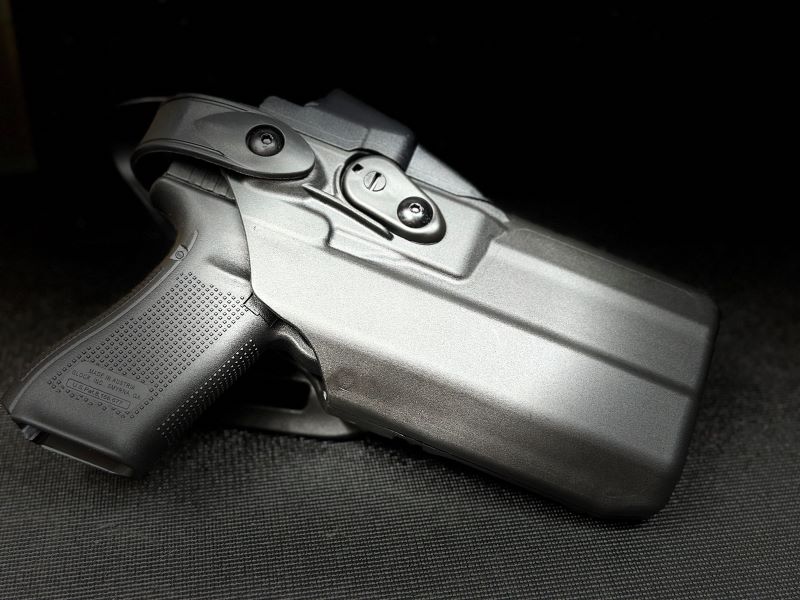
Many Glock clone handguns will also work with holsters designed for Glock pistols. With some exceptions, the overall cosmetic appearance doesn’t change the compatibility of the gun. Some guns may be tighter or looser in certain holsters, so it is important to check compatibility before purchasing.
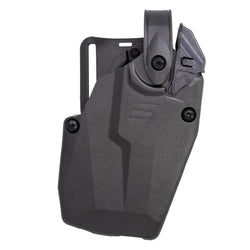
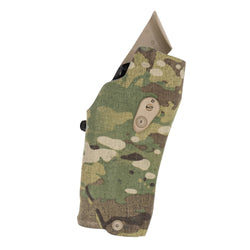
Holsters with retention may have some compatibility issues with Glock clone models that enhance the trigger guard or width of the slide and/or frame. In general, however, Glock clone handguns can use the same magazines and holsters as OEM Glock pistols. Safariland Duty Rated holsters may have compatibility issues with Glock clones. Safariland lists the fits that have been tested for retention on the product pages. Other clones may fit, but they have not been tested.
For example, the Safariland 7360RDS holster works with Glock 17/19/34 handguns and accommodates a light and optic. The BUL Armory AXE (G19 clone) fits well in the 7360RDS but has not been put through Safariland’s testing. The PSA, Anderson Arms, and BUL Armory Glock clones will all fit in the Safariland 6005 holster, but have not been tested.
The Clones are here to stay
Glock continues to set the standard that other firearms manufacturers, holsters, magazines, and gun parts companies follow. There are reasons to own both a Glock OEM and a Glock clone, depending on the needs of the buyer. A tactical Glock 19, for example, could be a Glock 19X, Glock 19 MOS, or a Glock clone from several companies that offer removable optic plates and Picatinny rails for tac-lights.
The bottom line is that Glock clones offer more options for customization with similar reliability. From budget-friendly to tactical, flashy, or competitive, Glock clones are here to stay, and the more choices, the better!
Frequently Asked Questions
What exactly is a Glock clone, and how does it differ from an original Glock?
A Glock clone is a handgun manufactured by a third-party company using mostly the same specifications as an original Glock. While they often feature cosmetic differences, like slide cutouts, different colors, or unique frame textures, their internal parts are typically designed to be interchangeable with Glock original equipment manufacturer (OEM) components.
Why would someone choose a clone over a genuine Glock handgun?
The primary reasons are customization and price. Many clones offer features Glock doesn’t provide from the factory, such as all-steel frames, specialized grip angles, and “Gucci Glock” aesthetics with colorful barrels and slide cutouts. Additionally, clones are available at a wider range of price points, from budget-friendly models under $300 to high-end custom versions exceeding $1,800.
Are all Glock clones compatible with the same parts and accessories?
Not necessarily. It is important to verify the “Generation” compatibility, as many clones are based on Gen 3 specifications, while others (like the Zev OZ9V2) use Gen 5 parts. While most clones are designed to fit the same magazines and holsters, modifications to the trigger guard or slide width can sometimes cause issues with holsters, particularly duty-rated ones with active retention.
What is the “Fire Control Insert” found in newer clones like the Ruger RXM?
The Fire Control Insert (FCI) is a removable chassis that contains the serialized part of the firearm. This feature allows the user to swap out the entire grip frame for different sizes or colors—such as the Magpul Enhanced Handgun Grip—without needing to purchase a new firearm, offering a level of modularity not typically found in traditional Glocks.
Will Glock magazines work in these clone handguns?
Yes, one of the biggest advantages of the Glock ecosystem is magazine compatibility. A fully cloned Glock should accept OEM Glock magazines as well as aftermarket versions from brands like Magpul and ETS. This also means you can often share magazines between your clone handgun and many Pistol Caliber Carbines (PCCs) that are designed to use Glock mags.