
Gun folks pay attention when they see guns on the big screen. We get excited when Hollywood gets things right—especially every small detail—and sigh when they get it wrong, AGAIN!
Does the actor or stunt performer have his finger on the trigger? Is the safety on? Did they manipulate the safety? How come John Rambo’s belt of ammo for his M60 seemed to get longer without reloading? How awesome was the gunfight in Heat?
Of course, I would be remiss to not mention Alec Baldwin and the tragic events on the set of Rust. That incident had a lot of productions shy away from blank-fire guns in favor of rubber, replicas, and airsoft. It is safer in their minds. Hollywood is mostly a liberal, anti-gun world. So to them, CGI muzzle flashes are better than risking another tragic incident. Fortunately, time has passed, and that mindset is fading away.
The High Stakes of On-Set Safety
Rust, sadly, is not the first tragedy on a film set. Brandon Lee was shot on the set of The Crow in 1993, when a blank discharged during a scene and expelled a live projectile that had been lodged in the barrel of the gun previously.
Jon-Erik Hexum, a 26-year-old actor, died in 1984 after accidentally shooting himself in the head with a prop gun loaded with a blank cartridge while on the set of the television series Cover Up. During a break in filming, Hexum was playing around with a .44 Magnum revolver, which he believed was unloaded. It actually contained one blank round. He pointed it to his temple and pulled the trigger, not realizing the danger.
Blanks can, and have, caused death and serious physical injury to people.
There are steps and protocols that should be used on set to prevent tragedies. One is “cheating angles”. That is when a shot is set up so that each “shooter” slightly points the firearm offline of the other character they are “shooting” at. Camera angles can be manipulated to prevent you from seeing it on screen.
There are also different types of plugs that can be used in the barrel of a blanked firearm to prevent some or all of the flash and unburnt powder from exiting and striking anyone. This is especially useful when a contact-range shooting scene needs to be filmed. This obviously can’t be used all the time, or there would never be any muzzle flash on screen.
For more on the dangers of blanks, including a video demo, click here: https://www.stretztactical.com/actor-safety-education
The Logistics of Storytelling: Why Realism Fails
What most audiences don’t realize is the amount of work that goes into a production, even without firearms. It really does take a village.
It starts with “production”—the people producing the film, mini-series or TV show. They have a particular vision of how they want to tell the story. Some producers and directors put a lot into getting it right. Some don’t, even if it is a true story and the characters are based on the actions of, and named after, the actual heroes.
Often times, several real-life people or incidents will be combined into one character or scene in a production to tell the story. If that didn’t happen, a 2.5-hour movie would be a 6-hour movie.
The Battle for Authentic Actor Training
When discussing why they get it wrong, you have to ask, did they hire a technical advisor? How closely does that advisor’s background match the true-to-life people from the specific period of time that the production is set in?
Is it a “law enforcement advisor” for an NYPD or FBI show who was never a New York City police officer or FBI agent? Maybe they were, but maybe they were active 20 years before or 20 years after the incident being portrayed actually happened.
Were they actually involved in the incident? Is it a military story, and the only technical advisors are from one branch of service when the actual battle included personnel from multiple branches of service? If so, you can end up getting input from only one perspective.
Even if they hire everybody who was on the ground, the producers or directors may not go with everything they’re being advised to do. Did the technical advisors train the actor? Even if they did, I have seen both really experienced and capable special operations and law enforcement advisors fall way short when it comes to providing quality training and knowing how to actually teach.
Sometimes it is the actor. I know of a well-known actor who showed up for training because he was forced to by production. He was mentally checked out and had a bad attitude. The prop company providing the training cut him loose early because it was a waste of time.
Sometimes the actors live in “non-permissive” environments like New York, so providing live fire training may not be legal based on the type of firearms needed. Often, their schedules do not allow for travel to receive training, so replica or blank fire weapons will be used.
Even if live fire is conducted, a lot of actors only want to be in the training for two or three hours for one or two days, a few months before filming. Maybe they will get another hour or two refresher on set.
Will it be up to the weapons department of the prop house to do the actor training? If it is the weapons department, what is the background and skill level of the personnel?
Were there last-minute cast changes or decisions to provide training? Was the training “check the box”?
I once did training for an actor who had firearms training in their contract. After spending 30 minutes on the phone with the producer and his assistant, I geared up for handgun training for the actor. When the actor arrived at the training location, they were surprised that I was providing handgun training, since they were playing a sniper. They made a call and were told to do the handgun training and that they would be brought back for rifle training at a later date, which never happened.
On the same production, I caught a major typo regarding their rifles’ caliber in the script and advised the actor that it was a completely wrong line—one that would make the character and the movie look really bad. The actor made the necessary notifications, but the wrong line remained in the movie.

The Toolkit: Wardrobe, Props, and Guns
This in itself can be an issue. I have seen people in charge of wardrobe and gear use Google to find out what was “correct.” More often than not, this leads to the wrong gear, wardrobe, or guns for the period the story is set in. When objections are raised during “pre-production,” or just when the company is establishing a reference library for a given military or first responder organization without a current project on the table, it can be met with “they meant well, leave it alone. If we need authenticity for a particular project, we will deal with it then.”
I worked on one production where I caught several police uniform errors. When I went to correct them, I was told to leave it alone. The mindset was that the first two episodes had it wrong, and they were more concerned with continuity.
Now imagine that your name is in the credits as the technical advisor. Do you wait until no one is looking and fix it? Or do you just be a good soldier and live with it?
I have seen it handled both ways. That can be frustrating. Sometimes everything I mentioned thus far is done perfectly, but a piece of gear, gun, or accessory doesn’t exist commercially or otherwise isn’t obtainable. Then the weapons department, wardrobe folks, or prop company as a whole will do their best to recreate everything to the best of their ability. Budget will definitely be a factor in that ability, as will any timeline constraints to make it happen.
Choosing the Right Weapon Tier for the Scene
This area can be tricky as well. What is the budget? Are the weapons more modern and unavailable in the wild? Will they be fired with blanks or CGI? Will there be close-ups? Loading/unloading sequences? How many characters need a gun? Is the actor or stunt performer a convicted felon in real life?
All of the aforementioned come into play when selecting an option. So what are the options available to a production? There are several: rubbers, replicas, airsoft, and blank firing firearms.
Rubber Prop Guns
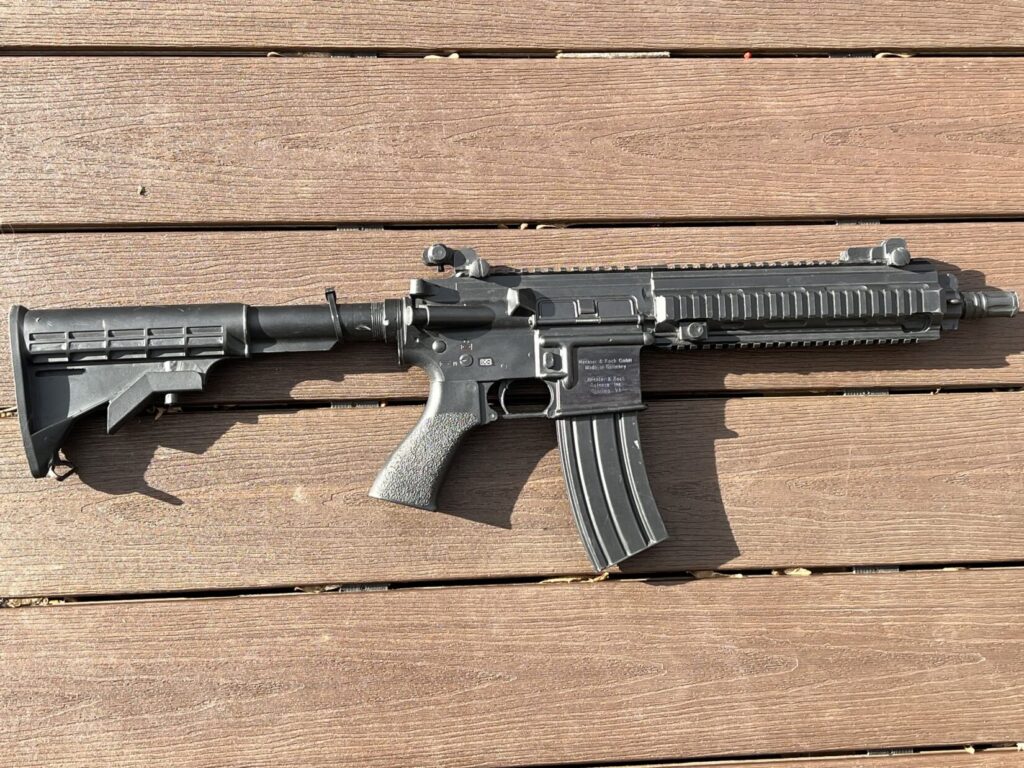
Rubber or plastic facsimiles are made out of the molds of the actual gun. These can be done in great detail with the actual wear marks and scratches of the molded gun painstakingly painted on by artists. This is important for close-ups. It can also be important if live guns are being used and a rubber is needed for a stunt scene (an explosion or a fall, for example).
Lesser versions may not even have the flash suppressor carved out or may have the seam visible from the mold it was made out of. Rubbers can also be fitted with optics, lights, lasers, and slings. That includes replica accessories such as a mold of an optic with a plastic window put in place where the real optic’s glass would be. You can also attach real working lights and lasers from, say, Surefire, or cheap knockoffs of the same model accessory.
Replica Firearms
There are different grades of replicas.
The lowest grade are the cheap ones you find on a website for a dirt-cheap price. Some will look better or worse than others on camera, depending on the detail that went into the manufacturing. Some may or may not have reciprocating actions or removable magazines.
The best ones that I have worked with are M4 carbine-style replicas that, from the manufacturer, were deemed “non-firearms” by the ATF. They use a similar lower receiver to a live M4 with an M4-style trigger that can be pulled, but the receiver cannot accept fire control parts. They can accept real uppers, the bolt can be manually cycled, and magazines can be inserted and removed. You can even do a close-up and chamber a round. No one would ever know, even at first glance, while holding and manipulating the “non-firearm”.
Airsoft Options
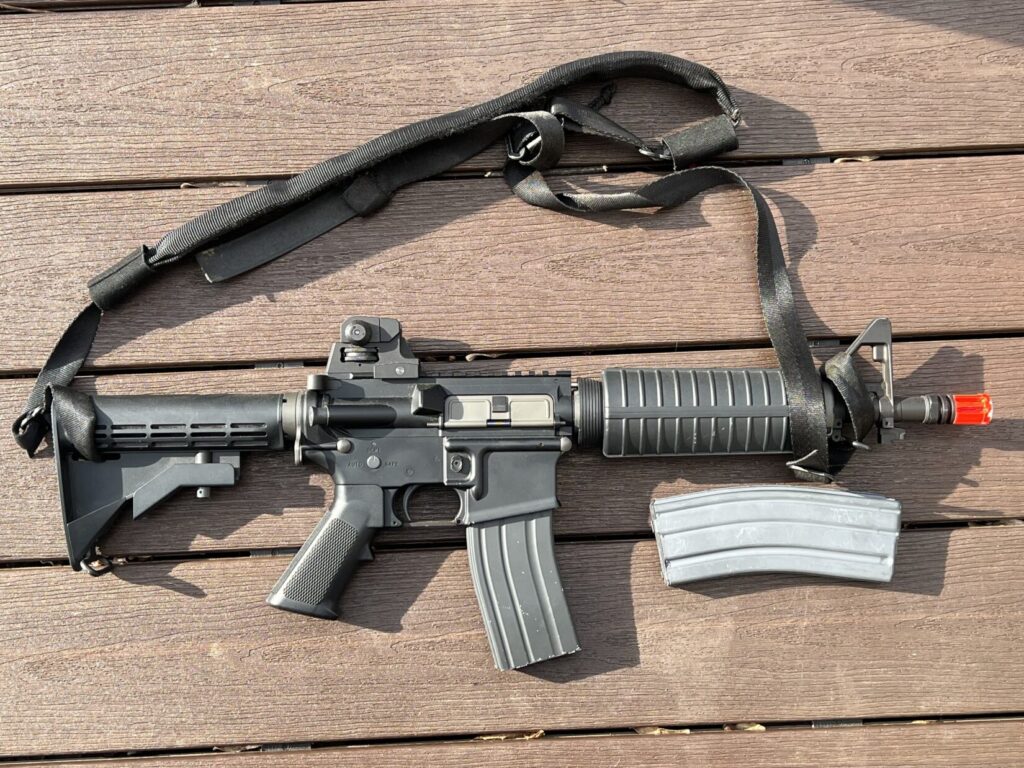
Airsoft is another popular option. Most of the modern firearms in use by the military and law enforcement today have been duplicated by the airsoft community, from handguns to belt-fed machine guns and even grenade launchers with launchable projectiles.
Airsoft replicas of the live-fire guns fire small plastic BBs. The higher-end airsoft products are one-to-one replicas—or very close to it—in terms of weight, dimensions, and color, as the actual gun. There are electric and gas-powered versions whose actions can reciprocate with a pull of the trigger and can fire in both semi-automatic and fully automatic modes.
Their slides can even lock back when empty, like the real firearms. Of course, precautions are taken to plug the barrel so that no BBs can be expelled from the guns, should they somehow be negligently introduced.
Airsoft and replicas are more popular options for actors who have felony convictions in their criminal history. An actor or stunt performer who is a convicted felon cannot possess a firearm, even one converted to only fire blanks. This can and has offended some well-known actors who have been told they can’t use the real thing. But with a high-quality airsoft firearm, especially a rifle or machine gun that feels so real, it can soften the blow to their ego a little.
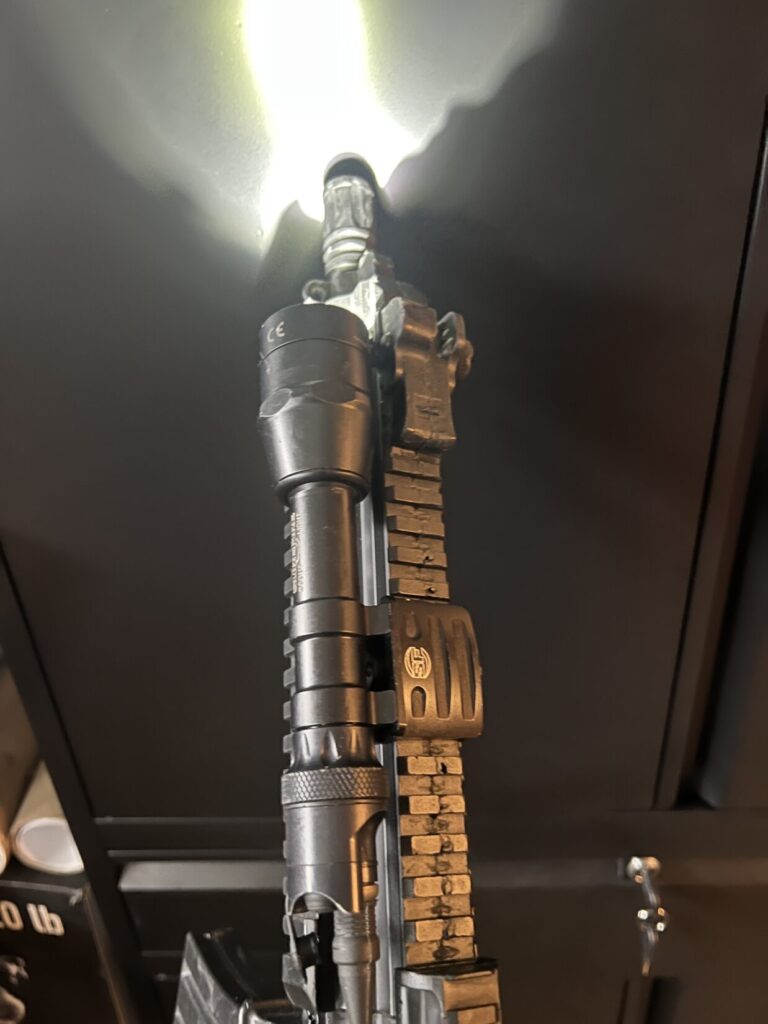
The real thing
Probably the most satisfying for gun guys (and girls) is seeing real guns, firing blanks through period-correct guns with the appropriate accessories for the character’s background, and being properly manipulated by a properly trained actor or stunt performer.
If you follow the “cloner community”, you already know that it can be difficult to get it right. Some military units or law enforcement agencies may have had several models of a given carbine, for example. Individual preferences can also play a role. There may be a standard-issue optic, light, sling, or other accessory, as well as a policy allowing something different to be employed.
The availability of period-correct guns or a particular model of gun, gear, or accessories may no longer be available. Or, it may be available, but at a high cost that production may not be willing to pay for, so a substitute will be used, or it will be omitted altogether.
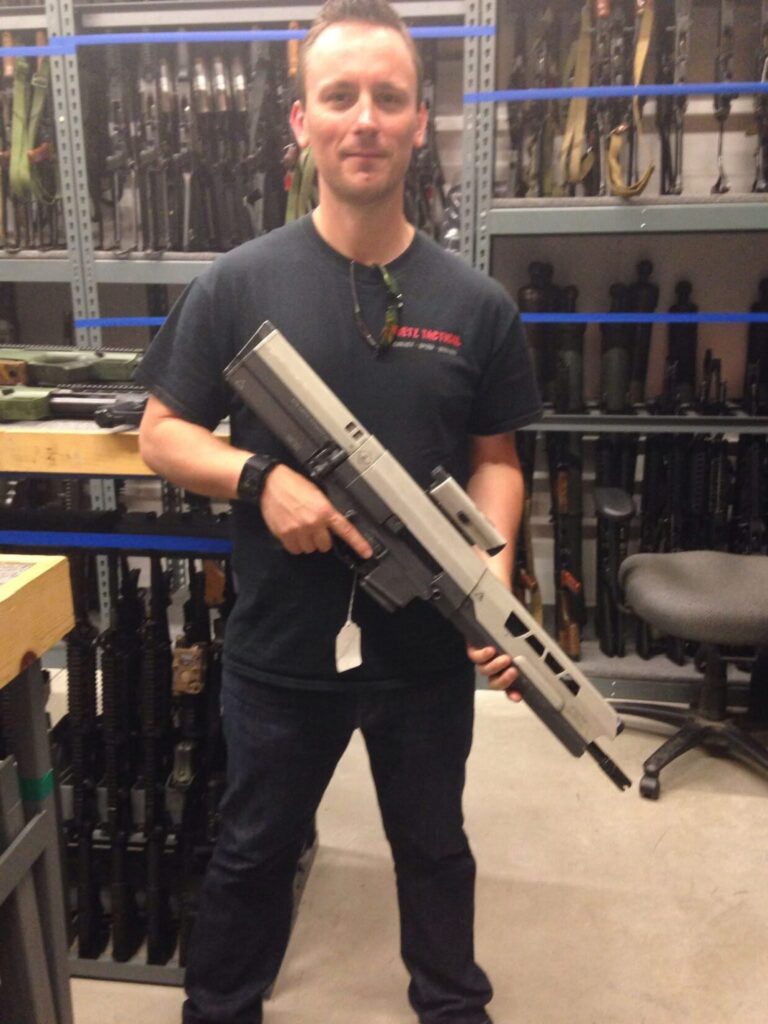
Sometimes writers, producers, or directors may require a futuristic gun that doesn’t exist, but can still fire blanks. That is where the art department of a prop company works together with the weapons department to create a “shell” that the real firearm can be inserted into. This allows the gun to function and still look futuristic, like the gun in the picture above (used in a well-known production). This has been done for many productions over the years.
closing thoughts
Budget, an actor’s schedule, timeline of production, the prop department, technical advisors, and yes, the actor’s attitude, all have an impact on the outcome of the end product.
I hope this sheds a little light on firearms in Hollywood and why you should get excited when they get it right, especially the little details. A lot is working against it being done right.
When it is done well, know that a lot of work went into it, and you should look for other productions by the same cast, director, and writers. You usually won’t be let down.