
If you have seen the hit CBS/Paramount show SEAL Team and you are familiar with the character Trent Sawyer, then you have seen Tyler Grey, who plays Trent. Tyler was a real-life special operations soldier, but not in the Navy.
Tyler was a US Army Ranger and sniper who went on to serve as an Operator in the US Army Special Mission Unit. Tyler was medically retired after being seriously injured in a blast while on an operation in Iraq.
In addition to his careers as both an actor and a soldier, Tyler has also done firearms training and technical advising, is an author, and is now an inventor who created the NDEX Sights.
Thank you to Saberdyne Systems for providing a sample. All thoughts and opinions are my own.
What Are NDEX Sights?
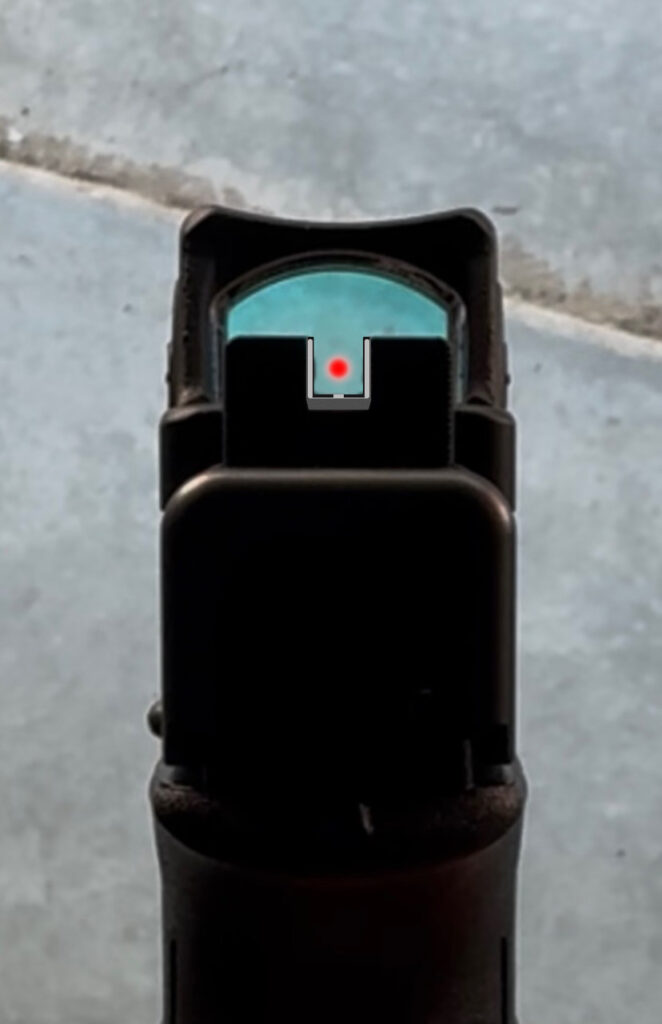
NDEX sights do away with the traditional front sight post so you can stay focused on the target. They look like two rear sights. Instead of the traditional blade, the front sight is similar to a Glock factory plastic rear sight, with the white “upside-down staple outline” used to align the innovative front sight design with the notch in the rear sight, while remaining target-focused.
First Range Trip
I have to say that I was both skeptical and intrigued at first. I mounted the Tall-height NDEX sights on my Gen 6 Glock 17. Normally, I test a new handgun, optic, or pistol sights at 25 yards on an NRA B-8 bull and check zero.
With Tyler’s NDEX sights, I decided to start with something different. I started on a plate rack at about 8 yards. To my surprise, I cleaned the plate rack: zero misses and pretty quick, although I didn’t use a timer.
It definitely felt a little weird staring through the sights and also trying to keep the “white staple” aligned using my peripheral vision, but it worked, and it worked well.
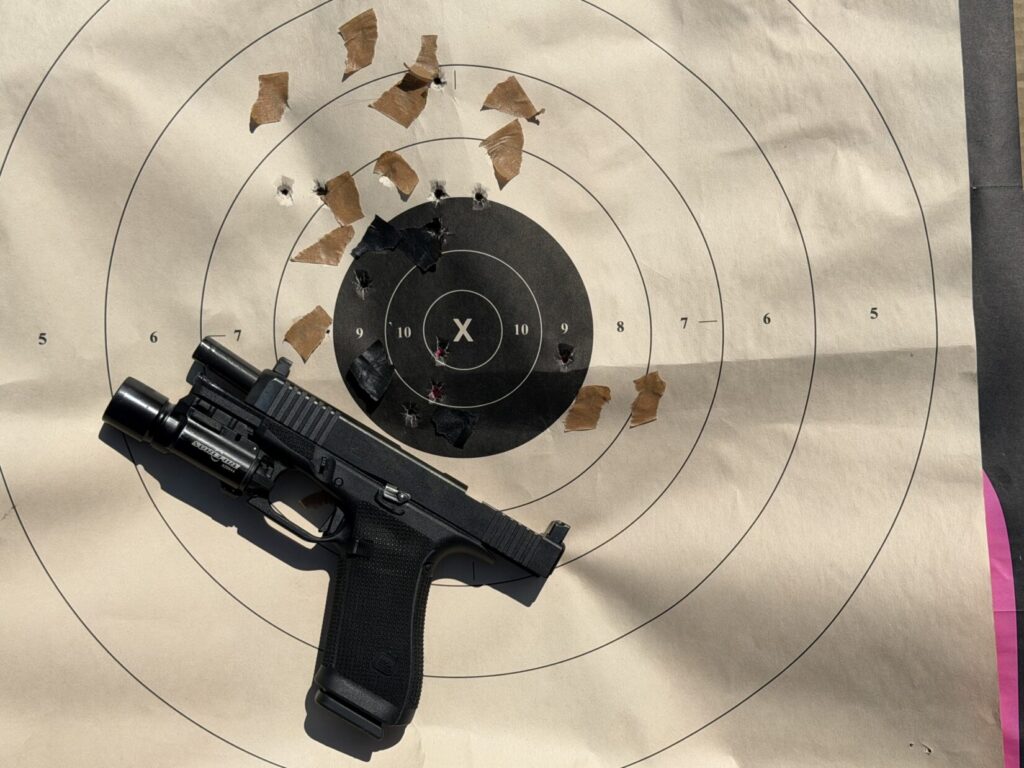
Next, I moved back to 25 yards and went to work on the aforementioned NRA B8. I’m not going to lie, the first target was not pretty.
That said, Tyler told me two things I kept in mind at 25 yards: these are not target sights, and they are capable of headshots at 25 yards. After about my third 10-round string at the 25-yard line, I was able to understand where and how to hold, and I also noticed the white tick mark at the 6 o’clock of the front sight helped me line up the shot.
I’m not sure if they will be as accurate doing bullseye work as conventional sights. But they weren’t designed for that, and it may just take some time to get used to aiming at a bull with them.
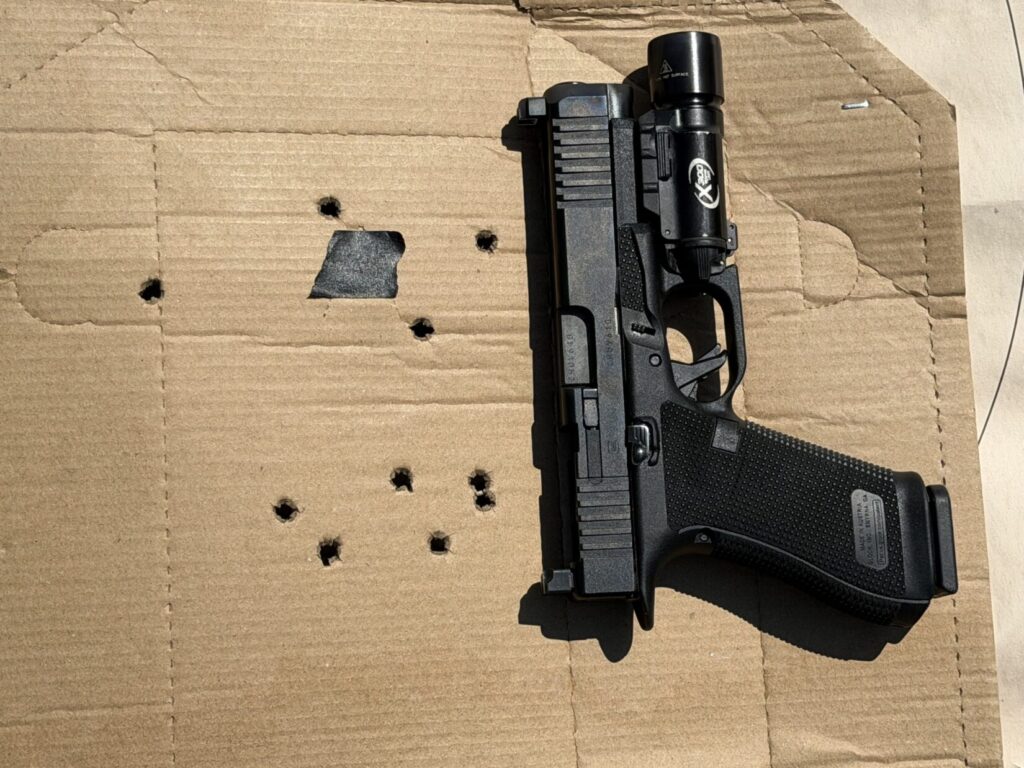
Next, I moved to a USPSA target at 7 yards and did some one-shot presentations and Bill Drills. What I started to notice is that, although I was target focused at a black pasty high in the A-zone, I was subconsciously following the white outline of the front sight down below my point of aim in recoil and firing as soon as the line was lined up with the rear notch.
Once I realized what I was doing, I consciously stopped focusing on the white line on the front sight, and the shots started to land in the upper portion of the A-zone for follow-up Bill Drills.
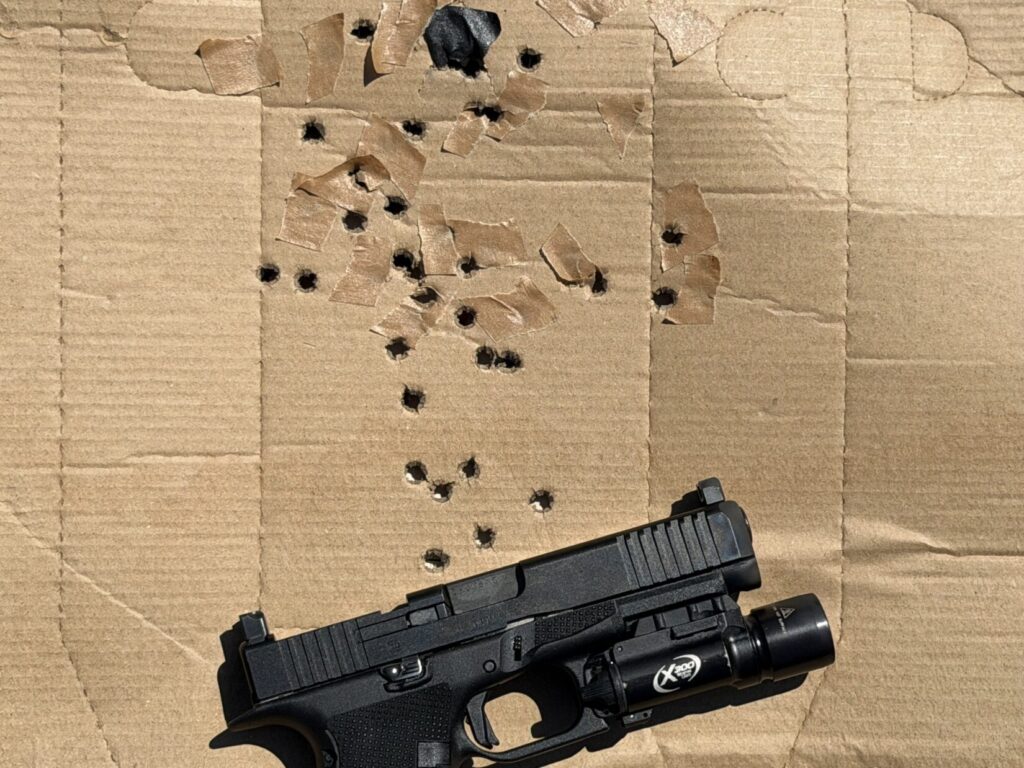
Shooting on the move was next up, and these sights shined in that area. It was super easy to be target-focused and keep almost every shot in the A-zone.
I did notice some vertical stringing, as seen in the photo above, that I don’t normally experience with traditional irons or a red dot. My guess is that my eye was tracking the white outline of the front sight again (as described earlier).

Target Focus With Traditional Iron Sights
We live in a red dot world. That has led to debates on which is better: teach irons first? Or red dot first?
Leaning on my military background, I believe irons first. I equate it to teaching land navigation first and then using the GPS.
Now, if your GPS goes down or is lost, you will be comfortable pulling out a map, compass, and protractor to navigate. I apply the same to pistol sights.
Then comes the next debate. Can you really be target focused with traditional irons? Most people that teach or compete with a red dot say yes.
A lot also use an occluded optic drill to teach being target focused with the red dot. There is no occluded optic drill for irons.
I learned to be “target focused” with iron sights, if you can call it that, by developing my skills as a shooter: lots of quality classes, dry fire, and then competing. It was during several pistol competitions, back when irons dominated, that I started to notice that my focal point was somewhere between the tip of my front sight and the target.
I initially thought I was missing since I wasn’t looking at either the target or the front sight. Checking the targets revealed A-zone hits. That was later explained to me as “intermediate focus.”
Today, people would call it target focus. But it is a long road and a lot of work to get there, compared to a red dot or the NDEX sights.
The question that also has to be posed is: do you have to be target focused with irons, and will you see your handgun sights in a gunfight? Some former special operators and competitive shooters say you won’t see your handgun sights in a gunfight and the decades of “front sight focus” were wrong. Were they, though?
Bill Allard of NYPD Stake Out Squad fame was in 40 gunfights with a handgun and claimed to have used his handgun sights 39 out of those 40 times. So, is it a training issue? Or a training AND experience issue?
With the NDEX sights, you don’t have that problem, and you can be truly target-focused. That was Tyler’s goal: developing a set of sights that allow you to be target-focused during a lethal engagement.
The idea came to Tyler while working on the set of a movie. He observed a director put both hands up, making an “L” with each thumb and forefinger to “frame a shot” he was about to film. That was Tyler’s light-bulb moment, and the NDEX sights were conceived.
It would be several more years of R&D by Tyler to get them where he wanted and to bring them to market.
Running NDEX With an Optic
If you are interested in the sights and run an optic, you’ll need to find a sight height that works for it. The suppressor height sights were not tall enough to work with my Vortex Defender XL and took up almost 50% of the window of my Holosun EPS. Saberdyne also sells an “Extra Tall” set, as well as a Small set, which I did not evaluate.
Final thoughts
After a short learning curve to get used to the sights, I like them and think they are best served on pistols without a red dot. They work as advertised: they allow you to easily be target-focused close up and while shooting on the move and still be capable of headshots at 25 yards. To learn more, check out their website: Saberdyne Systems
A Few Quick Answers on NDEX Sights
Saberdyne sells three heights: Small ($139) for pistols without a red dot, and Tall and Extra Tall ($149 each), which are red-dot compatible.
The Tall and Extra Tall heights are red-dot compatible. In my testing, the Tall sights weren’t tall enough for my Vortex Defender XL and took up almost 50% of the window on my Holosun EPS.
I ran the Tall set on my Gen 6 Glock 17. Saberdyne’s NDEX page doesn’t list compatible pistols, so check with Saberdyne for your model before ordering.