
Humbled. That is what I felt earlier today after shooting the PSGT Standards. It is one of the more demanding courses of fire I have ever shot, and it whooped me.
Even better, it inspired me to train more and train harder. I know I still have a lot to learn about shooting, and I often describe myself as mediocre enough with both a gun and a keyboard to do this job. Having that verified makes me want to get out to the range even more.
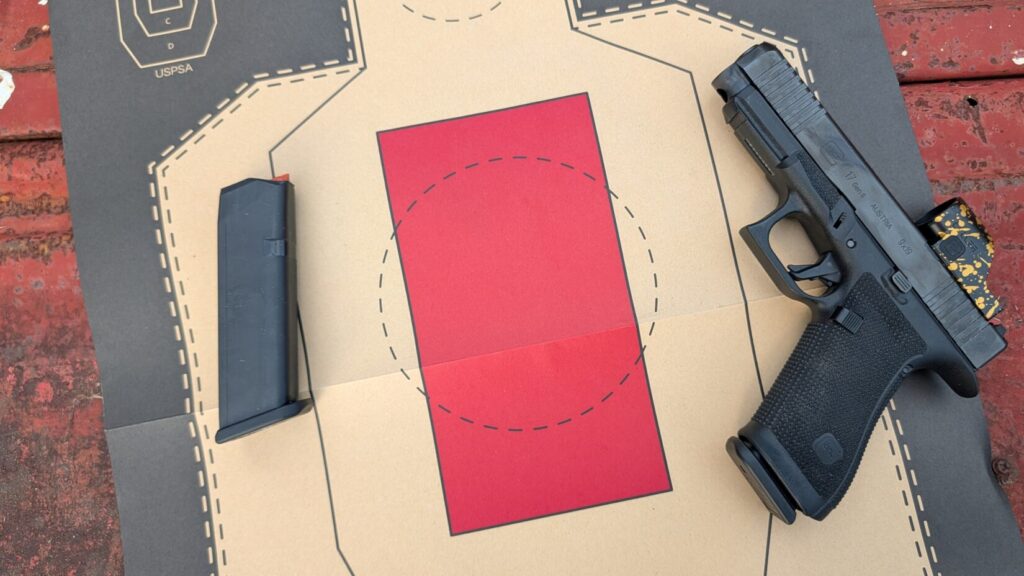
PSTG stands for Practical Shooting Training Group, led by champion shooters Ben Stoeger, Joel Park, and Hwansik Kim. These guys know their craft, so it is no surprise that the PSTG Standards are significantly tougher than your average police qualification.
There are several variants of the PSTG Standards adapted for shorter ranges, tighter par times, and different stage layouts. I ran the standard course of fire today, but I plan to integrate all of them into my training routine.
What You Need for the PSTG Standards
You do not need a mountain of gear, but this is far from a minimalist drill. You will need a 25-yard range that allows movement, drawing, and rapid strings of fire. The course requires 68 rounds of ammunition, at least two magazines, a reliable holster, and three standard USPSA targets.
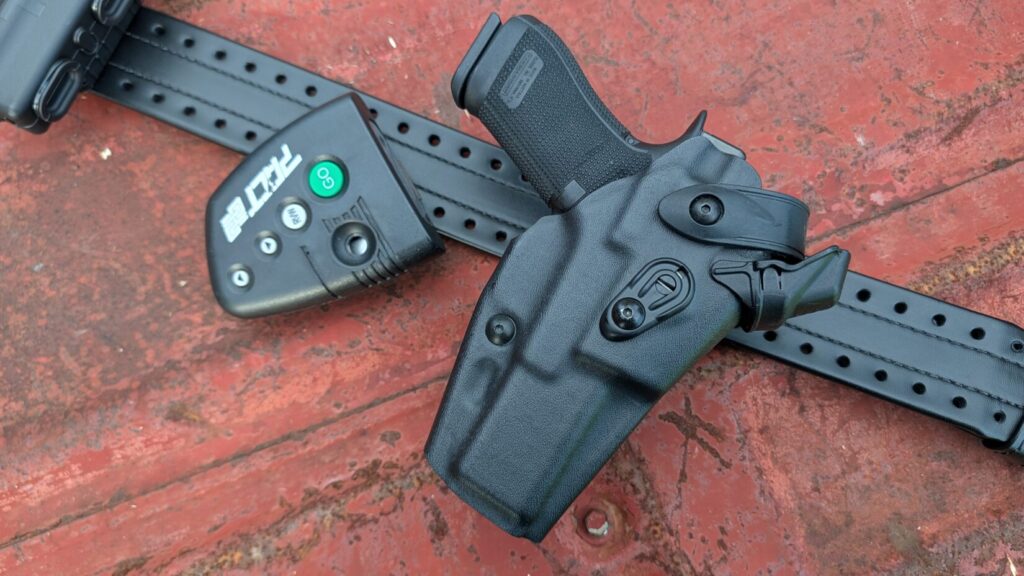
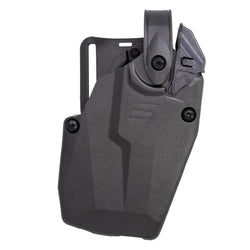
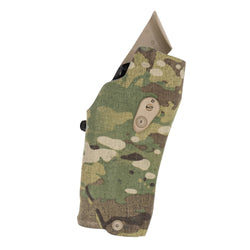
Every string of fire is timed, so bring a reliable shot timer. I ran my Glock 17 riding in a Safariland 6360RDS Level 3 holster mounted to my HOLLE belt at mid-ride height.
The three targets must be spaced three yards apart edge-to-edge, so you need adequate berm width downrange. Once the bay is set up, it is time to load up and get to work.
The Course of Fire
I did not realize until I arrived at the range that I had grabbed slightly reduced-size USPSA targets. I would love to use that as an excuse for my poor score, but target scale was hardly my only problem. Even so, I started out optimistic.
I had put plenty of reps into this gun and holster setup; surely I would sail right through the standards.
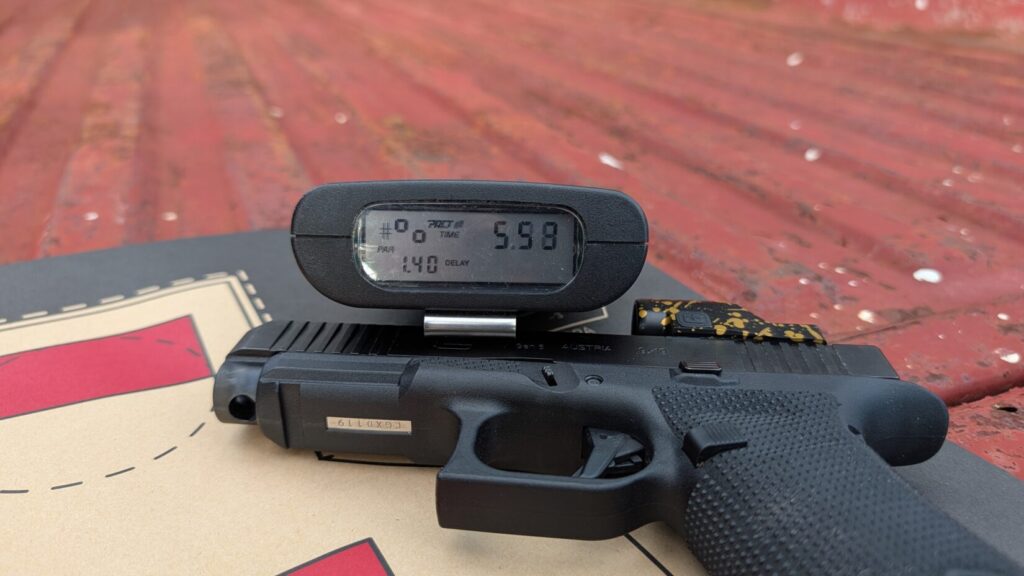
Not even close.
Every string starts from the holster, and every engagement requires a minimum of two rounds per target. The course begins back at the 25-yard line before working forward to 15 yards and finally finishing at the 7-yard line.
Scoring follows standard USPSA values:
A-Zone: 5 points
C-Zone: 3 points
D-Zone: 1 point
Misses: 10-point penalty each
Overtime Shots: 10-point penalty for each shot fired after the buzzer
There are 340 total points possible, with a passing threshold set at 90% (306 points).
Stage 1: 25 Yards (Two-Handed Freestyle)
- Starting Position: Holstered.
- Course of Fire: On the signal, draw and engage the targets in a specific order: Middle, Left, Middle, Right, and finish back on the Middle target (two rounds per engagement, 10 rounds total).
- Par Time: 7.5 seconds.
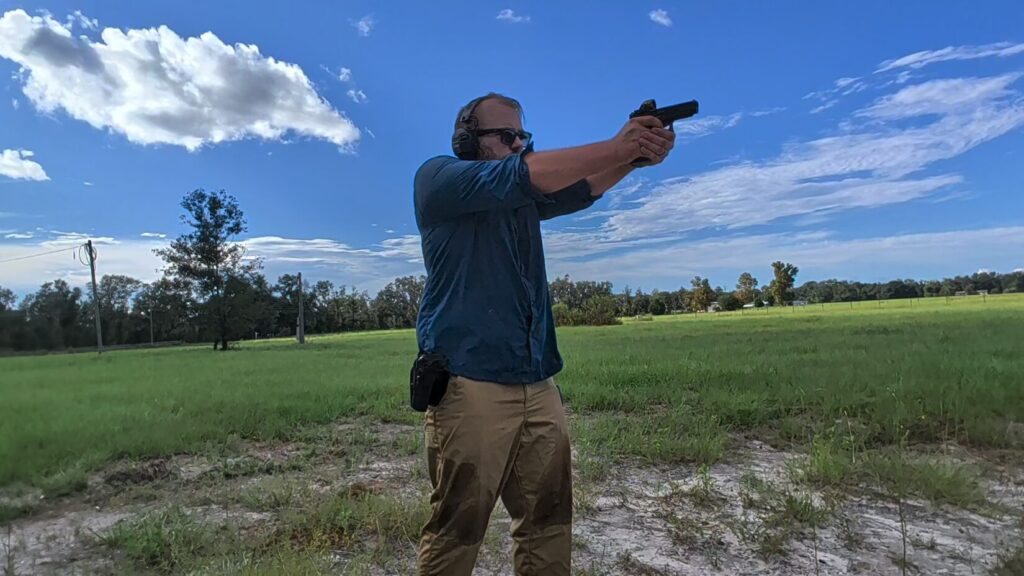
Stage 2: 25 Yards (Positional Movement)
Starting Position: Standing, holstered.
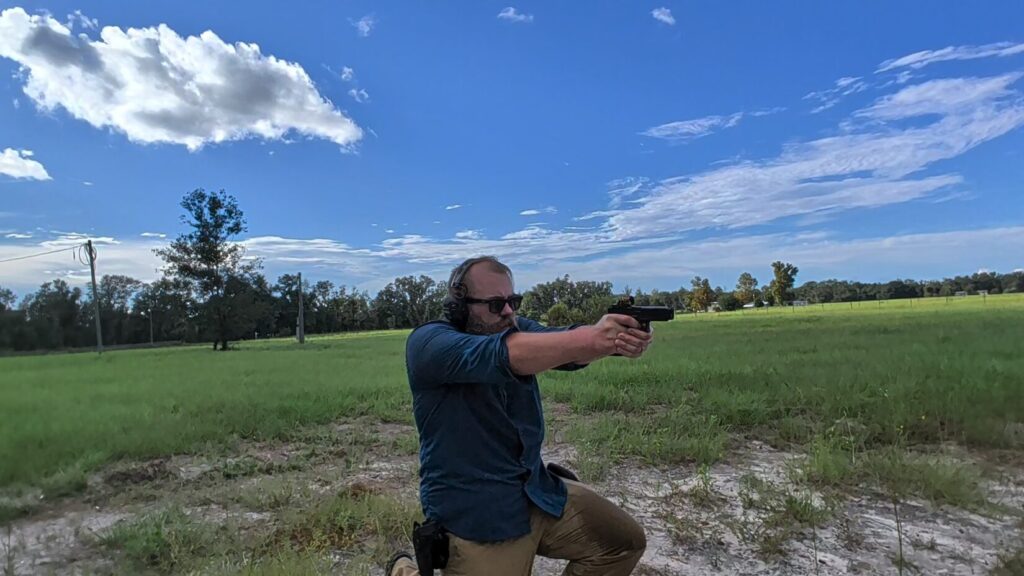
Course of Fire: On the signal, draw and engage the left target with two rounds freestyle. Drop to a knee and fire two rounds into the middle target, then return to a standing position and fire two rounds into the right target (6 rounds total).
Par Time: 7.5 seconds.
Stage 3: 25 to 15 Yards (Movement Forward)
Starting Position: Holstered at the 25-yard line.
Course of Fire: On the signal, draw and engage the left target with two rounds, then the right target with two rounds. Advance to the 15-yard line and engage the middle target with two rounds, the left target with two rounds, and finish on the right target with two rounds (10 rounds total).
Par Time: 10.0 seconds.
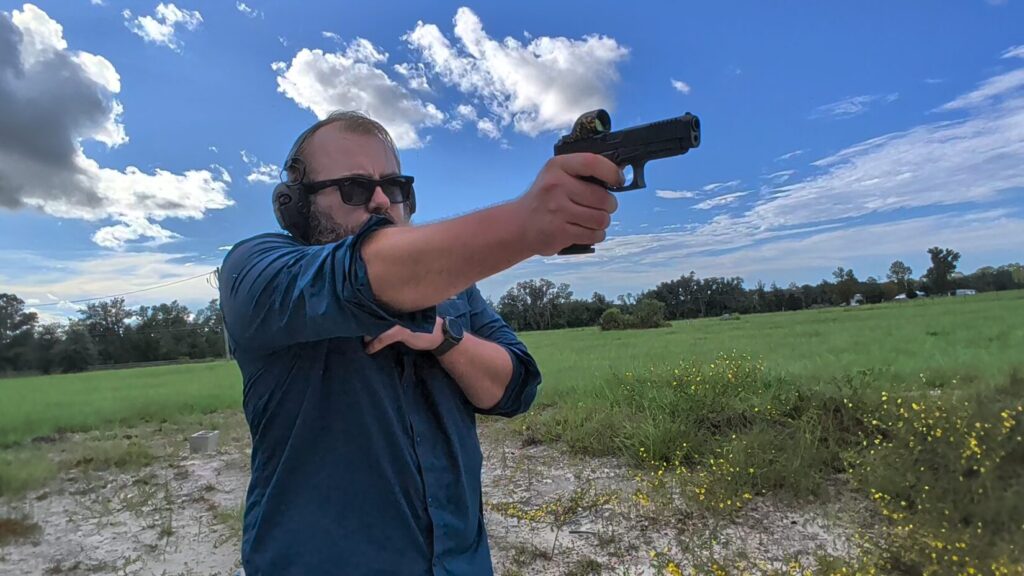
Stage 4: 15 Yards (Strong Hand Only)
Starting Position: Holstered at the 15-yard line.
Course of Fire: On the signal, draw and engage each target with two rounds using strong hand only (6 rounds total).
Par Time: 6.0 seconds.
Stage 5: 15 to 7 Yards (Movement Forward)
Starting Position: Holstered at the 15-yard line.
Course of Fire: On the signal, draw and engage the left target with two rounds and the right target with two rounds. Advance to the 7-yard line and engage the middle, left, and right targets with two rounds each (10 rounds total).
Par Time: 8.0 seconds.
Stage 6: 7 Yards (Support Hand Only)
Starting Position: Holstered at the 7-yard line.
Course of Fire: On the signal, draw, transfer the pistol to your support hand, and engage each target with two rounds using support hand only (6 rounds total).
Par Time: 6.0 seconds.
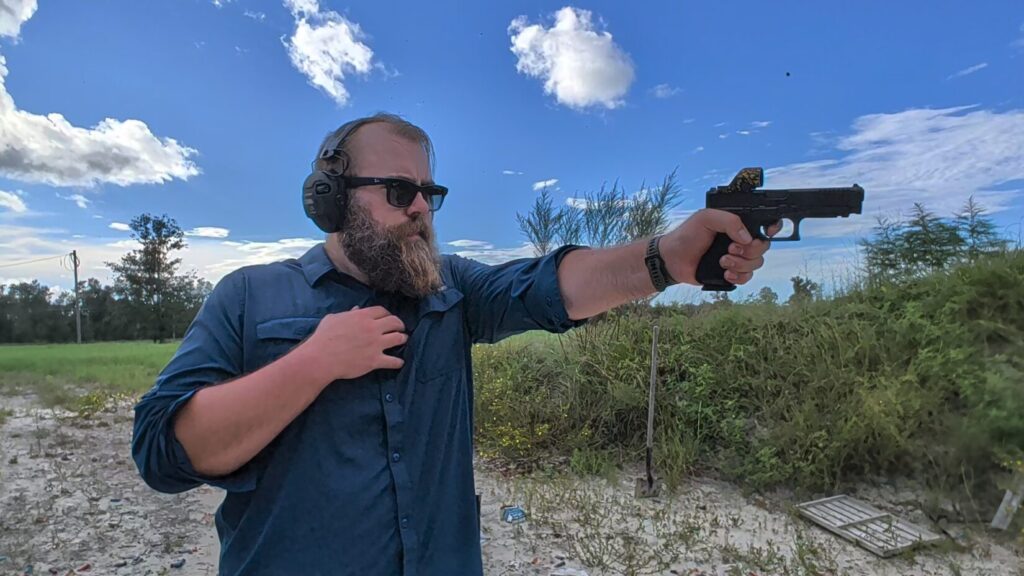
Stage 7: 7 Yards
Starting Position: Holstered at the 7-yard line. Load two magazines with exactly 10 rounds each.
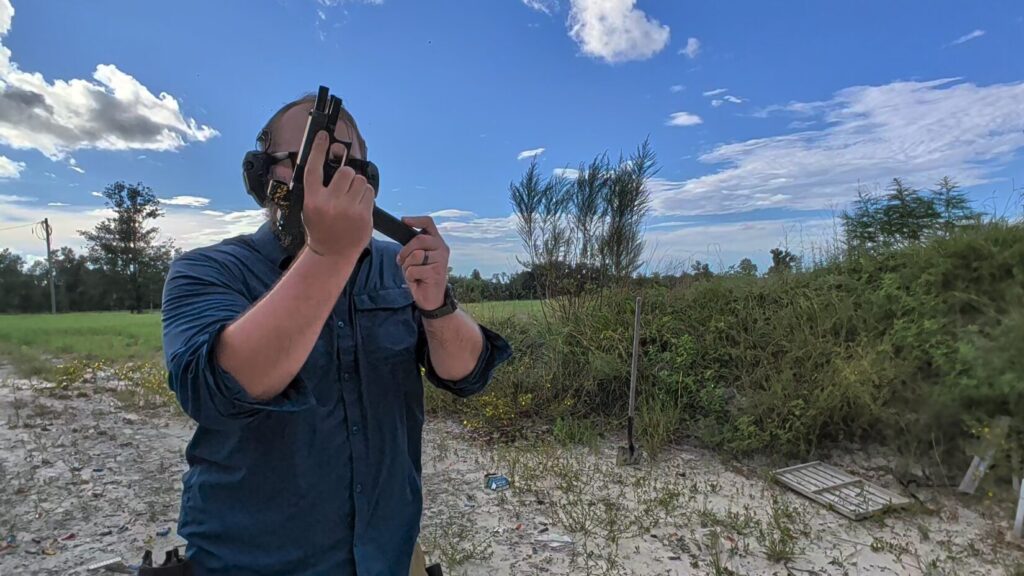
Course of Fire: On the signal, draw and engage the targets in order: Middle, Left, Middle, Right, Middle (two rounds each, running the gun to slide lock). Perform a slide-lock reload and repeat the sequence: Middle, Left, Middle, Right, and Middle (20 rounds total).
Par Time: 7.5 seconds.
Why This Drill Works
After wiping the sweat out of my eyes, the timer and target confirmed a hard fail. I ran it repeatedly throughout the afternoon.
I never hit the passing threshold, but my consistency improved with every run. That is the value of high-standard drills: they ruthlessly expose deficiencies and force growth.
The PSTG Standards demand uncompromising balance between speed and precision. One bad trigger press or a fumbled grip out of the holster blows the entire string of fire.
The fundamentals tested here are comprehensive. You are forced to execute crisp draws, track sights through aggressive recoil, call your hits, and control the gun under real-time pressure. Distance adds teeth to the clock; that A-zone looks remarkably small across 25 yards of open range.
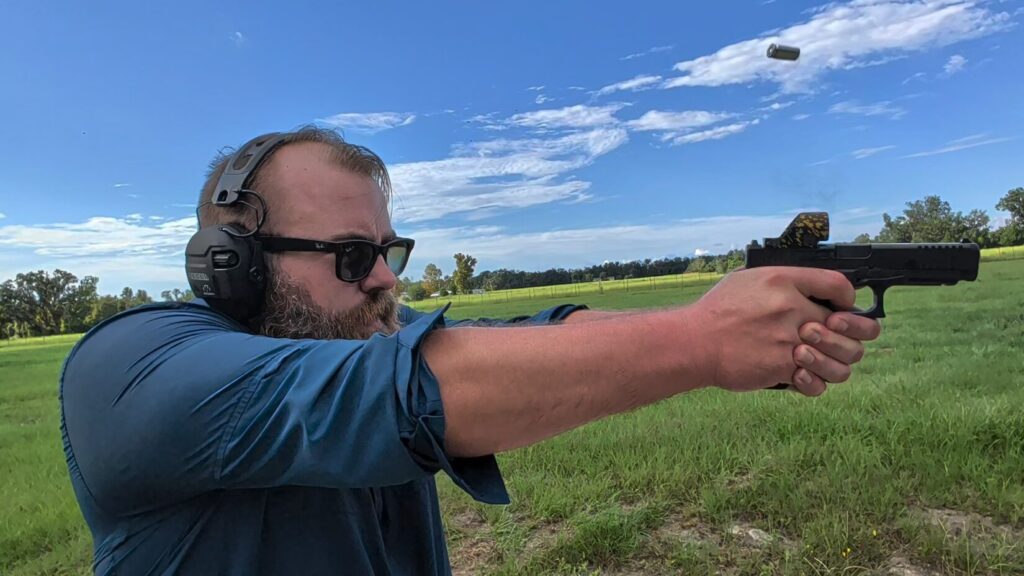
Beyond the raw mechanical skills, the cognitive workload is substantial. You cannot simply blast away; you must remember strict, non-linear engagement orders while moving and managing magazine capacity.
Some might argue that rigid engagement sequences do not mirror a real gunfight, but forcing the brain to process instructions and make decisions under stress is exactly what practical application demands.
Meeting the Standard
The PSTG Standards are unforgiving, demanding, and uncompromising. Passing requires a fast draw, clean recoil control, efficient footwork, and a sharp head under time pressure.
Until I put up a clean 90%, this course remains at the top of my dry-fire and live-fire training list. If you want a no-nonsense benchmark that tells you the hard truth about your shooting ability, set up three targets and let the timer run.
FAQ
What does PSTG stand for?
Practical Shooting Training Group, led by champion shooters Ben Stoeger, Joel Park, and Hwansik Kim.
How many rounds does the PSTG Standards course require?
68 rounds total across seven stages, with a maximum possible score of 340 points.