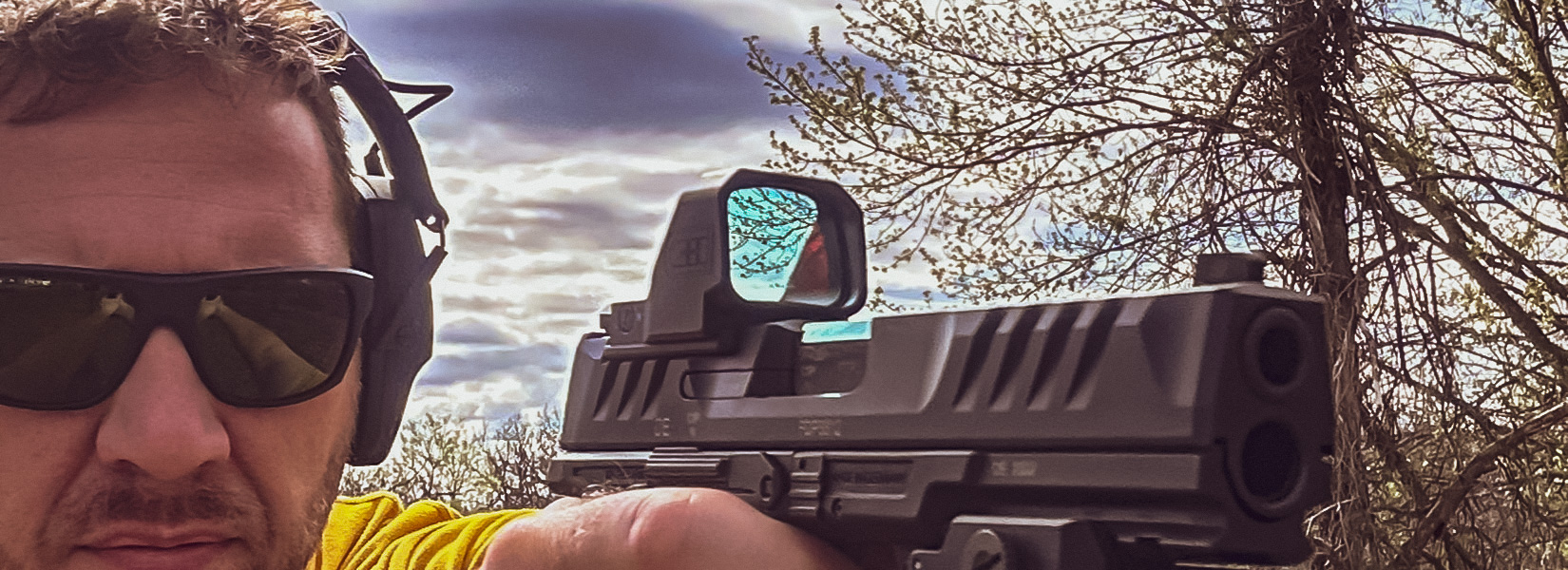
I’ve been using the C&H Comp Max red dot for a while in preparation for this review. It’s got some great things going for it, one of which is the extra-large 35mm window.
When you are in the process of selecting a new handgun optic, there are several things to consider, and the overall optic size is just as important as anything else. There are reasons to have a small, compact optic, and reasons to have a larger one like this.
Handgun-mounted red dots aren’t just for tactical shooters or gear nerds anymore. These days, you’ll see optics on everything from concealed carry guns to competition pistols. And there is a reason for this: a red dot can help speed up your target acquisition and improve your accuracy. But there’s one thing that still trips up some shooters: small window size.
A tiny window can make it harder to find the dot quickly, especially when transitioning between targets or shooting on the move. That’s why some gravitate towards those optics with larger windows, like the Comp Max Red Dot.
A close look at the C&H Comp Max Red Dot
Handgun-mounted optics appear to be headed in two different directions at the same time. Companies are making some smaller and more compact, and others, larger.
This shouldn’t surprise us, however, because the gun industry is doing the same thing. There are different purposes for different handguns, and we want optics that go with them.
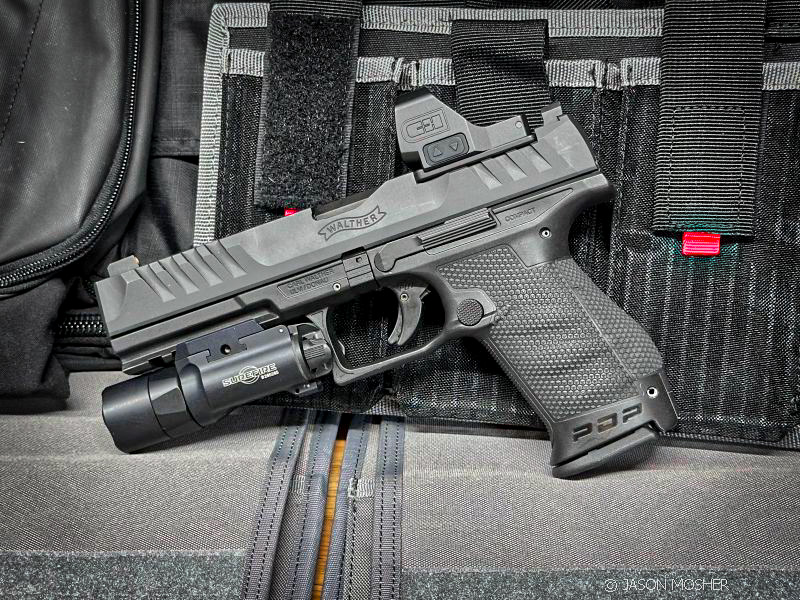
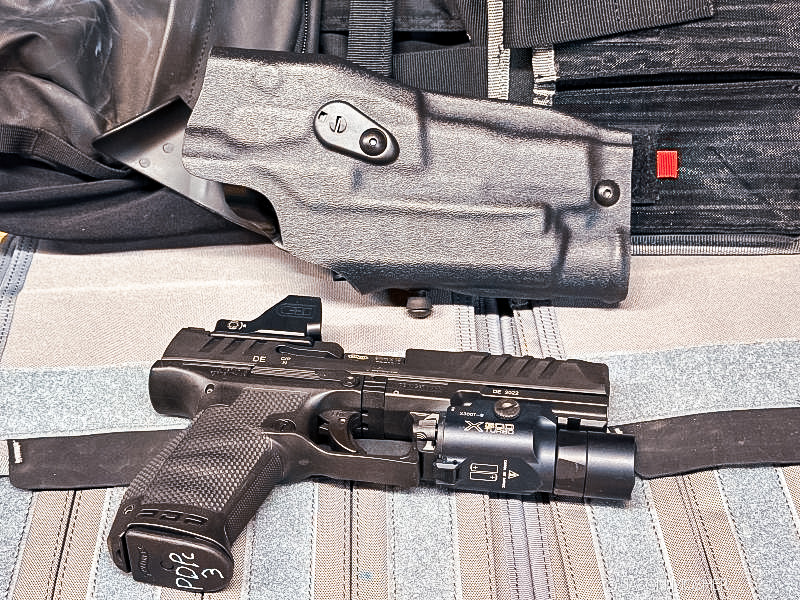
Let’s start by talking about this 35mm window. One thing I noticed right away after mounting it to my Walther PDP is that the optic doesn’t feel overly large on the gun. Part of this is because it’s an open emitter optic, and those tend to feel smaller than enclosed emitter optics.
I know enclosed emitter optics are the newest rage right now, and they have some great benefits. But they also tend to feel a little bulky and oversized sitting on top of a handgun.
The window on the Comp Max is 35mm wide by 25mm tall. Of course, the most beneficial aspect of a larger window size is the sight picture. We will talk more about why this is important later.
2 MOA dot and multi-reticle options
When it comes to the dot size, C&H uses a 2 MOA, which is smaller than a lot of other larger optics. A larger dot is great for fast target acquisition for self-defense or speed shooting at closer targets.
But if you need something that can hit the bullseye a little further out, you want a smaller dot. This is what makes this optic great for competitive shooters.
Another feature I really like about the Comp Max is the multi-reticle options. You can choose from three combinations of reticles, which include:
- 2 MOA dot only
- 32 MOA circle only
- Circle and dot combo
Having the ability to change the reticle is nice because you can change it depending on what type of shooting you are doing. The 2 MOA dot gives you precision, while the circle helps with fast acquisition.
Battery and run-time
Battery location and run-time are important to me when selecting a new optic. I didn’t mind removing my optic to change the battery when that was the “standard.” But now we have side and top-loading batteries, and I’ve become spoiled. It’s such a hassle to remove an optic for a battery replacement, isn’t it?
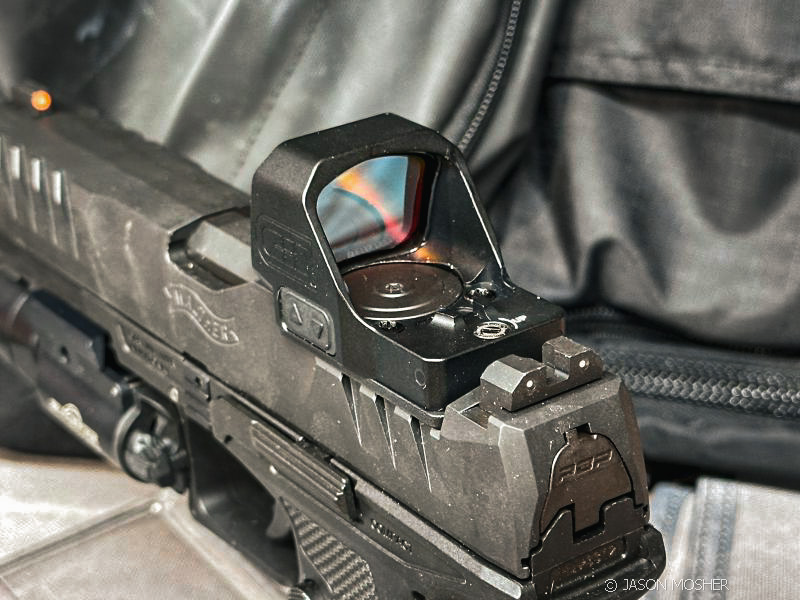
The Comp Max uses a top-loading design for the CR2032 battery that powers it. According to C&H, the Comp Max will run for up to 50,000 hours (depending on the brightness setting). That’s up there with the longest runtimes you will find on a handgun-mounted optic.
It does require a small tool to change the battery, so you can’t do it on the go, but with a run-time like that, it’s not a big deal.
Construction and durability
Unless you want an optic that costs the same as a fast-food burger, you want something that is durable and won’t fail when you need it to work.
C&H uses 7075 T6 aluminum for the housing of the optic. This is an industry standard that has proven to hold up well over the years with everything from optics to firearms.
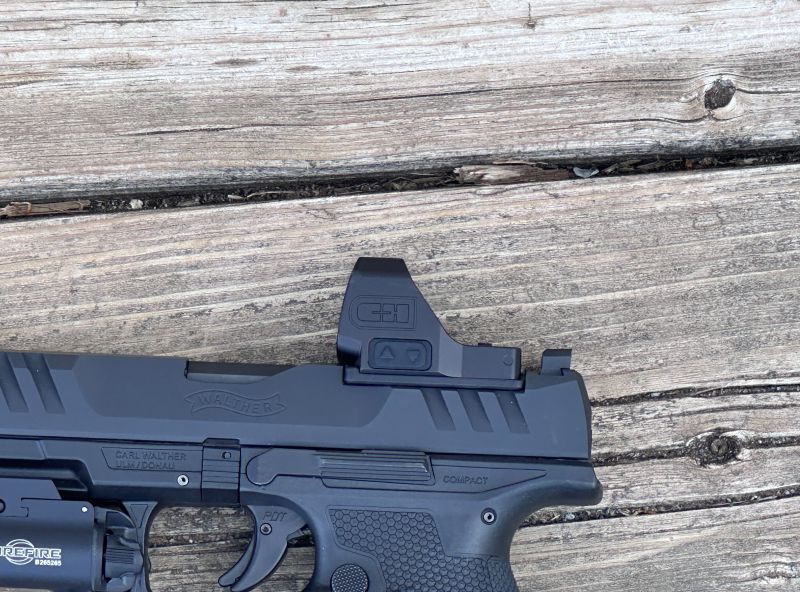
I like to put optics through my own little tests when I’m doing a review, so I did the same with this one. These tests include freezing the optic, baking it in the oven, submerging it in water, and dropping it from multiple heights.
The Comp Max wasn’t affected by any of these tests and continued to work as it should.
Other features
Like most other optics on the market today, the Comp Max has 10 brightness settings, two of which are night settings. The Comp Max also has a shake-awake feature.
I remember when auto off/on technology was the big thing in the optics world. Now, it’s more of a standard that most optics feature.
Turning it on and off manually is also straightforward. Push either button to turn the optic on. Press and hold the down arrow to turn it off, and press and hold the up arrow to cycle through the reticle modes.
Comp Max Specs:
- Window size: 35mm x 25mm
- Reticles: 2 MOA dot, 32 MOA circle, or combo
- Battery: CR2032
- Battery life: Up to 50,000 hours
- Body: 7075 T6 aluminum
- Brightness: Manual adjustment
- Mounting pattern: RMR footprint
- Technology: Shake awake, motion-sensing shutoff
On the Range with the Comp Max
You would think all optics would be about the same when you are using them on a handgun. But just like handguns, optics are different for everyone. Some people prefer one optic over the other, regardless of quality or price. I’ve used some great quality optics before that I just didn’t care for.
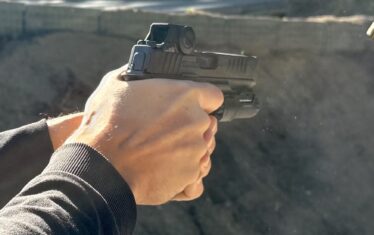
It only took a few shots at the range for me to decide I liked the Comp Max red dot. The reticle is super clear, and the size of the window made shooting it feel more like a video game.
When you sight-in the red dot, make sure to bring the small flathead that comes with it. The screws are so small that a normal flathead screwdriver will not work.
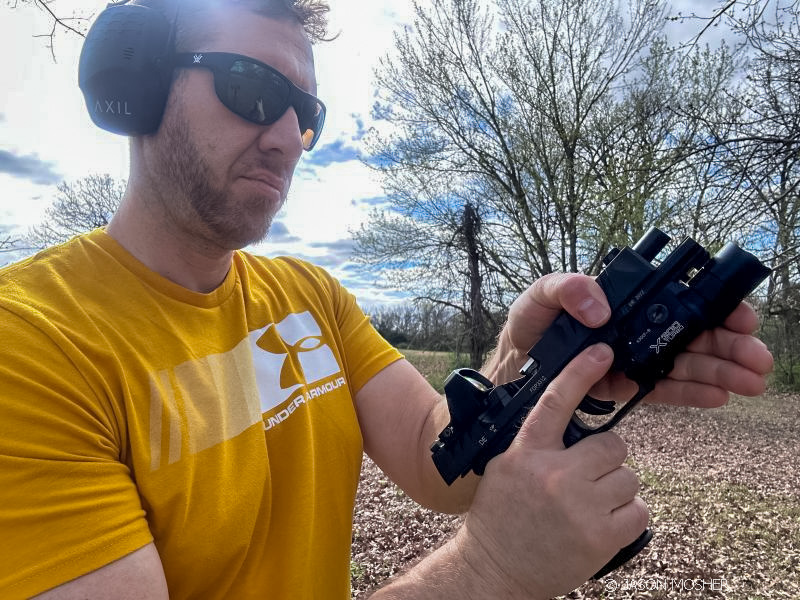
When using the elevation and windage settings, the Comp Max is one click equals 1 MOA. It didn’t take me long to sight in the optic at 25 yards. While this is the normal range to sight in a handgun optic, I often sight-in my conceal carry guns at a closer distance.
But the PDP with a 5-inch barrel is more of a duty-size handgun, so I want it to zero further out.
The fun part… shooting ammo
After loading up my mags with Federal 115 grain 9mm FMJ provided by AmmoToGo.com, I started the fun part, shooting.
I recently reviewed the C&H EDC-EN, which is a smaller compact optic. It has the same reticle (circle with a dot), and I’ve decided this is my favorite reticle for speed shooting.
It was easy to find my dot floating out there as I found each target. Once I started shooting out to 75+ yards, however, I had to change it to the single dot. At 75 yards, the circle reticle covered up my whole target. The single 2 MOA dot was perfect for longer distances.
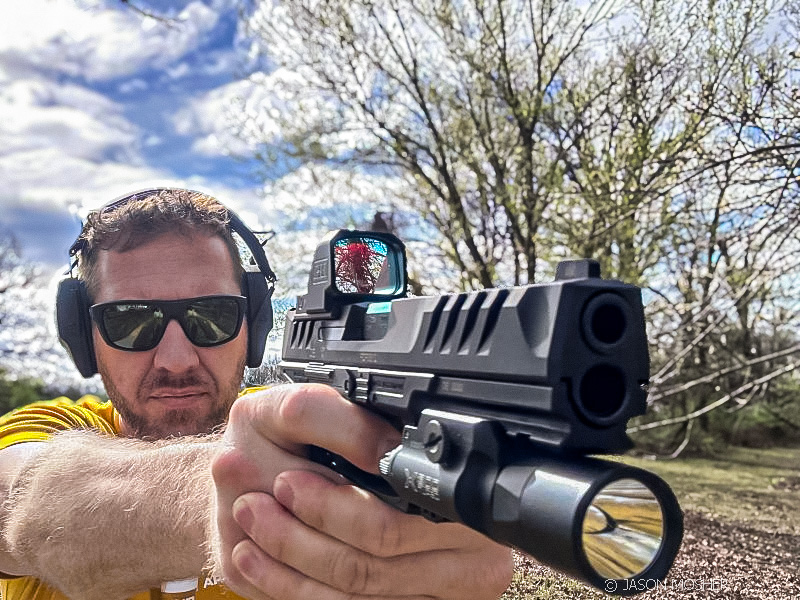
After shooting about 400 rounds and doing multiple holster drills, I used a hand rest to check the zero on the optic again. It was in the same place and hadn’t moved, which is a good sign.
After my first range day with the Comp Max, I used the PDP on duty and out at the range over a two-month period. Each time I went back to the range to do some shooting, it was zeroed in.
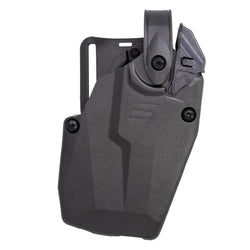
For this size of gun, I like to use duty holsters, and the Safariland 6354RDSO is my favorite. They just released this holster for the PDP 5-inch not long ago, and it will work with enclosed emitter optics like the ACRO as well.
They also make one with an optic hood for smaller optics, but I kind of like being able to use one holster for any size of optic.
Why a Large Window Optic?
Let’s be honest. If you’re in a competition and can’t find your dot quickly, you’re toast. A large window like the one on the Comp Max makes a huge difference.
The same rule applies to defensive situations, too. I will concede that most defensive shootings take place at less than 7 yards and therefore shouldn’t be compared to competition shooting. But in a life-or-death situation, a combination of speed and accuracy is needed. The closer the threat, the more speed you should be using.
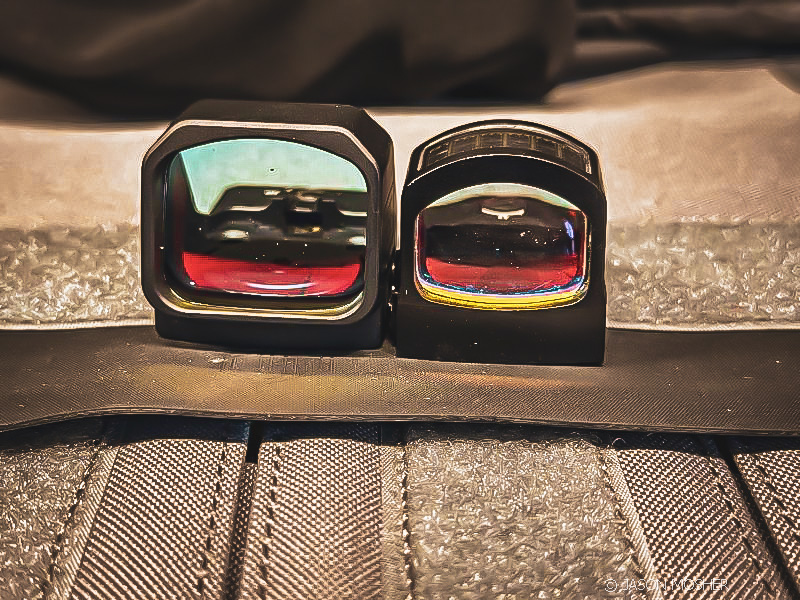
When you are moving fast, larger windows with larger reticles make it easier.
Larger windows give you more visual room to work with. If your presentation is slightly off, you’re still likely to see the reticle. That means faster dot acquisition, better follow-up shots, and less frustration during transitions.
Go big or go home?
I think the size of an optic should be viewed the same as the handgun. Carry as big as you can while doing so practically. If it’s cooler out and I can wear a jacket or coat, I carry a larger gun OWB. With a larger gun, I can get away with a larger optic. Of course, I wouldn’t try mounting this optic on a micro-sized pistol because it would defeat the purpose.
This is a perfect option for any full-size handgun. As I mentioned above, the optic doesn’t feel all that much larger than other models. It uses the RMR footprint, which is a common footprint on full-size guns.
So, if you’re searching for a new optic, I wouldn’t hesitate to give this one a try. It’s easy to use, has a nice, clear reticle, and is top-notch quality.