
Springfield Armory has upped its concealed carry game with the integrally-compensated Hellcat Pro Comp. Double stack 9mm subcompact pistols have been all the rage in concealed carry circles since 2018, and the Hellcat ranks among that genre’s best sellers.
Smaller frames, of course, often come with a trade-off of snappier recoil. But a compensator can mitigate that effect somewhat. I run an aftermarket comp on my regular subcompact carry gun, so I was interested to see how this Hellcat performed, especially since it keeps its 3.7-inch barrel length intact.
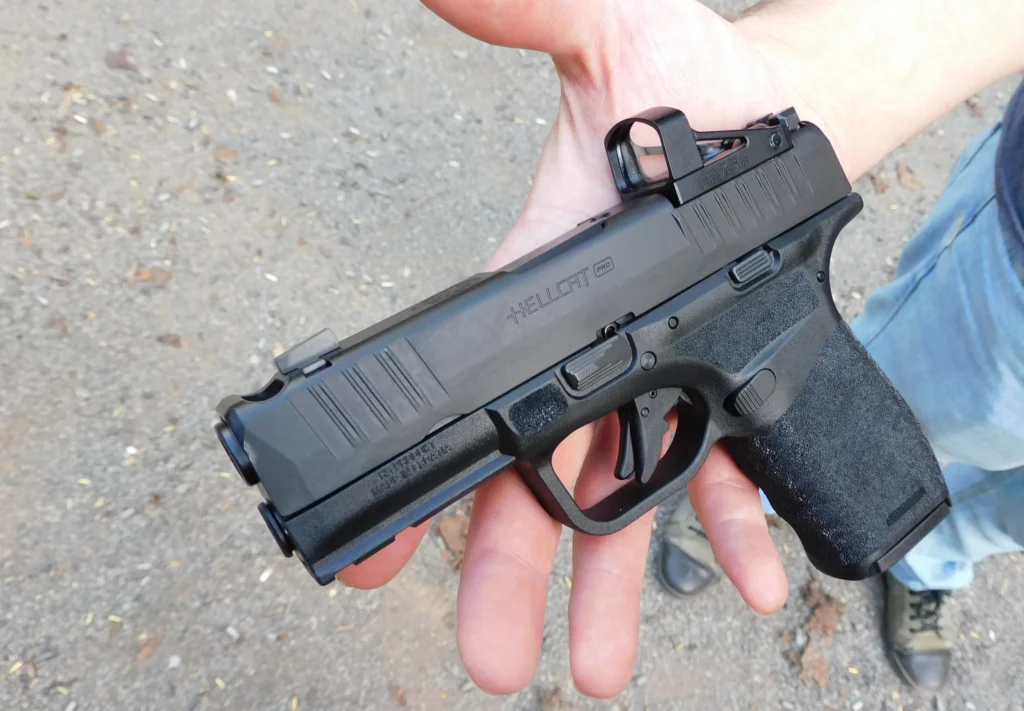
I have a couple hundred rounds through this Hellcat, along with some side-by-side stuff with my comped Sig P365XL. Here’s what I found. Springfield Armory provided this gun for testing. I do not get to keep it.
Hellcat Pro Comp Specifications
- Caliber: 9mm Luger
- Capacity: 13 or 15 rounds
- Barrel Length: 3.7 inches
- Overall Length: 6.6 inches
- Height: 4.8 inches with flush mag; 5.3 inches with extended mag
- Grip Width: 1 inch
- Weight: 21 ounces (Unloaded)
- Striker Fired
- Optic Ready: Springfield OSP System
- Polymer Frame
- Hammer Forged Barrel
Hellcat Pro Comp Features
The Hellcat Pro Comp’s slide is very smooth, and cocking is easy. The front and rear serrations could be a bit deeper for bad conditions, but they work fine in dry weather.
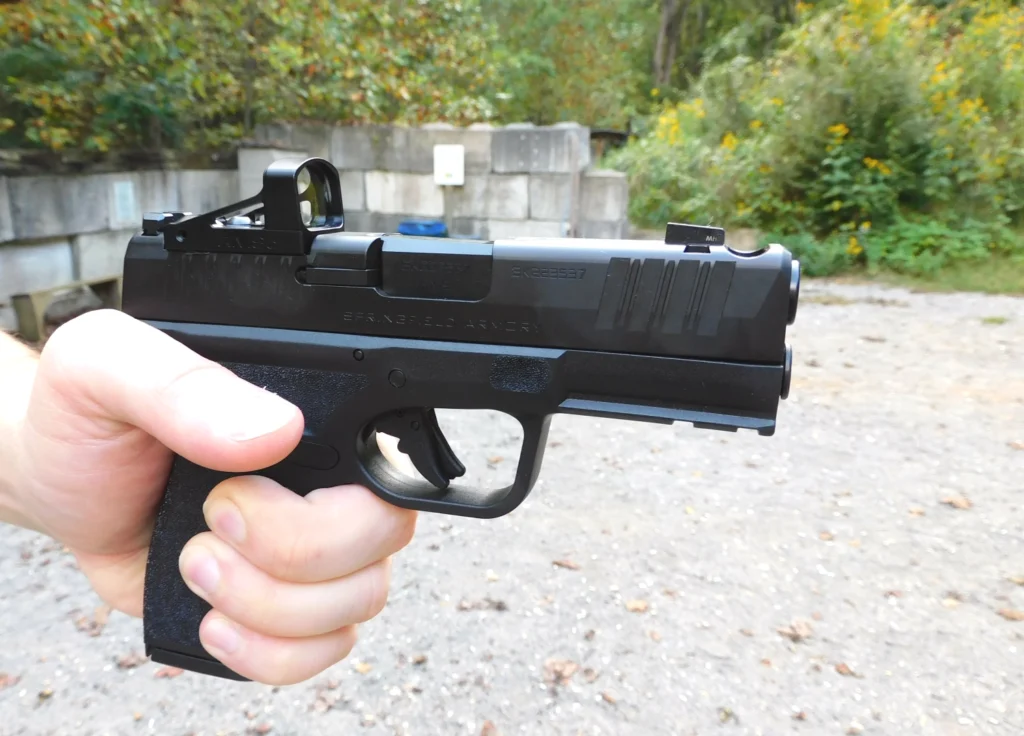
The slide is cut according to Springfield’s Optical Sight Pistol (OSP) parameters, making it compatible with multiple optic footprints. I really like that feature, especially since it doesn’t require separate plates. It would be nice if optic companies would settle on a common footprint or two, but that probably won’t happen. It’s nice that Springfield tries to mitigate that problem. The top observation port makes it easy to check the chamber.
The trigger is quite good, with a short take-up and a firm wall that breaks at an average of 5 lbs. 1 oz. according to my Lyman trigger gauge. I wouldn’t call the break “crisp.” More like you feel that wall and pull through it. I like it, though it bit me a few times before I adjusted my finger up just a touch.
The magazine release works well, positively ejecting each spent mag. It isn’t reversible, though, which may be a consideration for left-handed shooters. The slide release is a little stiff, but it works fine. It will probably loosen up with time and use. Disassembly is easy with a rotating takedown lever.
The polymer grip has very slight finger grooves that I barely notice. The stippling is positive without being overaggressive, which I appreciate. I mentioned that I like how Springfield’s OSP system makes it easier to find compatible optics, but I don’t like the modified Picatinny accessory rail. It works with some lights but not with others.
The Compensator
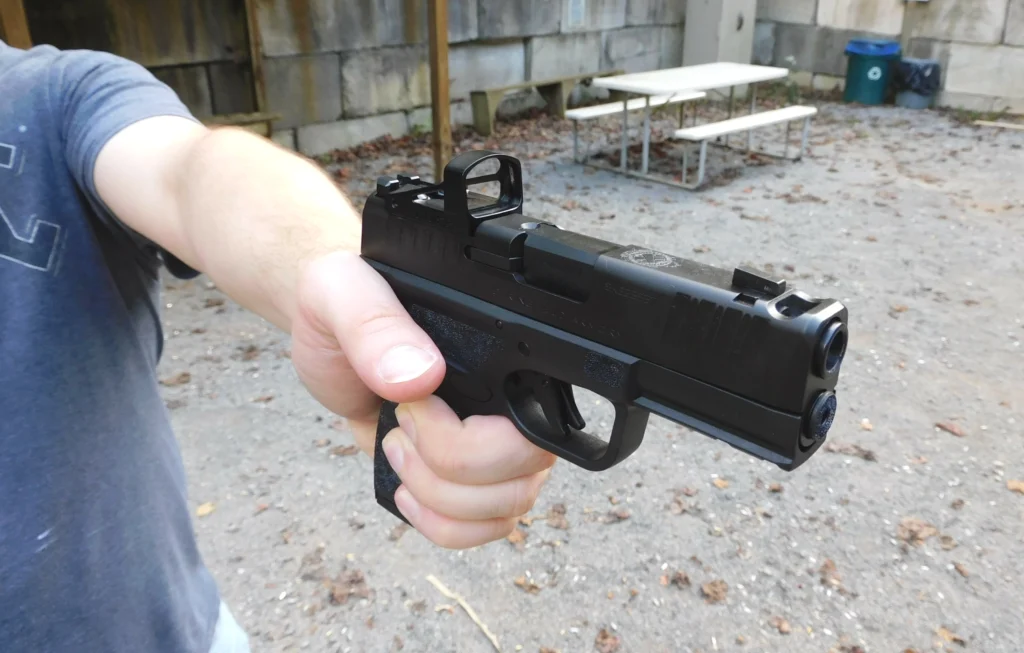
The Hellcat Pro Comp is integrally-compensated, meaning the single gas port is machined directly into the top of the barrel and the slide. The front sight sits just aft of the slide’s port to ensure a clear sight picture. It reduces the sight axis just a bit, but it doesn’t seem to matter, especially considering many subcompact pistols are already that short or shorter.
I like the idea of an integral comp on a carry pistol. It provides compensator performance without extra length. I like what Springfield has done here.
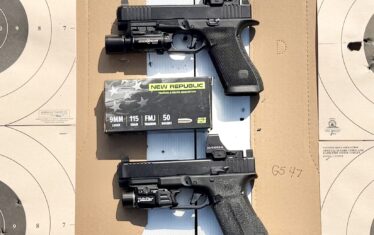
I fired the Hellcat Pro Comp alongside a similarly sized uncompensated pistol, using the same ammunition. The Hellcat was noticeably less snappy. The muzzle rise is less pronounced, as you’d expect, and I was just a touch faster getting back on target.
The recoil mitigation wasn’t quite what I get with my Sig P365XL, which also has a 3.7-inch barrel, but the Sig’s aftermarket comp also adds weight that the Hellcat lacks. Those extra couple of ounces so far forward help with muzzle rise on top of the comp itself. I give the Hellcat Pro Comp high marks here, considering the trade-off.
Range Performance
I’ve already covered the compensator, so I’ll just hit general performance here. Once I adjusted to the trigger, I liked the Hellcat. The grip is comfortable, the controls are responsive, and the trigger is nice. My issues in that regard were mine, not the gun’s.
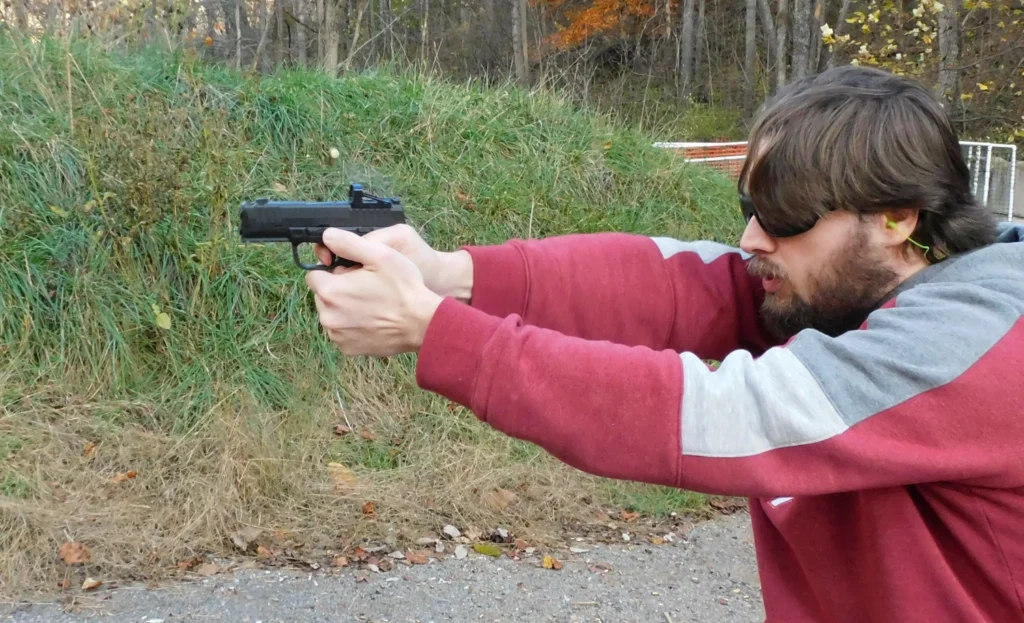
The direct-mounted Shield RMSc optic allowed me to use the U-notched tritium iron sights, which I found very effective. My two co-testers and I fired 300 rounds of 115-grain Blazer Brass FMJ during our trials, with one failure to feed. The stoppage was easily cleared, and we had no further problems. The ammunition was kindly provided by our friends at Ammo-to-Go, and I thank them for their continued support.
We found the gun to be accurate, and we all liked the reduced muzzle flip from the compensator. The nice grip also contributed to the gun’s accuracy. Not all grips are created equal, and I like how the Hellcat fills my hand, facilitating proper fundamentals.
Final Thoughts
I’ve heard good things about the Hellcat, and now I see why. This is a nice little gun, though, apart from the compensator, it isn’t fancy. It’s built to do a job, and it seems to do it well. My only real complaint is the accessory rail. I was able to fit a Streamlight TLR-7 on the gun, but only after swapping out the adapter. It just seems unnecessary.
The Hellcat Pro Comp’s price tag is a little higher than the standard Hellcat, but the extra machining no doubt costs a little more. I don’t think it’s overpriced in the current market. And you get increased performance, which is worth something.
I think this gun is an attractive option for shooters who may be a little recoil-sensitive but still want a smaller, more concealable carry gun. But even experienced shooters who can handle normal recoil will probably like what the Hellcat Pro Comp offers without having to add an aftermarket part. If that sounds good, give this gun a hard look. It might be just what you’re looking for.