
The Springfield Hellcat was among the first micro compact pistols on the market, and it has since spawned a whole family of handguns. All of these thus far are chambered in 9mm Luger, which is not exactly blissful to shoot in the lightest micro 9s on the market.
In fall 2025, Springfield Armory announced the launch of the Springfield Hellcat .380, mating the features of the original model with the lighter-kicking .380 ACP cartridge. As something of a .380 aficionado and a stranger to the micro compact concept, I had to wrangle the Hellcat .380 to see if going down in caliber elevates overall performance.
Hellcat OSP .380: Quirks and Features
Functionally, the Springfield Hellcat OSP .380 is the same as the base model Hellcat subcompact pistol, but instead of being chambered in 9mm, it is chambered in .380.
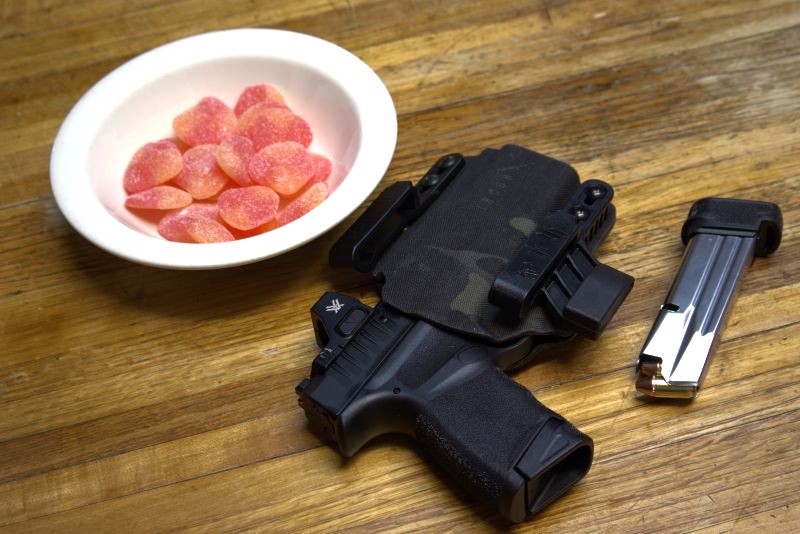
Weighing in at only 1 lb. 4.7 ounces fully loaded and a thickness of only 1.05 inches, the Springfield Hellcat is comfortably in the micro compact category and little larger than the previous generation of single-stack polymer framed carry pistols.
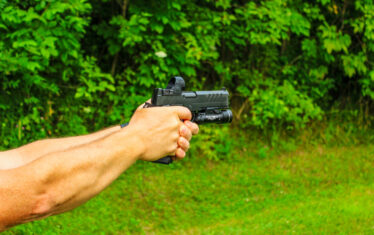
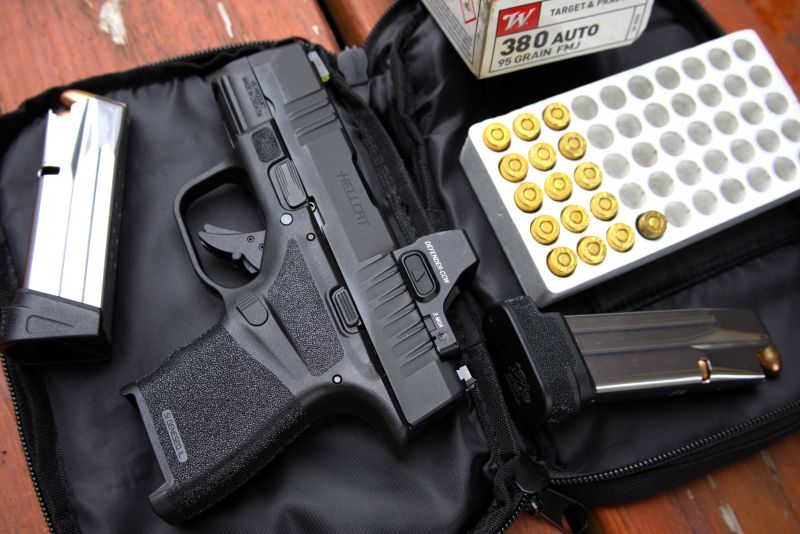
The Hellcat OSP .380 is a striker-fired pistol with a 3-inch barrel housed in a machined steel slide with a black melonite finish. The slide features spacy forward and rearward cocking serrations and is cut for a Shield RMSc optic. The available iron sights are a tritium front sight and a steel U-notch rear that is dovetailed for lateral movement.
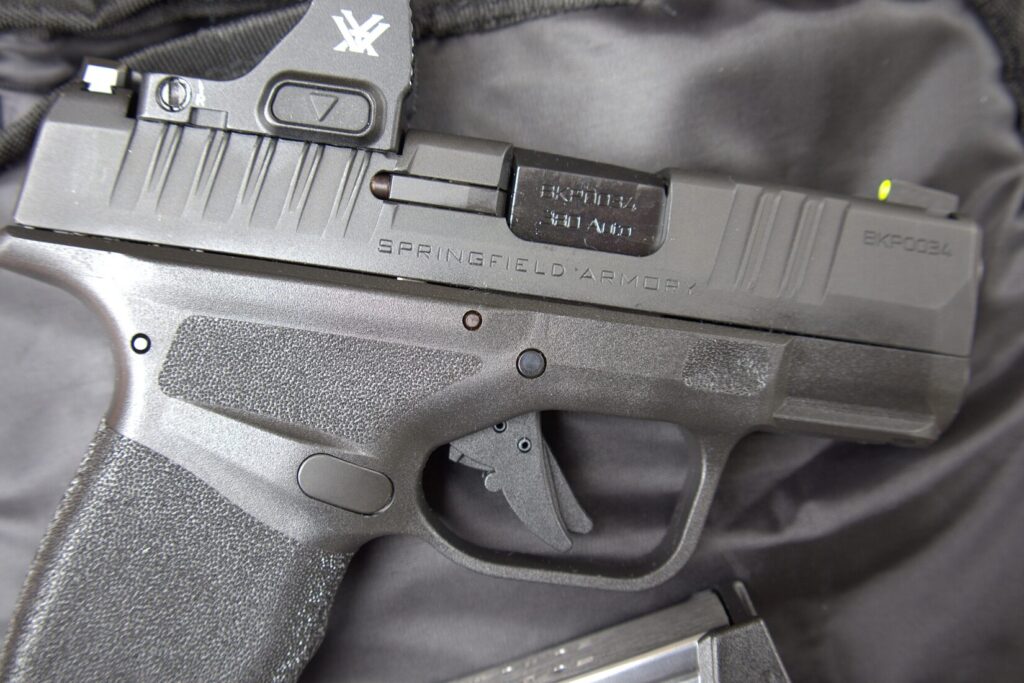
The polymer frame is grippy, yet nonaggressive, with ample real estate for the hand and a flat backstrap for better recoil mitigation. Forward of the trigger guard are index points on either side of the frame for placing the index fingers or thumbs while taking a two-handed firing grip.
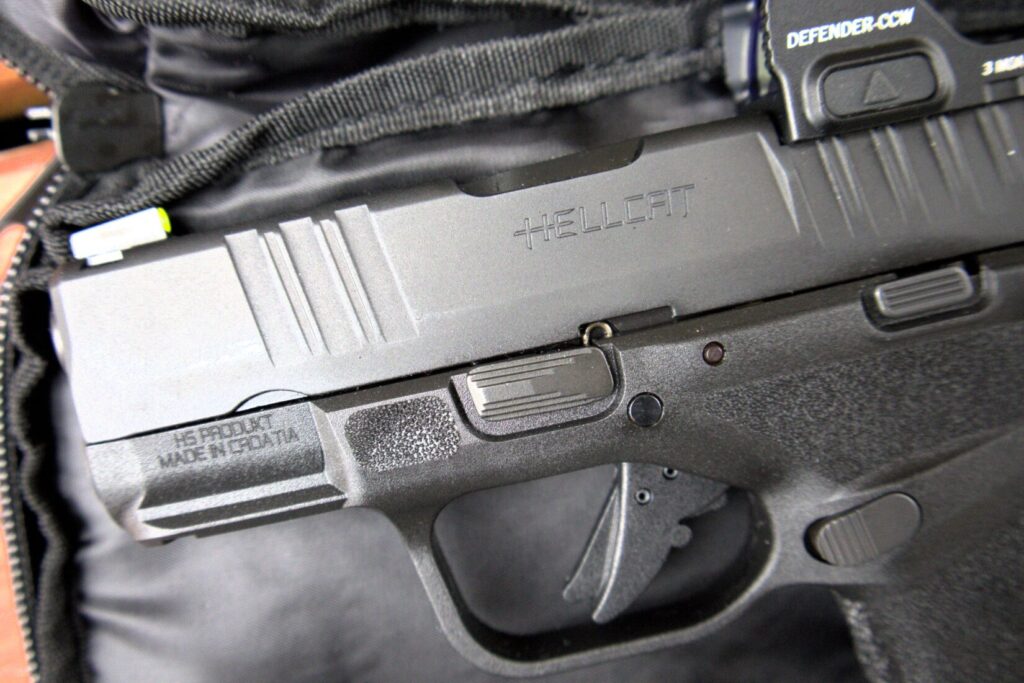
The Springfield Hellcat OSP has a short light rail, a right-handed slide release, and a reversible magazine release button. The Hellcat uses Springfield’s typical disassembly lever north of the bladed trigger, which requires an upward push to begin the process of removing the assembled slide from the frame.
The Hellcat ships with a soft case and two steel-bodied magazines. One is flush-fitting and holds 11 rounds, while the other protrudes and gives up to 13 rounds of capacity. MSRP starts at $653.
Specs
- Caliber: 380 ACP
- Capacity: 11+1 or 13+1
- Barrel Length: 3 inches
- Overall Length: 6 inches
- Height: 4 inches
- Width: 1.05 inches
- Weight: 1 lb. 4.7 oz. (loaded)
Why .380?
The Springfield Hellcat OSP is a mainstay in the micro compact world, and it is just the latest 9mm micro gun that now comes chambered in the .380 ACP cartridge. To that end, some may ask why.
As a long-time carrier and tester of .380 pistols and ammunition, I might be in a peculiar position to speak on the benefits and drawbacks. There are several in each category, but the chief perceived benefit is recoil, while the chief perceived demerit is low power.
The .380 is known for having less recoil than the 9mm. On paper, it does, but the reality is more complicated. The .380 ACP is a shorter cartridge than 9mm Luger and fires a somewhat lighter bullet at a somewhat slower velocity. Think of a 95-grain bullet at 950 feet per second as a ballpark figure compared to a bottom-floor 9mm, which runs a 115-grain bullet at about 1100 feet per second.
Unfortunately, the lower-powered .380 is most associated with small single-stack pocket pistols. When you step down to an even smaller and lighter handgun, recoil goes up, even in .380—to the point it can be counterproductive.
Although Springfield could have produced another pocket .380, they instead took their existing and slightly larger 9mm model and simply chambered it in .380. There is just enough weight and grip to hang onto and absorb recoil, making the low-recoil .380 a reality.
But there is no free lunch. The lower power of the .380 that gives you less recoil also means you get a less powerful round and will have to navigate it accordingly. It is said that the .380 ACP cartridge, thanks to modern ammunition, is adequate for personal protection. In truth, the latest defensive ammo is a mixed bag.
Some ammunition, like the Hornady Critical Defense 90-grain FTX, gives excellent penetration and expansion in short-barreled handguns. But the same ammunition overexpands and gives shallow penetration in larger pistols. Other hollow-point rounds fail to expand at all, while others overexpand no matter what. Some, including myself, use full metal jacket ammunition to ensure good penetration in any event.
There are good .380 loads out there, just like there are good .380 pistols, and it takes some trying for the two to meet. But is the Springfield Hellcat a good pistol? The short and long answer is yes.
On the Firing Line with The Springfield Hellcat 380
The lion’s share of my time with the .380 ACP has been with a little pocket pistol, the Ruger LCP. So, after loading my magazines and preparing to get behind the sights of the Springfield for an accuracy test, I half expected a sore hand after getting through a box of ammunition.
Of course, the Springfield is more feature-rich. There is more to hold onto, and I had a Vortex Defender CCW 3 MOA optic mounted to it, but I still expected some pain to get some gain with this smallish polymer-framed handgun.
First Shooting Impressions
The pistol’s slide, in tandem with the optic, is easy to manipulate and rack in that first round. I lined up the green dot on a paper target at 10 yards and let fly. The pistol budged slightly, belched an empty case, and I immediately caught my dot on the target. I turned the pistol over in my hand to make sure I didn’t get an underpowered round. But indeed, the bullet did hit the target where I was aiming. The gun did fire, but there was very little recoil indeed.
I put my last nine rounds of Winchester 95-grain FMJ and clustered an easy 3-inch group. I then set about filling my magazines and testing different types of ammunition to see if I could do better.
The magazines themselves have a polymer foot and base but a stainless steel body. On first loading them, the magazines were stiff enough to prevent the last round from going in. But after a night sitting on a shelf before their first use on the range, they loaded buttery smooth at that point without issue.
Accuracy
My 300-round battery of tests with the Springfield Hellcat OSP .380 included accuracy testing, drill shooting, and magazine dumps from awkward positions to get to the required round count. I also tried several different types of ammunition. These included:
- Winchester 95 grain FMJ FN
- Hornady Critical Defense 90 grain FTX
- Remington HTP 88 grain JHP
- Federal HST 99 grain JHP
- Underwood Extreme Defender 90 grain JHP+P
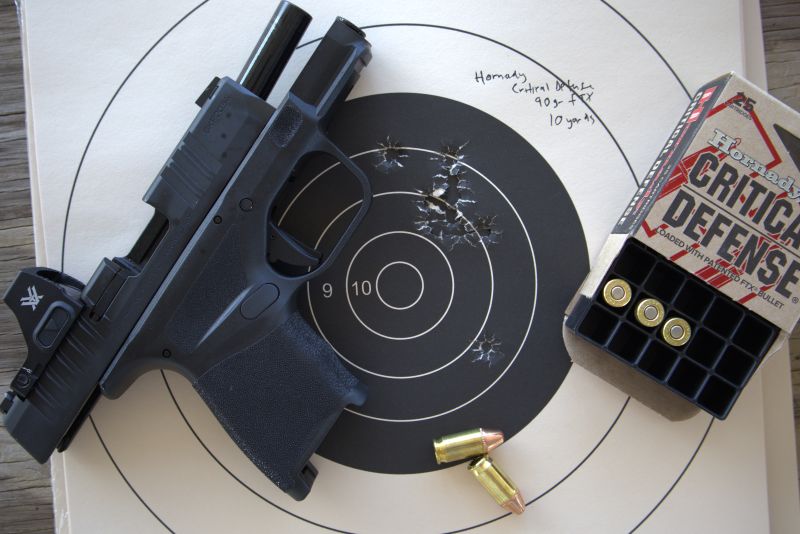
At a distance of 10 yards, the Hornady Critical Defense 90-grain ballistic tip round took the cake with consistent two-inch 10-shot clusters. The Remington load performed the poorest with a three-inch group, while the other rounds fell in between.
Recoil was indistinguishable between most rounds except for the Underwood +P load. With a speed close to its 1,200 feet per second advertised velocity, the Underwood load is snappy and more akin to a 9mm in recoil. It was not painful, but not easy to shoot quickly with.
Ergonomics
Magazine dumps and drills may not seem like they illustrate much on the surface, but how the controls of the pistol operate tends to magnify with the round count. Occasionally, I am lucky enough to break something. The Hellcat OSP .380 did defeat me in the end, as it ran through all 300 rounds without the slightest inkling of a malfunction of any kind. But the controls of the pistol did speak for themselves.
The slide is easy to manipulate thanks to the cocking serrations, squared sides, and the prominent sights and optic. But from the feel of things, Springfield resisted the temptation to reduce the recoil spring weight to make it easier to cock. Their 9mm is similar to manipulate, and the payoff is actual lack of recoil, as the spring absorbs some of it.
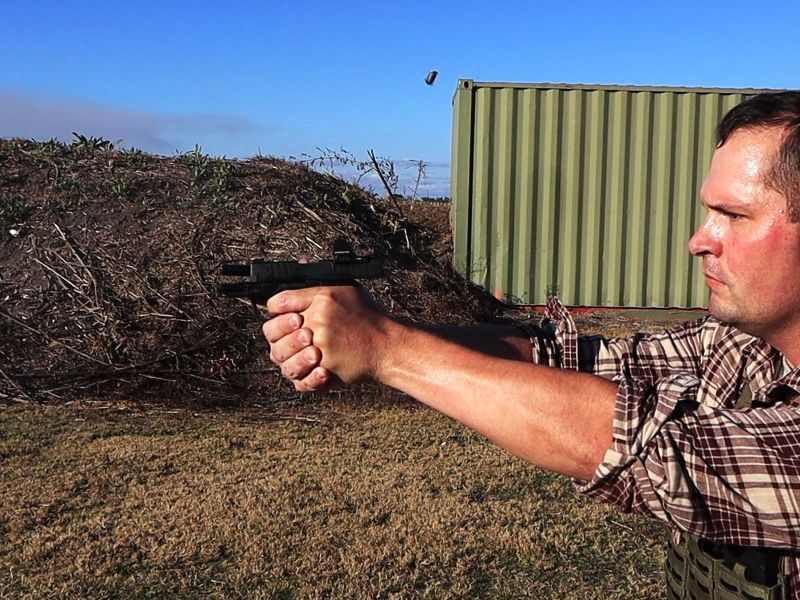
I initially did not know what to make of the grip except that the texture was grippy without being harsh, and the flat backstrap would make for an easier hit to the palm under recoil. But the frame is somewhat small for larger hands like mine, and it’s tempting to leave fingers drifting in space. That is where I finally got the use of those index points, which enhanced a strong grip.
The magazine release and slide release are large enough to hit reliably without being too large to hit accidentally while shooting or drawing. They operate without play, grit, or stiffness. Some lefties will disagree with the lack of a slide release on the right side as well as the left, but coming over the top to rack the slide worked for me.
The only room for improvement I could nail down was the travel of the trigger. The trigger has a bladed trigger shoe safety and has a good, crisp break. On my Lyman trigger scale, it comes in at 4.5 lbs. The travel is spongy, as expected. I was more taken aback by how much travel there was. From break to reset, I measured the travel at .390 inch.
At times, pulling through that travel with a little too much finger on the trigger sent rounds astray, particularly as the distances got longer than 10 yards. But after mentally nailing down the trigger’s reset and using those handy index points, I was able to nullify that tendency most of the time and shoot for some real speed.
A Worthy Buy?
The .380 ACP has its issues, ranging from power to the price of ammunition. But the promise of the round is best reflected in the Springfield Hellcat OSP. It is an accurate, reliable, and shootable performer that is effortless to carry all day, and all without the sting of the 9mm round. Even if you are among those who can shoot a 9mm Hellcat or similar micro compact pistol, I would be willing to bet that you can shoot the .380 version even better.