
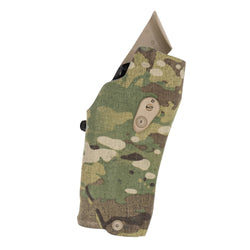
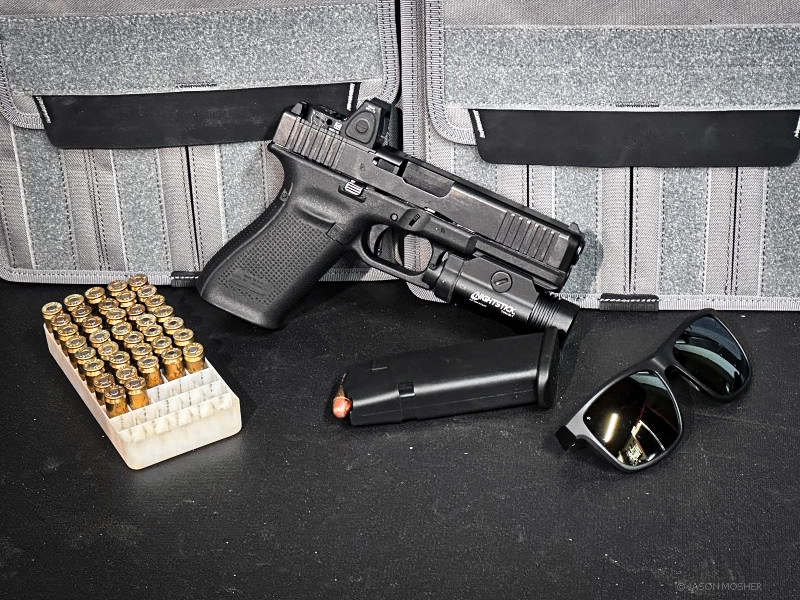
On May 26, 2026, Maryland Governor Wes Moore signed Senate Bill 334 into law. It will ban the manufacture, sale, purchase, receipt, or transfer of “machine gun convertible pistols,” meaning those built around a cruciform trigger bar. The cruciform trigger bar is a primary design feature of Glock and Glock-style handguns. That law is scheduled to take effect on January 1, 2027.
Glock has long been among the anti-gun movement’s top bogeymen, along with so-called “assault weapons.” That’s what happens when you dominate an entire sector of the firearms market, as Glock has for some time now. Glocks are so ubiquitous that rival companies make their own pistols based on the Glock design, such as the Palmetto State Armory Dagger, Ruger RXM, Bear Creek Arsenal Grizzly, various Shadow Systems guns, and others.
The law is essentially a “Glock ban,” but it’s deliberately worded to scoop up all those other guns in the process. This legislative effort is the anti-gun movement’s latest tack in an ongoing effort to circumvent the increasing roadblocks thrown up by the Supreme Court’s Heller and Bruen Decisions. Glock has been a particular target of late, so let’s look briefly at how this strategy has unfolded and what we can expect moving forward.
Bruen Spurs Anti-Gun States to Act
The 2022 Bruen Decision built on the earlier Heller case, emphasizing the prohibition on bans on guns in common use. Anti-gun activists moved to the state level, pursuing an insurgency campaign designed to overwhelm and ultimately bankrupt gun manufacturers and gun rights organizations by making them defend on multiple fronts instead of a single, federal-level effort.
New Jersey and the City of Chicago took the lead by suing Glock on the grounds that the company knowingly produced firearms that could be easily converted to fully-automatic function (machine guns) by adding conversion devices commonly known as “Glock Switches.” The suits demanded that Glock cease production and/or redesign their pistols to prevent their ready conversion.
There was no mention of the fact that the offending conversion devices were already illegal, had no connection to Glock, despite some bearing a pirated Glock logo, or that the devices were manufactured and smuggled into the country from overseas, most notably from China. Glock had literally done nothing wrong. The company was the victim of its own market success, which bad actors exploited to sell illegal enhancements to criminal gangs in the United States.
The problem was the cruciform transfer bar, a basic Glock design element. Changing that design would at least temporarily thwart the conversion devices, but doing so could potentially open Glock up to civil litigation, not to mention the expense of changing their entire design. The company chose to fight, prompting anti-gun lawmakers to target the Glock design legislatively. Maryland is the latest state to go that route, following California, Connecticut, and New York.
Glock and the Common Use Doctrine
Heller established the concept that the government cannot ban firearms that are in common use by the public for lawful purposes. Bruen reaffirmed that doctrine. No hard number exists to measure whether a firearm is in common use. It’s always been something that you know when you see.
Estimates vary, but most sources place Glock’s annual share of the civilian handgun market at about 30 percent, far larger than any other single manufacturer. That number balloons when we factor in the various Glock clones, which share the cruciform trigger bar feature. Glock has maintained those numbers for decades, meaning that cruciform trigger bar guns command the market far in excess of saying they are in common use.
But the law enforcement market illustrates Glock’s true dominance. Glocks, and by extension cruciform trigger bar pistols, account for some 65 percent of duty guns in American agencies and departments. “Common use” is a grossly inadequate term for that number.
NRA, FPC, and SAF Sue Maryland
The National Rifle Association, Firearms Policy Coalition, and the Second Amendment Foundation filed suit against the new law within minutes of Governor Moore affixing his signature. You can read the complaint here if you like.
Briefly, the complaint focuses on the fact that the new law is a handgun ban, which Heller expressly forbids, invoking the doctrine of common use. The plaintiffs note that Maryland enacted the law “out of concern that Glock and Glock-style pistols can be equipped with pistol converters,” as we mentioned before. It also points out that those converters are already illegal, as is the act of using them to convert otherwise legal handguns.
If Maryland uses the current anti-gun playbook, it will respond that the law does not ban currently-owned Glocks or other affected pistols. It merely prohibits the future manufacture, sale, purchase, receipt, or transfer of such firearms. Maryland will claim that such an approach does not “ban” anything. We see similar arguments in the various “assault weapons” bans currently being litigated. The plaintiffs have already preemptively addressed that argument by stating the right to possess arms includes the right and ability to acquire those arms, which Heller and Bruen affirm.
The suit was filed in the US District Court for Maryland, which has not been a friendly venue for Second Amendment cases. Whatever the decision, the case will be appealed to the US Court of Appeals for the 4th Circuit, another notoriously anti-gun court. One would think that Heller and Bruen’s clear commands would be applied at each level, but certain courts have sought every possible loophole to avoid affirming those rulings in their own cases. We will see.
All Eyes on Maryland
Gun rights advocates have a very strong case against Maryland, but other anti-gun states are watching this very closely. If the Maryland law stands, or at least drags out in the courts, other states will be emboldened. Watch for states like Virginia, Colorado, New Mexico, Illinois, New Jersey, and others to push similar bills.
Remember, they know such bans are unconstitutional. The goal is to overwhelm and bankrupt gun companies and gun rights organizations by making them defend multiple attacks, each of which is extremely expensive, far more so than concentrating on a single federal case. Deliberately introducing and passing an unconstitutional law is not, unfortunately, illegal.
That three major gun rights organizations are combining their resources for one complaint is also significant. It shows that they understand how the game has shifted, and they know that several individual complaints are less effective and more expensive than one coordinated effort. Working together frees up resources for other projects. Remember that governments essentially have unlimited resources with which to fight. Those challenging them do not.
NRA v. Moore is a case to watch, though it likely won’t be settled quickly, given the government’s ability to draw things out and the certainty of an appeal, no matter what the initial ruling. We’ll keep you updated as necessary.