
Psychologists William Edmund Hick and Ray Hyman coined “Hick’s Law” back in 1952. Hick’s Law is simple: the time it takes a person to make a decision increases with the number of choices available.
How this applies to you and your gear, in plain English: when things turn violent, having too many options slows you down. By systematically cutting out extra choices in your guns and gear, you shave precious seconds off your response time when it actually counts.
There are lots of ways to experience Hick’s Law. Turn on Netflix and see how long it takes you to find a movie or show to watch. That’s Hick’s Law in action.
The concept behind Hick’s Law inspired me to look at the guns and gear I carry, and how I can simplify everything—not only removing decisions, but improving consistency as a whole. This article doesn’t fully focus on Hick’s Law; instead, it focuses on consistency, cognitive economy, and decision-making under stress.
Hick’s Law is a useful launching point in examining our cognitive economy and figuring out how to reduce the time it takes to make a decision, so we can focus on making an effective one.
More Options, More Problems
Having more options sounds nice, but as the options increase, we can easily drift into analysis paralysis. We spend more time trying to find the “right” option than we spend being effective.
The good news is you’re currently in the prepare phase. Anytime we aren’t in the middle of a situation, we are in the prep phase. A lot goes into the prep phase, but today’s focus is on systematically eliminating unnecessary choices.
What Happens to Your Brain Under Fire
When you move from the prep phase to a high-stress engagement, your body undergoes immediate physiological shifts:
- Adrenaline Surge
- Increased Cognitive Load
- Reduced Working Memory
- Divided Attention
- Auditory Exclusion
- Tunnel Vision
Your brain has a lot to process in a violent situation; don’t give it extra problems to solve. Right now, as you’re reading this article, you have the time to solve those problems before the bullets start flying.
The Man With One Gun (Kind of)
If you’re reading this, you probably own several guns. Striker-fired guns, hammer-fired guns, revolvers, and beyond. When it comes to guns, my motto is more is better! Owning a variety of different guns is fine.
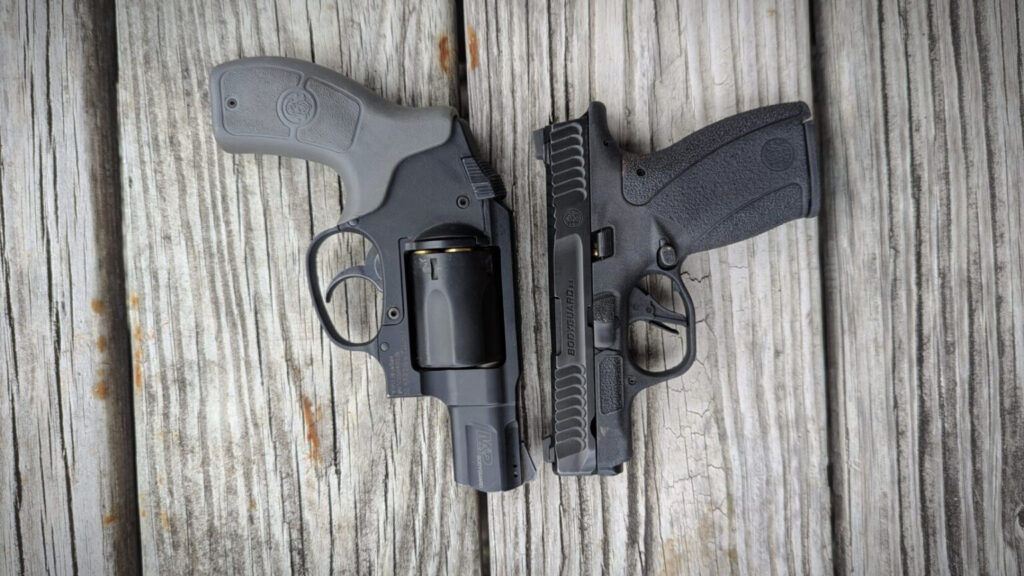
The problem isn’t owning several guns. It’s constantly rotating between them or chasing every new wonder gun that comes to market.
The “New Wonder Gun” Trap
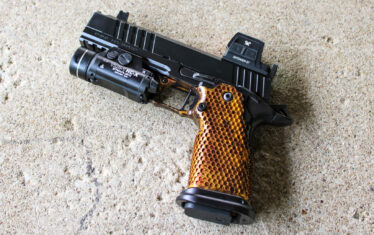
The firearm industry is often focused on consumerism. Every couple of years, we have some new fad take the market by storm. We are currently in the era of the 2011.
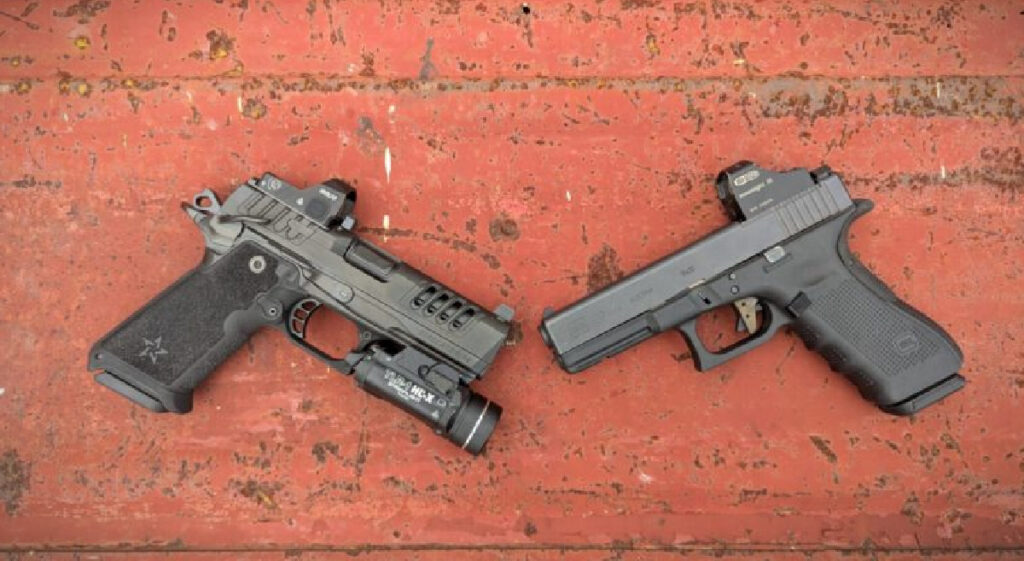
If you’re constantly changing guns to keep up with fads, then you’re likely never going to reach a level of training close to mastery. Of course, there are exceptions. Swapping from a S&W Shield to a Shield Plus isn’t a big jump.
Swapping from a Glock 19 to a Staccato P4 HD is a much bigger jump. Now you’re spending more time going back to the basics of a handgun instead of pushing your training forward. My general advice is that you likely do not need the new wonder gun; you’d be better off training with the gun you already have.
The Carry Rotation: Manual of Arms Matters
If you carry a Glock 17 on duty and a snub-nose revolver off duty, you have two very different guns, and it makes sense to have a different pistol for different purposes to an extent.
On duty, you have a duty belt, a duty holster, and an issued gun that’s a competent fighting pistol. When it comes to off-duty carry, you want something small and convenient to carry.
I do think it’s fine to have different guns for different purposes. However, I think there is a smarter way to do it.
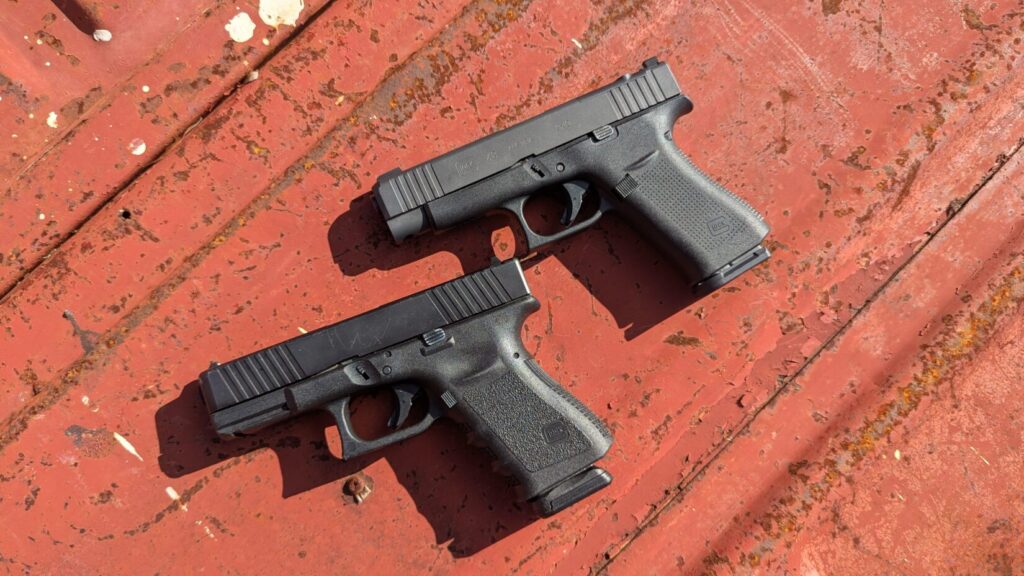
The downside of carrying two different guns is that you have two very different manuals of arms. Reloading, trigger pulls, sights, grip angle, and more are extremely different. This requires two different training programs and a lot of time to get halfway good with both platforms.
If you’re carrying a Glock 17 on duty, it makes more sense to carry a Glock 42, a Glock 43, 43X, 48, or 26 off duty. Yes, they are different guns, but they share a manual of arms with your duty pistol. You still need to train with both pistols, but because they are so similar, you’ll be more efficient in training with either.
Training from one pistol can translate well to the other. It’s not a 1-for-1 trade-off, but it’s a lot closer than two radically different pistols. When it comes to serious-use firearms, try your best to limit the difference between your guns.
The same goes for the accessories you utilize on your gun. If your duty gun has a red dot, having one on your concealed-carry firearm makes a lot of sense. Aim to keep the accessories on your guns as similar as possible.
Gear Standardization & Motor Memory
There is a bit of fun in experimenting with duty gear setups. Moving things on your plate carrier and belt to optimize your setup makes sense—to a point. If you are constantly changing your duty belt or plate carrier, some of the repetitions you’re performing are no longer reinforcing the system you’ll actually use.
This constant swapping becomes a physical incarnation of Hick’s Law.
You should certainly experiment with your gear to figure out a configuration that lets you access each and every tool with ease. But once that’s figured out, stop swapping things around.
You need that motor memory to remain the same when you’re in a violent situation. You want to know exactly where your tourniquet, Taser, and reloads are, and you don’t want to reach for one tool only to find the wrong one.
Consistency in Holster Retention: ALS and SLS
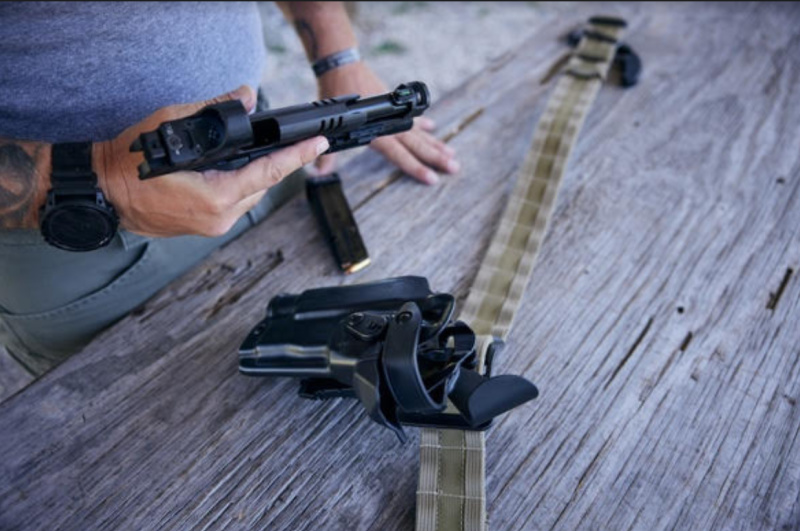
Additionally, if you’re constantly changing holsters, you’re never going to have the reps you need to be efficient while drawing and engaging. This doesn’t mean you can’t swap holsters based on the task and new accessories.
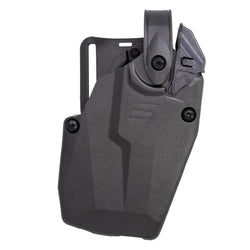
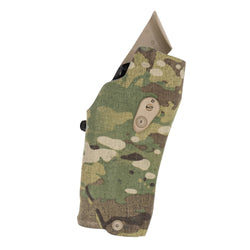
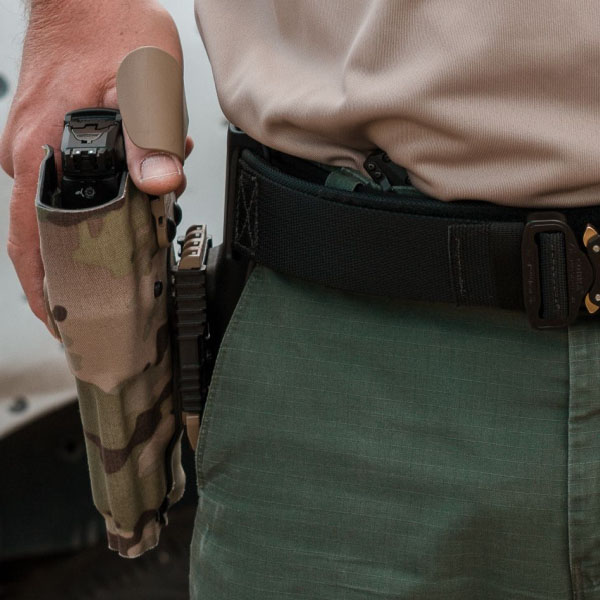
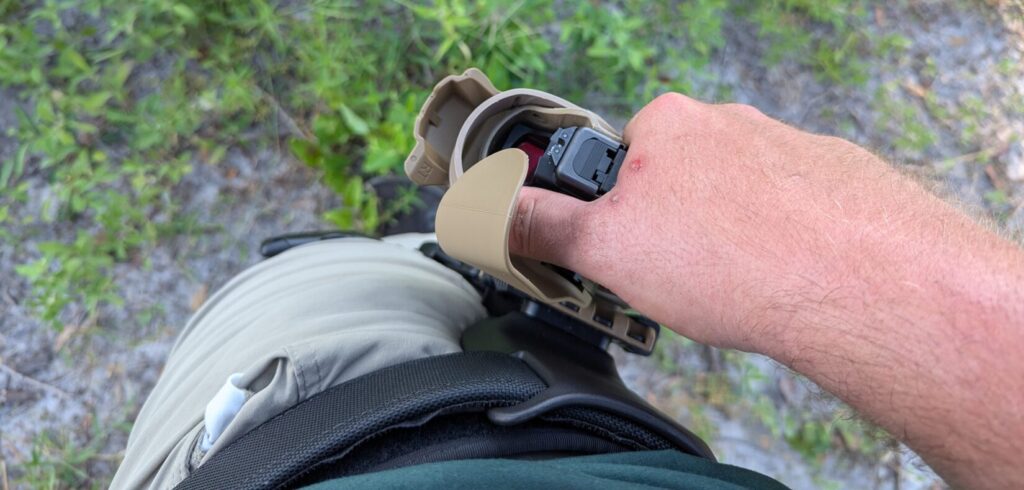
Some of the genius behind Safariland’s retention system is that it’s the same between different holsters. The mechanics of the SLS and ALS systems remain the same regardless of which holster rig you’re carrying.
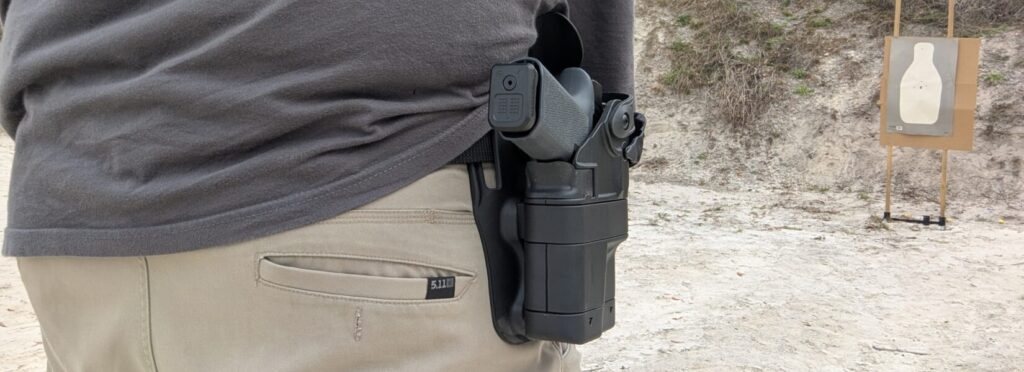
If your agency starts issuing optics and weapon lights, you can swap to a Safariland holster that accommodates the new accessories without having to learn a new holster.
Keeping Carry Gear Simple
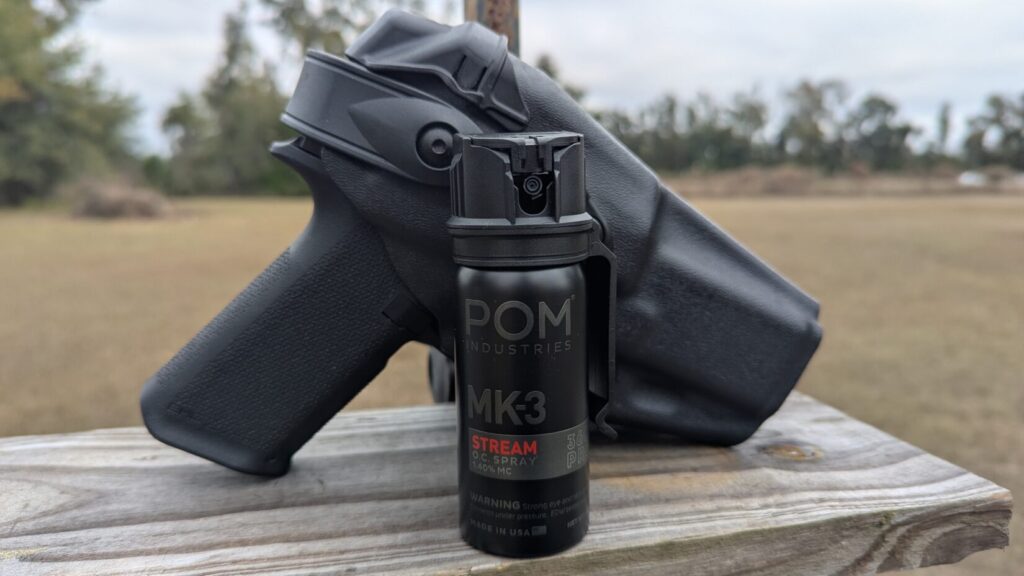
I’m a fan of ‘less is more’ for concealed carry. For defensive applications, I want two options: a lethal and a nonlethal. I have a firearm and a can of pepper spray. My choices are simplified, and I’m not thinking about whether I should use a knife, a gun, mace, a stun gun, or strike with my flashlight.
It’s gun or pepper spray; my decisions are as simple as left and right.
I’ve seen a lot of options creep into the world of defensive gear. While it may seem that having a multitude of options is beneficial, you can run into analysis paralysis at a time when indecision can lead to serious consequences.
For police and military users, you are often assigned to carry a particular set of tools, so your options here can be limited. The best thing you can do is not only train in the use of these tools, but also examine your use-of-force procedures in detail and know which tool to use in each situation.
Having this mental list memorized cuts down the decisions you have to make in the moment.
The 70% Solution: Making Decisions in the Middle of It
We can prep our gear all day long, eliminate our decisions, reduce our options, but that can only take you so far. Once a situation turns violent, you’ll be hit with a completely random set of options you can’t predict.
What can we do in this situation to avoid the negatives associated with Hick’s Law? How can you make the perfect decision?
Sadly, you can’t.
In Afghanistan, my squad was ambushed as we moved across an open field. I was the second man in the squad, and when the rounds started flying, the point man and I charged forward, making our way to the cover in front of us.
The rest of the squad went back to the original cover because it was considerably closer. That was the better decision. Was my decision wrong?

No. The wrong decision would have been to take the time to look around, mentally measure which cover was closer, and then decide.
The Marine Corps MCDP-1 Warfighting doctrine advocates that a 70% solution now is better than a 100% solution later. When an option appears, take it, evaluate it quickly, and adapt to it.
- Is that car better than the brick wall for cover?
- I’ve fired a few rounds; should I reload?
- Do I apply a tourniquet to the arm or leg first on a person with multiple wounds?
When bullets are flying or blood is leaking, you don’t have time to figure that out. Make the decision, dedicate yourself to that decision, act, and then adapt.
Field Questions: Consistency & Real-World Use
How does Hick’s Law affect shooting accuracy and response time?
Hick’s Law shows that response time increases as choices multiply. In a high-stress gunfight, having to pause and process non-standardized gear, unfamiliar handguns, or complicated draw mechanics increases cognitive lag—slowing down your target engagement and raising the odds of a stress-induced error.
Why is having a “carry rotation” with different operating systems risky?
Rotating between handguns with fundamentally different mechanics—like switching between a single-action 2011 with a thumb safety, a double-action revolver, and a striker-fired duty gun—forces your brain to recall platform-specific steps under threat. That fraction of a second spent remembering your safety or trigger pull can cost you the fight.
How do Safariland ALS and SLS systems help mitigate Hick’s Law?
Safariland Automatic Locking System (ALS) and Self Locking System (SLS) holsters maintain uniform, intuitive thumb-release mechanics across different models. Because the draw stroke remains identical whether you are running a duty rig, a tactical setup, or a concealment holster, your motor memory stays automatic without adding extra decision steps under fire.
Final Takeaway
Hick’s Law isn’t about reducing options completely; it’s about reducing unnecessary options. Every choice you make before the fight should help reduce your cognitive load in the fight. When the fight comes, you’ll appreciate the prep work because in the moment, you’ll be faced with countless other decisions.
When those countless decisions seem insurmountable, remember that the 70% solution now is better than the 100% solution two minutes from now.
The decisions you make before and during the fight will be influenced by your training—so, as always, never stop training.