
Ask any gun store owner what the most popular handgun round is, and they’ll likely say “9mm.” It’s true — the 9mm offers a great blend of manageable recoil, greater capacity, excellent terminal ballistics, availability, and overall performance. A generation or two ago, there was another popular handgun round that felt more American and had a winning history in “two world wars.”
I’m talking about the .45 ACP, of course, the Lord’s caliber, the round you carry because they don’t make a .46. Surely, the .45 ACP has some drawbacks, including heavier recoil, lower capacity, and greater weight, but the ammunition choices out there make the “flying ashtray” an excellent option for the firearms enthusiast today.
.45 ACP Ammo at a Glance
| Load | Best For |
|---|---|
| 230-grain ball (FMJ) | Practice and suppressed shooting |
| Frangible | Indoor ranges and steel targets |
| Hard-cast lead | Deep penetration outdoors |
| Solid copper (HoneyBadger) | Self-defense with less felt recoil |
| Snake shot | Pests at close range |
| Hollow point | Self-defense |
Good Old 230-Grain Ball Ammunition
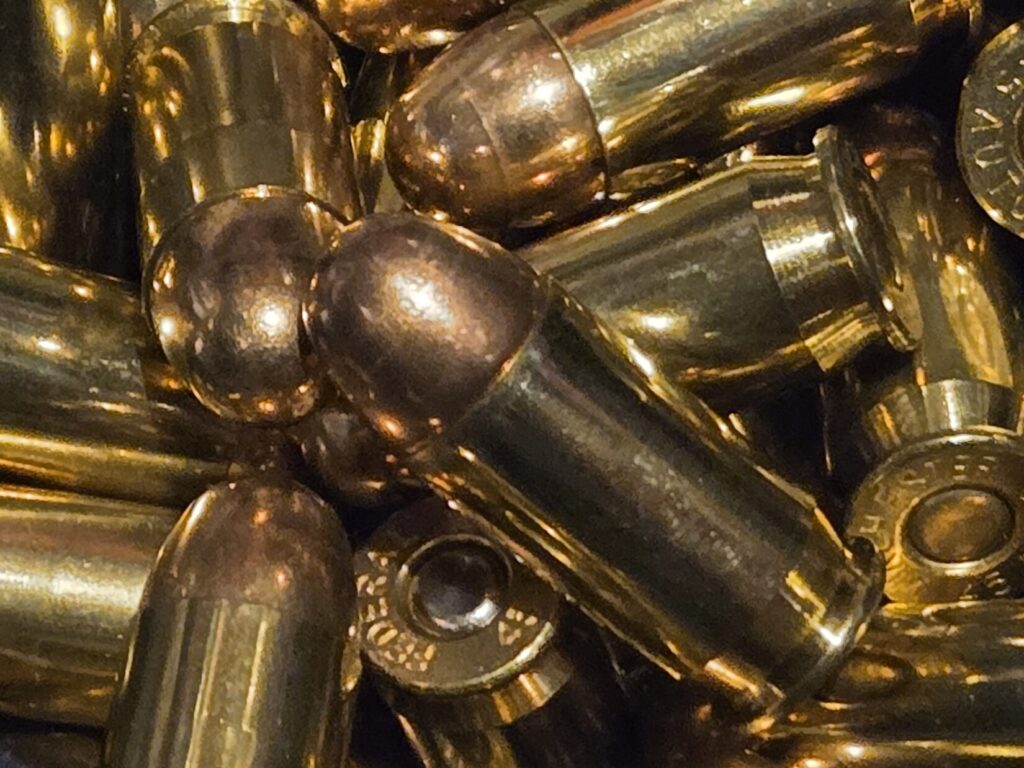
At 230 grains and with a standard powder charge, the .45 ACP ballistics expected are a muzzle velocity of 825 feet per second plus or minus 25 feet per second and about 350 to 400 foot-pounds of energy. Well under the average speed of sound, this ball ammunition is perfect for suppressor use, and there is no need to knock down the powder charge to achieve desirable results.
Ball ammunition is relatively inexpensive, and when purchased in bulk, it is even more affordable. You can dig into the stories from military history of .45 ACP use and learn about the incredible effects simple ball ammo had on the battlefield.
Frangible Ammunition
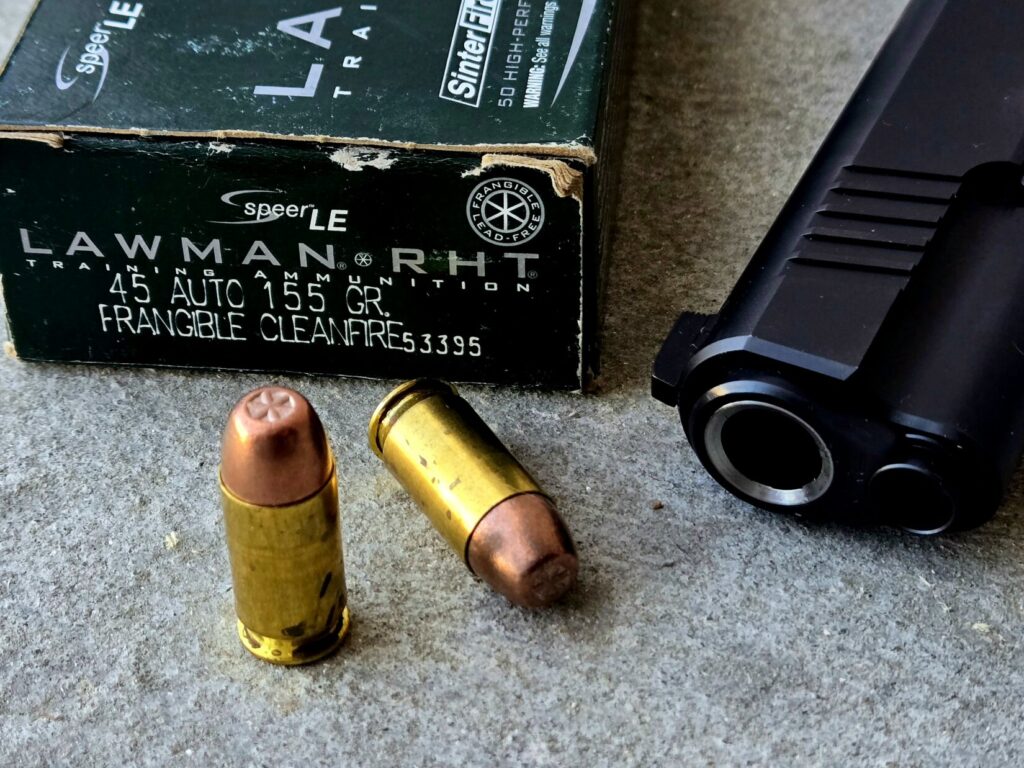
In 2016, I attended a course at the SIG Sauer Academy that was held at an indoor range requiring frangible ammunition. I shot about 250 rounds that evening and learned how expensive that round is compared to the 9mm frangible my friends carried.
Frangible ammunition is made mostly from compressed copper powder. Upon impact, rather than throwing spall like a jacketed round, the frangible ammunition becomes dust. I’ve shot plenty of frangible ammunition out of my 1911 and my SIG P220 over the years, and it functions just as flawlessly as regular ball ammunition, making it an excellent training product.
Hard-Cast Lead
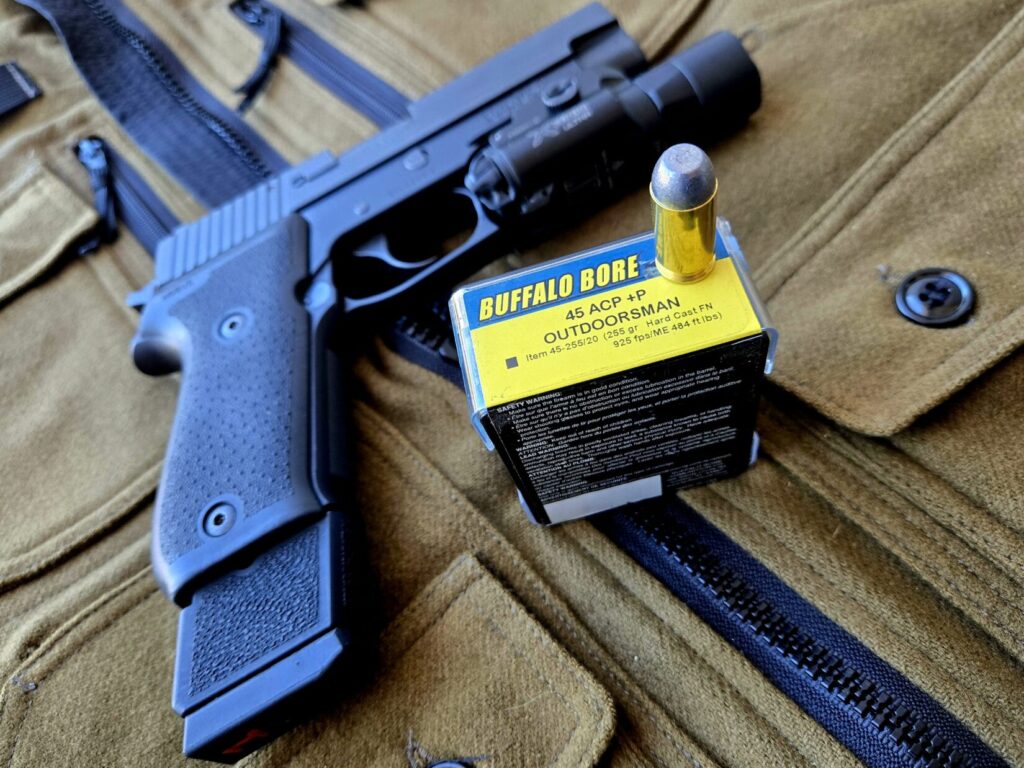
The opposite of frangible ammunition meant to disintegrate is ammunition that is not meant to break up when it comes in contact with organic medium. Hard-cast ammunition, like Buffalo Bore’s Heavy Outdoorsman line, is meant for deep penetration with minimal expansion.
The .45 ACP Outdoorsman is an effective round for dropping wild boar and black bear. It is +P powered and pushes .45 ACP to the upper limit of what the round is capable of. Out of my SIG P220, the 255 gr Buffalo Bore ammunition travels 974.6 feet per second compared to 819.5 feet per second from the SIG Sauer FMJ.
HoneyBadger Solid Copper
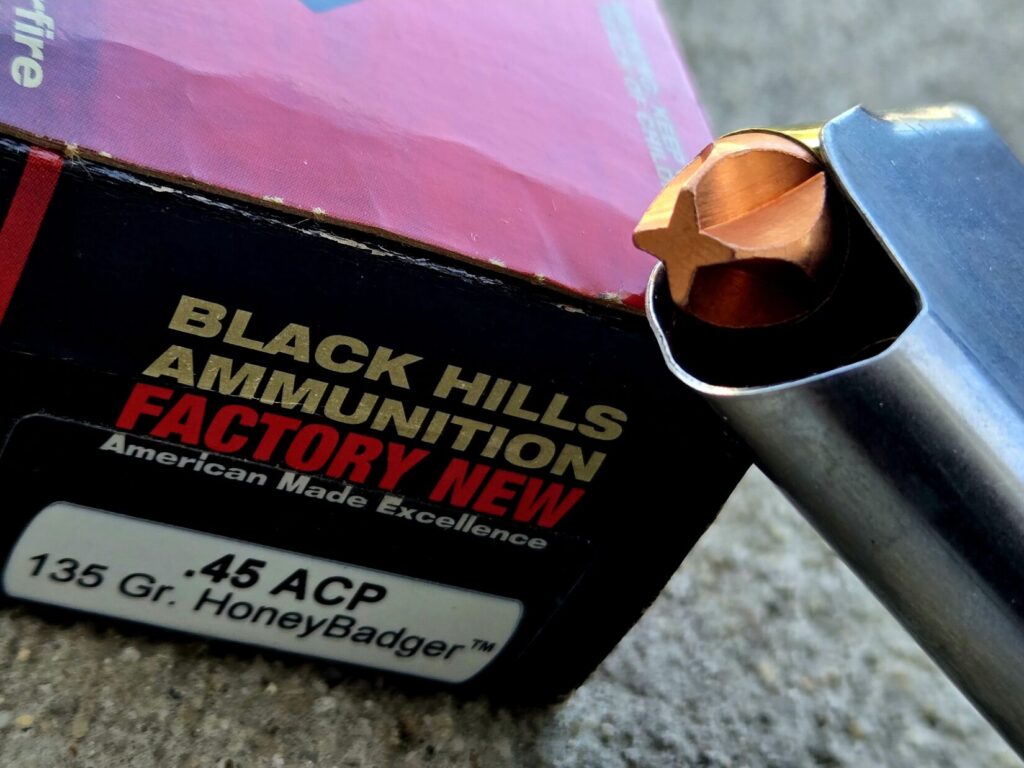
Another copper round found in this panel of versatile rounds is the HoneyBadger solid copper round from Black Hills Ammunition. At only 135 grains, the HoneyBadger has a reported velocity of 1,250 feet per second with 468 foot-pounds out of a 5-inch test barrel.
The bullet heads are made by Lehigh Defense, and they are designed for incredible penetration using the principle of the Venturi effect to push fluid and soft tissue out of the way. A secondary benefit of the HoneyBadger rounds is the lower felt recoil from the lighter projectile. This makes itr a good choice for self-defense for those who may be recoil shy.
Snake Shot
Back in 2021, I attended a course at Gunsite in the middle of the summer when rattlesnakes are very active. While walking to the target backers, we spotted a mature rattlesnake slithering onto one of the firing platforms we had shot from only minutes before. The instructor asked the students to step away while he accessed a spare magazine loaded with snake shot.
One carefully aimed shot and there was one fewer snake to worry about on the property. Snake shot is meant to be used in somewhat close proximity, and there are usually different shot sizes for close or closest range use. Snake shot works like a miniature shotgun load, and it is safer to use to dispatch pests than firing a much heavier, more powerful round.
If you’re wondering about that snake from Gunsite, one of the other students on the course claimed it, and the skin was sent to a local leathermaker to create a unique snake belt and holster from it. That’s what happens when the snake is shot where someone else was lying prone.
Hollow Point
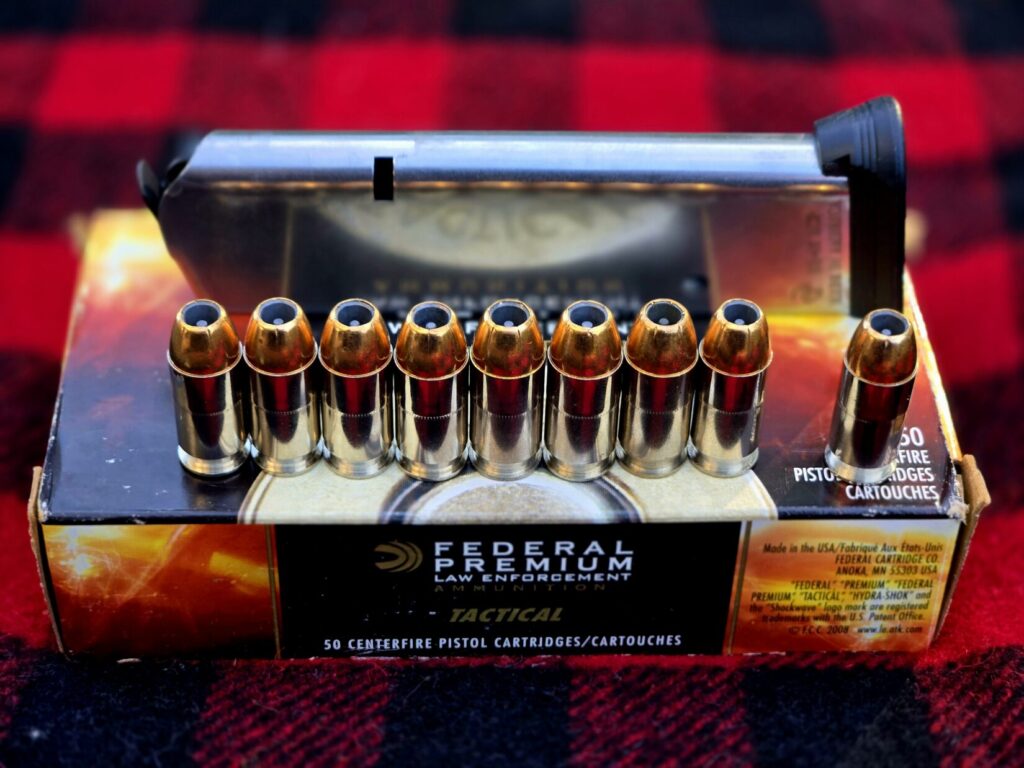
The “flying ashtray” nickname comes from the size of the .45 ACP hollow-point round. The size of that ashtray varies from round to round, and the expansion offered will as well.
With modern ammunition, the 45 ACP hollow point reaches depths in ballistic gel greater than 14 inches, and the round expands north of three-quarters of an inch and closer to .85 inches. I wasn’t able to test my favorite .45 ACP round, Federal HST 230 gr +P, in ballistic gel, but researching results of other testers online, the findings are all similar and incredibly impressive.
One criticism of the hollow point is the phenomenon of the hollow filling with organic medium and not expanding. To counter this and as a compromise, the polymer-tipped version aids in expansion.
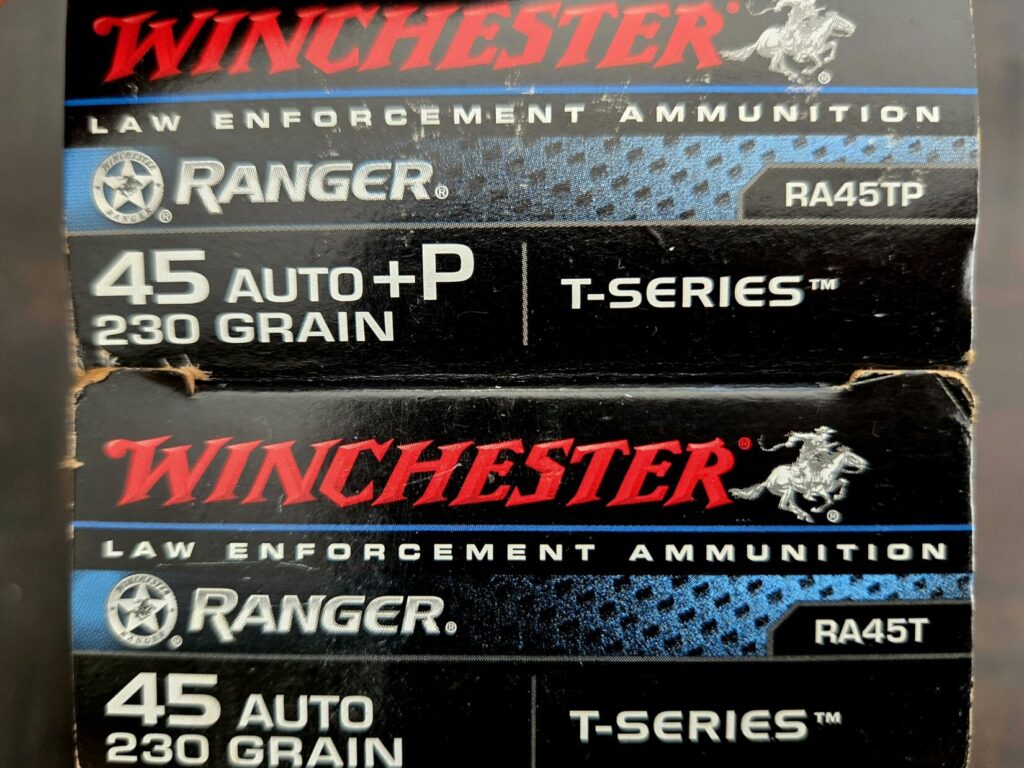
One example is the Critical Duty round from Hornady. The polymer tip is designed to push against the jacket and provide reliable expansion. Out of my P220, the 220 grain +P version achieves 1,019.4 feet per second at the muzzle.
Honorable Mention
There are some rounds not included in this roundup that make the list in this honorable mention section. I simply do not have enough time or experience with them, but they have certainly been brought up in conversation with others.
Tracer ammunition is typically reserved for rifles, but it is available for the .45. Historically, this ammunition was carried by the US Military in Vietnam, and the tracer trail was meant to intimidate the enemy while the downed pilot made his way to rescue.
Another honorable mention in this list is reduced powder loads. If strictly used for competition, the full metal jacket 230 gr bullet can be downloaded to closer to 750 feet per second for a softer shooting experience.
When used with a steel frame and steel slide pistol like a 1911, the reduced powder rounds shoot incredibly flat. When switching to this type of lower-pressure round, there may be reliability issues if the recoil spring is not reduced in power as well
I love my .45s, and I love shooting the round. I know it is heavier and more expensive, but there is a reassurance knowing you have a sturdy handgun at your side. Perhaps I’m hitting my Fudd years early, or maybe I am nostalgic for times before the 9mm took over in popularity.
Whatever it is, I know I am not alone. What is your favorite .45 ACP? If you’ve read this through, I’m assuming you’re a fan of the round like me.