
The basic Stoner-designed AR platform comes in numerous variants and various calibers. The two primary being the AR-15 in 5.56 and the AR-10 in .308, but the calibers have extended well beyond those. Regardless of which rifle and caliber you’ve picked, there is always a reason to reduce AR recoil.
In general, the AR platform isn’t a heavy-recoiling design. It’s fairly light; even the full-powered .308 in an AR-10 doesn’t hit hard. You might even want to make fun of someone looking to reduce AR recoil, but you’d be in the wrong.
Reducing AR recoil isn’t about being afraid of recoil and trying to protect your shoulder. It’s about shooting faster and straighter. The more recoil you reduce, the faster you can effectively employ your firearm.

The less recoil you have, the faster your sights can return to the target and the faster you can shoot an accurate follow-up shot. This can be useful in nearly any shooting situation.
For self-defense, the faster you can shoot, the better off you’re likely to be. Competition shoots are often won by fractions of a second, and every little bit of recoil you can shave off, the easier it is to win. Even precision shooting can benefit from reducing recoil; the less the gun moves, the better.
That’s why we want to reduce AR recoil. Let’s dig into five ways to reduce recoil in an AR-15, AR-10, and basically any other AR-type design.
1. Hydraulic Buffer
Every AR has a buffer, but buffers vary. For instance, the buffer in a 5.56 AR is different than the buffer in a 9mm AR. The weight of the buffer often matters in reducing recoil, but ensures good reliability. A new buffer is one way to reduce AR recoil, but not just any buffer; we’ll be looking at a hydraulic buffer.
Hydraulic buffers aren’t new. Colt experimented with them for years, but they never worked all that well. It took a few decades and a company called KynShot to get it right. The top of the hydraulic buffer works as a piston, and the bolt carrier group compresses the piston against the resistance of hydraulic fluid.

This slows down the bolt and reduces recoil. In my experience, the best benefit is your sight returning back to target very quickly. The KynShot buffers are made for various calibers and AR designs in various barrel lengths. You have to be very picky when choosing the right hydraulic buffer for your gun.
This is one of the easiest ways to reduce AR recoil.
2. Muzzle Devices
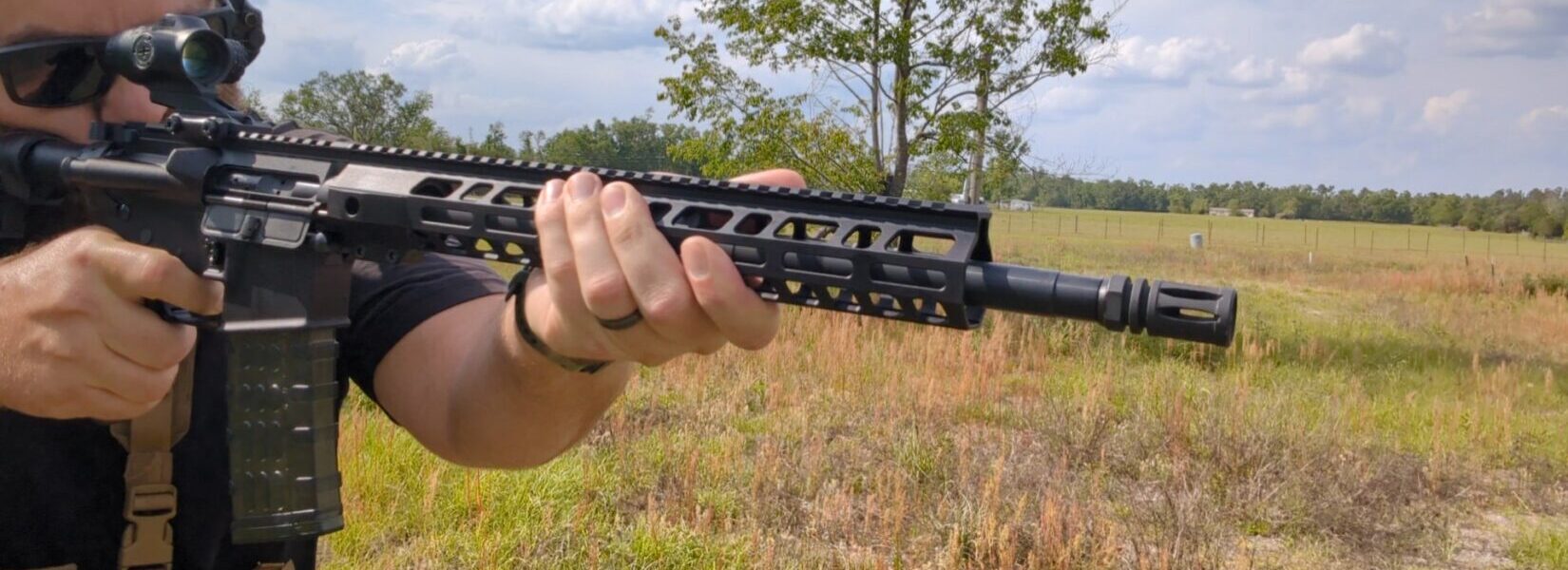
We started at the back of the gun, but now we are moving up front. The tip of an AR barrel is typically threaded, and threaded barrels are designed for accessories. There are plenty of options.
For reducing recoil, we have two options: muzzle brakes and suppressors. Additionally, compensators can reduce upward muzzle rise, which can count as recoil reduction. There are hybrid muzzle devices that combine brakes and comps to get both effects.

Brakes and compensators both redirect gas to reduce recoil or muzzle rise. With a brake, the device has vents on the side with walls between them. When the gas hits these walls, the gun is pushed forward, which reduces recoil.
With comps, the ports face upward, and the gas is redirected upward so the barrel is pushed downward.
A suppressor works better than either option. The weight of the can helps keep the gun low and on target. The baffles in the suppressor reduce recoil the same way a brake does.
The tip matters! So make use of it to reduce AR recoil.
3. Tuned Gas System
AR-15s are gas-operated, so a portion of the gas from each round fired keeps the gun running. Longer gas systems tend to work best, but barrel length and caliber will determine what length gas system is required to make your gun function. Regardless of the gas system length, there is one accepted truth: more gas means more recoil.
We need a certain amount for the gun to run reliably, but we can reduce gas to an acceptable point, which will prevent overgassing and reduce AR recoil. We need an adjustable gas block to reduce the gas flowing through the gun.

Users will have to carefully adjust the system and test to make sure it works reliably with their chosen ammo. Different loads can create different gas flows, so it’s best to pick one load and stick with it when tuning your gas system.
Adjustable gas systems can be matched with buffers and specialized bolt carrier groups to reduce recoil even more.
4. Recoil-Less Bolt Carrier
Speaking of specialized bolt carrier groups, let’s talk about the Velocity Precision Engineering Recoil-Less Bolt Carrier. This BCG is far from mil-spec. The idea is to reduce bulk, and VPE did just that by eliminating about 3 ounces of steel and leaving us with a 6.8-ounce BCG.
What’s the point? Bolt carrier groups recoil rearward, which adds to recoil because it’s bulk reciprocating rearward. The lighter the BCG, the less bulk is racing backward. Less bulk means less recoil.

The Recoil-less Bolt Carrier works best when paired with a tunable gas system. This allows you to get the best effect of both systems. Sadly, this is an expensive upgrade and costs $325. If you don’t mind the cost, it will reduce AR recoil.
5. MAKO Recoil Reducing Stock
Everything I’ve talked about so far isn’t exactly plug-and-play. It requires some knowledge of the platform, some time, a fair bit of money in some cases, and messing with how the rifle works. For our last pick, we are going to look at a simple plug-and-play option for your AR rifle, and it comes from MAKO.
The MAKO Recoil Reducing Stock is a six-position adjustable stock like you’d see on any standard AR-carbine. The stock has a set of springs that compress as the weapon recoils, which will slow down the recoil path and reduce felt recoil.

The MAKO Recoil Reducing Stock doesn’t work as well as the other options, and it won’t be felt all that much on your typical 5.56 AR-15 firing 5.56. On an AR-10, or a blowback-operated 9mm AR, it shows its worth.
On higher-recoiling AR rounds, like the 6.5 Grendel, it’s also quite useful. The simple design and plug-and-play style make it an easy add-on that works on some of these higher-recoiling AR platforms.
Keep ARs Flat
That’s it, those are the five ways I know to reduce AR recoil. The popularity of the AR platform has made it one of the easiest to accessorize platforms in the world. Recoil reduction is one of the most beneficial upgrades you can make to your rifle.
Remember, shooting fast and straight is always the objective, and anything that can help you do that is worth the squeeze.