
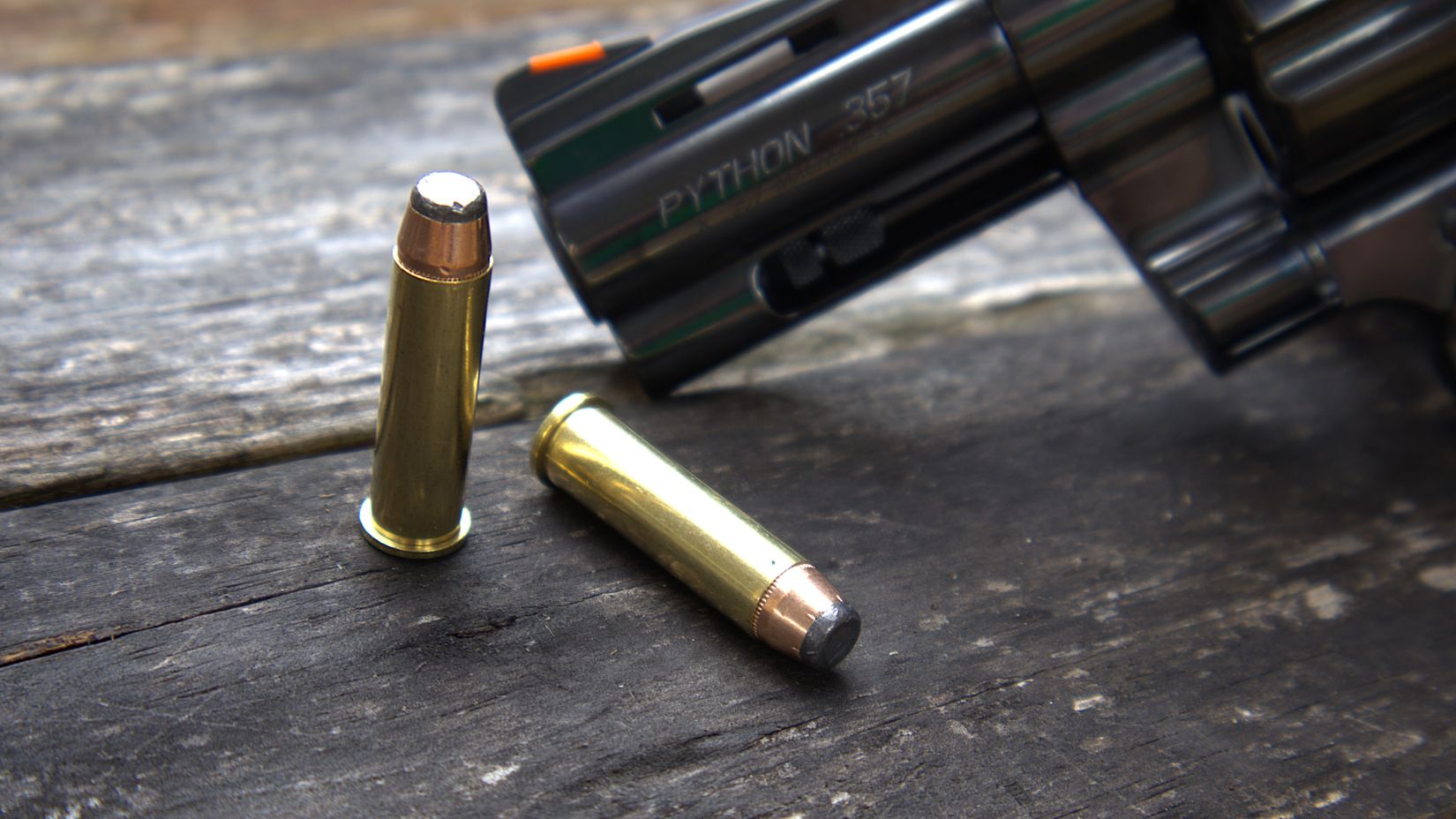
The 357 Magnum debuted as the most powerful handgun cartridge in 1935. Though it has since lost that crown, the .357 remains the gold standard for personal protection and has found new popularity in competition shooting and hunting.
This is how the .357 Magnum cartridge transformed from a law enforcement staple to an all-time great:
The Need for Speed: The .357’s Brash Beginnings
Law enforcement training and equipment tend to change conservatively—until there is a bloody inflection point that changes the direction as officer survivability takes priority over public appearances. The Newhall Shooting in 1970, the 1986 Miami Dade Shootout, as well as Columbine and the North Hollywood Shootout make the list. However, the first wave of officer survivalism began in the 1920s.
In the 1920s, the Bureau of Investigation (later the FBI) was not authorized to be armed. Nationwide, beat cops were routinely armed with .32 caliber Colt and Smith & Wesson revolvers that carried easily in a pocket so as not to alarm the public. Small handguns like these also made sense when walking the beat all day or night.
But bigger is better when cops and criminals took to automobiles. More policemen began to gravitate toward .38 Special revolvers as a result. Still, as Prohibition heated up in the desperate days of the Great Depression, even this upgrade was not enough to stop heavily armed motor bandits who relied on force and V8 engines to make their getaway. The .32s and .38s in service had serious trouble penetrating the steel bodies and engines of an automobile, as well as ad-hoc body armor sometimes worn by the perps.
In the autoloading world, a solution was found in the .38 Super, which was introduced in the Colt 1911 in 1929. For officers armed with .38 Special revolvers, a change in ammo was desirable and it came in the .38-44 Hi Speed cartridge. That round grew out of the development of high pressure .38 Special rounds by Elmer Keith, who successfully tamed this Magnum-like cartridge in Smith & Wesson’s large .44 caliber frame handguns.
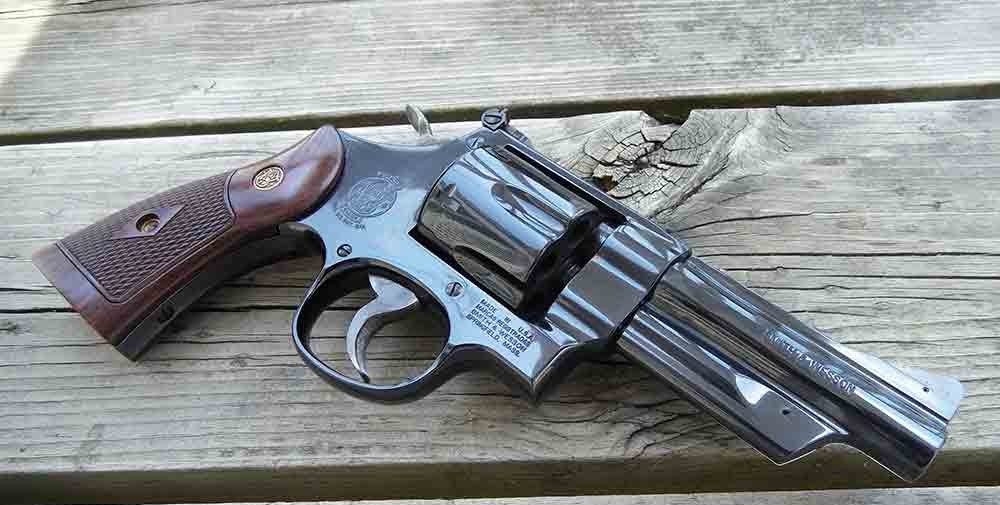
On its introduction in 1930, Colt announced its existing Official Police revolver could handle the new load. Smith & Wesson answered its rival in 1935 with the S&W Registered Magnum chambered in .357 Magnum.
Slow Climb Up
The Smith & Wesson Registered Magnum was built on what would become the N-frame Model 27, which is the same frame later used for the .44 Magnum. It was a step above the S&W K-frame .38 and even larger than the rival Colt Official Police revolver. The answer to the question of power always seems to be a bigger handgun.
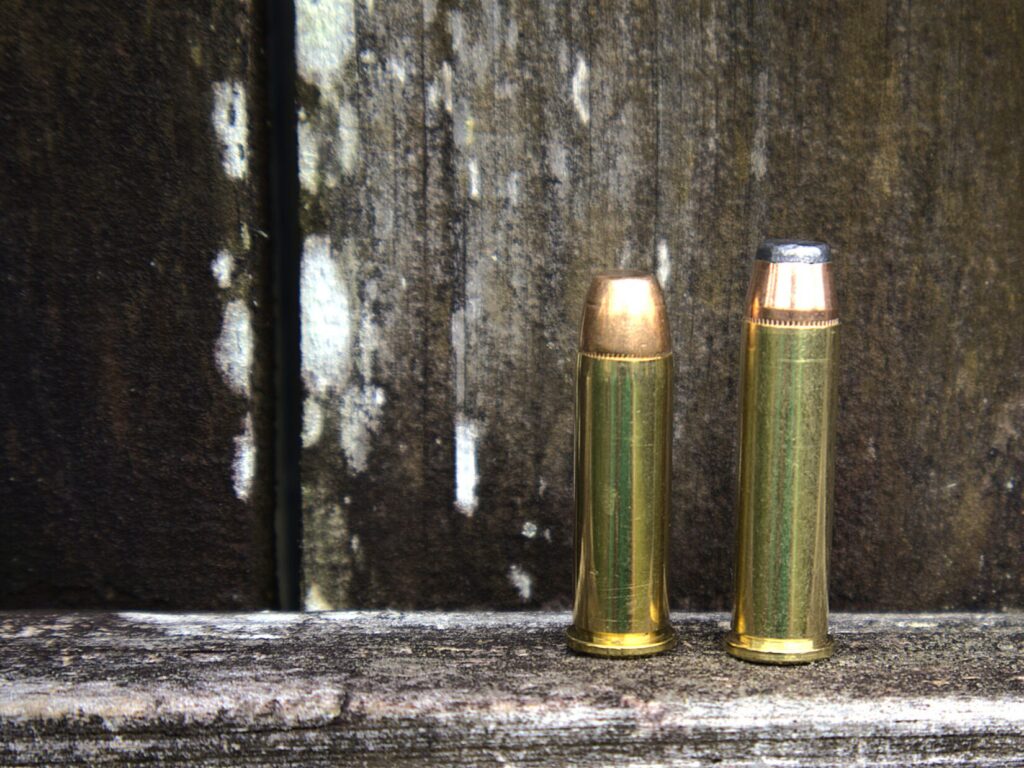
The cartridge itself featured a 158-grain metal-piercing bullet at over 1,500 feet per second. Phil Sharpe of Winchester and Douglas Wesson of Smith & Wesson were key in the development of the cartridge, but Elmer Keith’s pre-existing experiments tended to overshadow their role.
The .357 Magnum was more powerful than the .38/44, and the case length was extended to 1.29 inches, which is made 1/8th of an inch longer for more powder and the assurance that the otherwise identical .357 round could not be loaded in a .38 Special revolver.
Second Fiddle
The six-shot Registered Magnum sold for $60 in 1935, the equivalent of over $1,400 in 2025 dollars. Compounding that, bank failures of the Great Depression saw 1/3 of America’s money disappear from circulation. Despite the expense and the real lack of funds, the new revolver sold, but it was only to the most enterprising law enforcement personnel and shootists.
The Registered Magnum was further boasted by a nationwide hunting tour spearheaded by none other than Doug Wesson, the president and heir of the Smith & Wesson Company. He used the Registered Magnum to take any number of big games up to and including grizzly bear to promote the most powerful handgun in the world.
Colt had no immediate answer to the Registered Magnum and, despite the hype, the fortunes appeared to be on their side. The Official Police became the archetypical service revolver, since it could handle harder .38 caliber rounds. For more firepower that could tackle cars and those within, the FBI and other agencies turned to shotguns, lever-action and semi-automatic rifles, and later, submachine guns.
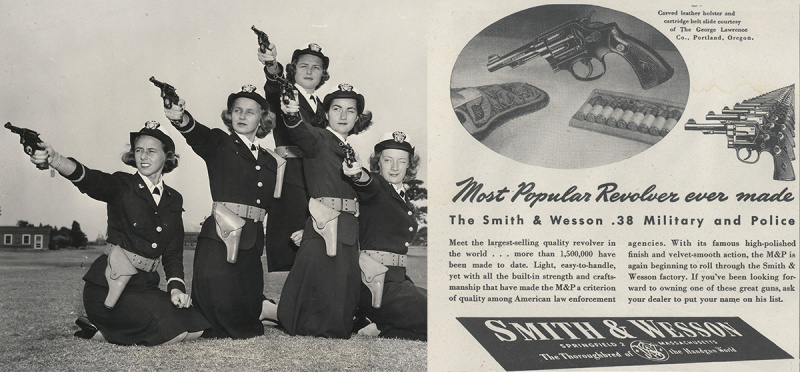
The Great Depression ended in 1946. With the shackles of government management and rationing gone, the people, and by extension, law enforcement, were freer to spend. The .357 truly caught on, particularly with newly formed Highway Patrol agencies. But the .38 Special revolver remained commonplace, as it was easier to shoot and it avoided unwanted complaints about excessive force.
But the need for Magnum ammunition where it was needed won out on a national level when the FBI adopted the S&W Model 13 revolver in 1981. This would be the last revolver adopted by the FBI and nominally loaded with the effective high-pressure .38 Special +P 158 grain lead hollow point. But 145 grain .357 Magnum Winchester Silvertip load found favor with authorized agents, as did the Remington 125 grain jacketed hollow point with law enforcement nationwide.
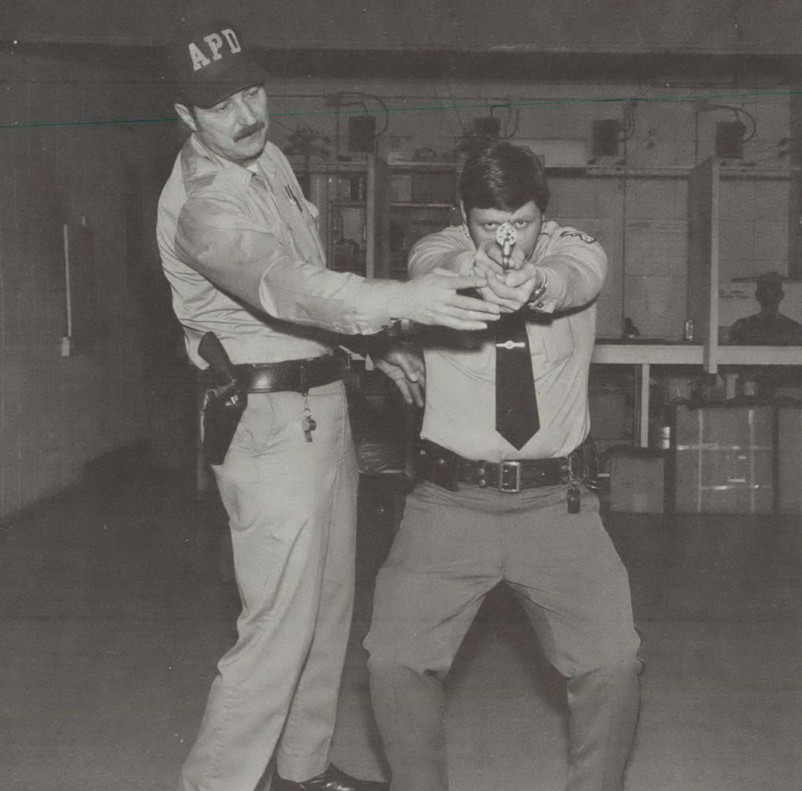
But the 1980s saw a transition by law enforcement away from revolvers and toward semi-automatic pistols. Just as the .357 was entering its own, its day was nearly over. But shooters, gun makers, and ammunition cobblers would keep trying to duplicate what made it special for decades on.
What the studies show
Even before the advent of modern jacketed hollow-point ammunition, the .357 Magnum gained the reputation for great penetration and the ability to stop assailants with one well-placed shot. You might know it as stopping power.
We might argue whether handgun calibers have enough velocity and energy to have the power to physically disable an opponent immediately in the same way higher velocity rifle and shotgun rounds do, but the .357 is a higher velocity round by handgun standards, and it was a reputation that only seemed to grow over time.
This reputation was espoused in magazine periodicals. Even Jeff Cooper, an advocate of the .45 ACP and, later, the 10mm Auto, conceded this. The lore was later backed up by Evan Marshall and Edwin Sanow’s 1992 study, Handgun Stopping Power. Their study of real-world shootings suggested that the .357 Magnum had a 93-97% one-shot stop rate with a torso hit. The Remington 125 grain semi-jacketed hollow point came in at the high end of the bell curve. By comparison, the famed .45 ACP 230 grain FMJ yielded a 61 % one-shot rate. Interestingly, the same study, taken at a time when 9mm Luger was falling out of favor, found that 115 grain+P and +P+ loadings demonstrated 90% effectiveness.
Greg Ellifritz later pointed out that Marshall and Sanow’s work was skewed by their ‘one-shot’ exclusion—ignoring any incident where a second round was required to finish the job. His follow-up, An Alternative Look at Handgun Power, expanded the sample size by including all hits, though it created its own debate by including psychological stops.
Despite its issues, it also addresses the number of rounds needed on average as well as failure rates. The .357 Magnum (lumped in with .357 Sig) and the .40 S&W come out with a 44% and 45% one shot stop rate. The .357 had the lowest number of shots needed for incapacitation. Only 9% of perpetrators failed to be incapacitated, no matter how many rounds were fired—the lowest on the list of service calibers surveyed.
The Problem and the Reality of .357 Ballistics
After law enforcement moved away from revolvers, revolvers more generally saw waning prevalence in the commercial market, a wane that has waxed in the 2020s as interest in revolvers has grown. Although the .38 Special remains the most ubiquitous revolver cartridge out there, the .357 Magnum is the most popular of the magnums and comes in platforms both large and small for applications ranging from everyday carry to hunting.
The allure of hard-hitting power in a package you can still carry around favors the .357 over other magnums like .44 Magnum and .460 Magnum. The .357 certainly benefits from a large number of handguns chambered for it as well as excellent ammunition availability. It also outperforms conventional semi-auto pistol cartridges like 9mm and .45 ACP.
But is the .357 Magnum really worth it, not in the 1920s but the 2020s? More power can be a good thing if that power actually manifests. And if it does not come at the expense of something more important.
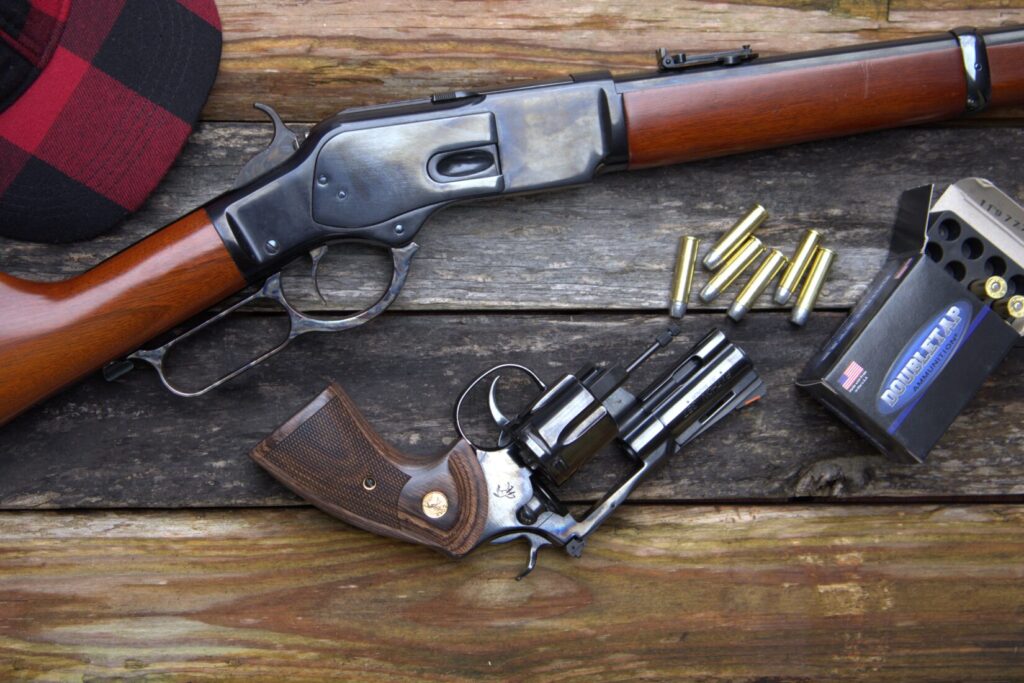
If the track record is a judge, the .357 is a standout. The Marshall and Ellifritz studies disagree greatly, but both converge on the fact that the .357 is at the top of the heap in terms of effectiveness on human targets.
In its early years, the .357 Magnum was demonstrated to take grizzly bear and walrus, although it is considered small for those tasks today. Since then, the .357 has developed a solid reputation on deer sized game inside 100 yards when fired from a carbine or service revolver. That has kept the .357 in mainstream popularity, despite the decline of the service revolver.
The .357 also has the added advantages of greater ammunition availability as well as chambering in lighter and slimmer handguns or rifles over larger magnum rounds like the .41 Magnum or .44 Magnum.
But the power level of the .357 can be a double-edged sword. It can be simultaneously overpowered and underpowered for the tasks it is asked to perform.
The .357 Magnum’s higher velocity yields higher stretch cavitation in tissue and some hydrostatic shock compared to conventional rounds like 9mm or .45 ACP. But, on the whole, the Magnum penetrates more deeply. More penetration is good for tough four-legged predators, but it can be wasted energy on two-legged ones.
The .357’s superior energy may not be transferred to the target. But it is transferred to the shooter, who gets excessive recoil and blast over conventional pistol rounds. This can encourage bad shooting habits at worst or slower follow-up shots at best, particularly when going to a smaller-sized handgun like the Smith & Wesson 360 or Ruger SP101 that can be downright painful to shoot with some loads.
On the other hand, the .357 Magnum is the smallest of the conventional magnum revolver cartridges. This gives the shooter a more compact handgun, but the cartridge rides the knife-edge of viability on large and dangerous game.
The .357 Magnum at 90
The .357 Magnum was the most powerful handgun cartridge when it debuted as the Model 27 back in 1935. What started as an exercise in officer survivability became one of the best all-around handgun cartridges on the market today.
Although the police revolver is more often found in the police museum than in a duty holster, the .357 Magnum revolver remains one of the best all-around options thanks to its mix of power, compactness, and sheer availability that can be hard to ignore.