
If you’re looking for a firearm for home defense, you have essentially three choices on the civilian market. The pistol, the rifle, and the shotgun. If you’re considering the shotgun, well, you’ve come to the right place.
This is Part 1 of a multipart series on the defensive shotgun that will cover it in as much depth as we can. Part 1 will focus on why one would choose the shotgun.
Firepower
A shotgun, when loaded properly and when used within its effective range, is a devastatingly effective defensive tool. A proper load of buckshot delivers multiple pellets per trigger pull, allowing you to put multiple effective rounds into a target.
We have three ways to stop a threat.
Psychological stop: The threat is too scared to continue to attack and decides to end the fight.
Blood Loss: Big surprise, your blood belongs in your body. Lose too much of it, and you reach the game-over screen.
Physiological Stop: Striking something vital can end the fight fairly quickly. The most desirable is a central nervous system disruption, which means striking the upper spine or brain.
Hitting someone in the heart can end the fight quickly, but not instantly. Hitting the lungs can also stop the fight, but again, not instantly by any means.
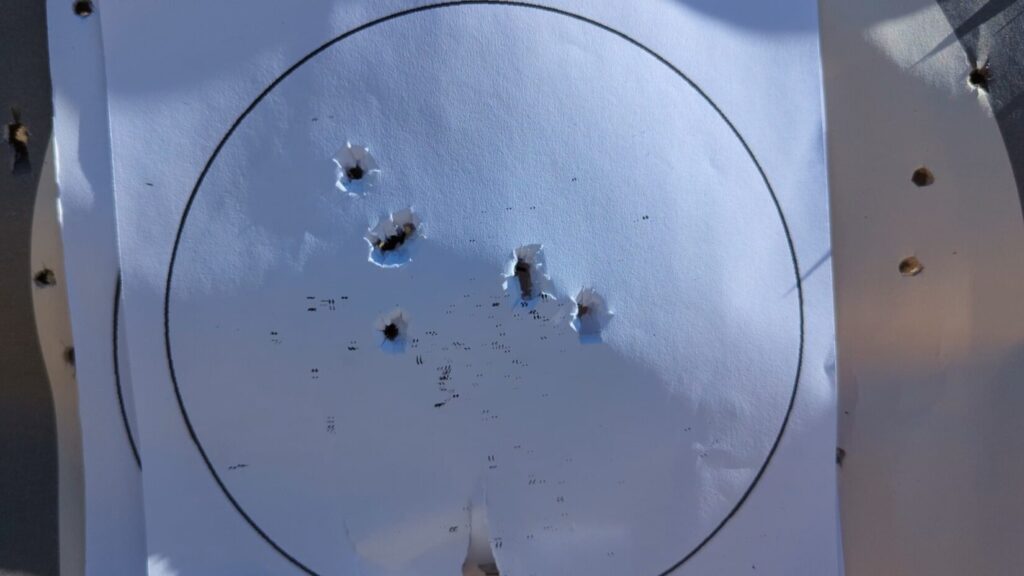
The shotgun can be devastating to the human body. Buckshot and slugs in particular are absolutely capable of quickly stopping a target. Buckshot offers you multiple opportunities to land a vital hit.
If you do not achieve a CNS hit, the damage done in the upper torso by a shotgun can be devastating.
Stats
According to Greg Ellifritz’s research, shotguns have an 86% chance to stop the threat when the round strikes the torso or head. Shotguns are very effective fight stoppers. When using buckshot, the rounds offer a potential secondary advantage.
There has been data gathered by Dr. Gary Roberts on rifle round fragmentation, and it has been published on the Primary and Secondary website. I’m going to quote the article here.
Projectile fragmentation in tissue can also greatly increase the permanent cavity size. When a rifle bullet fragments in tissue, each of the multiple fragments spreads out radially from the main wound track, cutting its own path through tissue.
This fragmentation acts synergistically with the stretch of temporary cavitation. The multiply perforated tissue loses its elasticity and is unable to absorb stretching that would ordinarily be tolerated by intact tissue.
The temporary cavitation displacement of tissue, which occurs following the passage of the projectile, stretches this weakened tissue and can grossly disrupt its integrity, tearing and detaching pieces of tissue.
This reflects a rifle round fragmenting, but in asking others, it’s theorized that a shotgun’s pellets, hitting close enough together, could do the same.
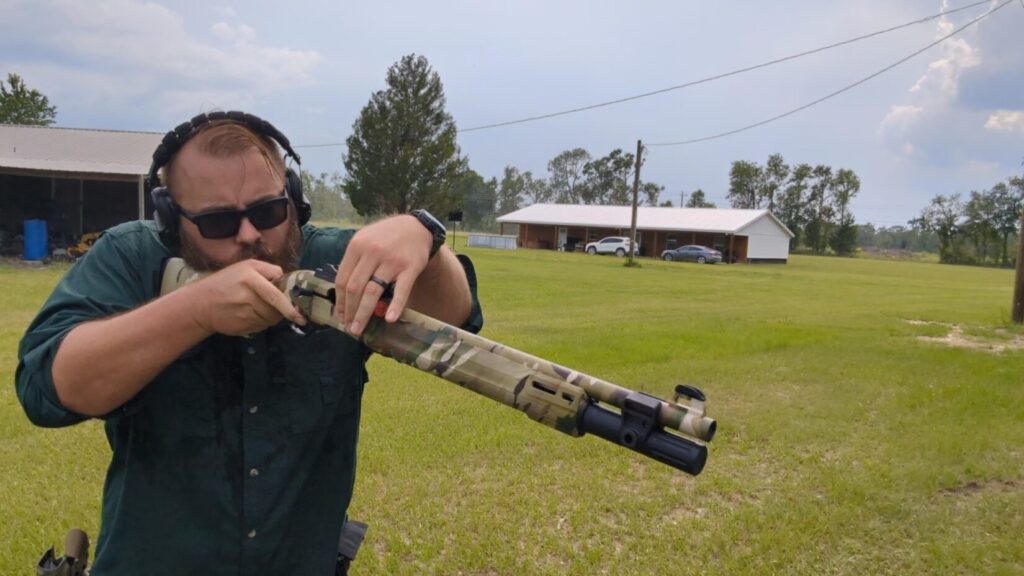
No handheld firearm guarantees an instant stop in every situation. A shotgun doesn’t guarantee an instant stop, but when loaded properly, at the right range, a shotgun creates more physiological damage than a rifle or handgun.
Shot Placement Forgiveness
Shotguns do not fire walls of lead. You have to aim a shotgun, and shot placement is the key to stopping threats.
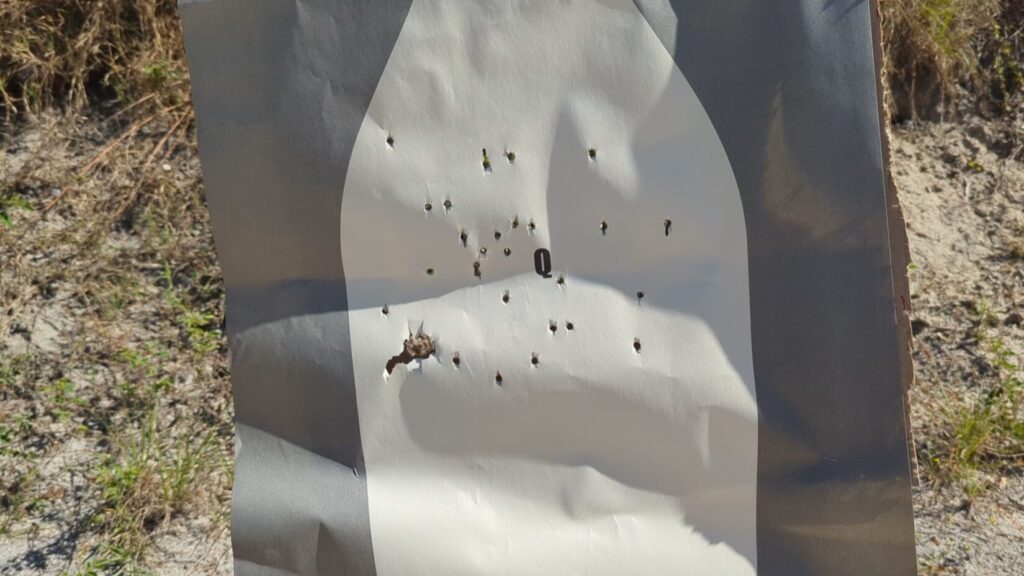
With a shotgun, the buckshot pellets do give you a hair of forgiveness. As they hit soft tissue, the pattern continues to expand and grow. This helps iron out that human error issue, at least a little.
Availability and Price
Shotguns are everywhere. In states with strict firearms laws, a standard pump or even semi-auto shotgun is unlikely to be banned.
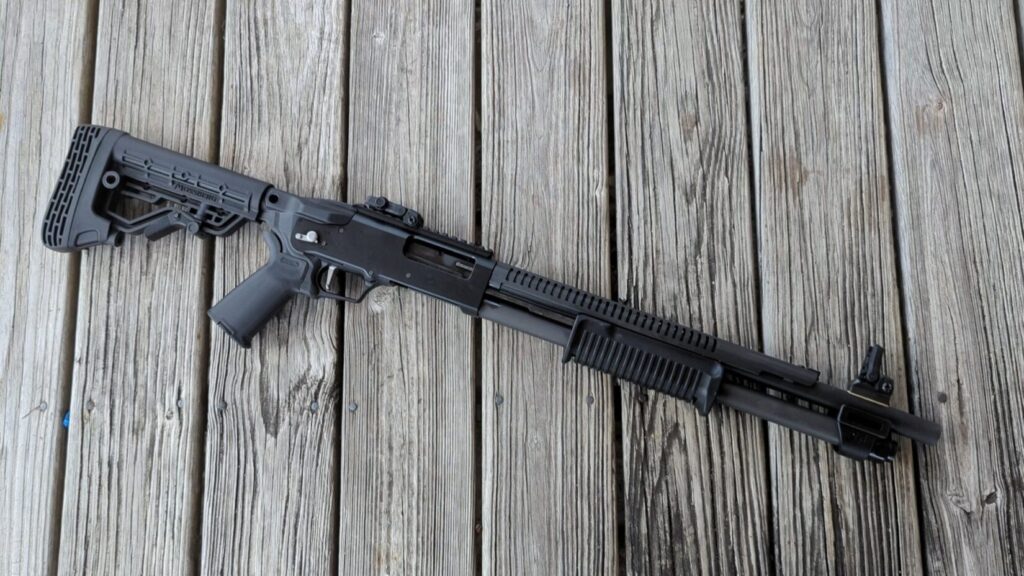
They can also be found at all price points, albeit some, primarily Turkish shotguns, lack reliability. With that said, a Mossberg Maverick 88 is likely the cheapest, most effective firearm for home defense. They are reliable, well-made, and available for a lot less money than a quality rifle or handgun.
Ammunition is also widely available for shotguns at basically anywhere that sells guns.
Versatility
Shotguns are versatile firearms capable of firing a variety of projectiles. For a lot of people, this doesn’t matter much for home defense. However, as a middle-of-nowhere resident, my defensive applications may vary.
On my side saddle, you’ll see rounds of birdshot, slugs, and No.4 buckshot. Inside the gun, I have nothing but 8 pellet Flitecontroll 00 buckshot loaded. I keep a variety of rounds for different purposes, none of which have to do with two-legged vermin.
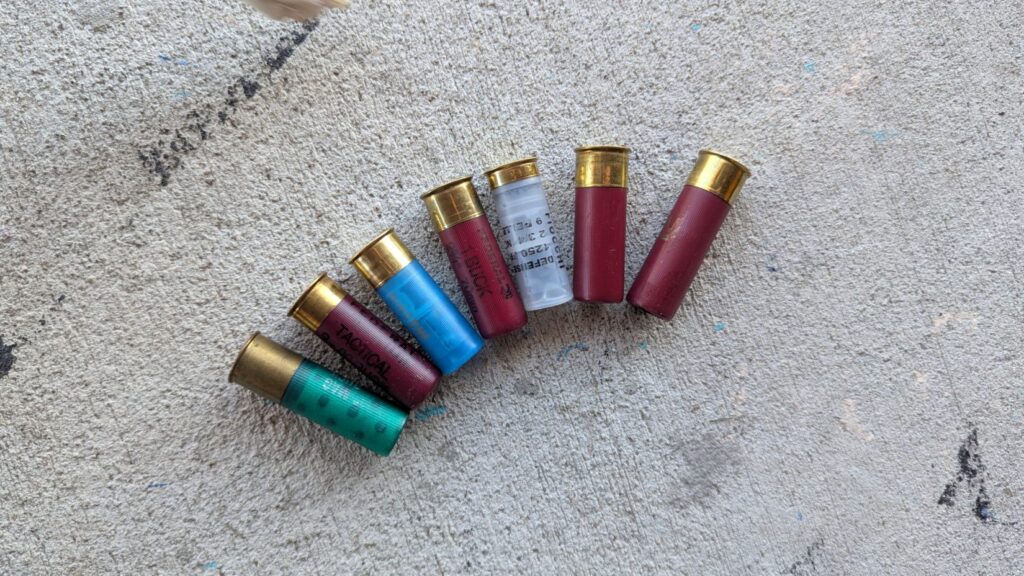
Birdshot is for dealing with venomous snakes. I’d prefer to chase them away, but as a man with children, I dispatch them.
Slugs are for hogs or coyotes across the field, as long as the backstop is clear. Hogs are invasive, dangerous, and vermin. Coyotes are vermin that chase my neighbors’ cows and prey on calves.
No. 4 buckshot is for dealing with closer-range coyotes. The extra pellets and spread make it a little easier to hit a moving coyote.
Again, this is a niche use case, but one worth mentioning for us middle-of-nowhere types.
The Jury Trial
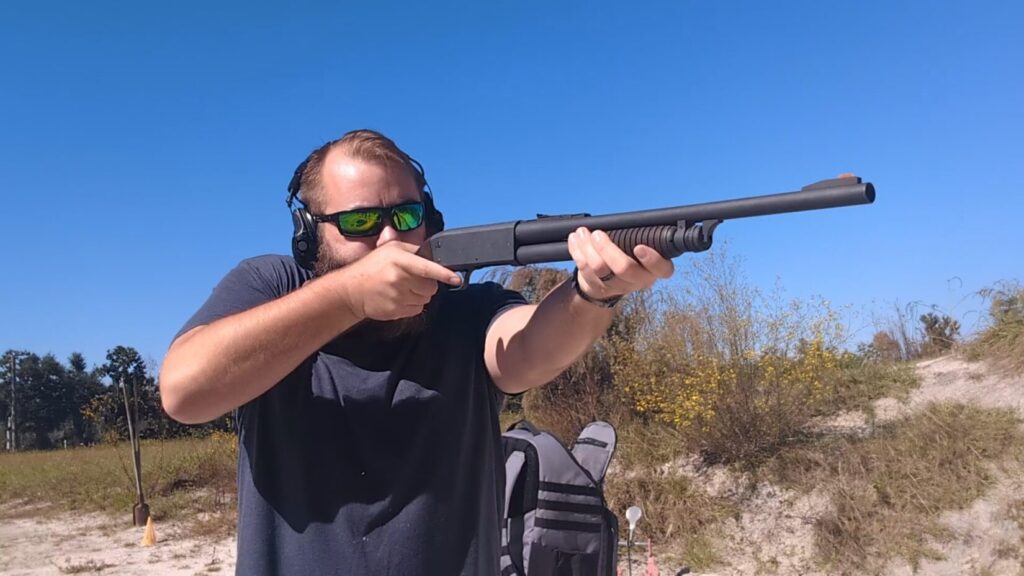
One benefit of a shotgun that is most certainly speculative is its appearance to law enforcement, prosecutors, and juries. Shotguns simply don’t appear as intimidating to the uneducated compared to modern semi-auto rifles.
There is also a strength in the fact that it’s less likely you’ll need multiple trigger pulls to stop the threat. Firing one or two rounds from a shotgun is easier to explain than firing five to six rounds from a rifle or handgun. Each use of force from a shotgun gives you anywhere from eight to 17 hits, but you’re still only pulling the trigger once.
Again, this is extremely speculative, and I hesitated to include it. However, I think it’s at the very least worth thinking about. That’s not any research I can find in terms of home defender convictions regarding shotguns vs. rifles.
However, as James Reeves explained on his channel, in mock jury trials, the Ruger Mini 14 was perceived better than the AR-15 when it came to both convictions and sentencing, so jurors at the very least consider the firearm used in defensive shootings when making their decision.
The Downsides
When selecting a defensive firearm, you have to know its advantages, but you have to study its downsides.
Recoil
Recoil is the biggest downside. Shotguns are not forgiving or egalitarian. A 12-gauge has noticeably more recoil than an intermediate rifle. While many will advocate for a 20-gauge shotgun for lower recoil, this isn’t always the case, and we’ll explore that later in the series.
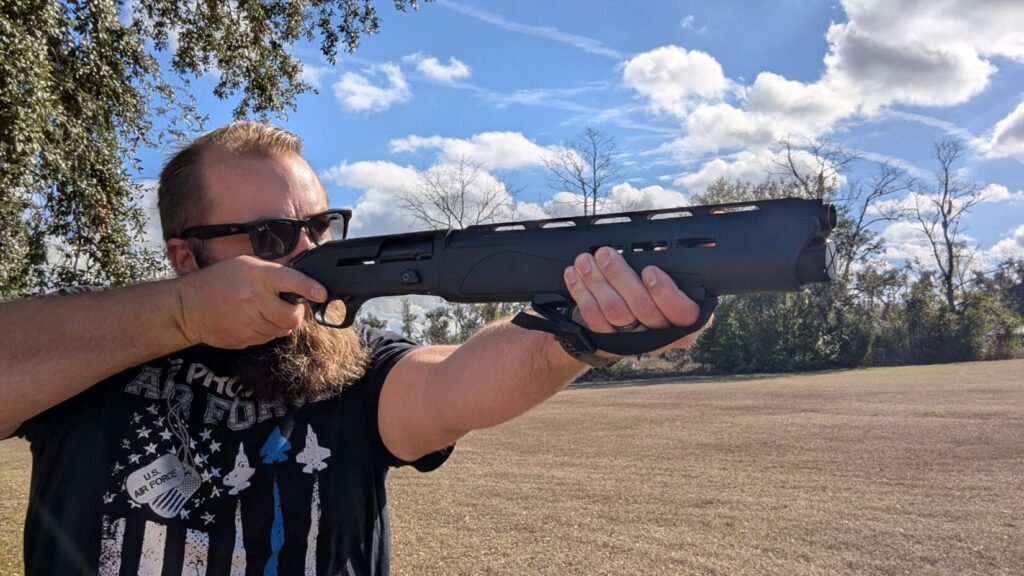
Recoil can be mitigated through training, ammo, and gun selection. It takes more effort and time to learn to use the shotgun effectively, but it can be done. We’ll cover ammo, gun selection, and training in the series as well.
Maneuverability
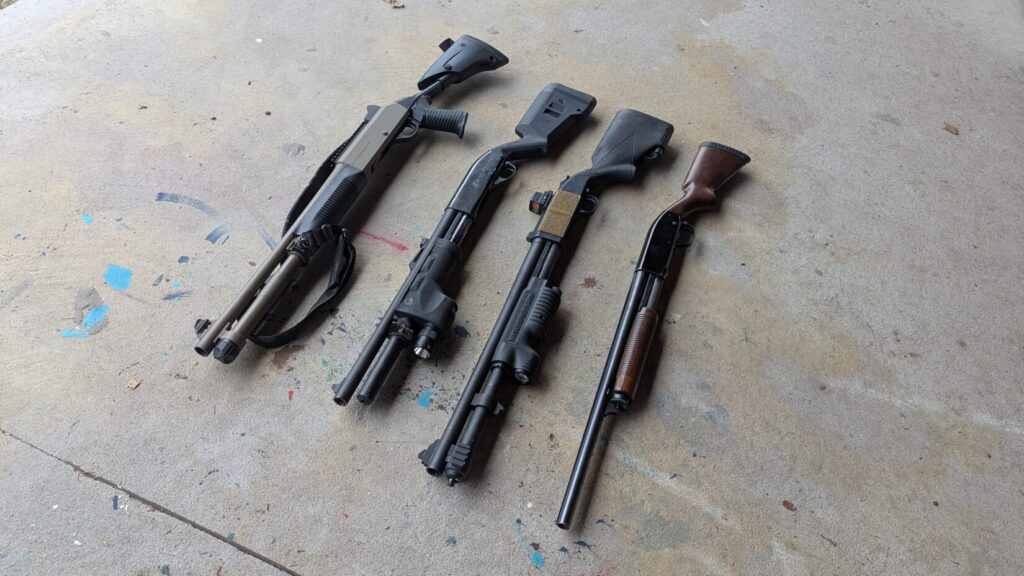
In most cases, you’ll be using a shotgun with an 18.5-inch barrel. Shotguns are notably a little longer than intermediate caliber rifles. They can also be heavier, especially when loaded and bearing accessories.
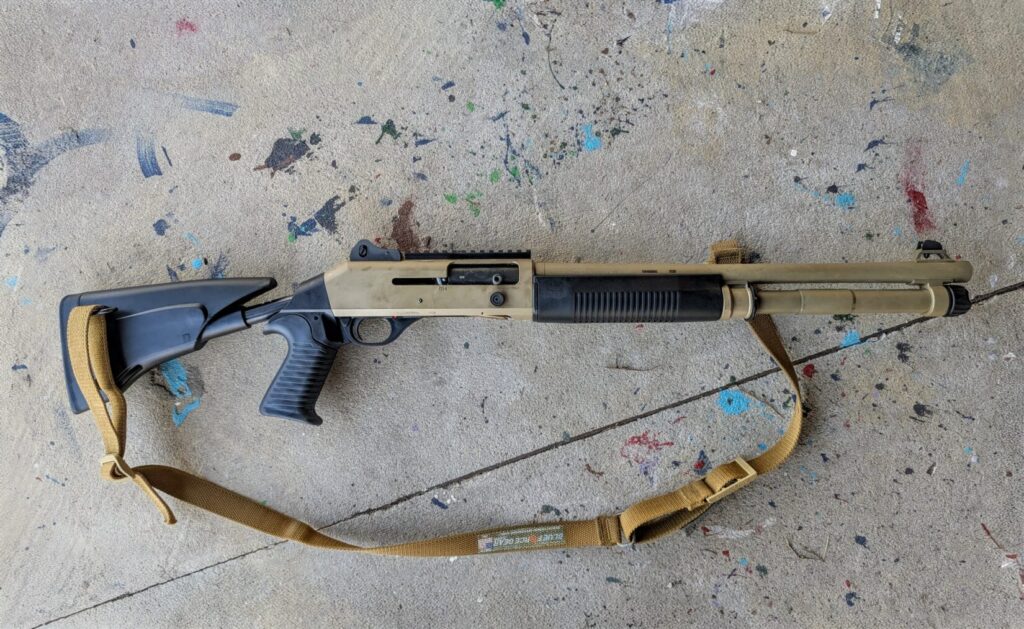
This makes them more difficult to use indoors. There are techniques one can apply, but it’s much easier to use a modern rifle, or even a large-format braced pistol, than a shotgun.
Accessories
Accessories are also difficult to mount compared to rifles and handguns. Adding lights and optics is much easier on a modern rifle than on a shotgun. There have been some notable strides in this department, but in general, accessorizing the gun is more difficult.
Manual of Arms
The manual of arms can vary between shotguns. There isn’t a universal set of controls between different guns and brands. This means if you use an 870, a Mossberg 500 might feel odd. When we get into European guns, we have even more oddities. In the AR world, an AR is an AR for the most part.
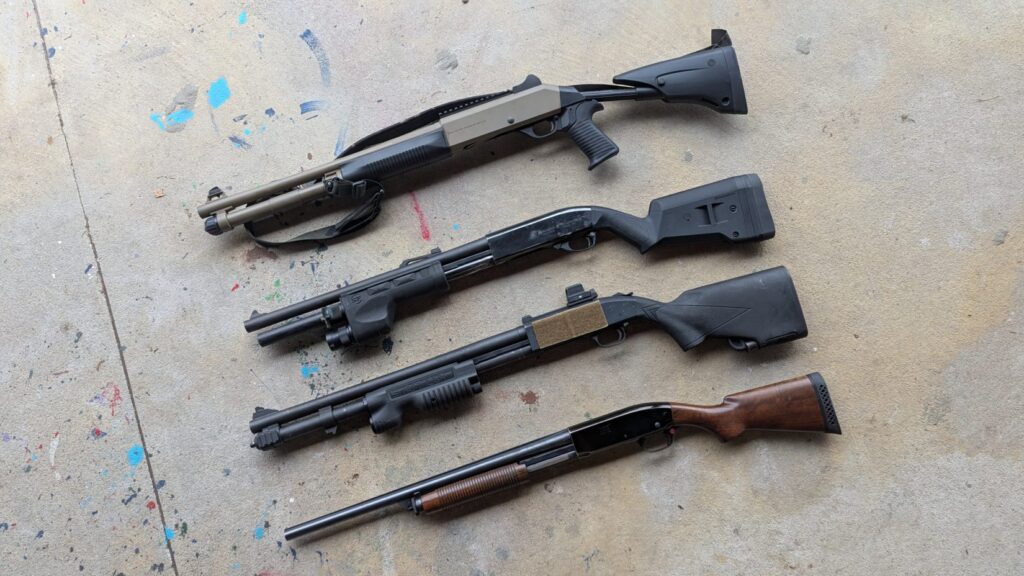
This means you generally have to figure out how your gun works and train extensively on it.
The Questionable Downside
An AR-15 with a standard capacity magazine holds 30 rounds, and a tactical shotgun holds anywhere from four to eight rounds. A shotgun with an 18.5-inch barrel typically tops out at seven rounds.
Comparing the two, it would certainly point to a lower capacity than other options. Objectively, the AR holds more rounds; most handguns hold twice as many rounds as a shotgun. In a military context, a shotgun is low-capacity because military engagements often require suppressive fire, and shotguns truly suck as suppressive weapons.
With that said, capacity is relative to the rounds needed to stop the threat.
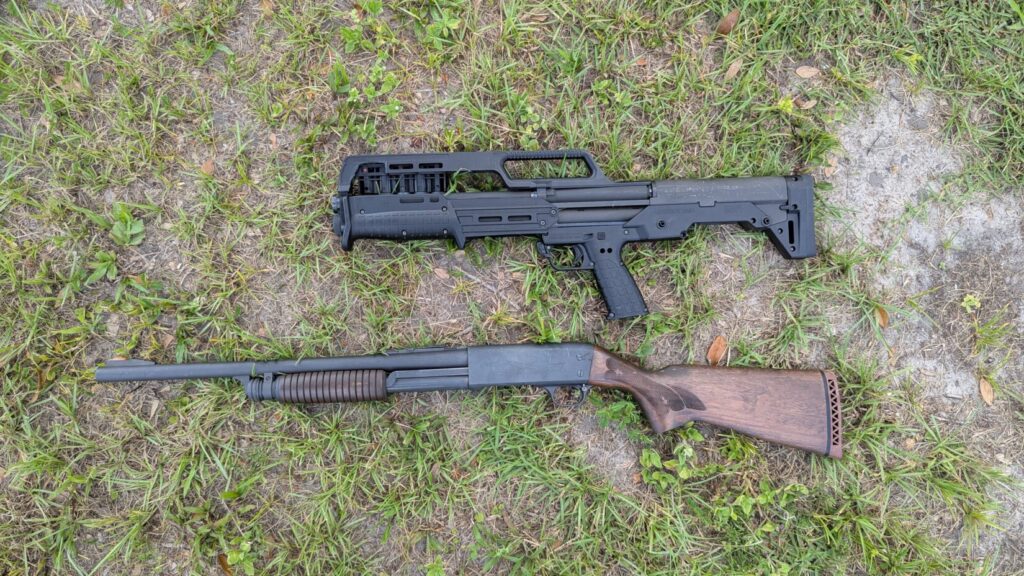
My shotgun, with its desired load, fires eight pellets per trigger pull and holds eight rounds. That’s 64 projectiles fired before I have to reload.
I’ll run a Bill Drill with a shotgun versus anyone with an AR or handgun, and we’ll see who puts six holes in the target first. I can do it in about half a second from the low ready.
A miss does mean eight misses, so it’s a bit like swinging an axe; if you miss, you waste a lot of energy. At home defense ranges, repeated misses are fairly unlikely with a long gun, unless you start unloading at noises in the dark, which is not a valid strategy for home defense.
How Much Is Needed?
Trying to find situations where reloads are necessary with a shotgun is difficult. I’ve found news stories of homeowners dealing with multiple threats with a shotgun, including one where the homeowner hit two of four home invaders, one of whom was armed, and ended the threat.
That’s not to say it hasn’t happened, but I cannot locate a news story where the home defender died with an empty shotgun.
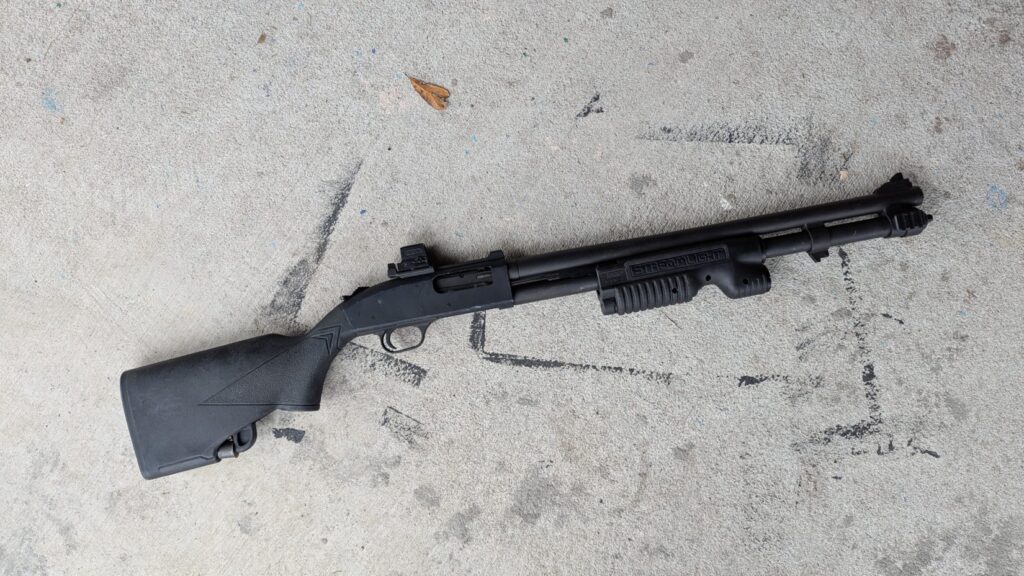
Even in the event of multiple bad guys, it’s going to get to the point where the bad guys are taking heavy losses, and we have to wonder how many of their friends they’re willing to climb over to get to you.
Sure, it’s possible, but is it probable? For that reason, I don’t consider the shotgun a low-capacity weapon, but you might, so I’ll leave this one for you to decide.
The Basics
That’s the pros and cons of a defensive shotgun, and that concludes Part 1 of this series. From here, we’ll discuss shotgun selection before diving even deeper into my favorite subject, shotguns.