
A lot of us want “military-grade” gear when it comes to firearms and the mountain of accessories that go with them, not because we plan on jumping out of a plane into a war zone—we just want good, solid gear. We’re looking for something reliable that will hold up to heavy use and in all weather conditions.
Eotech is an established name that most would recognize as high-quality. But quality often comes at a price…literally.
For example, the new Eotech HWS EXPS3 HD runs for about $1,000. While that’s not a surprising price for a military-grade optic, it’s often too expensive for some wanting quality on a budget. And I get it, there is a fine line between quality and “budget.” But you can have quality gear without shopping at the top-end of the battle gear pyramid.
The Eotech HWS 512 has been one of my favorites for a long time. It’s about half the cost of the HWS EXPS3 HD, but it’s still a solid optic that will get the job done.
Eotech started in 1995 as a subsidiary of the Environmental Research Institute of Michigan. They revolutionized the industry by introducing the first holographic weapon sights. Over the years, Eotech has built a massive reputation with elite military units and law enforcement. They have survived the harshest combat zones on the planet.
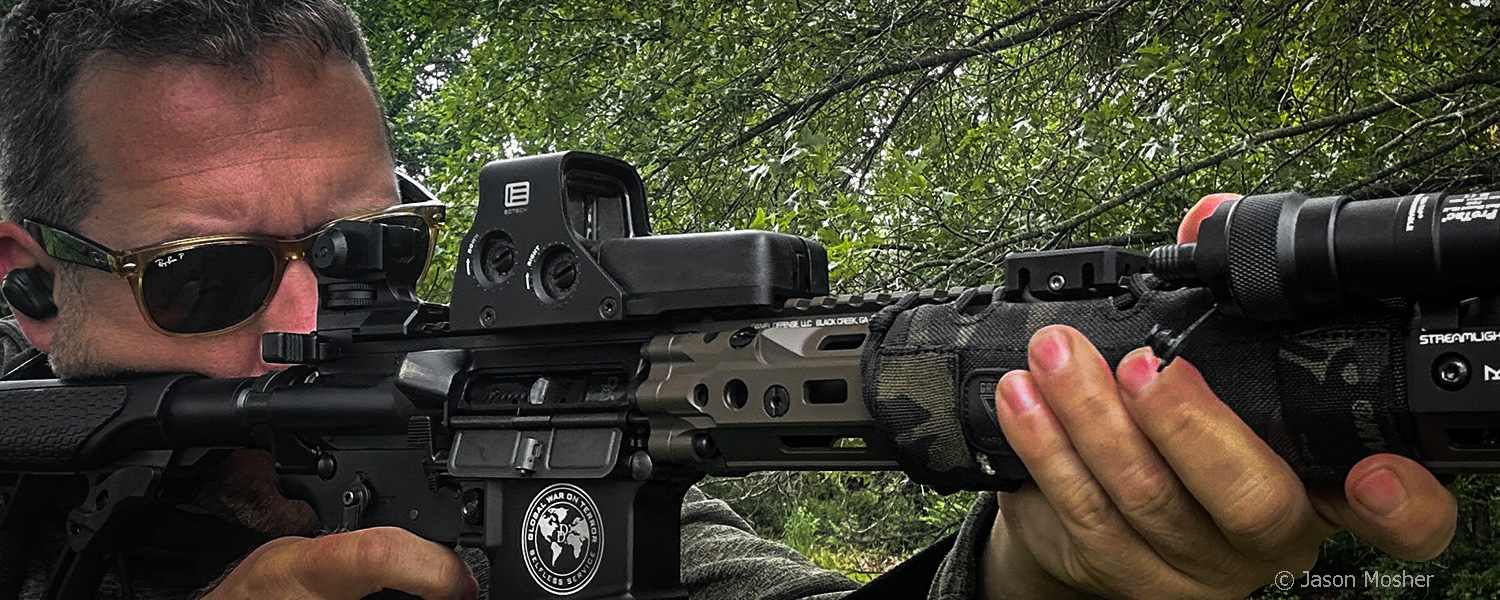
And so today, we are looking at the Eotech HWS 512 holographic rifle sight.
HWS 512: The Old Reliable Workhorse
The HWS 512 is the most popular non-night vision optic in Eotech’s lineup. It’s an older model and, of course, is longer and takes up more rail space than newer models. It measures about 5.6 inches long and weighs roughly 11.5 ounces.
The first thing that makes this sight so durable is the aluminum hood that protects the glass from impacts. I’ve seen these sights take a lot of abuse, and it doesn’t seem to affect them at all.
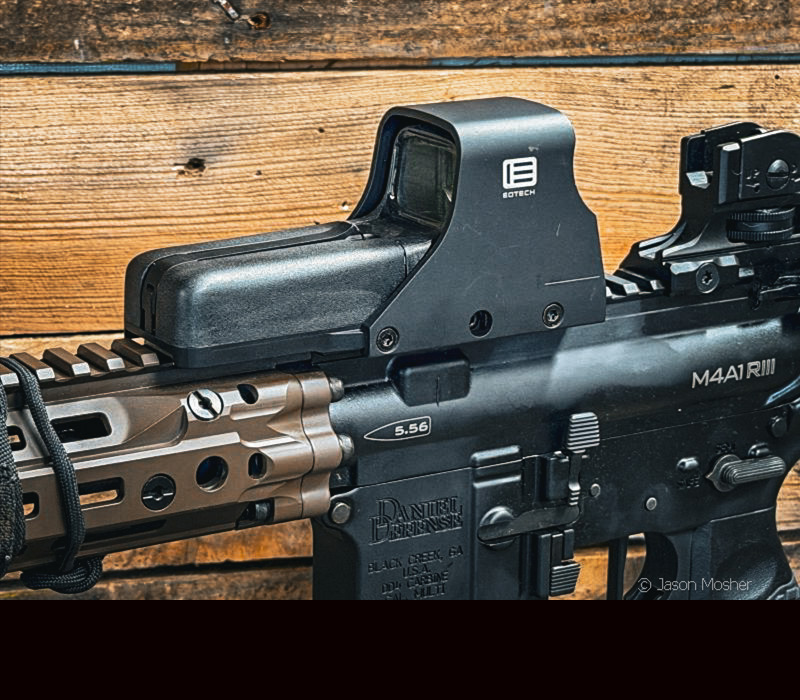
Another thing that adds to its reliability is the fact that it’s a holographic sight. There is some debate on what makes an optic “reliable,” but for me, holographic sights have an edge. We will discuss more in a bit.
The HWS 512 is water-resistant down to 10 feet, so it will start running in the rain, a tsunami, or whatever condition you are using it in.
AA Batteries are a plus for me
Because the HWS 512 uses AA batteries, the housing of the optic is longer, which takes up a little more rail space. This doesn’t really bother me at all, and I would gladly give up that space for a common battery size. While the CR123 battery is extremely popular in the optics world, it’s not as popular in the everyday world.
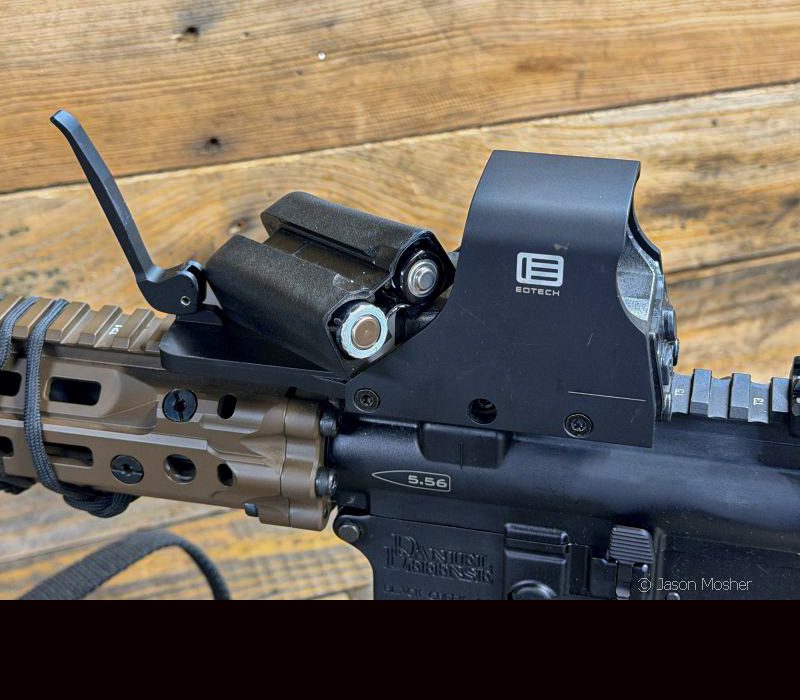
On a medium setting, you can get about 2,200 to 2,500 continuous hours of runtime from the HWS 512. That’s not comparable to the modern handgun optics that run for 50,000 plus hours these days. But it’s still plenty of run-time for a good rifle optic.
How to Operate and Zero Your Optic
Operating the Eotech 512 is very simple, and another thing I like about it. There are two large buttons on the back, making them easy to reach. To turn the sight on, just press either one of these buttons (Up or Down). If you turn it on with the “Up” button, it stays on for eight hours. Using the “Down” button sets it to a four-hour auto-shutdown timer.
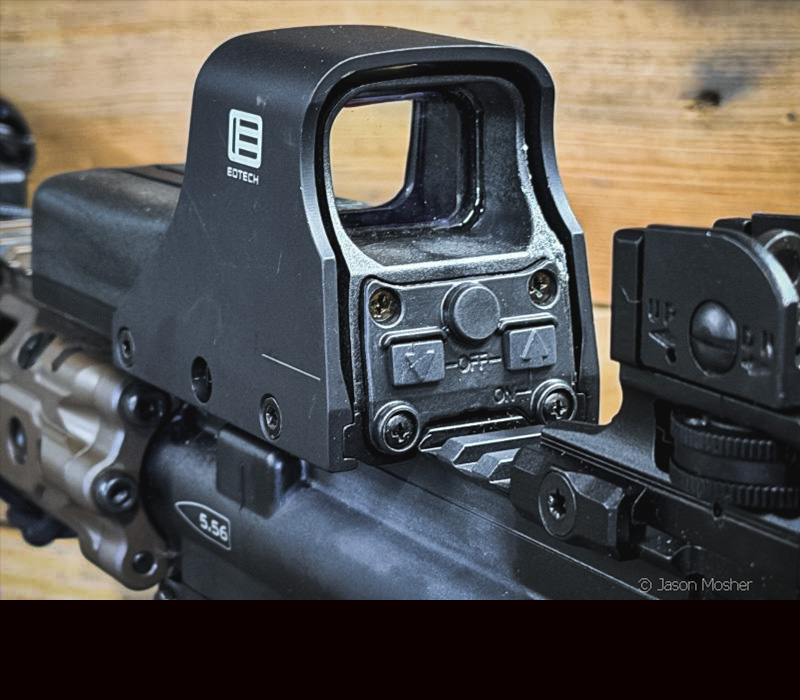
Pressing both buttons at the same time will turn the unit off immediately. It doesn’t have a “shake-awake” feature like most optics do these days. Having a shake-awake feature has its benefits, and while I prefer one, it’s not the end of the world.
On this particular set-up, I use fixed iron sights, so I have redundancy and an aiming device even if I grab the gun in a hurry and don’t get it turned on.
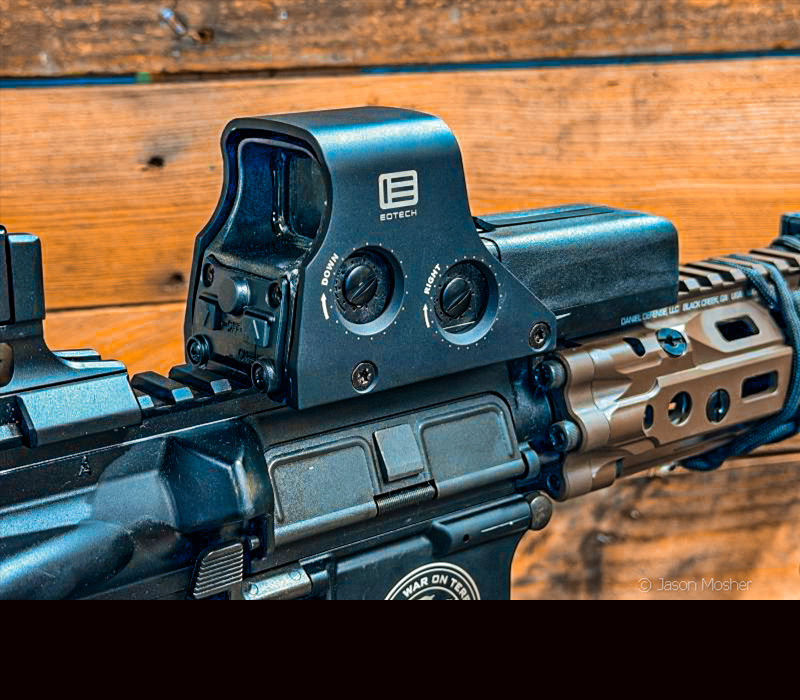
Sighting in the HWS 512 is extremely easy. There are two large adjustment screws on the right side of the housing. Each click represents 0.5 MOA, which is half an inch at 100 yards. I recommend starting at 25 yards to get on paper before moving to 50 yards, and then 100. There is a 1 MOA center dot for precise aiming and a larger circle for quick acquisition.
Mine has stayed zeroed since I first started using it.
Holographic vs. Reflex Sights
In the gun world, some will swear by reflex sights and others by holographic sights. Like anything else, each one has some pros and cons, so it really depends on what you’re using the optic for.
There are a lot of extremely reliable reflex dot sights out there that I love. But for a battle gun, I view holographic sights as the most reliable.
If you are not familiar with the two, there are several key differences between holographic and reflex sights.
A red dot reflex sight uses an LED to reflect light off the front glass. This makes the sight accurate, and it uses little power and can be compact.

Holographic sights, on the other hand, use a laser and mirrors to project a 3D image. This makes the Eotech reticle look like it is floating out in front of the rifle. One major pro for holographic sights is that they work even if the glass gets cracked. The front glass can even be completely broken out, and it will still run.
As long as you can see through a small piece of glass, the reticle stays visible. Standard red dots usually fail if the glass breaks because the reflection point is gone. But a holographic sight requires larger components, which makes the optic larger overall.
Is the HWS 512 Worth the Price?
When looking at the Eotech lineup, the HWS 512 is widely considered the best value. Most flagship models like the EXPS3 often retail for over $700 to $1,000. But you can typically find the 512 for between $350 and $450.
You are getting the same glass quality and battle-ready durability for nearly half the cost. The main trade-off is that the 512 lacks night vision compatibility and a quick-detach lever. It also has a larger footprint on your rail because of the long battery compartment.

Compared to other brands, the 512 sits in a unique middle ground. It is more expensive than budget red dots, but those budget optics are not true holographic technology.
You may pay more for an Eotech, but you are buying a duty-grade tool made in the USA. For many of us, the peace of mind knowing you have a “battle grade” optic is worth the extra investment. It is a professional-grade optic that fits a “working man’s” budget without sacrificing performance.