Full-sized guns are more difficult to conceal, but what’s the relationship between handgun size and concealed carry accuracy? Not group-size, exactly, but practical accuracy?
Two overly simplified generalizations: larger handguns are easier to shoot; smaller handguns are easier to conceal. At the two ends of the spectrum, there is some obvious truth to both statements. But what about the more nuanced differences between a compact and sub-compact? How do more subtle size differences change performance?
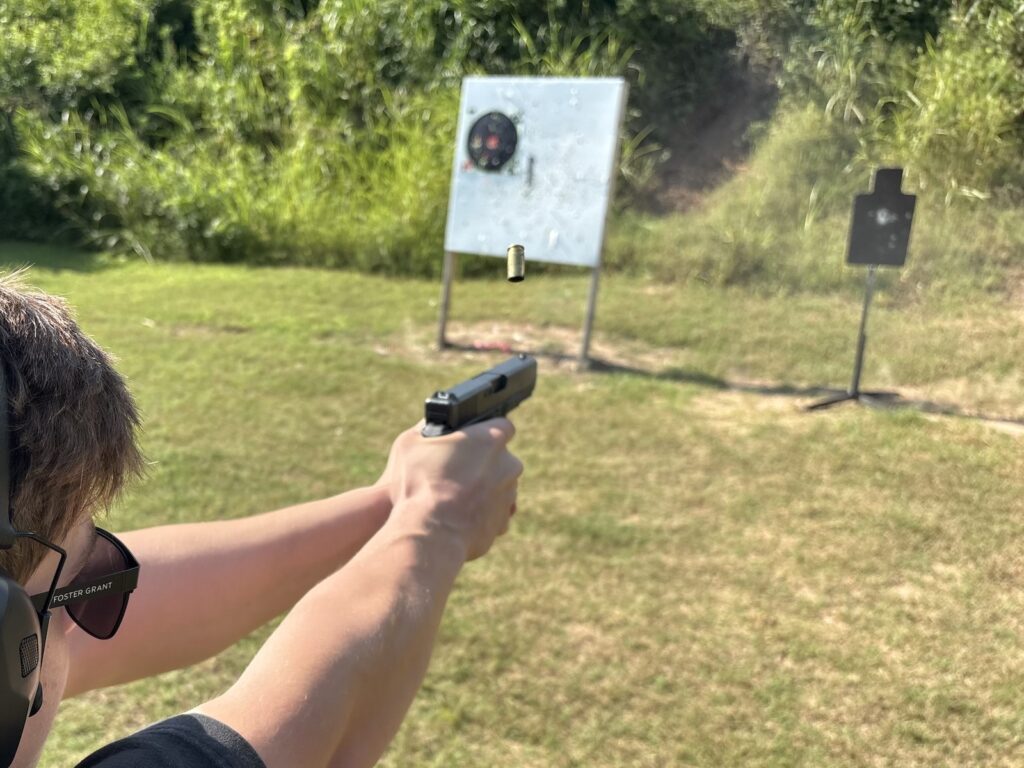
My (not completely scientific) experiment
I’m working on a hypothesis: handgun size affects control and accuracy.
There’s hardly anything revolutionary in this. There’s more surface area and opportunity for both weight and ergonomics on a gun like a Walther PDP than there is on a Ruger LCP. But most guns are closer in size. How would a GLOCK 19 compare to a GLOCK 43X in the hands of the same shooter?
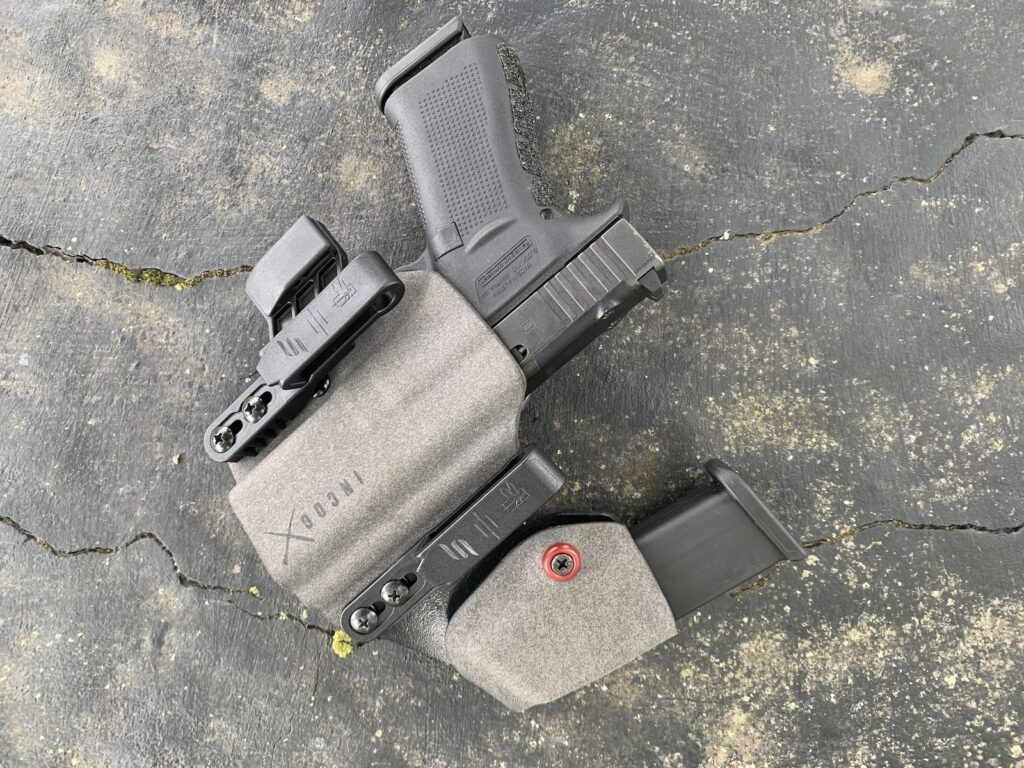
If my hypothesis holds, full-size guns should be easier to control than sub-compacts or micro-compacts.
Handgun Size in Drills, Concealability vs. Shootability
For years, the only phrase anyone used to describe keeping a handgun out of sight was “concealed carry.” That didn’t really capture the dedication to a lifestyle, and it certainly didn’t cover wearing a gun outside the waistband, so some began using “everyday carry.” The term didn’t mean concealed exclusively, and it covered larger guns that are more difficult to conceal.
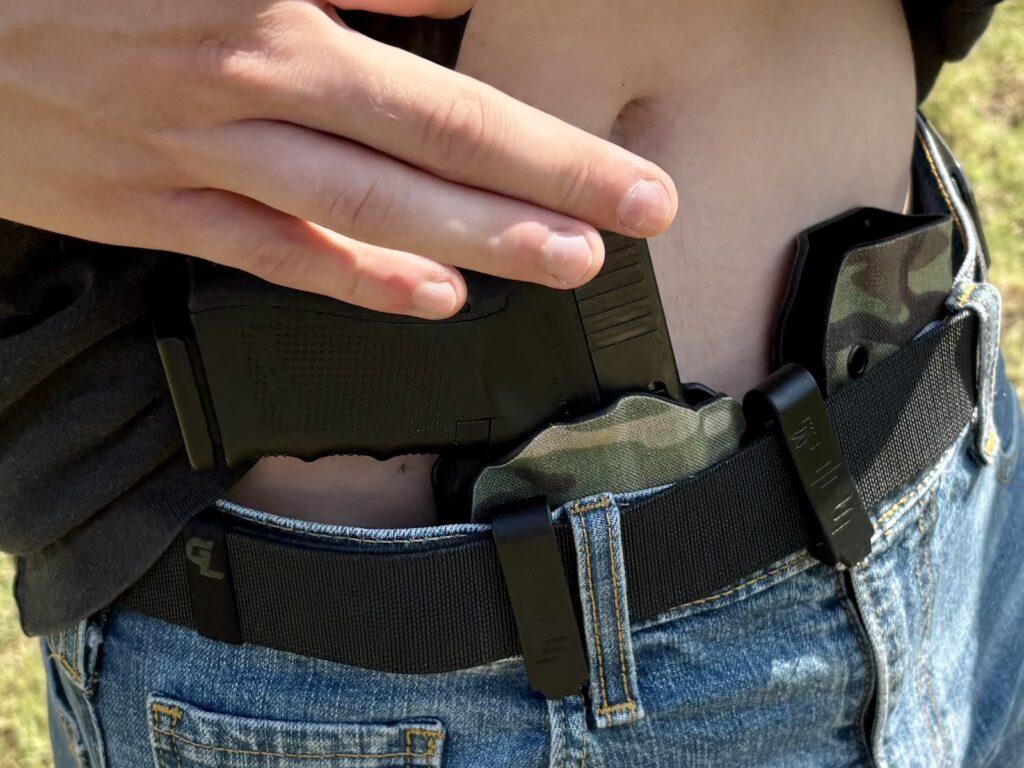
This is the tradeoff. It always has been. Big guns are easy to control. Small guns are easy to conceal. What do you give up by carrying a larger gun? Concealment. What do you sacrifice to have a light mouse-gun? Accuracy, control, and capacity.
So which one should you carry? Most people choose the smaller gun on the premise that it can be carried more easily and that most defensive uses of handguns happen at contact distance.
Gun sizes and shooting drills
The G43X and G19 are both common concealed carry guns. There are larger GLOCK 9mm guns, and smaller ones. Any deep dive into GLOCK’s catalog shows how there’s a continual progression of added grip length and barrel/slide lengths.
| GLOCK 19 | GLOCK 43X |
| GEN 4 | Slimline |
| Barrel length: 4.02 in | Barrel length: 3.41 in |
| Slide length: 6.85 in | Slide length: 6.06 in |
| Slide width: 1.00 in | Slide width: 0.87 in |
| Frame width: 1.26 in | Frame width: 1.10 in |
| Overall length: 7.28 in | Overall length: 6.50 in |
| Overall height: 5.04 in | Overall height: 5.04 in |
| Weight: 23.65 oz | Weight: 18.70 oz |
| Capacity: 15+1 | Capacity: 10+1 |
For those new to guns, the G34 and G17 are both longer. A G48 sits between the G43X and the G19. The original G43 has a shorter grip. And then there’s the stubby double-stack G26. Basically, GLOCK has filled in the catalog by taking the same basic action and expanding it ever so slightly to create many nuanced options.
Testing theories on the range
I’ve put thousands of rounds through my G19 over the years. Before this experiment, I’d only shot one magazine out of a G43, and that was years ago. But both guns work exactly the same.
The inverse is true for my friend Gabe. The G43X is his EDC gun, and he trains with it regularly. He has shot the G19 many times, but it isn’t his go-to gun.
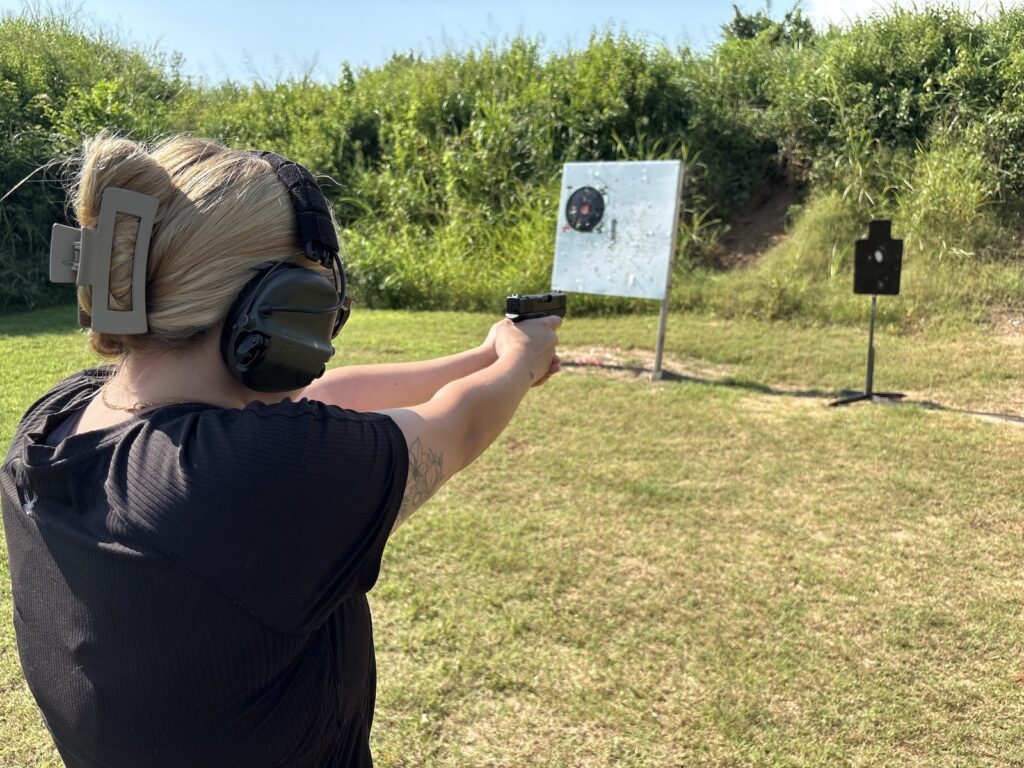
The third person is new to handguns. Eva’s just starting a career in LE, but had never shot the GLOCKs I picked for the test group.
All of these exercises were conducted with draws from Incog X holsters.
Run-and-gun
Our set-up was easy. We started a run-and-gun course at 60 yards. There were five short runs. All movement happened with fingers off of triggers and guns holstered (we were on a large U-shaped outdoor range with high berms). In total, we fired 10 rounds during the sprint.
- Step one: fire one round from a concealed draw, reholster, and run to the 30-yard mark.
- Step two: fire two rounds and reholster, then run to the two yard mark.
- Step three: fire two, reholster, cross 20 yards along the row of targets
- Step four: fire two, reholster, run out to the 30-yard mark.
- Step five: fire two, reholster, run out to the 60-yard mark.
- Step six: fire the last round.
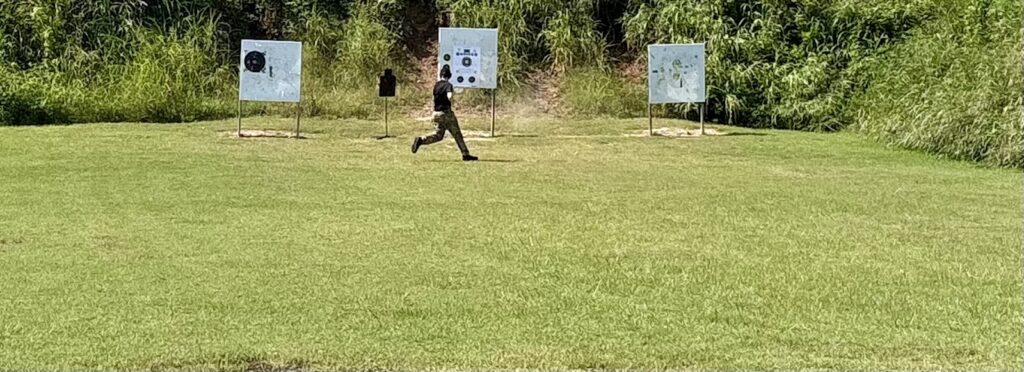
I ran the drill with the GEN 4 Glock 19. After a rest period, I repeated the drill with the G43X. With the G19, I only dropped one shot. With the G43X, I missed three times.
Gabe’s results: At 60 yards, his shot placement was spotty. From the halfway point in both runs, he was connecting better, but still not great. He consistently hit the majority, but not all of the shots. As expected, he did well at close range.
When he ran the same drill with my G19, he dropped two additional shots. He shot better with the G43X than with the G19.
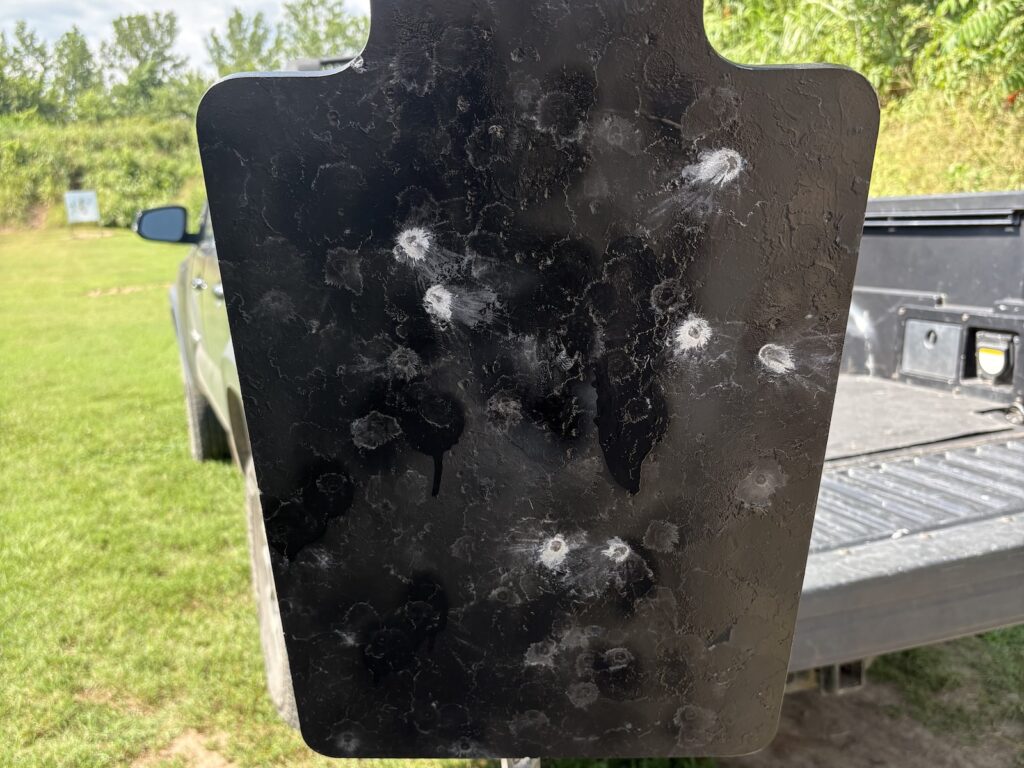
There’s no surprise here. Running added a new element to this. We were pushing to clear the course as fast as we safely could. I never fully stopped to take a shot, but I did slow down to a walk. Moving and shooting makes a noticeable difference. But it’s a good skill to train.
The other new element was counting shots fired instead of shots hit. There’s a tendency to shoot until you know you connected, and with steel you can hear it. With only one or two shots at every stage, missing meant moving on anyway.
Drills are adaptable analogues, not congruent simulations. This one builds the discipline to reposition until you’re confident before dedicating ammunition, and to reposition until you’re comfortable before you run out of it.
Static tests
How would the guns fare in a less stressful test? We shot from 7 yards to see. For this segment, we drew from concealment each time, fired one round at center mass on a steel torso target. Three draw/shoot combos with the G19, then three with the G43X.
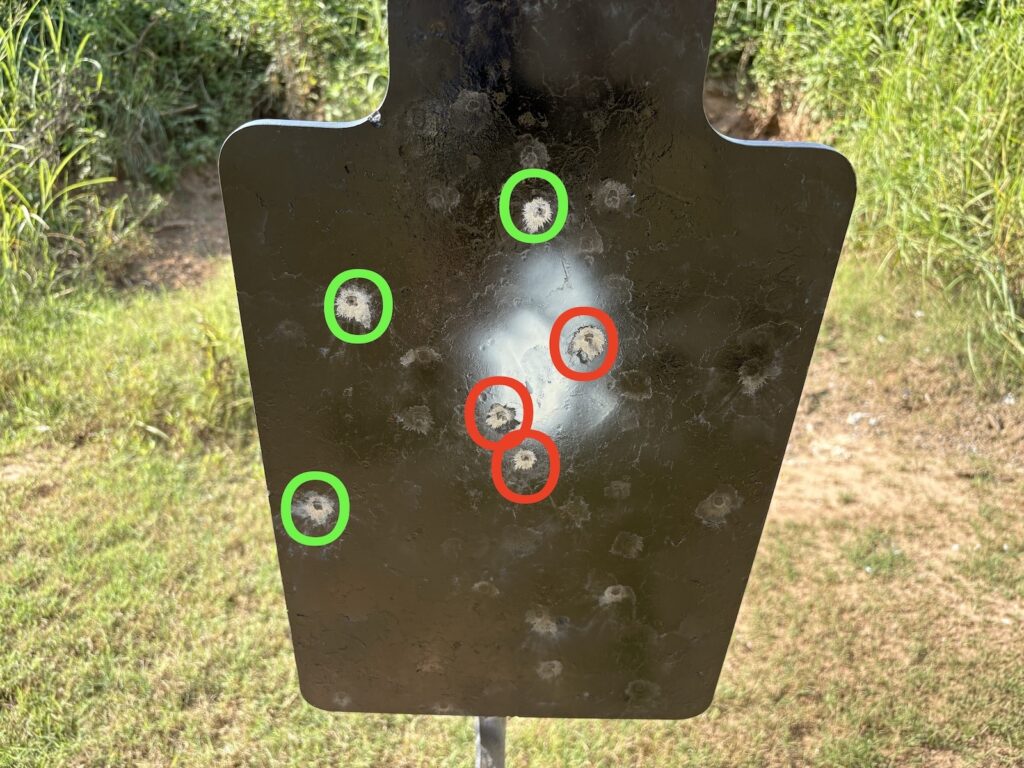
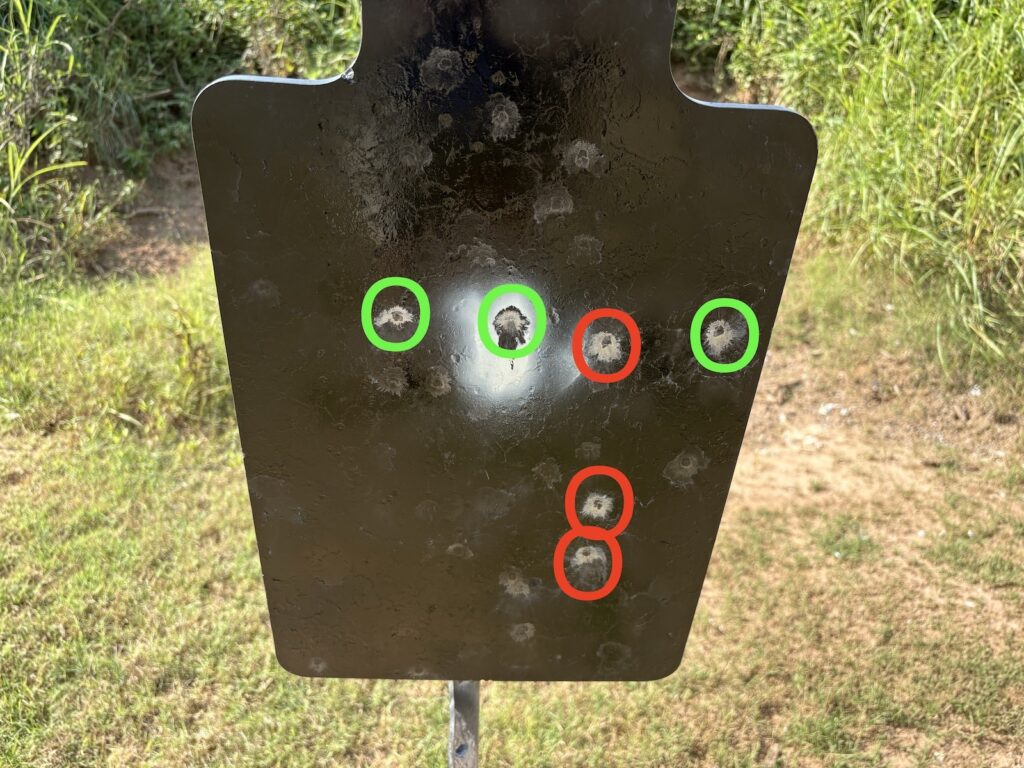
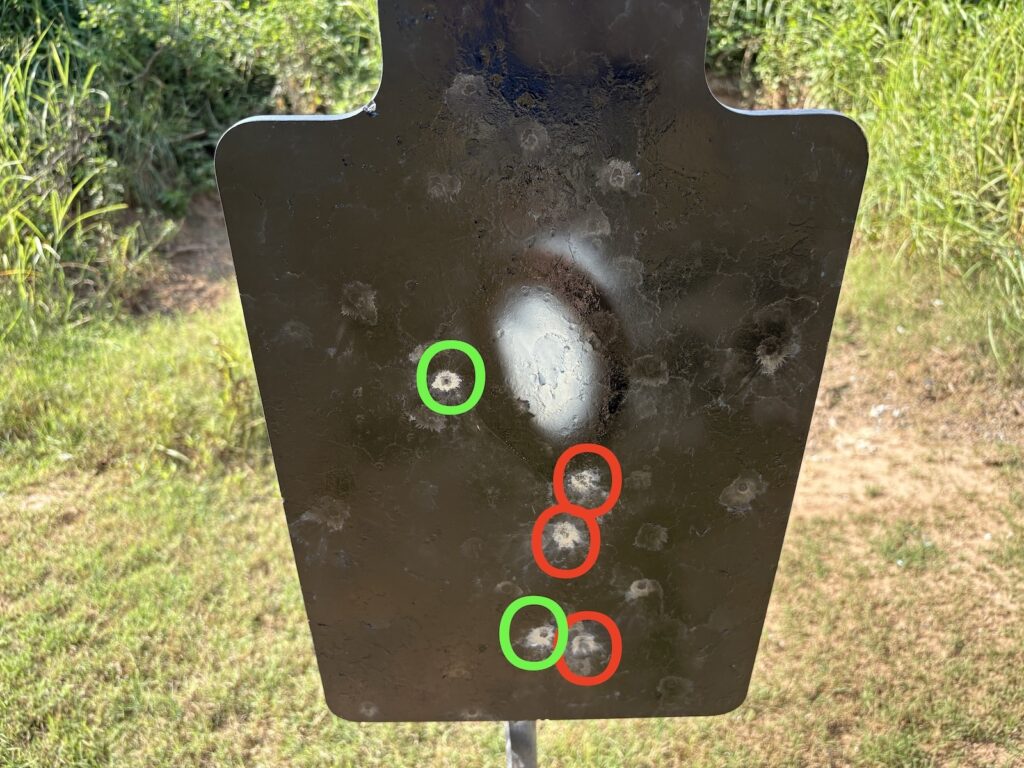
I shot better with the G19. Gabe shot better with the G43. Eva’s results? Inconsistent. She showed less of a pattern.
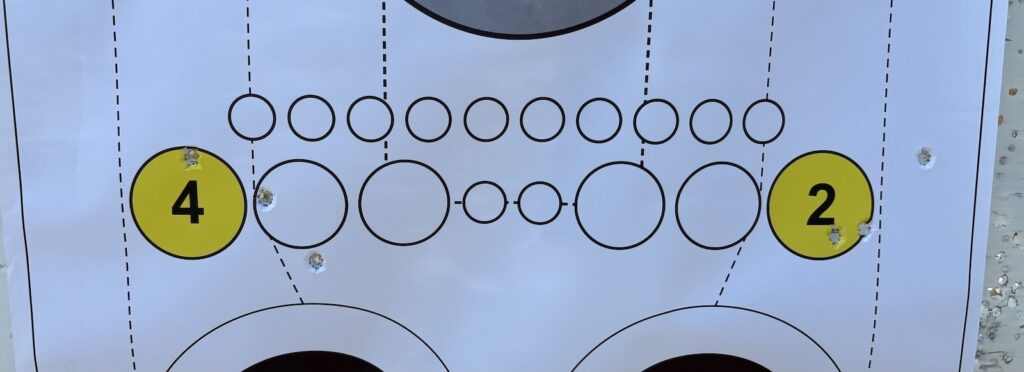
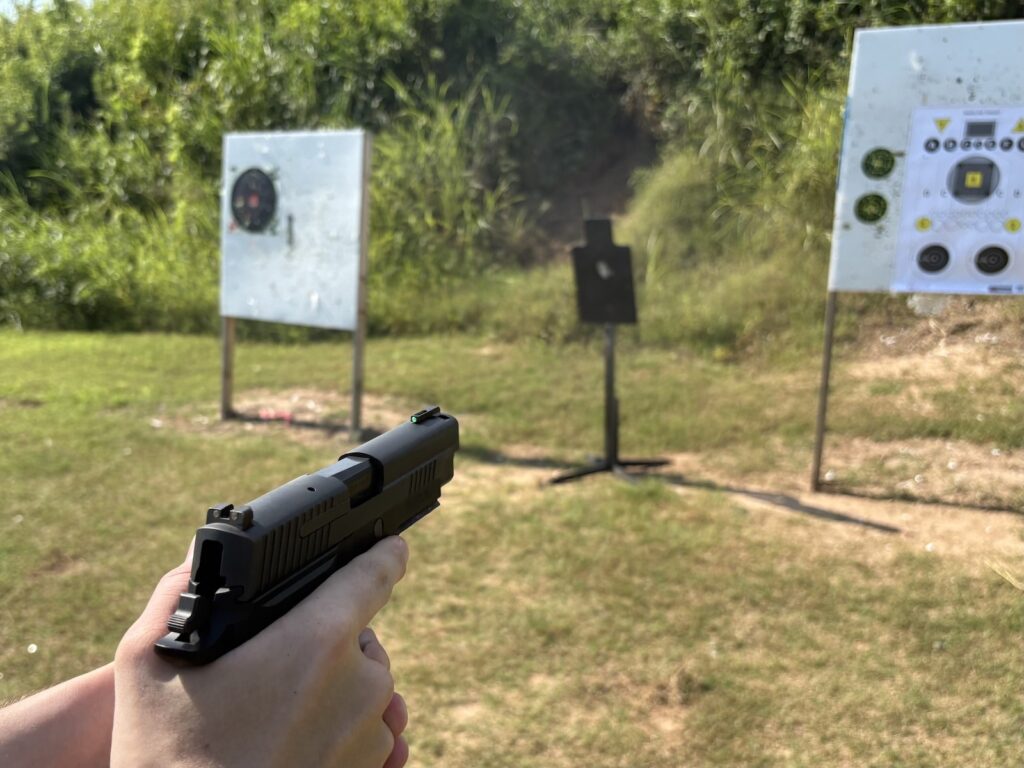
After, we backed out to the 25-yard mark and switched up the guns. For this last segment, we shot a P365XL and a P226.
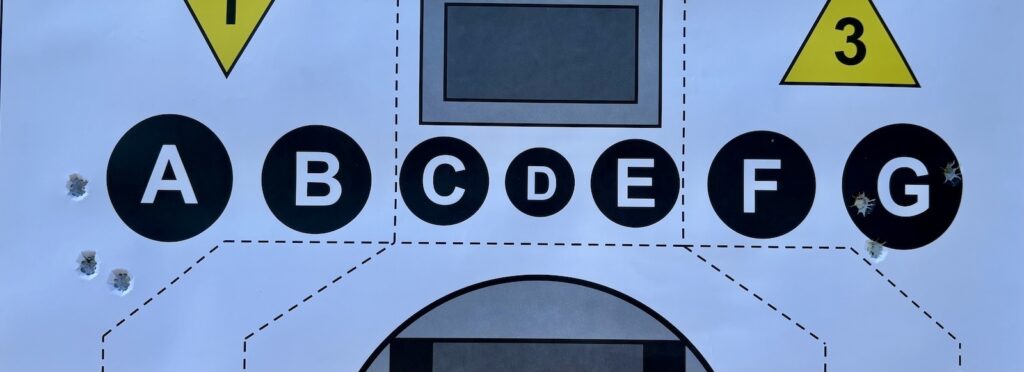
With the G43X and the G19, the differences are subtle. A P226 and a P365XL share almost no similarities. All three of us shot better from 25 yards with the P226.
The advantages of the larger gun
Between a smaller gun and a larger gun with the same ergonomic design, the larger gun almost always has the edge on accuracy and control. More weight means less felt recoil, and more surface area means more leverage and more potential to manage recoil.
Full-sized handguns tend to have more capacity than compacts or subcompacts, too, and they can be a little more practical to put a light and optic on. That’s why duty guns have traditionally been large. But if open carry is the intention, as it is with most duty pistols, sacrificing concealability is much less of a concern.
What you gain from smaller pistols
Smaller pistols sacrifice control surfaces and capacity, but they make it a lot easier to carry concealed. Don’t get me wrong, there are plenty of people who can and do carry full-sized handguns daily, both concealed and open. And that’s absolutely fine. But that isn’t viable for many people. The more compact a gun is, the less obtrusive it is in carry and the more accessible it is as an everyday option.
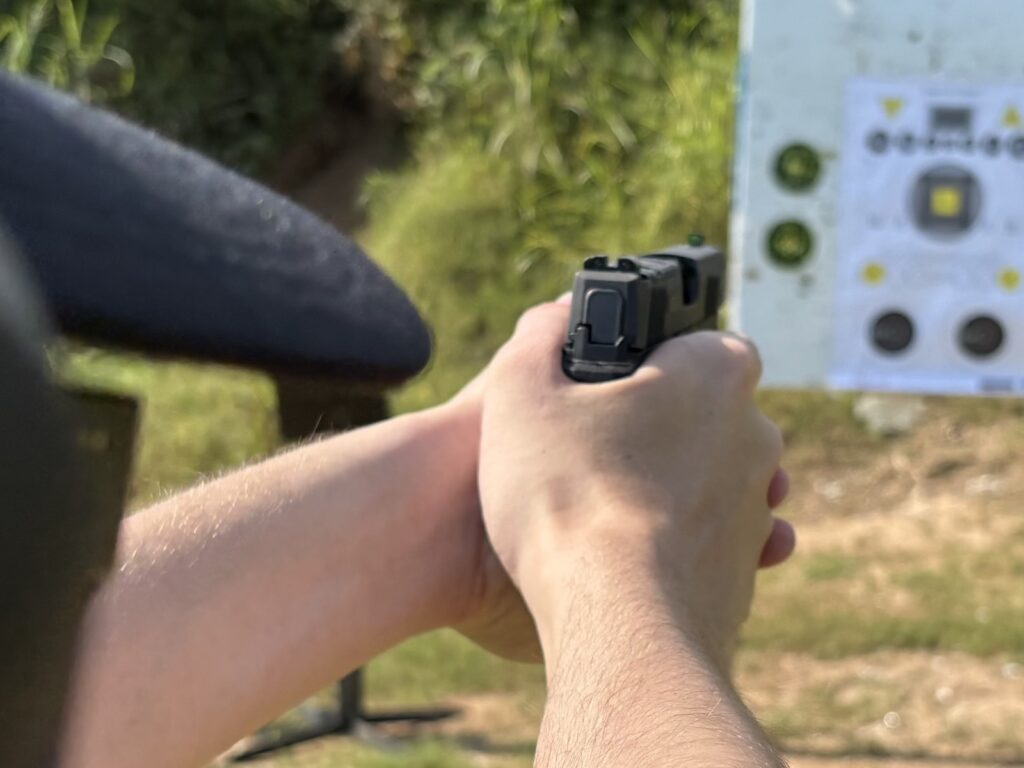
How small is too small? This is often a caliber question, too, as mouse-guns are built for much less effective rounds.
Conclusions
There are two key takeaways from our informal tests. I assumed we’d all shoot better with larger handguns, but it wasn’t the case. In drills where we compared the guns we regularly train with, we both shot better with our own. There’s no discounting the muscle memory and core competencies you build through regular trigger time with the same handgun.
When shooting with guns we neither actively carry nor train with, the larger, heavier guns tended to produce better results.
There are many ways you could spin this type of testing off for competitive shooting sports. I’m not shooting competitively, though, so I’m looking at this through the lens of EDC. For me, the takeaway has more to do with building the human skills needed for proficiency and less to do with trusting a tool to provide all the answers.
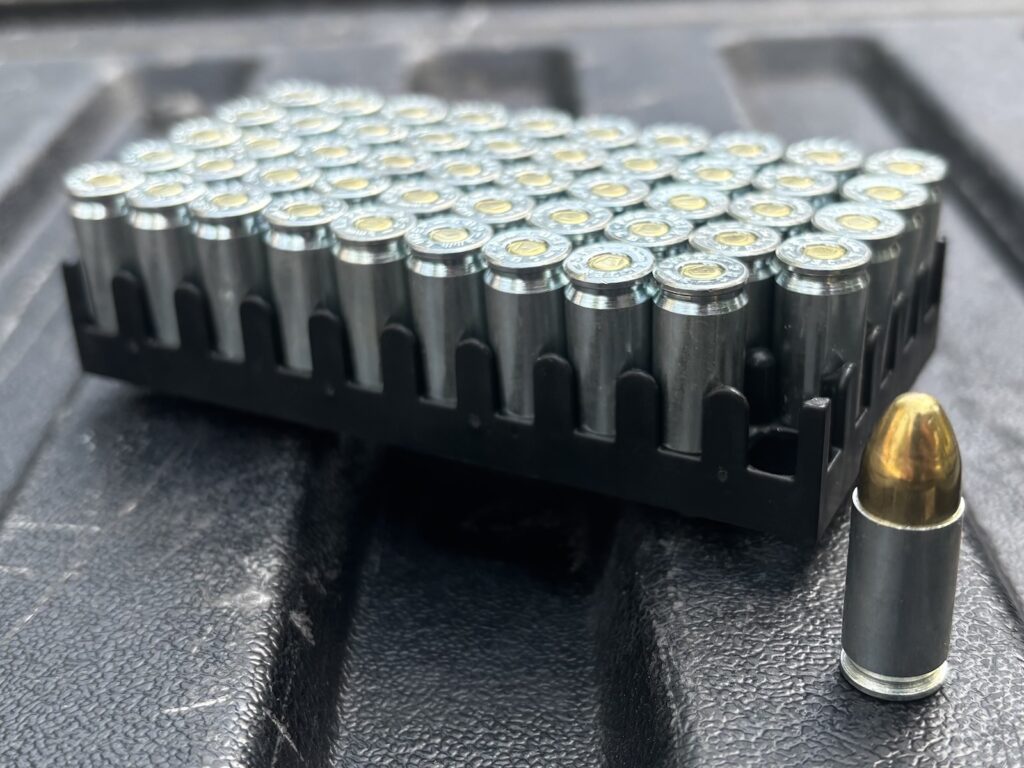
And, as always, you’ll need ammo. While mag-dumps aren’t training, you’ll still run through hundreds of rounds in an afternoon. MagTech’s 9mm is affordable and reliable.
Concealed Carry Gun Size FAQ
Does gun size affect shooting accuracy?
Yes. Longer barrels may mean longer sight radii, which allows for more accurate sight acquisition. Longer barrels, up to a point, help stabilize the bullet’s flight.
Micro compact or subcompact or compact 9mm for EDC?
I prefer a compact, the G19, but it isn’t always practical to conceal. Generally (with pistols), a smaller gun means a lower capacity but also a lower weight. What’s best for you depends on your build and your style of carry (I’ll have an article about that around the time this goes up). You can always carry a smaller gun, but you can’t always carry a larger one, so see what’s most comfortable and most concealable and go with that.
How much does barrel length affect accuracy at 7 yards?
I don’t find much difference in a four-inch and five-inch barrel, but my groups open up a little bit when I drop down to the three-inch barrel range.
Printing vs shootability in handgun choice: which is more important?
If your gun prints enough that you can tell it’s a gun, it’s beginning to miss the point of concealed carry. And if you can’t conceal your EDC gun and choose to leave it behind, what good is it to you? I have carried much smaller guns in situations where a G19 just isn’t practical. Shootability is important, yes, but so is adapting your carry to your situation.
What’s the best size handgun for new concealed carriers?
There’s a sweet-spot for new gun owners that allows for both ease of concealment and ease of training. I’m thinking of the G43s, P365s, or Taurus G3c sized guns. These are easy to conceal and not too abusive on the range. Learning to shoot is just as important as learning to carry, and a comfortably sized pistol does help.
Does a smaller gun really hurt your accuracy?
Yes. Snub-nosed revolvers and the micro-compact .380s are in their element at contact distances. Once you get into the truly tiny guns, like the NAA rimfire revolvers, accuracy is an afterthought.