
Nighthawk and Alchemy Custom Weaponry are classic-style custom gunsmiths. They hand-fit everything and offer many upgrades and custom features you don’t commonly find elsewhere. But they’re in the minority of 2011 manufacturers.
Other makers are also expert craftsmen, but they use modern machining and innovative design to deliver a truly unique product. Options are limited, but each one is special. These examples are what modern 2011s have become—functional works of art straight out of a science fiction film. First, the Miller Precision Ranger 9X.
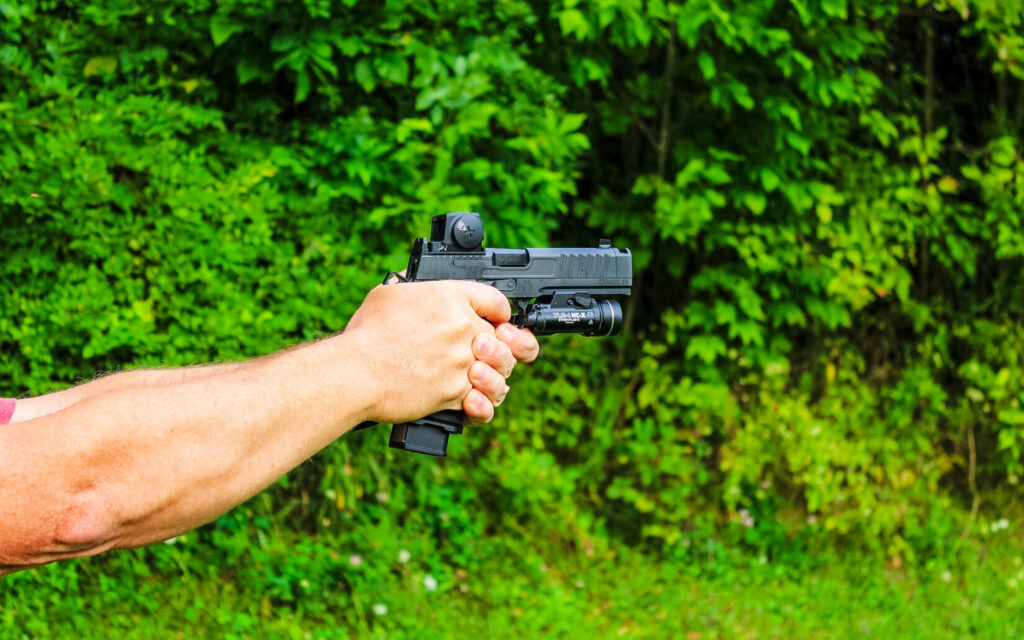
Thank you to Miller Precision for providing a sample. All thoughts and opinions are my own.
About the 2011 Project
To understand the history of the 2011, Staccato, and the rise of this pistol classification, check out “Party Like It’s 2011: Staccato and the 2011 Revolution,” which tells the origin story. That article lays the groundwork for what follows, and this is meant to give you honest opinions on this growing market. Every pistol in the series so far is on the 2011 Project tag page.
Unlike other trends that come and go, this one has staying power. But unlike other trends, pistols in this class can cost thousands of dollars. The goal here is to give you an unbiased opinion on how these models stack up and help you decide which is best for your needs and budget.
Who Is Miller Precision?
Miller Precision is a manufacturer of double-stack 1911 pistols, grip modules, and accessories. The company grew from a simple lesson founder Houston Miller learned from his father: how to work. After years spent machining one challenging project after another, he eventually landed on the double-stack 1911 and saw an opportunity to improve the platform.
Drawing on lessons from the evolution of the 2011, Miller Precision combines modern machining, gunsmithing, and shooting experience to build innovative pistols, grip modules, and accessories. The company’s philosophy is straightforward: keep tinkering, keep improving, and never settle for good enough.
Miller Precision Ranger 9x SPECS
Standard Specifications
| Specification | Miller Precision Ranger 9X |
|---|---|
| Action | Single-action, hammer-fired, linkless barrel |
| Caliber | 9mm |
| Capacity | 17, 20 rounds |
| Barrel | 5″ including compensator |
| Grip module | Machined 7075 aerospace-grade aluminum |
| Sights | Blackout front and rear |
| Optics | Optic cut with plates; RMR/SRO plate included |
| Trigger pull | 2 to 2.5 lbs. |
| Finish | Black DLC or Silver PVD |
| Price | $4,675 to $4,800 |
Ranger 9x FEATURES
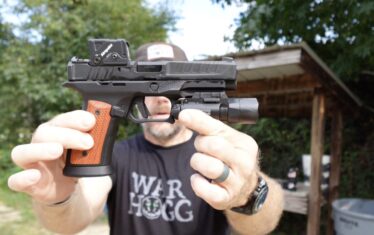
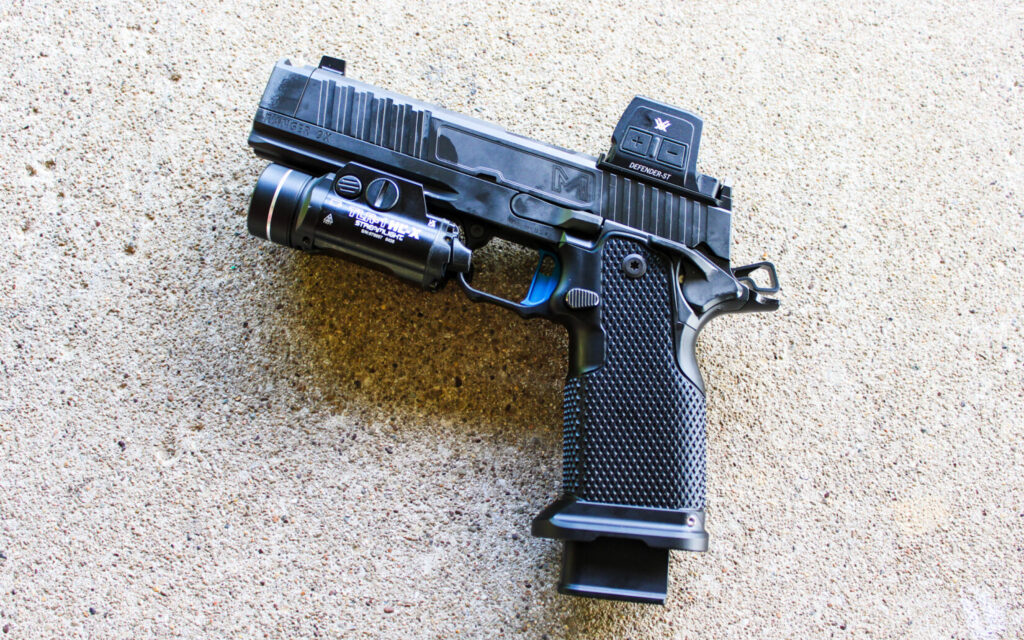
The Miller Precision Ranger 9X is a 5-inch, double-stack 1911 built around a linkless barrel system designed to simplify maintenance and barrel changes.
The 5-inch barrel length includes the compensator. A competition magwell, pinned grip safety, ambidextrous safeties, ambidextrous magazine release, and blackout sights complete the package.
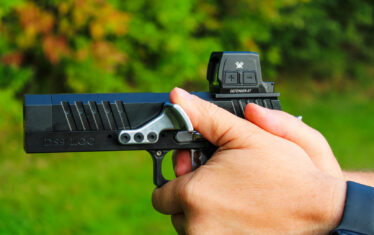
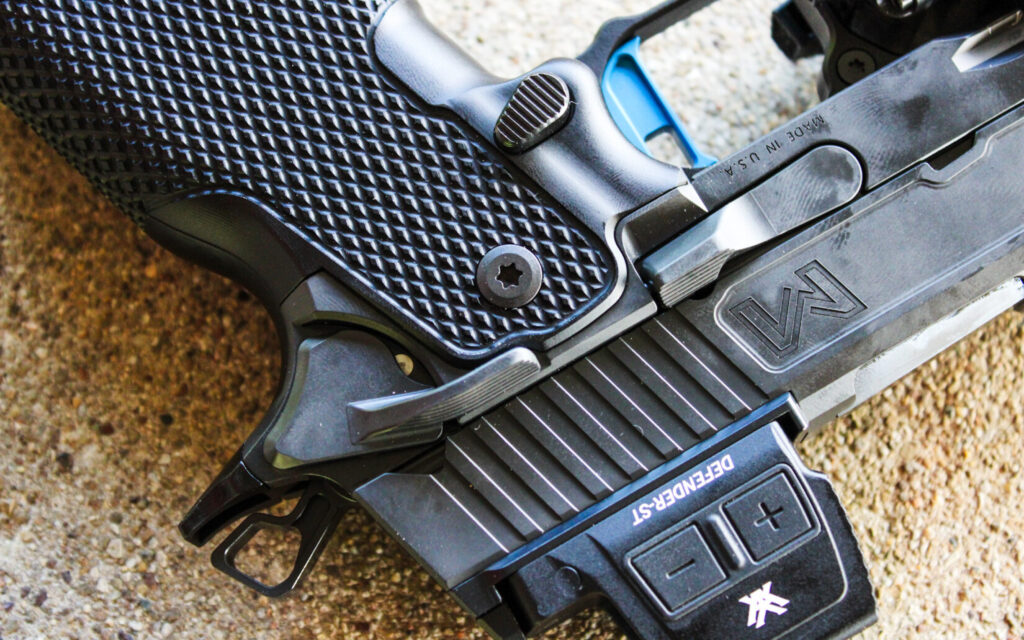
The Ranger 9X also uses Miller Precision’s patent-pending ambidextrous slide stop/release, allowing southpaws to feel included.
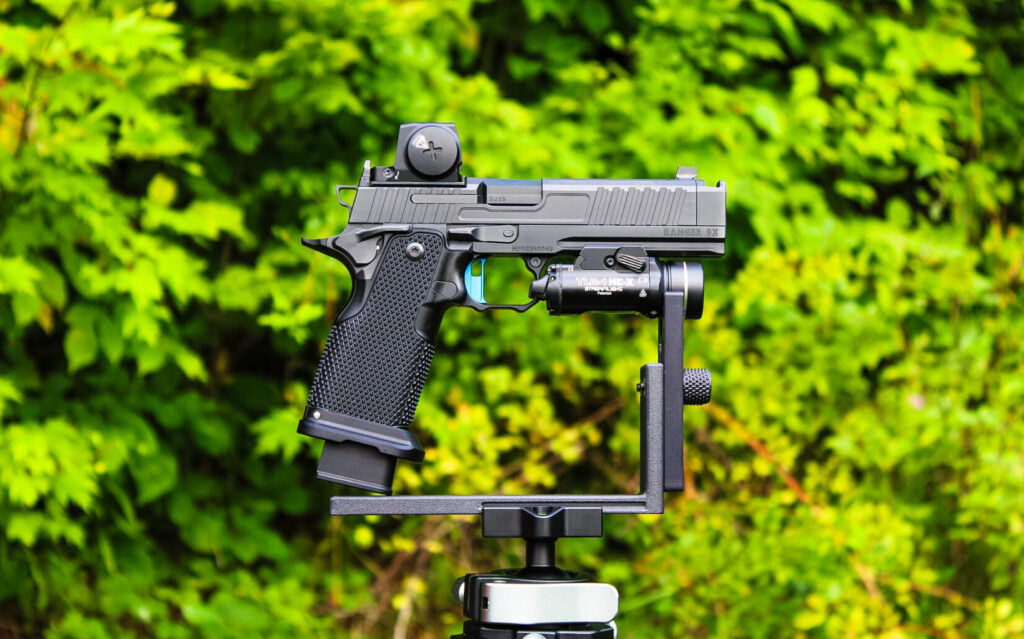
The proprietary optic plate system accommodates a variety of red-dot optics while retaining co-witnessed iron sights. The pistol also features Glock sight compatibility and Miller Precision’s patent-pending Easy Adjust Trigger, which lets you adjust take-up and overtravel without disassembling the pistol.
Finish options include Black DLC and Silver PVD, with multiple grip textures, trigger shapes, and trigger colors.
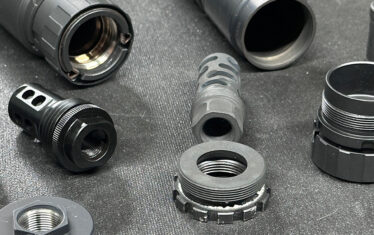
The Ranger 9X includes an RMR/SRO plate, two Atlas Gunworks magazines, a soft case, Lucas Oil, and takedown tools. Its most unique feature is a threadless barrel that lets you quickly swap from a compensator to a front sight block. Think of it like a tri-lug system.
Setup
Optic Plate and Optic
Miller Precision included a DPP footprint optic plate with my review sample. Mounting was straightforward. This is a very robust plate system. It is similar to those used by Race City Defense and Masterpiece Arms.
For the optic, I went with the Vortex Defender-ST Enclosed Solar. I’ve used it throughout the series with zero issues. At this point, that’s well into the few thousand rounds.
Light and Holster
I’ve also added a Streamlight TLR-1 HL-X. This proven light offers good value. The best part is that it is multi-fuel compatible and delivers up to 1,500 lumens and 20,000 candela.
And as I am throughout this series, I’m otherwise running this pistol stock. That keeps things on an even playing field.
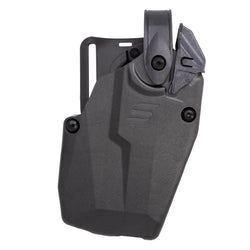
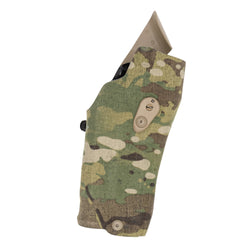
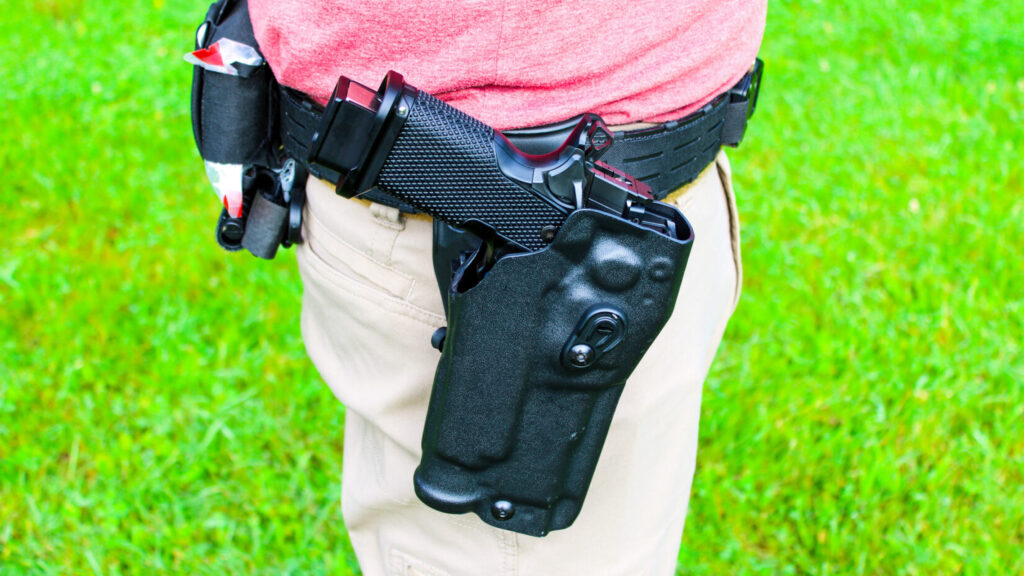
For a holster, I’m using the Safariland 6354RDSO – ALS Holster w/ QLS19 Fork and a mid-ride QLS adapter. This is my go-to setup for any kind of “tactical” shooting or training. Since I’m not in law enforcement, I’ve removed the hood for easier access.
This is mounted on the Safariland BASELINE MOLLE Belt, which I’ve grown to like quite a bit.
Now, let’s head to the range.
At the Range
A note on ammo. All “range ammo” is Blazer Brass 115-gr FMJ (5200). For accuracy testing, I used Hornady American Gunner 115-gr XTP. I picked up all the ammo for testing from Ammunition Depot.
Let’s get into the drills and accuracy testing.
Bill Drills
The splits tell the story here: first shots came in at .294 seconds, and follow-ups hovered around 0.134 seconds. I start in a low ready, with the target about 7 yards away, and the goal is six A-zone(ish) hits in 1.25 seconds or less.
The Ranger 9X is a race gun through and through. It is designed to crush the competition, which means it is pretty darn fast. My average time over six attempts with it was 1.006 seconds.
The gun’s ergonomics and overall feel are exceptional. This one felt like I could go full throttle and still maintain control.
Accuracy Testing
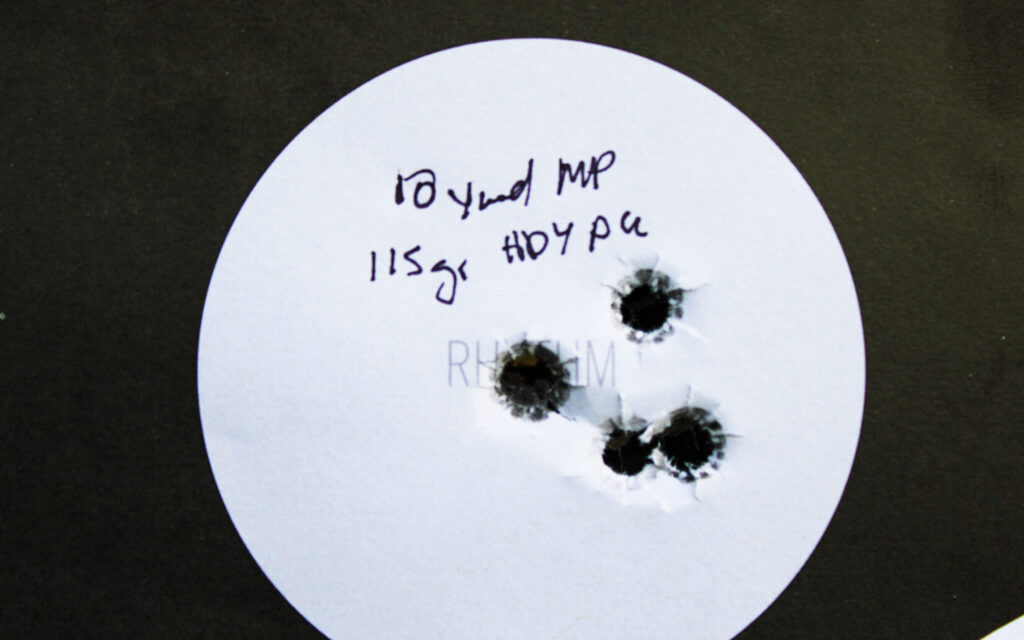
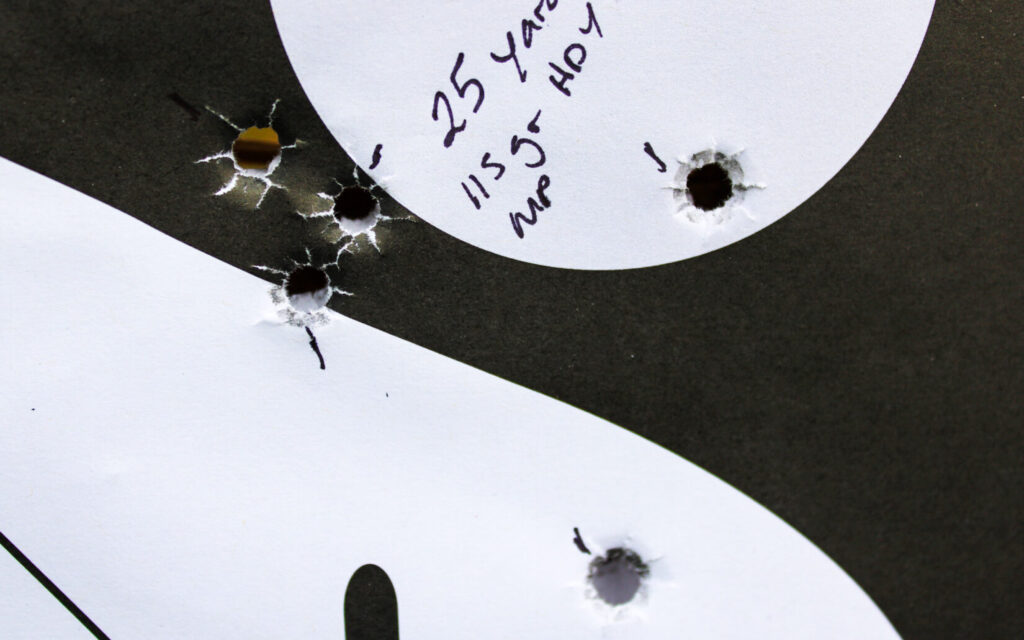
From a tripod-mounted pistol rest at 10 yards, the Ranger 9X shot a group measuring about 3/4” center-to-center. At 25 yards, the group opened up to 2.5” center-to-center.
I actually reached out to Houston Miller—the owner of Miller Precision—and asked about it. He said the guns are really tuned for heavier projectiles, which makes sense for hitting a USPSA power factor. Unfortunately, I didn’t have any “good” 124-grain or heavier 9mm rounds lying around to test it. But Houston is an engineering genius, so I’ll take him at his word.
1-and-1 Drills
This is my favorite drill to run. From low-ready, it’s one shot to slide lock, a reload, and one more shot, all against a 3.25-second par time.
I have small hands, which can make shooting 2011-style pistols challenging. For this, I’d roll my strong hand to engage the magazine release, then use my support hand to hit the slide release before moving back into position.
The Ranger 9X has some of the best controls in the test. First, the teardrop-shaped magazine release made reloads easy. The slide release is also slightly oversized, another plus.
My average time was 2.81 seconds, with a first shot of 0.322 seconds and reloads of 2.17 seconds. That’s excellent for me—which means that in the hands of a seasoned competition shooter, the results would be even more dramatic.
The Humbler
This is a good finisher I picked up from James Williamson of HK—no, it’s not the Humbler used by Larry Vickers and Delta Force. The par time is 10 seconds. Either start from the holster or from a bench.
Ten shots into the A-Zone, then reload and take two shots into the head A-Zone. This was a great run: 9.98 seconds with clean hits. It came out of the holster fast, and the double undercut on the grip module helped me control the pistol.
Sizing Up the Miller Precision Ranger 9X
Where the Ranger 9X Delivers
As I’ve already hinted, the Ranger 9X has some of the best controls and ergonomics in the entire test. I really like what Miller Precision did here. The double undercut is an excellent touch that helps the shooter maintain a high grip.
The teardrop magazine release makes it significantly easier to reach for those with small hands. The slide release is also enlarged. All pluses.
The trigger has about 1 mm of take-up, a hard wall, then about a 2-pound break. The reset is about 1 to 2 mm and is very audible.
Another positive: the controls are ambidextrous. Both the slide release and the safety are the same for lefties as righties. And, as far as I can tell, the magazine release is swappable (similar to how you swap a mag release on a Glock).
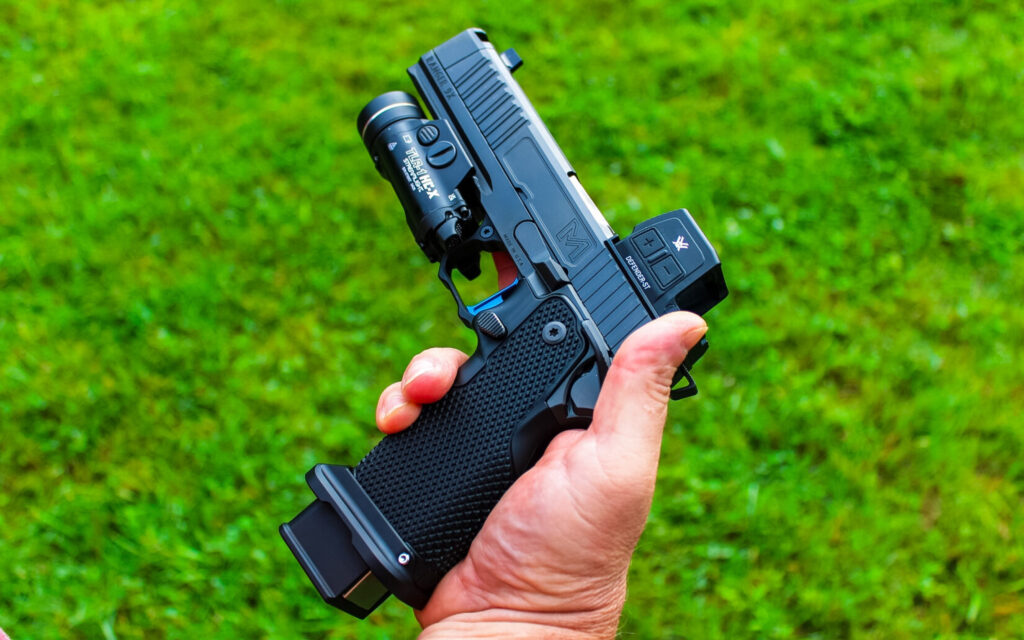
The optic mounting system is excellent; I had no issues. Outside of the Sig Sauer P211 GTO, this has the most effective compensator in the test.
That, coupled with how the gun feels, makes for a very flat-shooting pistol. It felt like it had the lowest bore axis of any 2011 so far, which is a good thing.
In terms of texturing, it’s another really good one. It’s grippy and doesn’t feel like it’s going to slip in my hand, even on a hot, humid day.
Mixed Results Here
Probably the biggest letdown is that the gun didn’t like 115-grain ammo. I had one failure to eject over 450ish rounds, and it was with the Blazer, on top of the accuracy inconsistencies with the Hornady American Gunner.
The gun ships with only two magazines, which is fine—three would be better. Otherwise, the package is good. The rest of the contents include a nice case with an RMR/SRO plate, Lucas Oil, and a few tools to maintain the pistol.
If you need another optic plate, like a DPP one, that will set you back $85.
Depending on the class you’re shooting in, you may want a larger magwell. However, it has two cutouts on either side to access the magazine in case of a jam, and you need to strip it from the gun. That’s cool. Otherwise, it’s mainly nitpicking.
I’d prefer slightly deeper front cocking serrations, but it may be fine for you. The gun uses an external extractor rather than an internal one. I had no issues—some purists don’t like that.
Where It Falls Short
Nothing. Even at the price, I think the value is pretty good. Given the feature set and innovation, it’s hard to say anything negative about the price.
Zooming Out
I give high praise to what Houston and his team at Miller Precision have accomplished. This is a very good pistol. It feels great and performed well in tests.
I don’t have anything negative to say. If you are considering a “high-end” 2011-style pistol, take a look at the Ranger 9X. You won’t be disappointed.
Up next in the 2011 Project: the Atlas Athena V3. While Staccato might lead the charge in explaining why the 2011 market has exploded, Atlas Gunworks is one of the most respected names in performance 2011s and components. Their fingerprints are all over the industry.