
The PSA JAKL is produced by Palmetto State Armory, and it’s a bufferless, piston-driven platform that blends the modern AR-15 with the reliability of a long-stroke piston system. Unlike a standard AR-15, the JAKL does not require a buffer tube, which allows for folding stocks and braces.
It has just a hint of a SCAR look to it because of the shape of the upper receiver, which I like. I’ve been shooting with JAKL rifles now for about two years, and the more I shoot them, the more I like them. My first JAKL was the 5.56 rifle with a pin and welded muzzle to keep the overall length from falling in the NFA category. That rifle has held up extremely well, but I wanted to try a shorter version, too.
As fate would have it, I came across a .300 BLK pistol version in a gun store for a good price. Of course, this was a no-brainer, and so I took it home with me.
The JAKL from PSA
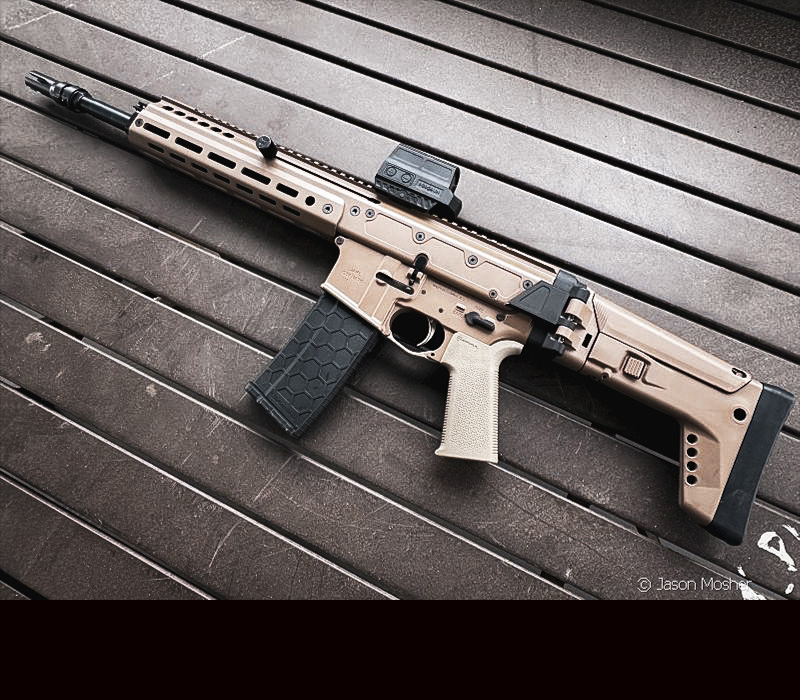
The JAKL was designed to be a “monolithic” upper receiver system that fits on a modified AR-15 lower. While it looks like it uses the standard AR platform at a glance, its DNA is a hybrid of several popular designs. The short version looks a little more AR, but the full-size version has much more of a mini-SCAR look to it than anything else. When you take the upper receiver apart, you can see some AK design as well.
Receiver Design
The upper receiver is built from 6061-T6 aluminum and has a continuous Picatinny rail. This is nice because you don’t have to worry about bridging when you mount an optic or scope.
PSA designed a bolt carrier group that looks a little like an AR carrier that has been cut down and a long-stroke gas piston system attached to it. This part is similar to what you would find in an AK-47 or a SCAR. It keeps the action cleaner and cooler than a traditional AR-15.
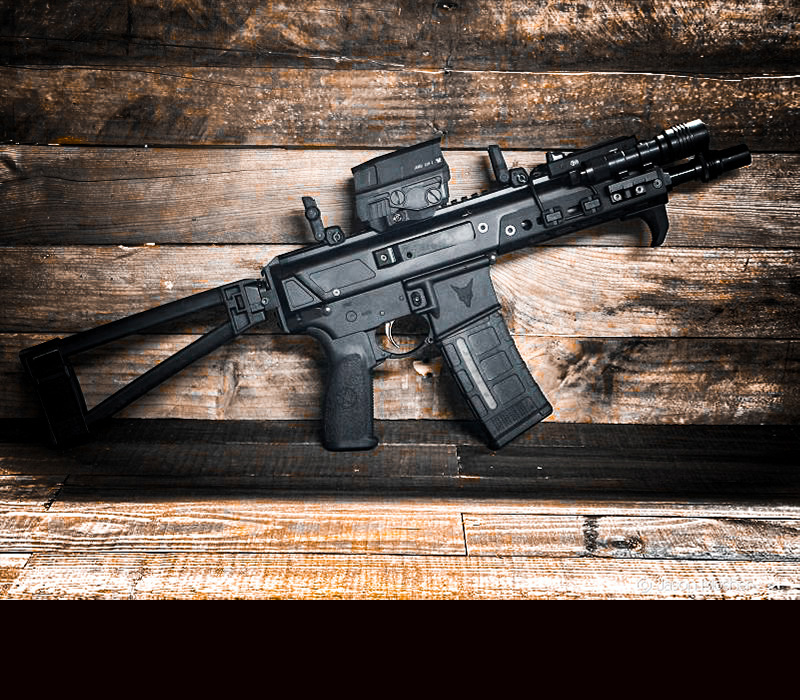
The lower receiver is basically an AR-15 lower but includes a proprietary “knuckle” adapter. This adapter replaces the buffer tube to allow for a folding stock or brace. Just about all the internal parts, like the trigger group, safety selector, and magazine release, are standard AR-15 components. This makes customization easy for those who like to upgrade parts on their rifle.
Because the pistol version is my newest project, most of this article will be based on that specific configuration.
JAKL .300 BLK Pistol Specs
- Caliber: .300 Blackout
- Barrel Length: 8.5 inches
- Gas System: Long-Stroke Piston (8-position adjustable)
- Twist Rate: 1:8
- Muzzle Thread: 5/8×24
- Receiver Material: 6061-T6 Aluminum
Setting up the JAKL
Setting up a new gun is one of my favorite things to do. Because I love to try out new gear and accessories, the process never ends. Most of my rifles change at some point as I try new gear and configurations.
When I set up the JAKL pistol, I had some gear that was just waiting to be installed on something. Overall, I think it turned out great. Here is a rundown of what I installed on the .300BLK PSA JAKL.
Vortex AMG UH-1
This holographic sight is one of my favorite optics, from one of my favorite companies. I can never mention a Vortex product without bringing up their unconditional, lifetime warranty. If anything goes wrong with their product, they will make it right with no questions asked. That is hard to find these days.
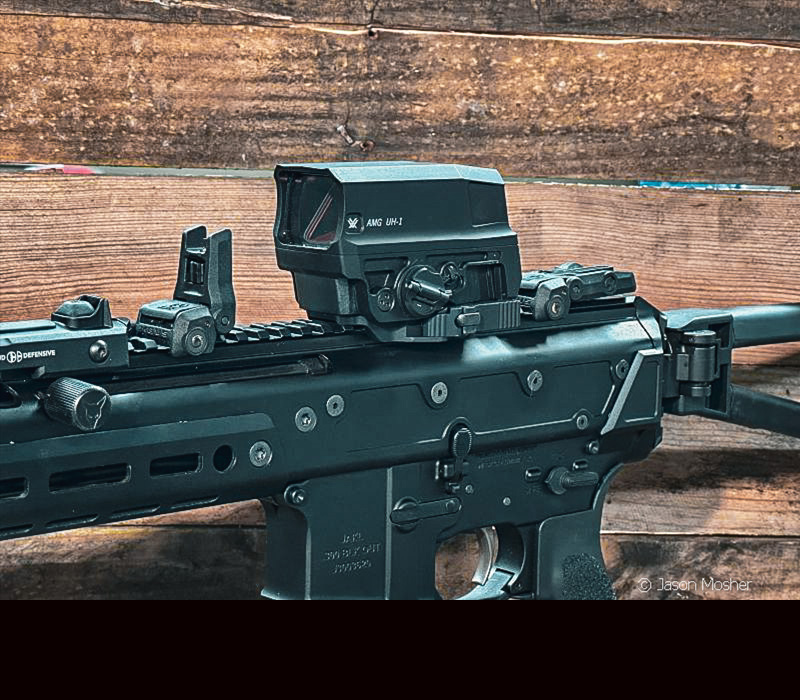
This optic has a large window, and the reticle is comparable to Eotech’s. It is a bit on the bulky side, but it’s incredibly durable and perfect for fast target acquisition. It runs on a CR123A battery and has a screw-down hatch on the side for easy battery access.
Magpul MBUS 3 Sights
I added these polymer flip-up sights as a backup. They are lower profile than the previous generation and take up very little rail space. Because I’m using a pressure switch for my light on this setup, I placed the front sight behind the pressure pad. The handguard on the JAKL is a little short, so you may have to move things around to get them to fit.
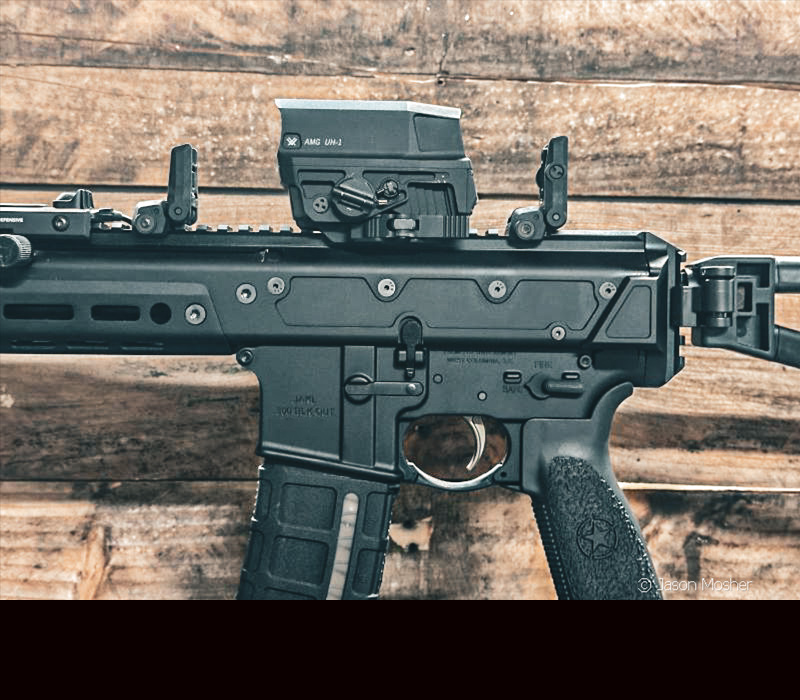
Of course, this set is spring-powered so all you have to do when they are needed is push down on the front of the sight and they flip up. You can adjust them for windage and elevation, and there are two peep hole sizes to choose from on the rear sight.
Streamlight ProTac 1 & Cloud Defensive LC5 MK2
The ProTac 1 is a little shorter than their other lights, so it was perfect for this setup. It puts off enough light for close quarters and has options for a direct switch or remote. The mounts for the remote pressure switch, however, are not the most stable. So instead of using those, I went with the Cloud Defensive LC5 MK2 holder to make sure the pressure pad never comes off.
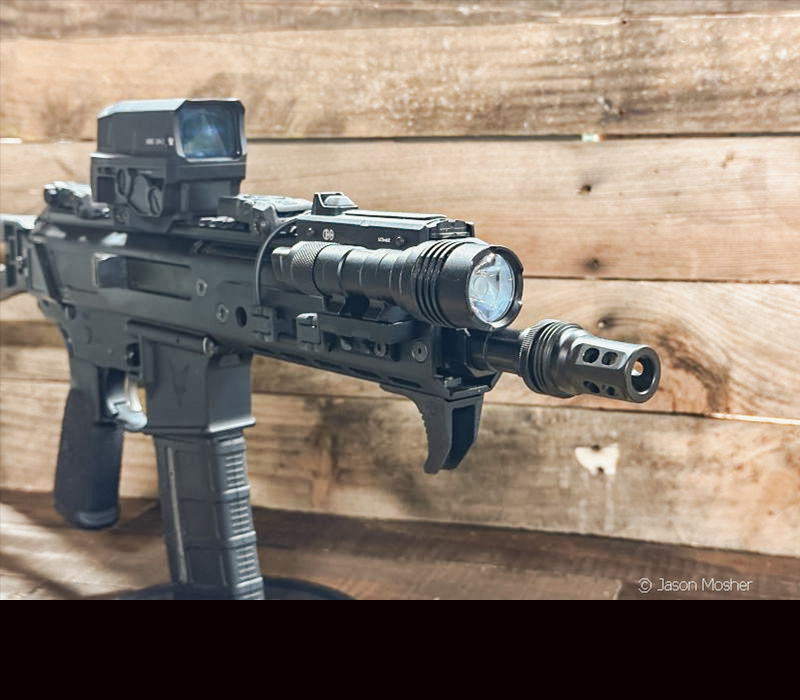
If you have never used a Cloud Defensive pressure pad mount before, you should check them out. It’s a metal mount that clamps onto your Picatinny rail, with the pressure pad inside. Once you tighten the screw to the rail, it’s rock solid and won’t move at all.
M300/M600 Offset Light Mount
Because of the shape of the handguard on the JAKL, a standard M-LOK mount doesn’t work. The light hits the edge of the handguard and keeps the mount from sitting flush. Streamlight rifle lights will work with M300/M600 mounts, however, so I purchased an offset mount for the M600 series, and it worked out great.
Magpul WCK Wire Control Kit
Everyone has their own way of keeping cables out of the way and secured to their handguard. I’ll admit, I’ve used everything from zip-ties to duct tape in the past. Nightstick makes some cool wire control boxes that mount to a Picatinny rail or M-LOK slot as well.
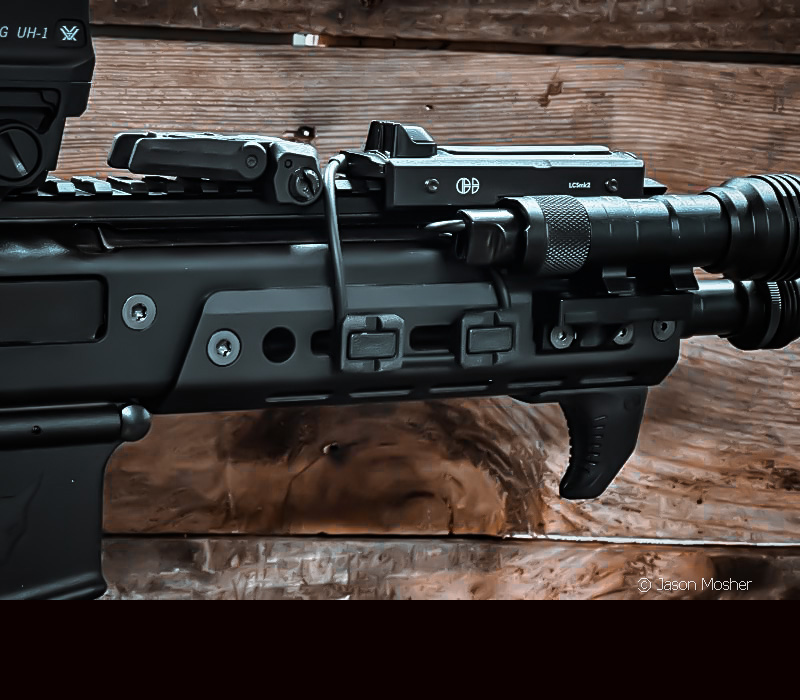
But for this setup, I used Magpul’s WCK (wire control kit). With these, you can run your wires behind the clip and then snap it into an M-LOK slot. It’s surprising how simple and quick they are to use. To get them off, just stick a small screwdriver behind the WCK and pop it off.
ASR Muzzle Device & SilencerCo VELOS LBP
I want to use my SilencerCo VELOS LBP silencer with the JAKL, so I installed an ASR-compatible muzzle device. This allows my VELOS LBP to screw on with a short set of threads and has a quick lock ring that locks the silencer in place.
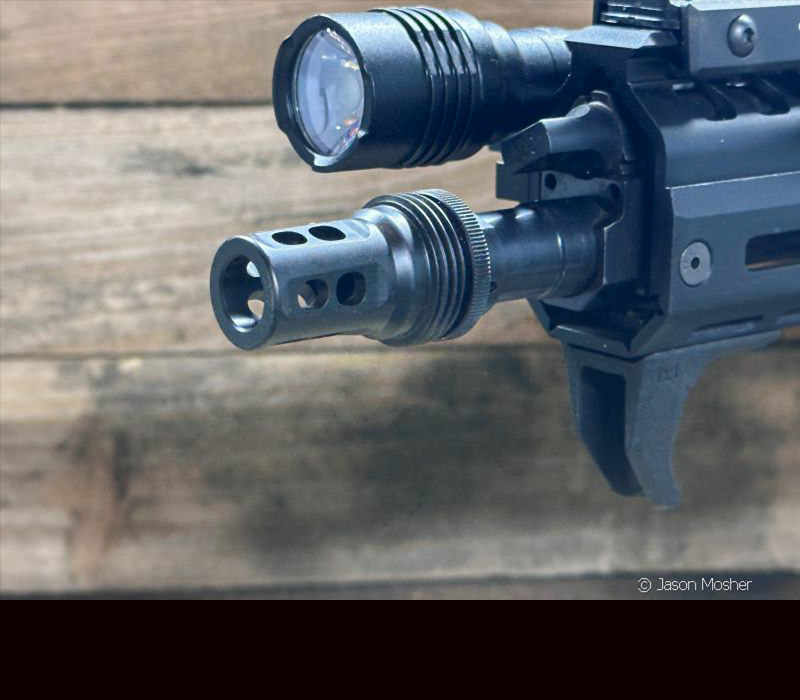
When I use subsonic .300 BLK ammo with this silencer, it’s about as loud as a .22 rifle. It’s also fairly light for being a heavy-duty silencer, so it’s nice not having a lot of weight on the end of the barrel.
You can get silencers faster these days, so it only makes sense to add a quick-detach system to your gun. Because you can easily adjust the gas on the JAKL, there are plenty of options for silencers for this gun as well.
Blue Force Gear Vickers Sling
There are a ton of great slings out there, but you can’t really beat a Vickers sling from Blue Force Gear. These have been used in the field by special forces units, SWAT, and patrol officers around the world. They are simple and durable.
Back in the day, single-point slings were all the rage with shorter firearms like the JAKL pistol. I have always favored the two-point sling, however. It keeps better control of your rifle while keeping it simple and easy to use. It has a quick-adjust pull tab that allows you to transition to the length you want, instantly.
Swapping the Charging Handle Left/Right
A great feature of the JAKL is the ambidextrous, non-reciprocating charging handle. By default, it usually comes on the left side, which is ideal for right-handed shooters. This is where I prefer it. But for left-handed shooters or those used to an AK platform, the right side is a better option.
To swap it, you simply field strip the rifle and slide the charging handle assembly out of its track. You can then reinsert it into the slot on the opposite side of the receiver.
Adjusting the Gas System
The JAKL has an 8-position adjustable gas knob located at the front of the handguard. This is needed when switching between various ammo types and using a silencer.
I like to find the correct adjustment for subsonic ammo and a silencer attached by closing the adjustment knob all the way (to the right). On mine, the bolt did not lock back, so I opened the gas up by one click and fired again. I repeat this process until the bolt locks back. Once the bolt locks back, I open the gas up by one more click.
You can repeat this process without a silencer, and whatever type of ammo you would use. Find the right setting and you’re good to go. Because I use a lot of different firearms and platforms, I write the settings down on paper and stick it in the handle so it’s handy. Once you know the setting, just turn it to the correct one for whatever set-up you are shooting with.
Field Stripping and Maintenance
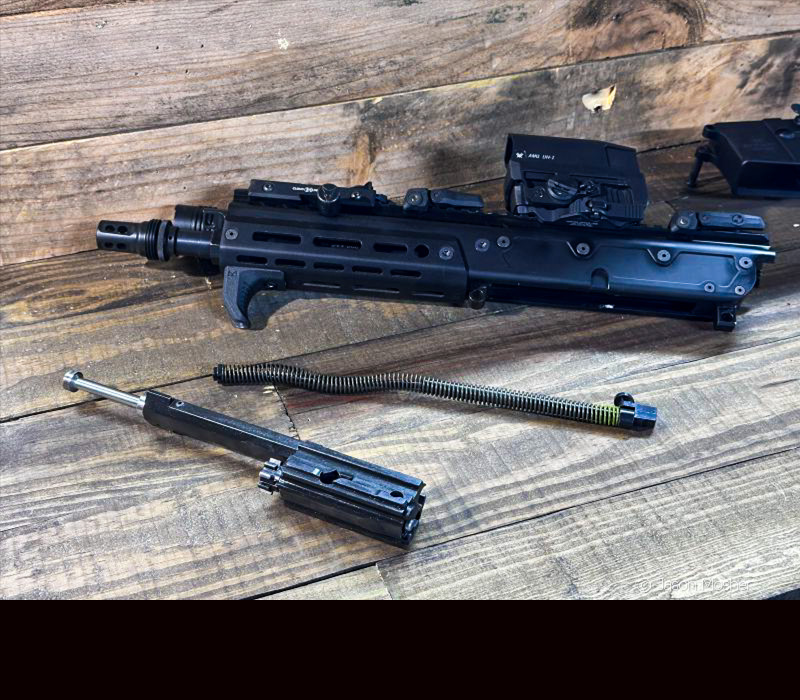
How to Field Strip the JAKL
- Clear the Firearm: Remove the magazine and verify the chamber is empty.
- Separate the Receivers: Push out the rear take-down pin. The upper will hinge open just like an AR-15, but you can also pop that pin out as well.
- Remove the BCG: Pull the charging handle to the rear. The bolt carrier group (BCG) and the attached piston rod will slide out as one unit.
- Detach the Charging Handle: Once the BCG is removed, the charging handle can be slid out of its track through the teardrop-shaped notch.
- Remove the Gas Plug: Depress the detent on the front gas regulator and unscrew it to remove the plug for cleaning.
Key Areas for Cleaning
When maintaining the JAKL, pay close attention to the piston head and the gas regulator. Carbon buildup occurs heavily in these areas, especially when shooting suppressed .300 Blackout subsonics. Scrub the piston head until the metal is visible.
Check the interior of the upper receiver rails. Since the BCG rides along these tracks, keeping them lightly lubricated will help it cycle smoothly. Finally, inspect the O-rings on the gas system for any signs of tearing or heat damage. Unlike a DI AR-15, the JAKL’s lower receiver stays very clean, so a quick wipe-down is usually all you need.