In the early hours of a brisk New Hampshire morning, Sig debuted the P385, a new family of double-stack 9mm pistols. Safariland was on-site with holsters, doing some live-fire evaluation. While this is a big launch party for the P385, it is also the culmination of almost a year’s worth of collaboration between the two brands.
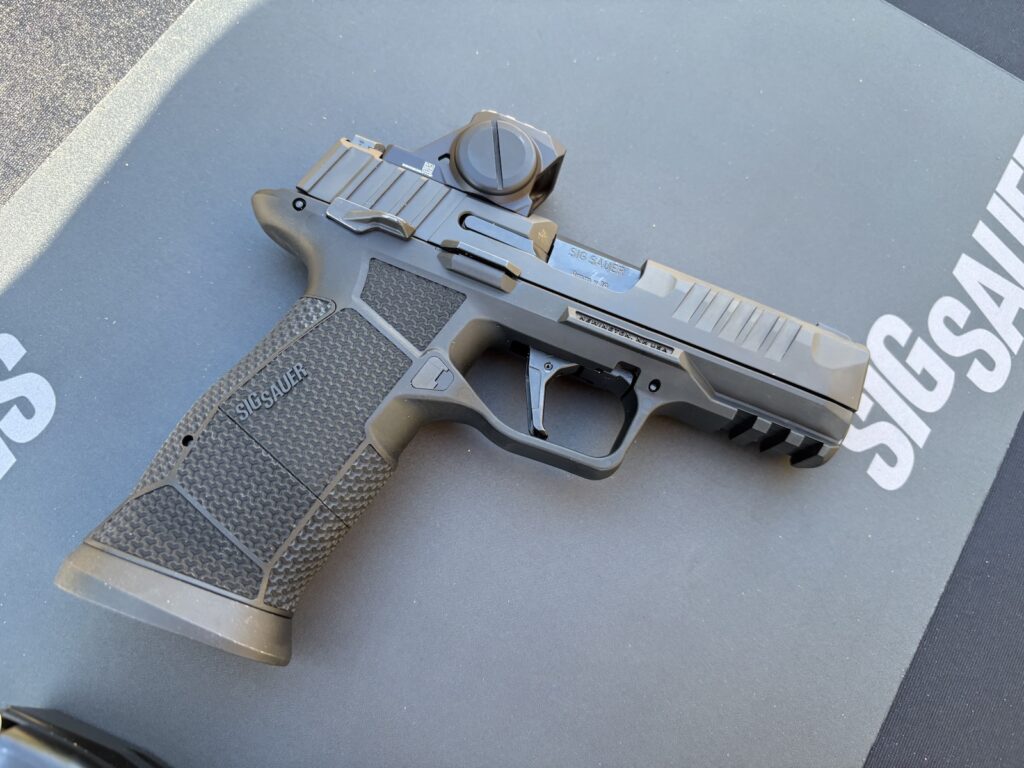
What is the new Sig Sauer P385? The Five Models
The Sig P385 is a new family of striker-fired, double-stack 9mm pistols built around a new Fire Control Unit, offered in five models.
- P385-Compact (4” barrel and a shorter grip)
- P385-Carry (4” barrel and a full-sized grip)
- P385-Comp (4” barrel with a built-in compensator that extends the length of the slide)
- P385-Full (4.7” barrel and a full-sized grip)
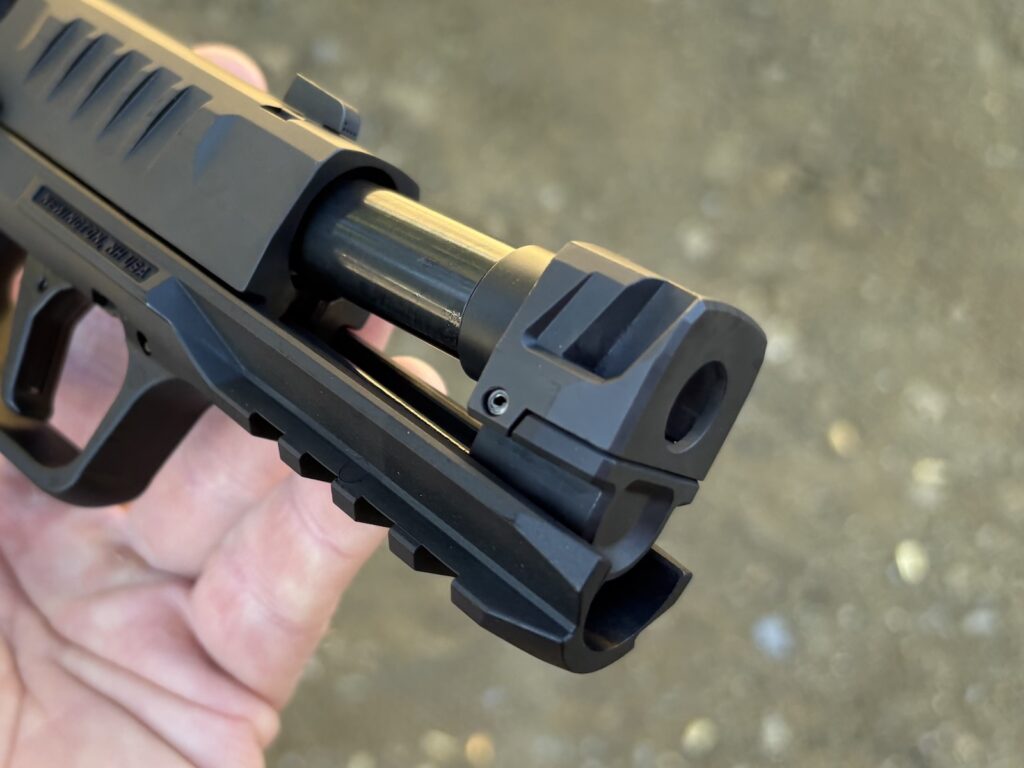
- P385-MACH3D (4.2” barrel with a brake that attaches to the end of the barrel)
The P320 was the last of Sig’s fat double-stack polymer 9mms. The P365 family varies in length from the basic P365 up to the Fuse, but it is thinner than the P320 line. Sig’s new P385 hits a midpoint between the two.
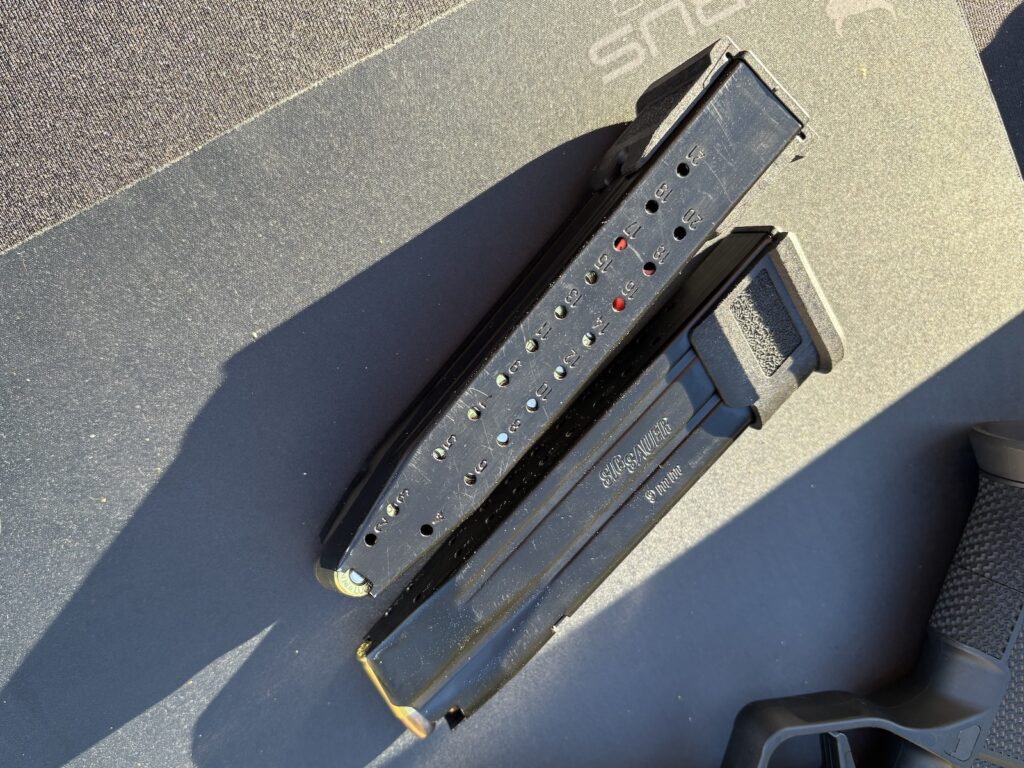
While it uses the P320 mags, it feels less bulky in the hand. Sig has done more with the ergonomics on this pistol, following what has become an industry trend toward guns that feel more like an extension of your hand than a chunk of plastic and steel.
This size also speaks to a new drive from some law enforcement groups that want smaller guns. There’s a push, one that was highlighted by the P320, to make guns adaptable for those who carry them. Sig’s move toward Fire Control Units marked a before-and-after moment for this industry, one some companies still haven’t embraced.
At launch, as is always the case, aftermarket support will be limited. Look to the P365 family for ideas on what’s coming.
Sig P385 Grip and Ergonomics
Part of the adaptability provided by an FCU is the freedom to replace the non-serialized grip module with something that fits you better. But you may be less tempted to start swapping parts than you might think.
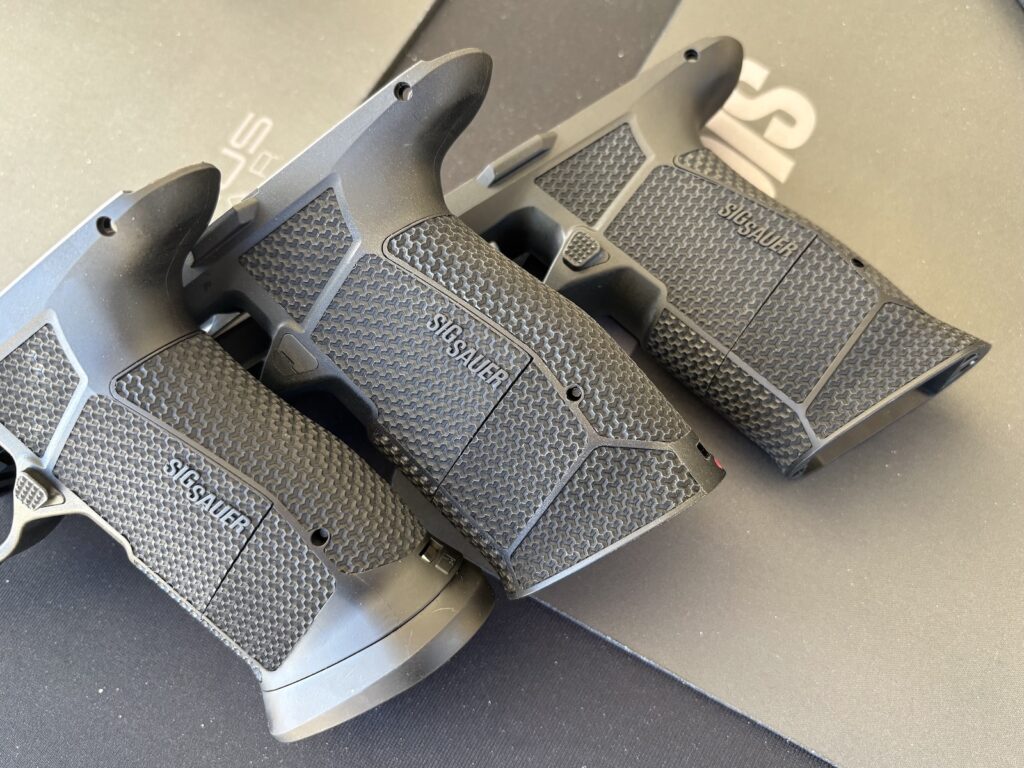
Sig’s P385 has more curves. The grip is cut deep below the beaver tail, which allows for a higher grip. There are options for getting wings on both sides of the gun. Some of this is built into the frame; some is built into takedown levers.
And the grip modules are two-piece designs. The mag well is detachable, allowing for a true mix-and-match between any of the lengths. If you want a huge mag well, you don’t need to replace the whole grip, just the bottom section.
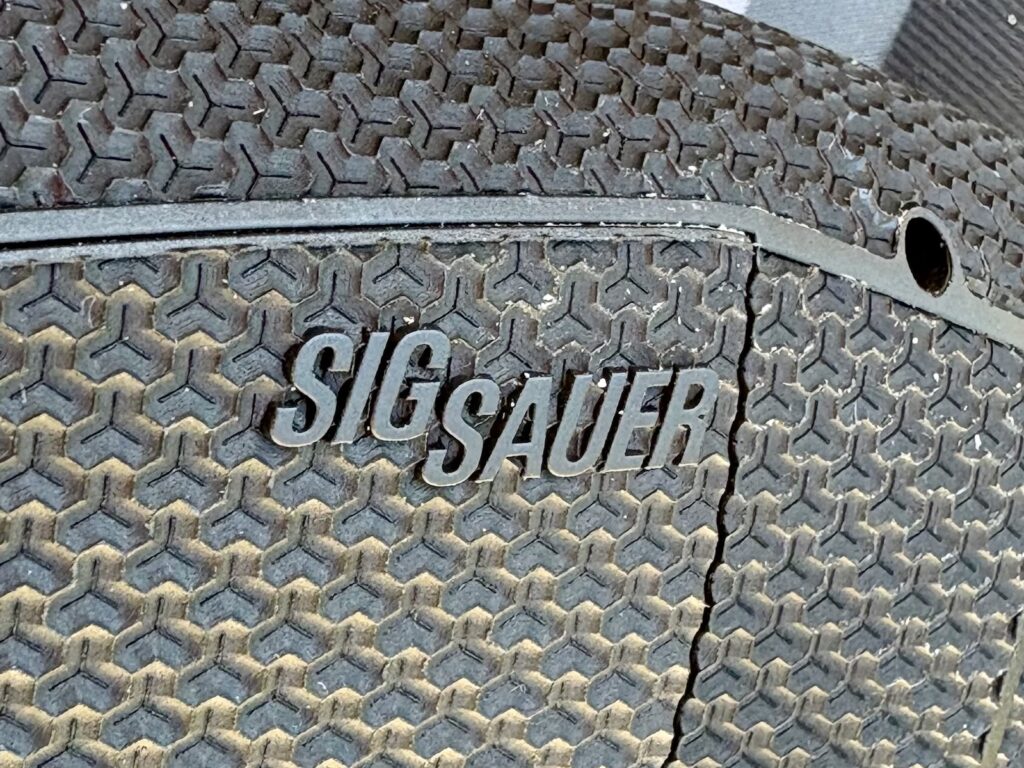
Grip texture is functional without feeling overly aggressive. Rather than building up to sharp points, Sig has done the reverse and taken away material from the surface. This leaves indentations rather than protrusions, and when you grip the gun, your hand presses into those voids.
The P385’s slide serrations are much more traditional. In many ways, the P385 builds on the P365 family. It feels very much like an evolution of that design.
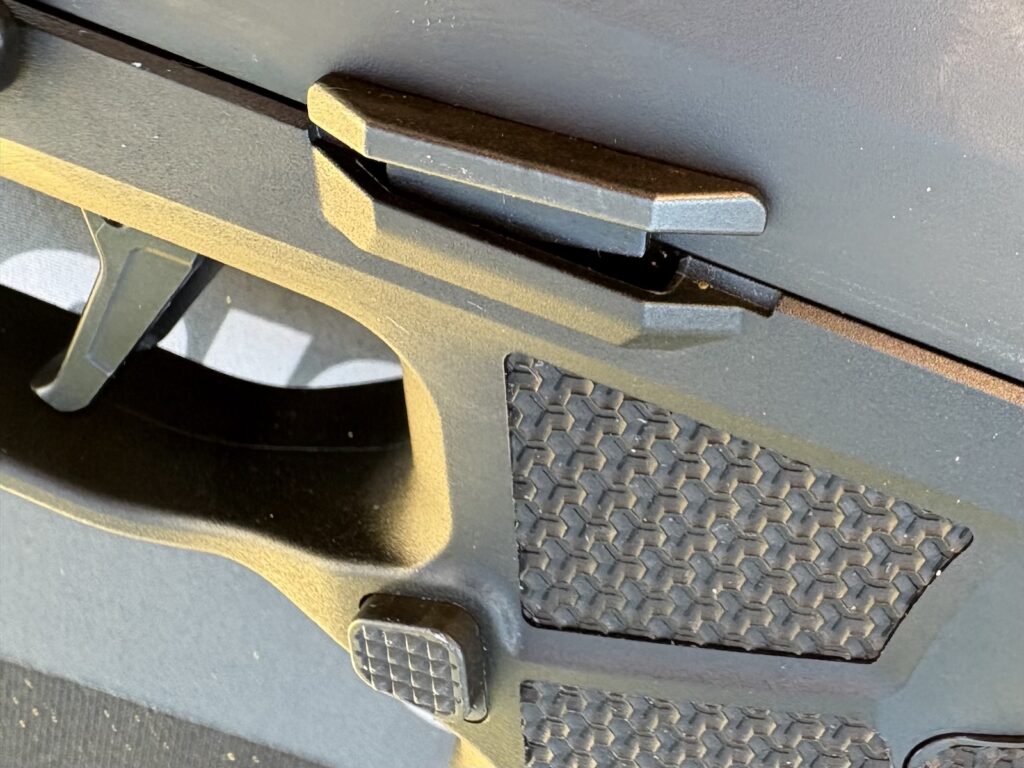
Sig P385 Trigger and Controls
It is still a striker-fired pistol at its heart. Someone will do a deep-dive into the action, soon, but it looks to be heavily influenced by the P365 design. I didn’t get an opportunity to tear one down on the range today, but we’ll have those details soon.
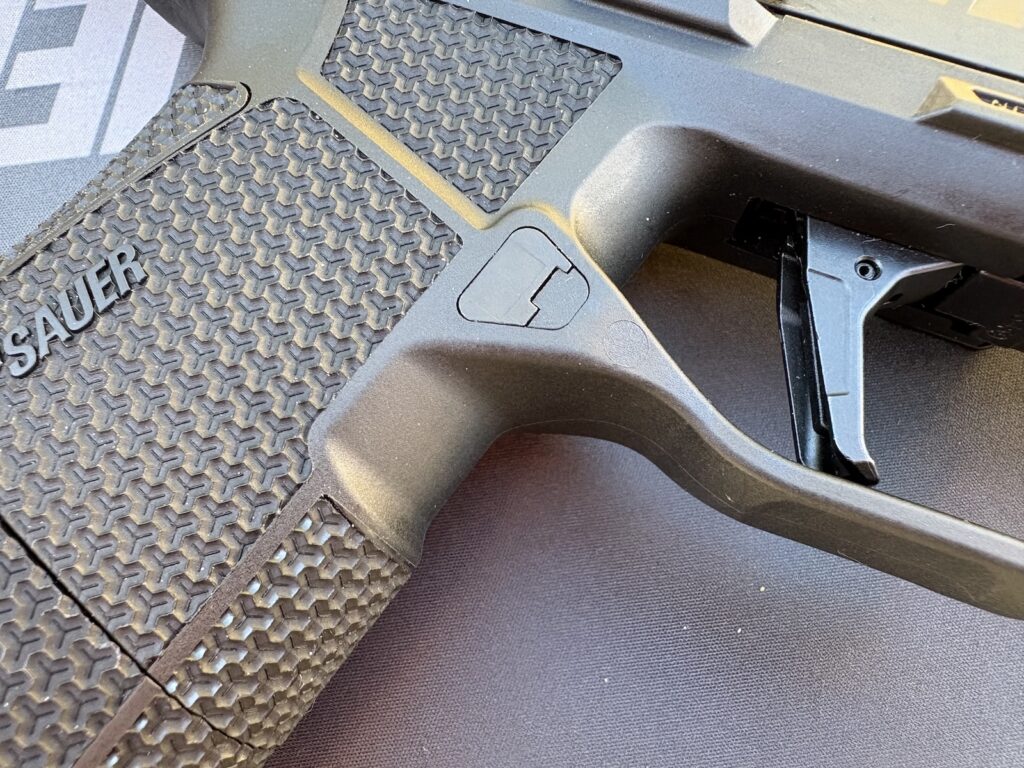
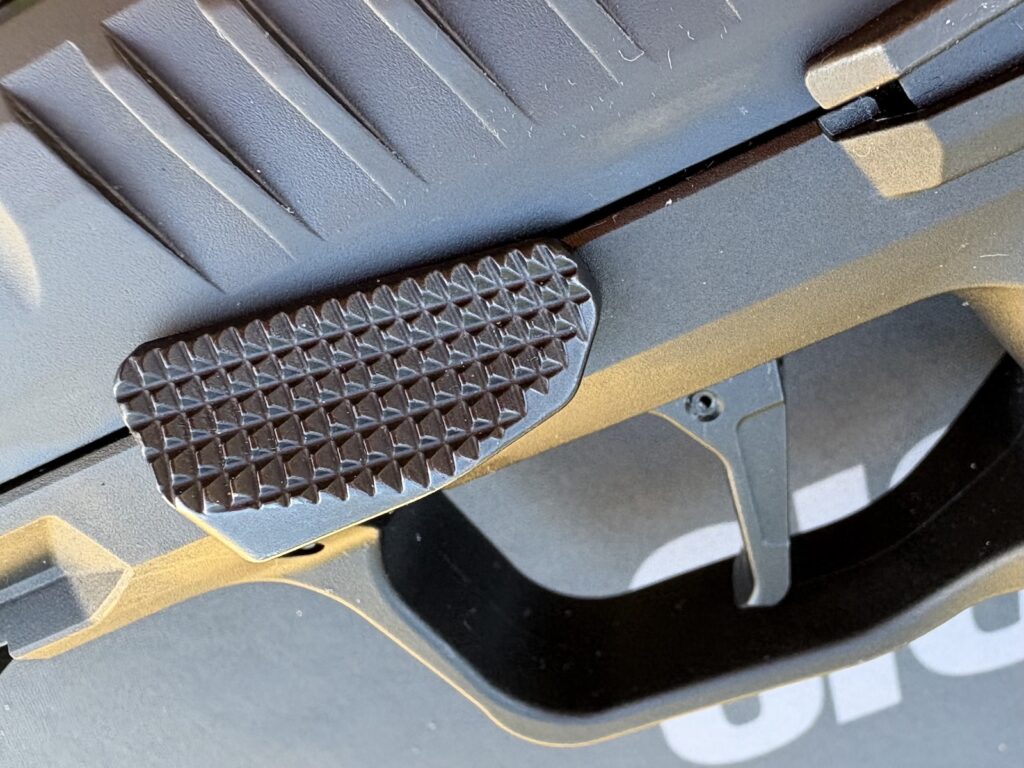
Triggers on these early versions felt like they were around seven pounds. While many triggers have the safety protruding from the trigger shoe, Sig’s new Trigger Block Design puts that safety into the shoe, so it sits flush.
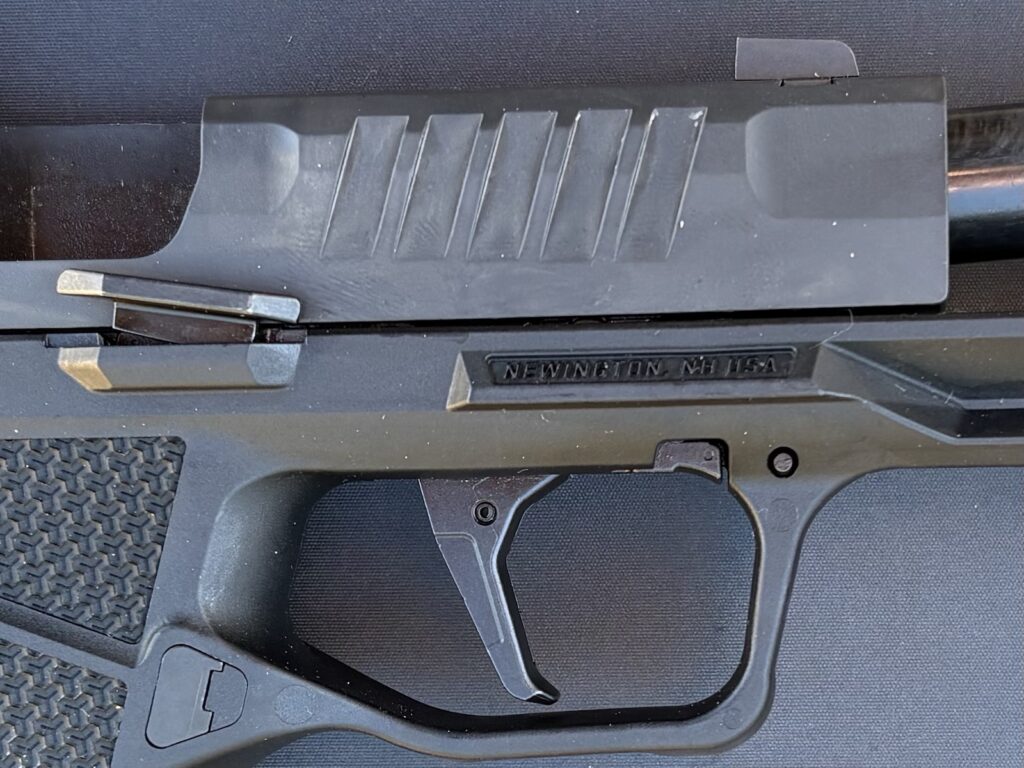
As you pull the trigger back, the blade is also engaged, allowing the gun to fire. If the shoe were to be pressed from the side, though, that blade would not, and the trigger wouldn’t drop the striker.
How Optics Mount on the Sig P385
Sig is using what they call Sig-Loc Pro for mounting optics on the slide. This is a direct-mount system that cuts out the need for adapter plates for Sig Optics.
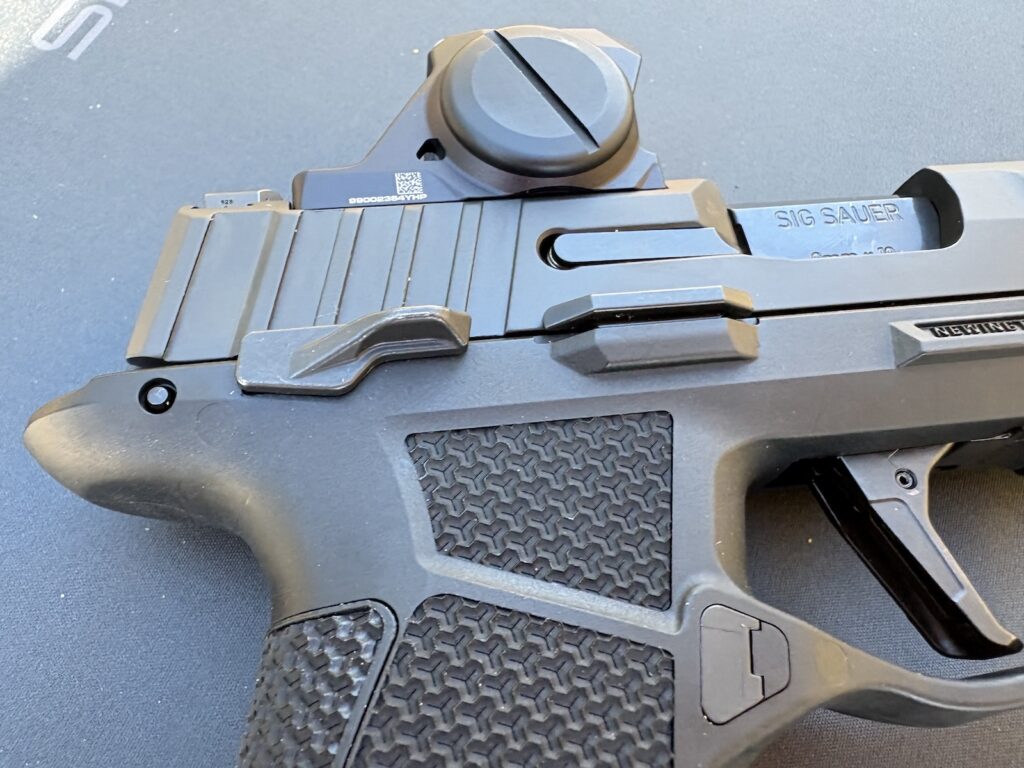
While this pistol is designed to be used with red dots, its iron sights are bright and easy to pick up. They’re not overly tall, but they don’t need to be. The optics Sig had on these sat low enough that the irons were just visible in the bottom of the glass.
Shooting the Sig P385: First Range Impressions
At the Sig Next event, the P385 family was clearly the star of the show. They had new models of the P226 and P365, too, as well as a bay decked out with P211s. After a couple of hundred rounds, the nuances between some models begin to blur.
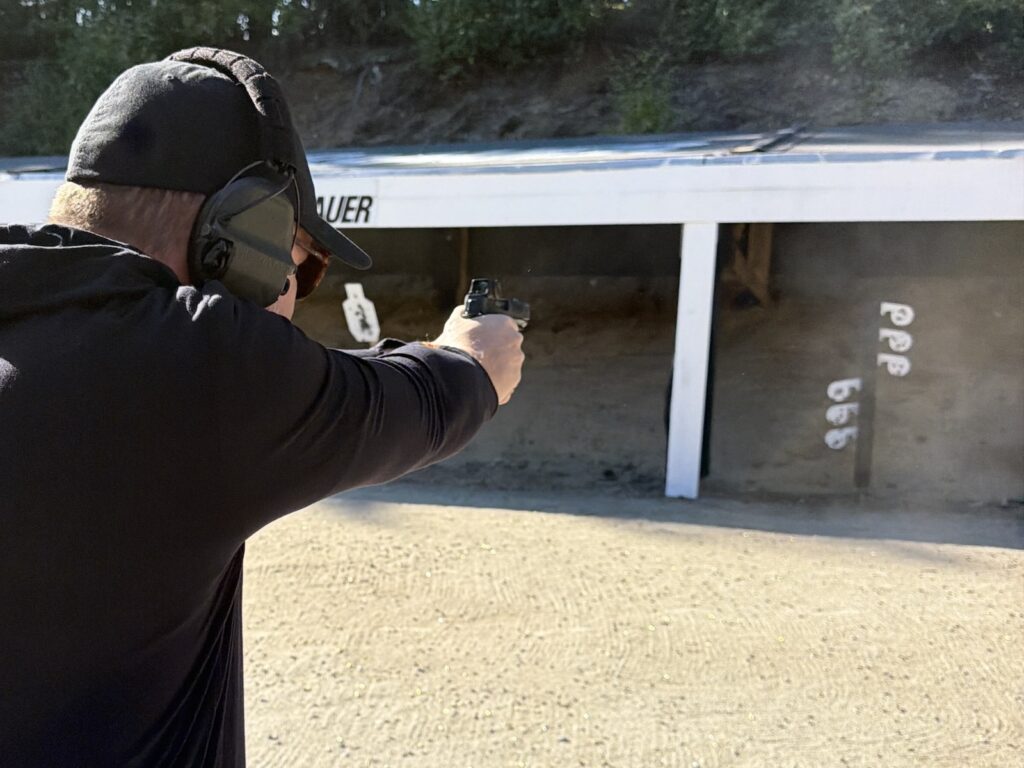
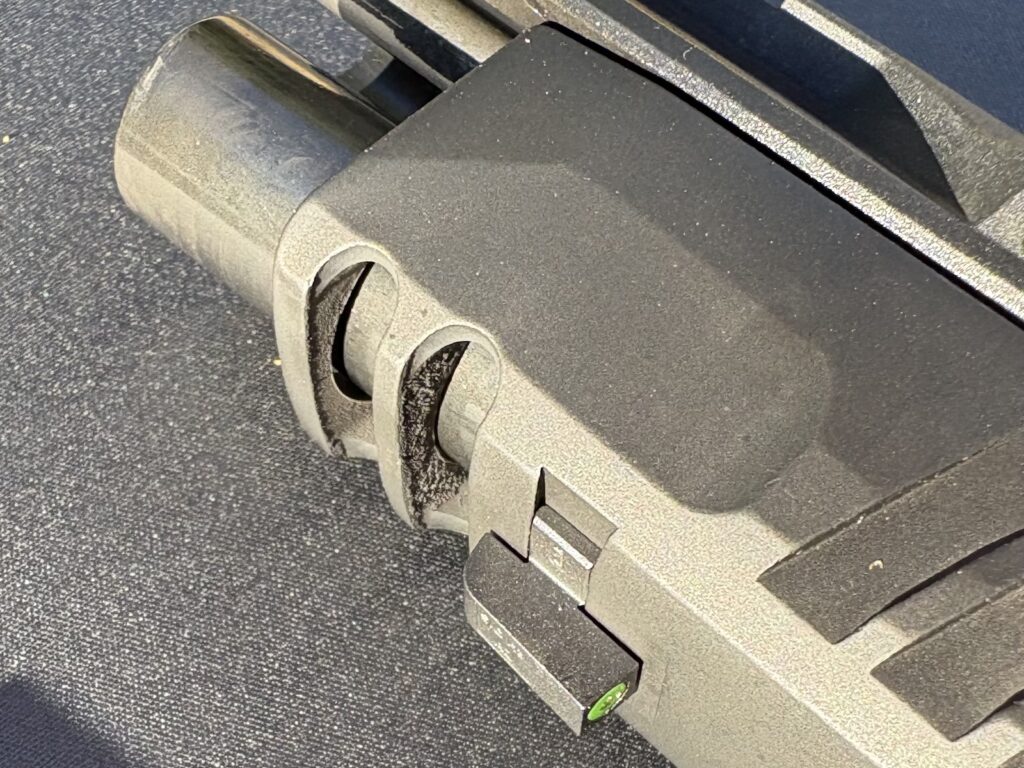
With a compensator, the P385-MACH3D shot very flat. At the other end, the compact felt more like a Macro. These impressions are clearly subjective.
There’s a noticeable weight increase between the P385-Compact and the largest of the P211 guns, and a gradual increase in size and weight between many of the other models we were shooting today. But the real question gets to intent.
With five different models of the P385 guns available in this first round, which one would stand out? Do you want a flat-shooting gun for competition? Are you looking for a new concealed carry gun?
The same questions will determine how you carry the P385.
What Holsters Fit the Sig P385?
Safariland’s Incog X IWB holster fits the P385 now, with more fits on the way.
Safariland is, fundamentally, a Duty brand. There will be significant law-enforcement interest in the P385. To best meet that need, Safariland has spent the last year building up duty holsters.
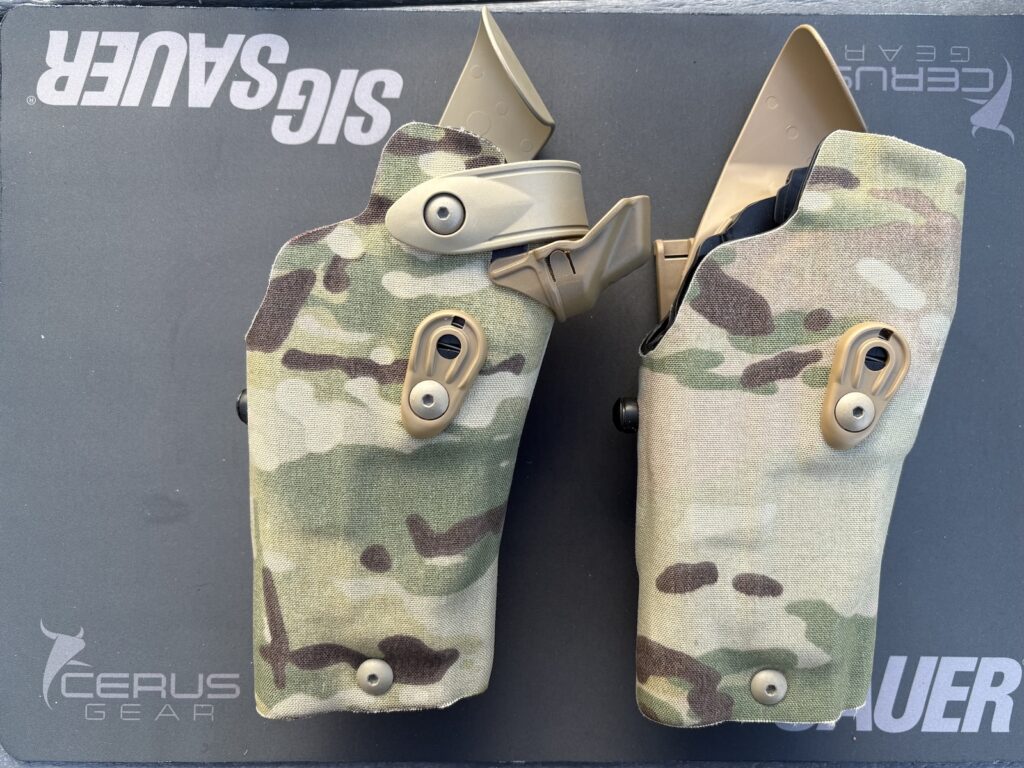
The 6,000 Series holsters will be available in Levels I, II, III, and IV. The bulk of these will be the Level III 6360RDS and Level I 6390RDSO. As the P385 will sit between the larger duty guns (like the P226 or the P320) and the smaller concealed carry guns (like the P365s), it is sized right for both small lights and large lights. Both light sizes will be available.
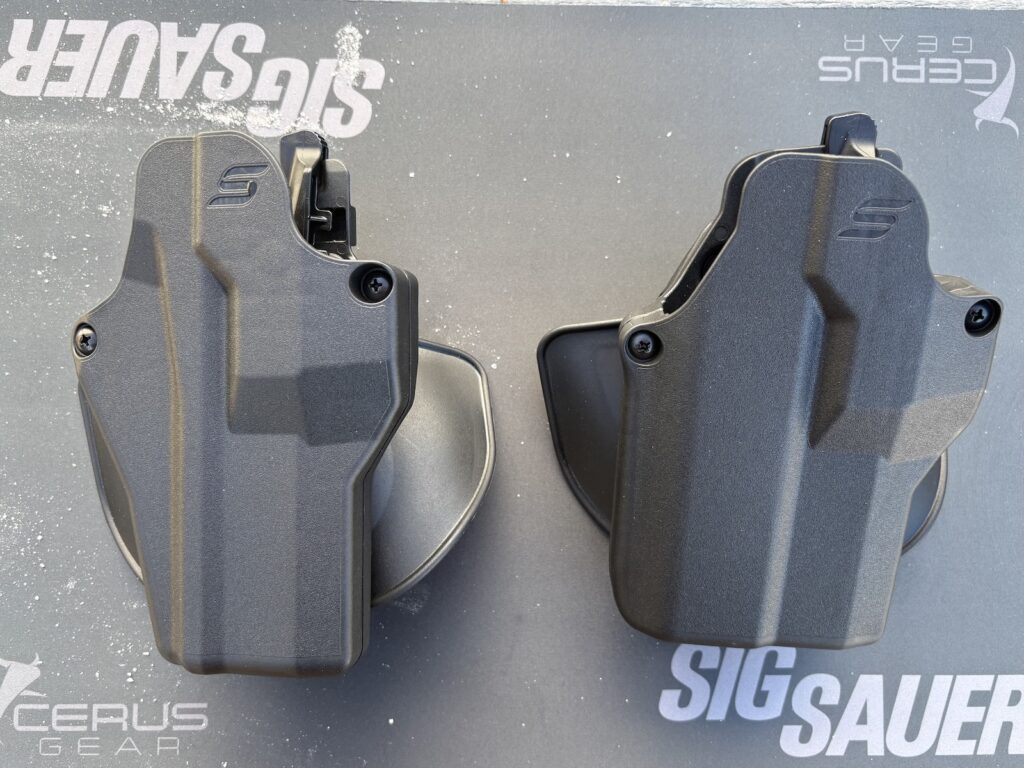
There will also be Solis holsters available. These injection-molded holsters ride higher and can be worn on a paddle or a belt loop.
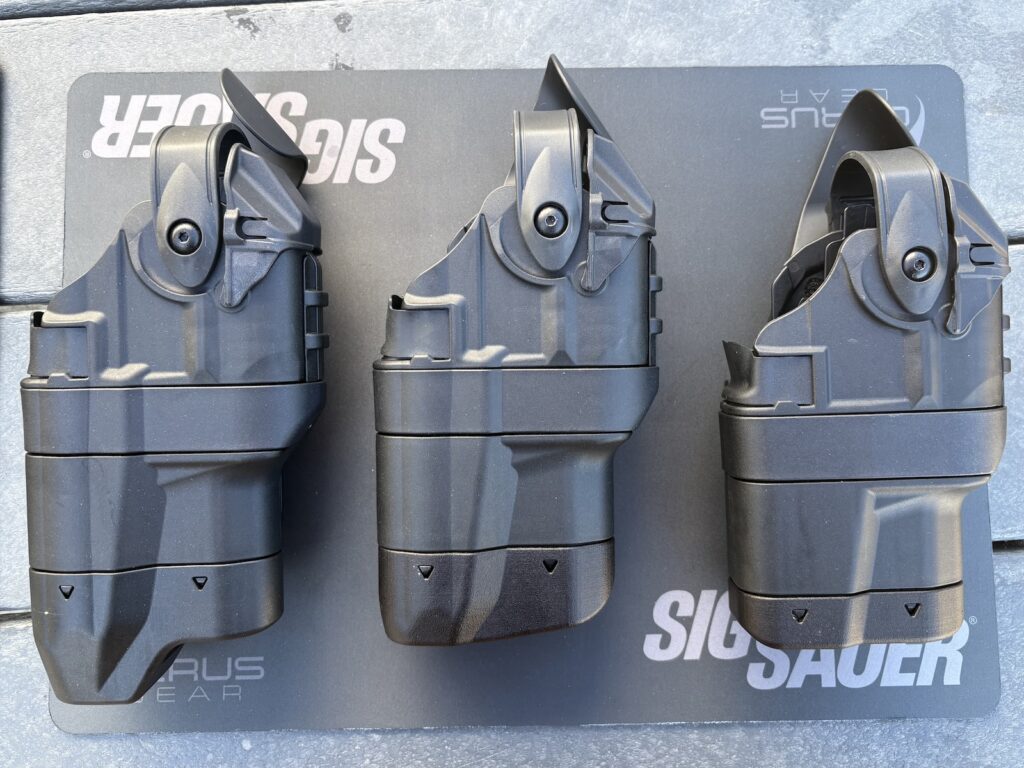
Ballast isn’t far behind. Safariland’s making the light pockets on these so that they will accommodate not only the standard lights from Surefire and Streamlight, but also those from Sig.
There are Incog X fits, too. As the P385 is slightly larger than your typical P365, the Safariland team is launching, first, with the dual-clip version of the Incog holsters. There may be a single-clip XS variant down the line for the more compact variants.
Find Your Sig P385 Holster

Ballast, 6TS, Solis, are all coming, with Incogs already available… that’s a solid start.
Day One Verdict on the Sig P385
The P385 is an interesting gun. In its smallest form, it feels more like a P365 Macro. This positions it well for concealed carry. At the other end, it feels more like a gun meant to be carried OWB. There’s a do-it-all feel to the line that may make this one of the more versatile platforms we’ve seen in a long time.
But this is just the end of day one. There’s much more to come on the P385.
Sig P385 Questions, Answered
What models are in the Sig P385 lineup?
Five: the P385-Carry, P385-Comp, P385-Full, P385-Compact, and P385-MACH3D.
What magazines does the Sig P385 use?
The P385 uses Sig P320 magazines.
Do you need an adapter plate to mount an optic on the P385?
No. The P385 uses Sig’s SIG LOC PRO system, which direct-mounts optics with RMR and DPP footprints without an adapter plate.
Does the Sig P385 have a manual safety?
A manual thumb safety is optional. The controls are fully ambidextrous, and the trigger uses Sig’s Trigger Block system.
What Safariland holsters fit the Sig P385?
The Incog X IWB holster is available now. Fits in the 6TS, Solis, and Ballast families are coming soon.