
Nightstick. Just when I thought they couldn’t get any better, they smirk and say, “Hold my beer.”
I’ve run a lot of lights over the years. Cheap lights. Overpriced lights. And lights that genuinely impressed me with the perfect balance of price and quality.
Nightstick has a reputation for being in that last category.
And now they’ve jumped headfirst into the high-candela “Turbo” game, which have really taken lighting tech to a whole ‘nother level.
If you haven’t been paying attention, high-candela tactical lights are having a moment, especially among law enforcement officers and serious defensive shooters. And after spending time behind Nightstick’s Turbo lineup, I get why.
But before we dive into specific models, let’s talk about the elephant in the room: Candela vs. lumens.
Lumens vs. Candela
For years, the marketing war revolved around lumens. After all, more lumens meant a brighter, “more powerful” light. 500 lumens. 800 lumens. 1,000 lumens. 1,500 lumens. The numbers just kept climbing.
Here lately, however, high-candela lights are all the rage.
Why the shift? Well, to really answer that question, we first need to understand the difference between lumens and candela.
Lumens measure total light output, meaning the overall amount of light spilling out of the front of your flashlight.
Candela, on the other hand, measures beam intensity. More specifically, it measures how tightly that light is focused and how far it can project usable illumination.
Think of it like this:
- Lumens = how much water is coming out of the hose.
- Candela = how tight and forceful the stream is.
It’s a weird analogy, but it makes sense, right?
You can have a light that floods a room with 1,200 lumens but only 10,000 candela. It’s bright up close and great indoors. But push it past 25 yards, and it starts to fade into useless splash.
Now take a high-candela light, say 60,000+ candela, even if the lumens are similar to the example above. That beam punches out to much greater distances, cutting through photonic barriers like headlights, streetlights, and tinted glass.
That difference isn’t theoretical; it’s practical.
And it’s precisely why high-candela handheld and weapon-mounted lights are exploding in popularity right now, especially among LEOs.
Gaining Ground
Urban environments are full of competing light sources, like car headlights, streetlights, porch lights, and illuminated signage. That ambient light can absolutely wash out a lower-intensity beam.
High candela options change that and level the playing field a bit, so to speak.
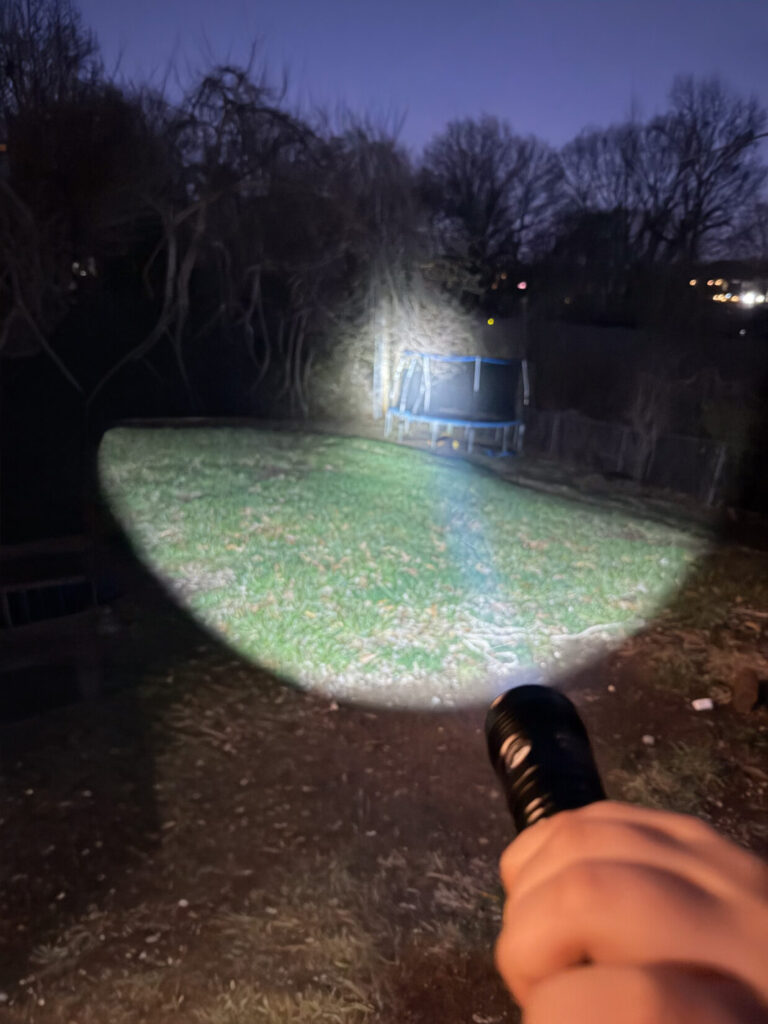
Instead of just “adding light” by amping up your lumen count, you’re projecting concentrated light that overwhelms and dominates what’s already there.
For law enforcement, that means better positive identification at a distance, more effective suspect control with light, improved visibility through the windshield glare and tinted windows, and stronger search capabilities in rural or open environments.
For armed citizens, it means better PID in parking lots or down long driveways and clearer target discrimination.
High candela translates to greater control and the ability to see clearly, dominate the space, and make more sound decisions in a high-stress home defense or duty environment.
And Nightstick clearly understands that. Of course they do.
USB-210: The Ultimate Pocket Rocket
Let’s kick this off with my favorite little pocket light: the USB-210 Penlight.
Now, the USB-210 penlight isn’t technically branded as a “Turbo” high-candela option. But it absolutely deserves a mention because it highlights an important point: Usability matters.
I’ve been carrying it in my pocket for a couple of weeks now, and it’s one of those tools you don’t think much about until you realize you’re using it constantly while rolling around on dusty floors or working in dark stockrooms.
Ask me how I know.
It’s slim. Disappears in a pocket. Charges via USB-C, which means I can top it off with the same cord that charges half my life. No hunting for CR123s. No proprietary nonsense. Just plug it in and move on.
What surprised me most was the adjustable bezel.
In its default “collapsed” position, it offers a wide, even flood beam that’s perfect for up-close tasks, digging around in a range bag, checking gear in low light, and looking under the hood of a truck.
Slide ‘er down and away from you, and the beam tightens into a noticeably more intense, focused spot. Not just slightly tighter. It’s actually concentrated enough to reach farther than you’d expect from something this small.
That flexibility makes it more than just a basic penlight. I’ve used it for quick admin tasks, gear inspections, and while fumbling around on crowded stock shelves.
Is it a high-candela “Turbo” light built for dominating a parking lot? No. But that’s not its job.
But as a daily-use, always-with-you light that you’ll actually carry instead of leaving in a drawer, it earns its keep. And the adjustable beam makes it far more versatile than most penlights I’ve run.
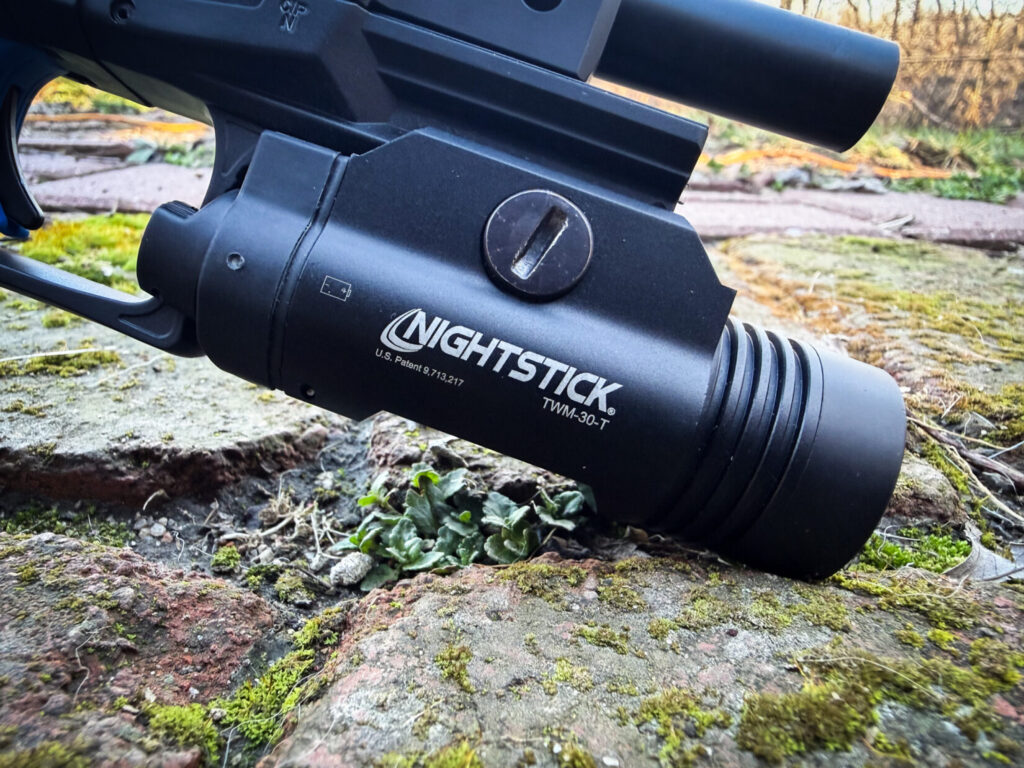
TWM-30-T: Full-Size Turbo
The first thing I did with the TWM-30-T was walk outside at night and aim it down the street.
That’s usually where lights tell on themselves.
Plenty of weapon-mounted lights look impressive on paper. Then you hit a real-world environment with streetlights, porch lights, ambient glow, and the beam kind of fades into the background.
The TWM-30-T doesn’t do that.
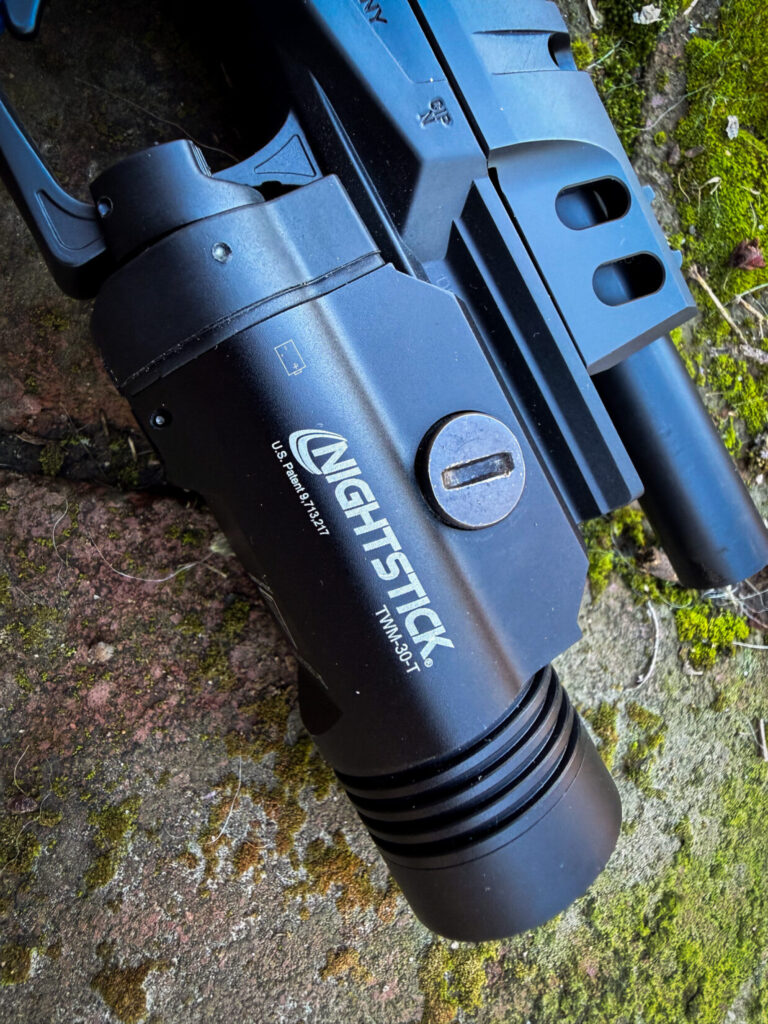
The hotspot is tight and intense. Not gimmicky, not laser-like, just focused enough that your eye naturally locks onto it. When I hit a tree line at a distance, the beam didn’t just “show” it; it defined it with visible textures and rich shadows. It felt deliberate.
Indoors, it’s equally noticeable. Down a hallway, the center hotspot draws your attention immediately, but there’s enough spill around it that you’re not operating in a tunnel. I hate lights that feel like a bad case of tunnel vision. This isn’t that, thankfully.
The operation is straightforward. I mounted it, ran some dry reps, then took it to the range. The rear paddles are easy to manipulate without shifting grip, and momentary activation feels nice and natural.
Build-wise, it feels solid without being obnoxiously heavy. Another win, in my book.
After running it side by side with more flood-oriented pistol lights, the difference was obvious. The TWM-30-T really reaches out there, illuminating far-off objects and persons… which, it turns out, is the whole point of this high candela movement.
Who knew?
TCM-10-T: The Tiny Turbo
Compact weapon lights usually come with a tradeoff: you get something small enough to fit your carry gun, but you give up some performance.
I expected that here.
I was wrong.
Mounted on my Shadow Systems MR920, the TCM-10-T still throws a beam that feels intentional. It’s tighter than most compact lights I’ve tested. Much like its full-size cousin, this little light provided exceptional definition and fast PID at distances well beyond the effective range of my handgun. Well… my effective range.
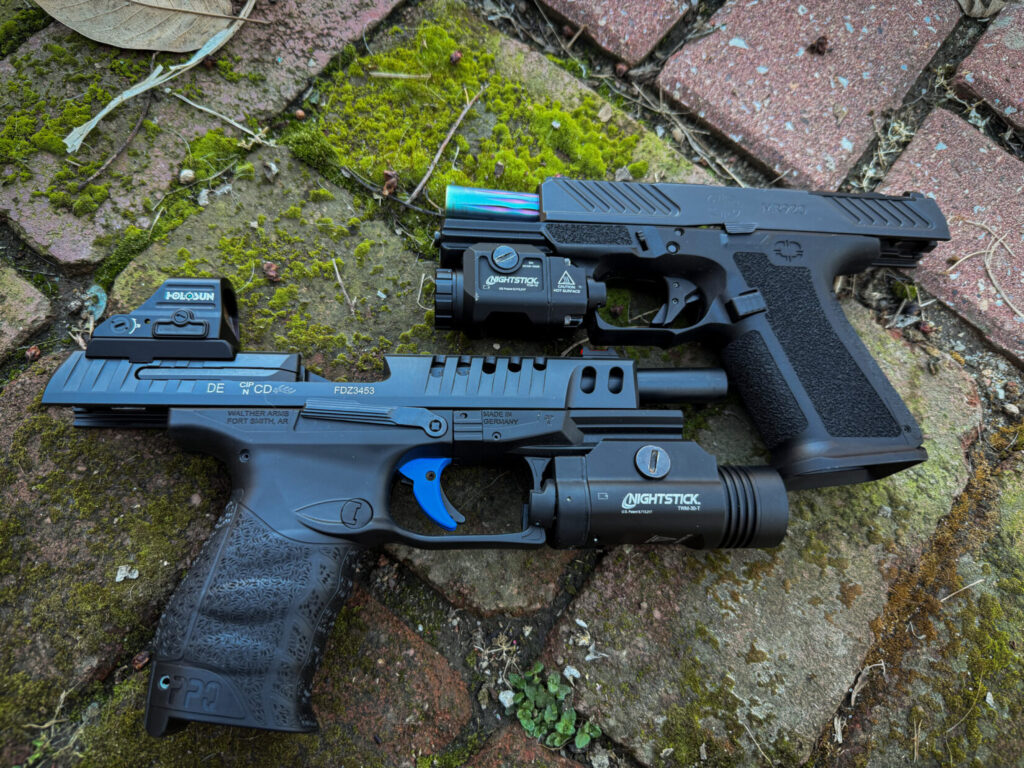
That’s what stood out. The ability to identify and respond effectively. I mean, being able to identify threats (or innocents) at further distances can literally spell the difference between life and death.
Some compact lights bloom out and lose intensity quickly. This one keeps its shape. You still get peripheral spill, but the hotspot carries enough energy that distance doesn’t immediately kill it.
So I say again, for concealed carry or home defense, that matters.
What I appreciate is that it doesn’t feel like a downsized afterthought. Controls are still easy to access. It doesn’t make the gun feel front-heavy. And it doesn’t neuter performance just to shave off length.
In practical terms, it gives you high-candela capability in a footprint that actually makes sense for compact and subcompact pistols. That’s a hard balance to strike. But Nightstick delivered.
LGL-160-T: The Meat & Potatoes
Rifle lights are where high candela tech has really taken the market by storm.
I mounted the LGL-160-T on a Sons of Liberty Gun Works EXO3 AR-15 (a stellar entry-level rifle), and took it to my local indoor range to stretch its legs with some low-light shooting.
Sadly, I couldn’t get pics of that.
With the target pushed to the 25-yard line and the range dark, PID was effortless with clear and rich shadows, defined silhouettes, and the like… you’re sensing a trend, yes?
While my environment was controlled, that 100,000 candela beam made it 100x easier to see and identify my targets than the traditional, washed-out high-lumen lights of yesteryear.
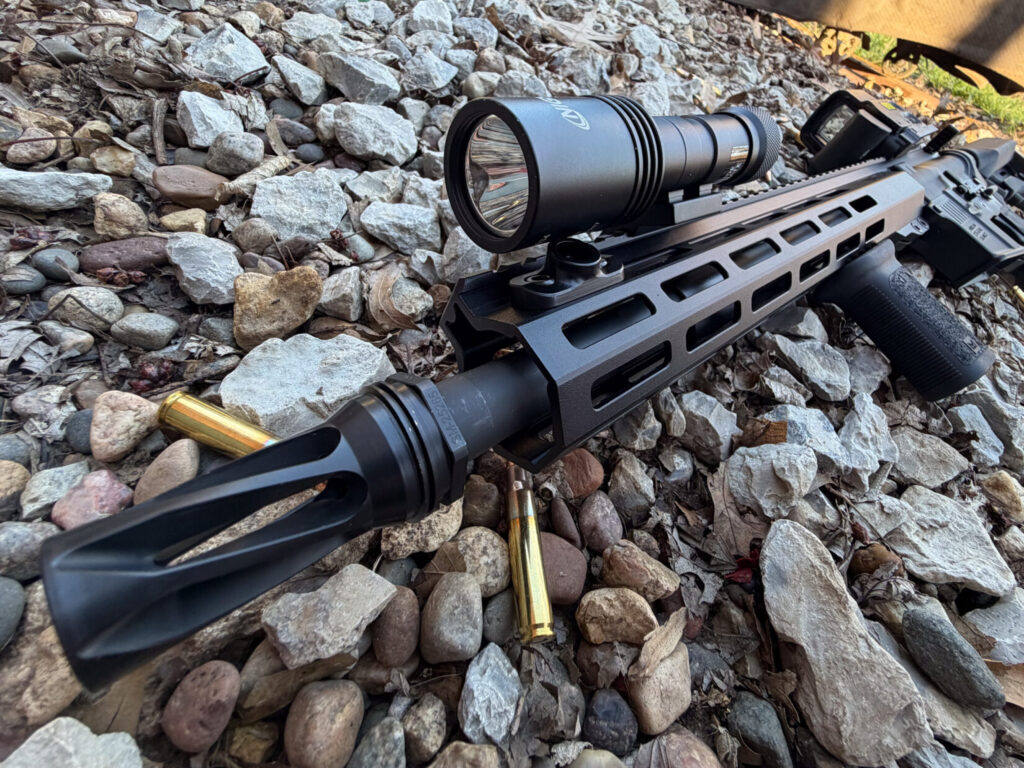
On a long gun, that reach translates to greater confidence.
But I should clarify that the beam isn’t so narrow that you lose awareness. Quite the opposite. Remember, we’re still packing 800 lumens in this light… We’re just driving those lumens out to greater distances.
I also paid attention to how the kit comes together. Mounting didn’t feel like an afterthought. The hardware feels purpose-built, and the placement of the remote switch is intuitive. Once it’s mounted, it feels integrated, like it’s part of the rifle. Factory. That makes a difference; it handles more smoothly and feels more natural that way.
Anyway, for rural properties, larger structures, or anyone running a patrol rifle, this is where high candela earns its reputation. Distance exposes weak lights quickly.
And the LGL-160-T ain’t weak.
Real-World Testing Makes a Difference
I’ll admit that I used to ride the lumen number bandwagon. If one light had 1,000 lumens and the other had 1,200, I assumed the 1,200-lumen light was better. Simple math.
Then I started testing lights in actual environments instead of white-walled rooms.
Stand under a streetlight. Add headlights in your peripheral. Maybe some light reflecting off glass or painted surfaces. Then activate a wide flood beam. It looks bright for about two seconds. Then your eyes adjust, and the beam blends into everything else.
Now hit that same space with a high-candela beam. The difference isn’t subtle.
The hotspot cuts through the background lighting. It creates contrast and draws your eye exactly where you point it. Even with competing light sources, it maintains authority.
After enough side-by-side comparisons, I stopped caring so much about raw lumen numbers and started paying attention to candela.
These Turbo series lights make that difference obvious.
Final Thoughts
After spending real time with these lights, here’s where I’ve landed: High candela tech isn’t some fading fad or over-inflated hype. It’s the new norm. It’s here to stay, as it should.
The difference shows up in real-world environments where old high-lumen lights get washed out and underperform. It shows up when trying to ID targets out past 25 yards with clear definition and rich textures.
It shows up where it freaking matters most, man. Duty. Home defense. Concealed carry. It’s hard to argue with that.
Like many of us, I used to think lumens were the whole story. They’re not. Beam intensity completely changes the equation.
If you operate in environments where distance, glare, or ambient light are part of the problem, and most of us do, Nightstick’s Turbo lineup is a noticeable step forward.
And once you see it for yourself, it’s hard to unsee. Get you one. Or three.