If there was a gun that defined my childhood, it would be the HK USP—the go-to choice of pop culture in the late 1990s and early 2000s. It graced the cover of Rainbow Six, and it became a big part of movies like Blood Diamond, Heat, and Tomb Raider. In general, it became one of the most popular “hero guns” of that era.
If you were making a serious action movie with serious characters, they likely wielded some variant of the HK USP. It came with HK branding, which was the professional’s choice. This wasn’t the gun the average grunt carried; it was for your special operations commando, which reflected real life.
The HK USP prototypes were entered into the Mk 23 program, which remains the first and only “offensive” handgun under military parlance. The Mk 23 established a rigid standard for durability, reliability, and capability. It was a great big beast of a gun designed for a specific role.
In comparison, the HK USP was the “Universal Service Pistol.” It was smaller, came in calibers other than .45 ACP, and came in several different size variants.
The HK USP was a big success for HK. The German Army and French Marine Forces adopted the pistol. So did special operations forces in Japan, Norway, Poland, Serbia, Spain, and Ukraine, alongside numerous police and regular military forces.
It became known as one of the most robust, durable, and capable pistols. One of its big claims to fame was its ability to withstand extreme round counts, even from the high-pressure .40 S&W.
The HK USP In Living Color
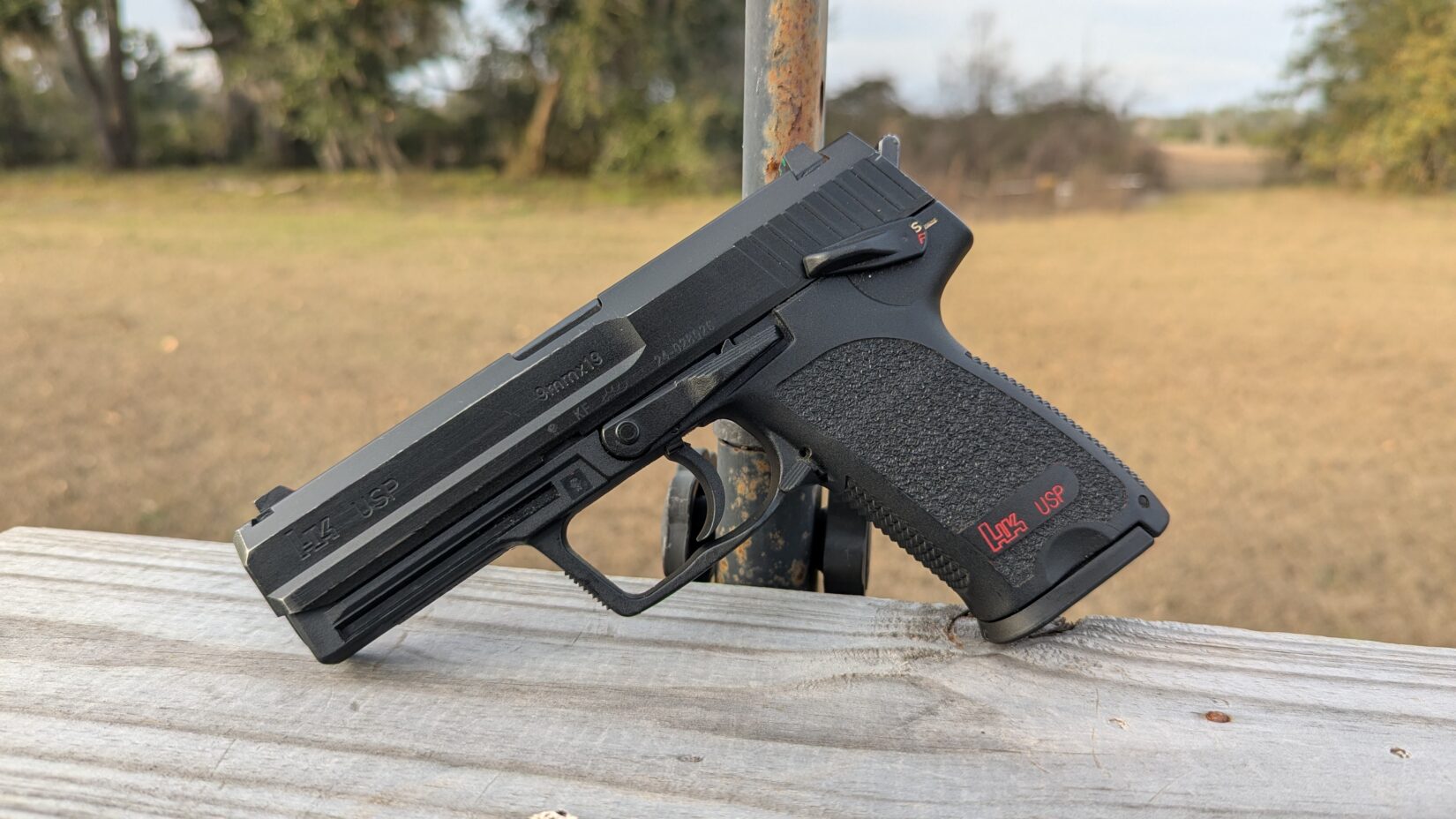
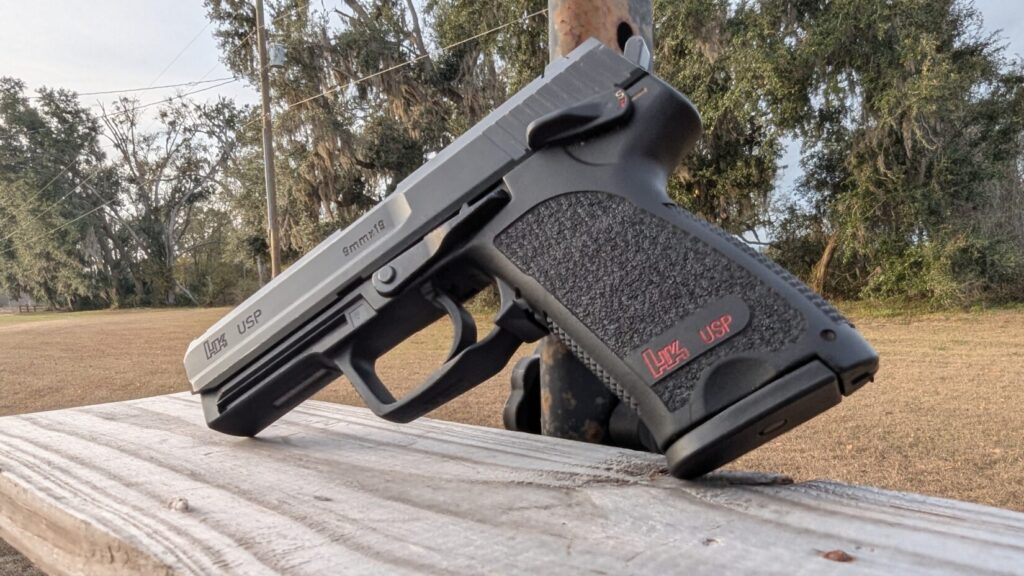
The HK USP is a polymer-frame, DA/SA, hammer-fired, short-recoil-operated, box-magazine-fed handgun. The gun came in four calibers: 9mm, .40 S&W, .357 SIG, and .45 ACP. Mine is 9mm.
Buying this gun in 9mm feels a little silly. It’s massive for a 9mm handgun and makes a lot more sense in .40 S&W and .45 ACP. The 9mm variant only holds 15 rounds.
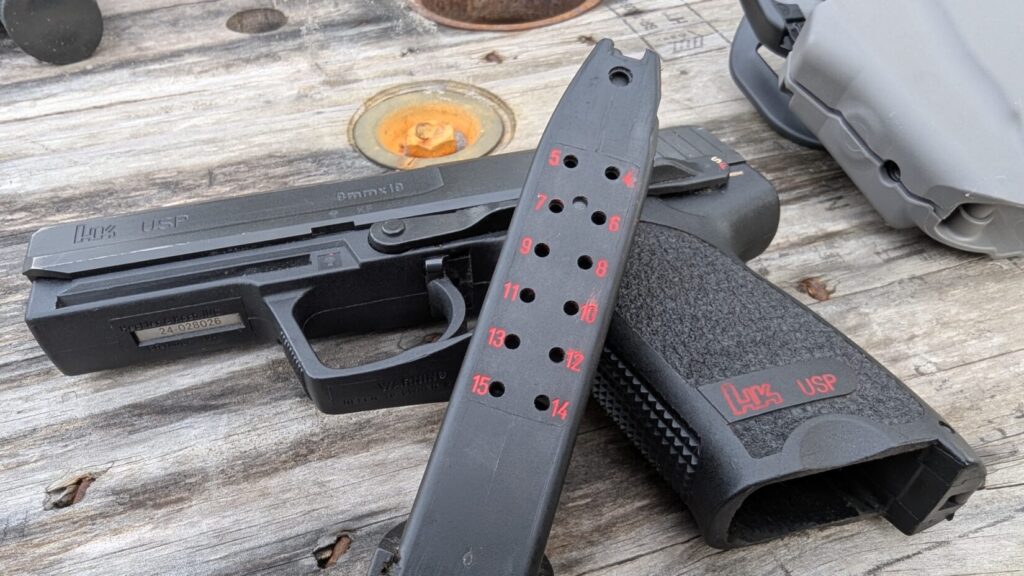
The specs between the numerous calibers barely change, including the overall width of the firearm. The 9mm and .40 S&W are identical, with the .45 ACP being a little taller and a little longer thanks to a slightly longer barrel.
9mm USP Specs
- Length: 7.68 inches
- Height: 5.31 inches
- Width: 1.26 inches
- Barrel Length: 4.25 inches
The stinger here is the $1,259 MSRP, with the guns still commonly selling for over $1,000. HK is certainly proud of the USP.
It comes in a ton of different models: the standard model you see here, but also the Tactical, the Compact Tactical, the Expert, the Match, and the Elite. Additionally, the gun comes with numerous safety and decocker variants.
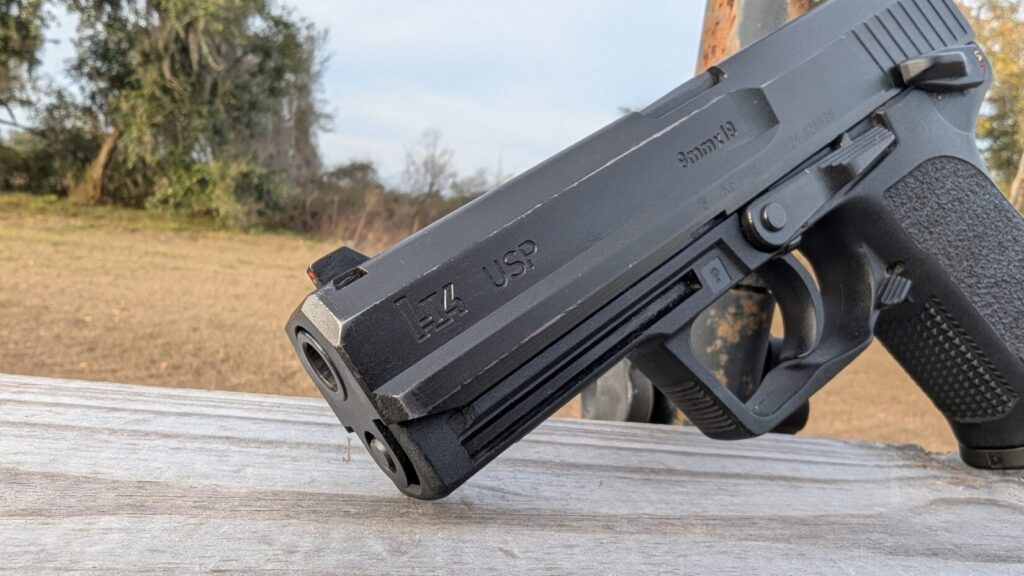
In fact, there are nine variants total. There are four safety lever configurations. HK counts each configuration twice because the variants come in left and right-handed options. There is also a variant with no lever in a DAO option.
I won’t dig into each variant, but mine is a Variant 1. This mixes a decocker with a safety. The gun can be carried “locked and cocked” in single-action safely, and decocked to double-action by pressing downward.
Shooting the HK USP
For a gun that retails for over a grand, I would expect a much nicer trigger. The double-action is heavy and long; it’s smooth, but if you’ve shot a CZ, a SIG, or a similar gun, you’ve experienced a better double-action trigger.
The single-action is fine. Not bad by any means, but far from crisp or 1911-like. Overall, the trigger isn’t bad enough to detract from effective accuracy, but it’s not helping either. The trigger shoe is wide and easy to reach.

The HK USP does allow for decently tight groups with the single-action trigger. At 10 yards, I can keep all of the rounds in a 2-inch circle with the iron sights. At 15 yards, I can keep the groups surprisingly tight and inside of an index card.
If we step back to 25 yards, I can clean up a reduced-sized IPSC target; it’s roughly 33% of a full-sized target. When we get back to 50 yards, it’s tough to see the smaller targets due to the front sight. I can drill a full-sized IPSC—not quite in the A-zone, but I can keep them in the torso of the target.
Going Fast
The dual recoil spring setup has been widely adopted, and it’s easy to see why. It works quite well. 9mm doesn’t recoil all that much in the first place, so a dual recoil spring, a fat, wide grip, and the overall weight of the gun make it a soft shooter.

It really shines when you start shooting 124-grain NATO loads. Compared to similar guns, the HK USP shows a definite difference in recoil. Shooting fast feels natural and normal with no loss of control.
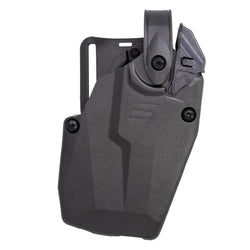
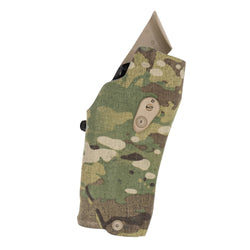
Cleaning up a Bill Drill in 2.4 seconds from a GLS holster is easy to do, even cold. That’s not necessarily the fastest Bill Drill, but from retention and concealment, I’ll take it. It’s about as good as I’m going to get with this rig and gun.
Running the USP
One place where the USP shines for me is ergonomics. In my big hands, I have no problem reaching and using the controls. The controls themselves are absolutely massive.
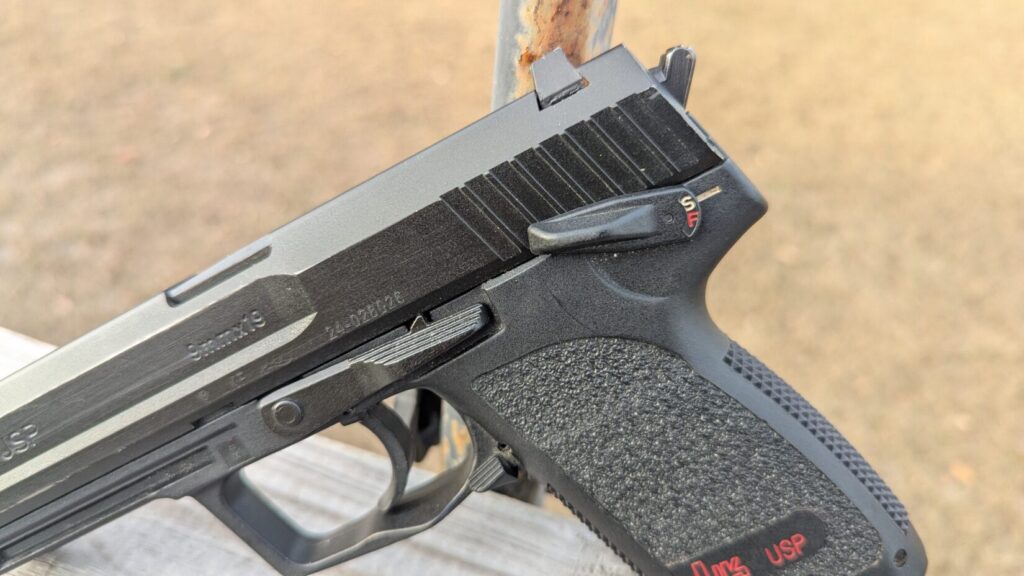
The safety lever is huge with a massive shelf that makes engaging the safety or decocking the gun something you can do without breaking your firing grip. The slide release is huge, and my thumbs don’t pin it down while I’m shooting.
The magazine release is going to be a “love it or hate it” affair. It’s mounted on the trigger guard and is pressed downward to drop the magazine. I like this type of magazine release, but I understand why others do not.
Bottom Line
Here’s the thing about the USP: It’s not worth it. It’s not worth two Glocks.
In fact, between a Glock Gen 6 and the USP, I’d rather have the Gen 6 Glock. The Glock and other polymer-frame, modern guns offer a better option. The USP is bigger than it needs to be.
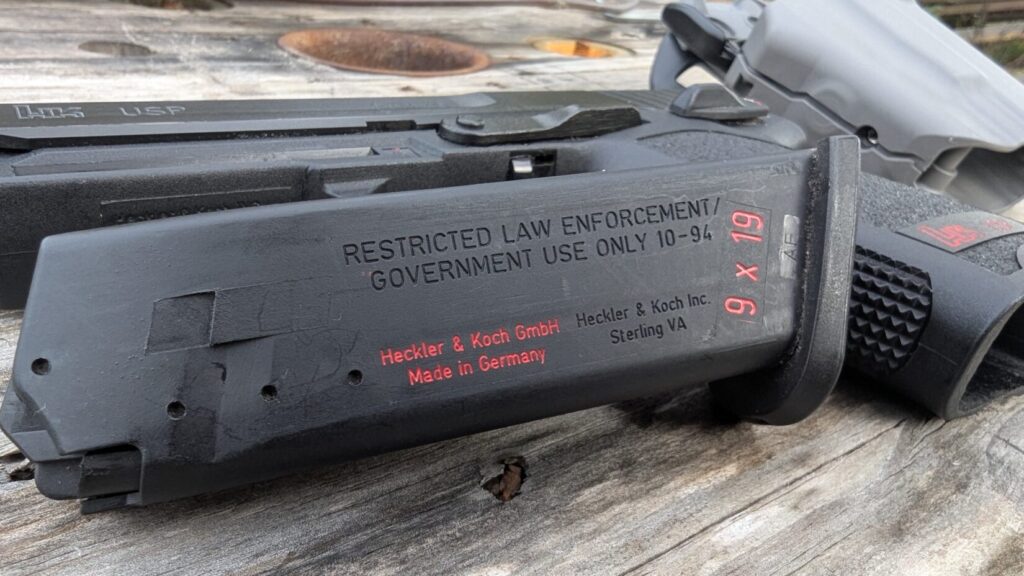
The gun has some neat modularity, but modern guns offer more. HK still produces these with a rail that’s unique to the USP, so you need to find one of the few lights that fit it or purchase a special adapter.
It’s not optics-ready, which is crazy these days. A $1,200 gun that can’t accept optics or common lights? It only holds 15 rounds?
Ehh, it’s out of date these days, and HK doesn’t seem keen to modernize the design. Is it a bad gun? No, but it’s not worth a grand.
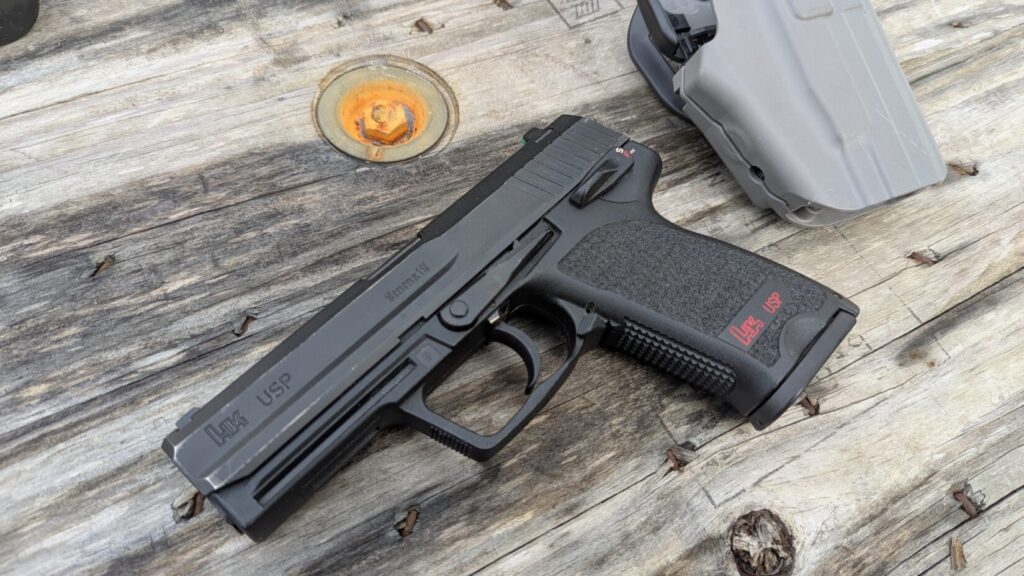
I got lucky and found mine as a LEO trade-in and paid nowhere near a grand. For me, it’s a “vibe” gun. It has a great history and a pop-culture past, but not much of a future.