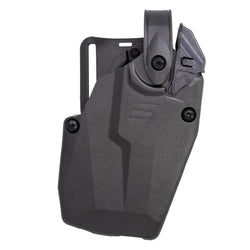
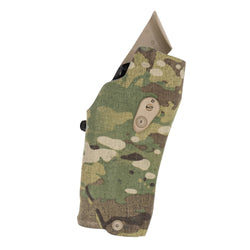
A few weeks ago, I had the opportunity to visit the Safariland holster factory in Jacksonville, Florida. While I knew there was a connection between Bill Rogers and Safariland holsters, I didn’t realize how deep this connection was. Turns out, Safariland’s holster factory was previously the Bill Rogers holster factory.
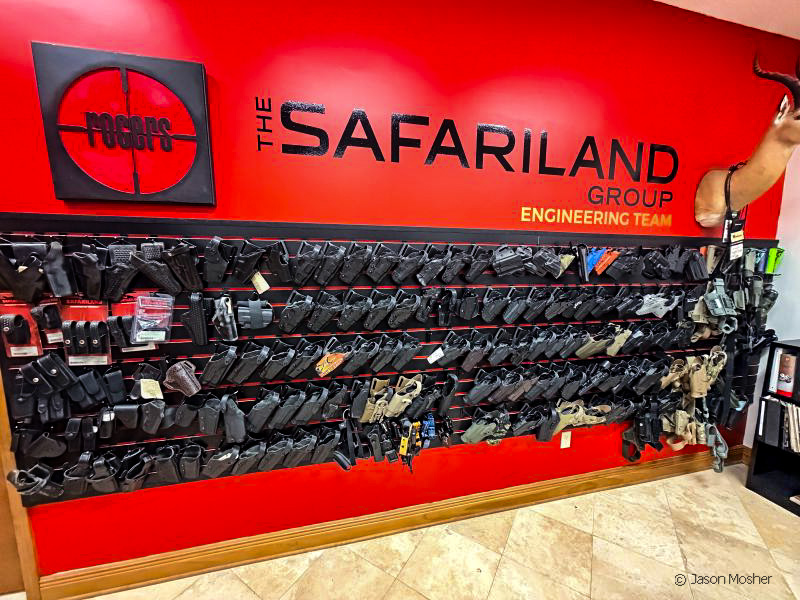
We all know firearms can tell stories. Each one displays the inventor’s ingenuity, the places they’ve been, and the stories they carry. Most of us probably never think of a holster in this way or really give any thought to the inventors or their history. But as I walked through the Safariland facility, Bill Rogers’ influence on modern-day holsters was clearly evident.
While the facility, holster design, and testing methods are all stories we will tell here on the CADRE Dispatch blog over the coming weeks, it’s best to start at the beginning. And in this case, the story starts with Bill Rogers and his holster designs.
From FBI Agent to Holster Innovator
Bill Rogers did not begin his career as an industrial designer or a holster maker. His career path led him into law enforcement; more specifically, the FBI.
Rogers worked for the FBI as a special agent before the days of polymer pistols and holsters. Leather was the dominant material for any good holster. And don’t get me wrong, I love leather holsters. But for duty use, they have some drawbacks. It didn’t take Rogers long to recognize some major flaws in standard-issue law enforcement gear, and he wanted to do something about it.
Leather looks classic, but it degrades over time. Moisture weakens the material, causing holsters to soften, lose retention, and collapse. In high-stress encounters, soft leather could interfere with trigger guards or hinder a clean draw. It can also be difficult to re-holster a handgun in a worn leather holster.
Besides being an FBI agent, Rogers was also a world-ranked IPSC competitive shooter and state trap champion. With over 40 years of competitive shooting experience, he analyzed weapon retention from a practical standpoint. He wanted gear that offered speed, durability, and better security.
Seeing an opportunity to make a better design, he established the Rogers Holster Company in 1973. His goal was simple: build a better, safer, and faster holster for working professionals.

Pioneering Kydex and Injection Molding
As I mentioned before, the holster industry relied almost entirely on hide and thread back in those days. Rogers went in a completely different direction and started using synthetic materials.
Today, he is considered the pioneer of modern holsters. He was among the first to use Kydex, a rigid thermoplastic sheet material, to build a holster. Kydex offered a lot of advantages over traditional leather holsters. This included:
- Weather Resistance: It did not absorb water, sweat, or oil.
- Dimensional Stability: It held its exact shape regardless of environmental heat or moisture.
- Consistency: It provided smooth, repeatable retention forces on every draw.
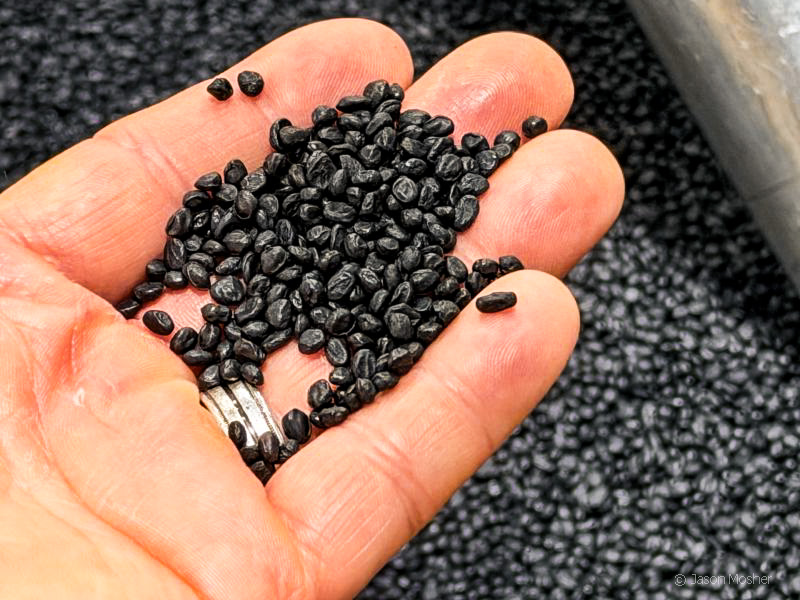
Rogers didn’t stop with custom-molded sheet plastics, however. He introduced advanced thermal laminates and heavy-duty injection molding to holster manufacturing as well. This shift allowed holsters to be made with precise internal tolerances. For the first time, a holster could actively clamp onto specific firearm contours without relying on tight, leather-stretching friction.
The Birth of Modern Retention
For law enforcement officers, firearm security is literally a matter of life and death. This is because suspects frequently attempt to disarm officers during physical altercations. Early leather thumb-break straps offered basic protection, but they were often easy to defeat.
Bill Rogers analyzed holster retention as a mechanical problem. He designed internal locking mechanisms that automatically engaged the firearm upon holstering. His designs required specific, intentional thumb or finger movements to release the handgun during a draw cycle.
These retention concepts laid the groundwork for modern duty holsters:
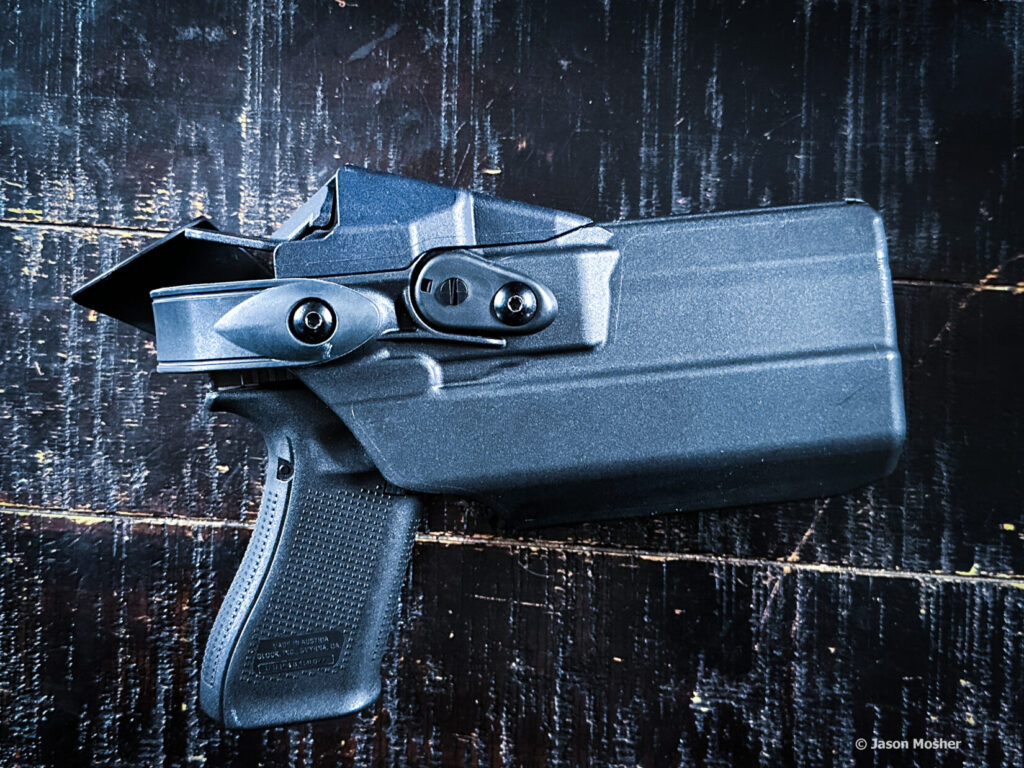
- Automatic Engagement: The gun locks safely into place the moment it enters the shell. Safariland now calls this the Automatic Locking System (ALS).
- Intuitive Releases: The release mechanism aligns perfectly with a natural firing grip.
- Multi-Level Protection: Combining multiple devices, a holster can have varying levels of security. You have no doubt heard of retention levels on a holster before. This concept was created by Bill Rogers.
When you draw from a Safariland holster featuring the Automatic Locking System (ALS) or Self Locking System (SLS), you are using mechanical principles perfected by Rogers. His designs allow officers to draw with speed under stress while preventing unauthorized access.
Decades of Partnership
The relationship between Bill Rogers and Safariland spans over four decades. Long before Safariland formally acquired his company, the two entities worked side by side.
Safariland brought massive global distribution, research capabilities, and market reach. Rogers brought a talent that is hard to find: tactical insight, tooling expertise, and cutting-edge mechanical designs. Together, they developed equipment that set new standards for law enforcement and military personnel.
In 2015, Safariland officially acquired majority ownership of Rogers Holster Company. The Jacksonville shop officially changed from the Rogers Holster Company to Safariland.
Rogers himself took on an executive role as Vice President at Safariland while continuing to lead design initiatives. The acquisition gave Safariland full access to in-house injection molding, custom design tooling, and proprietary manufacturing capabilities.
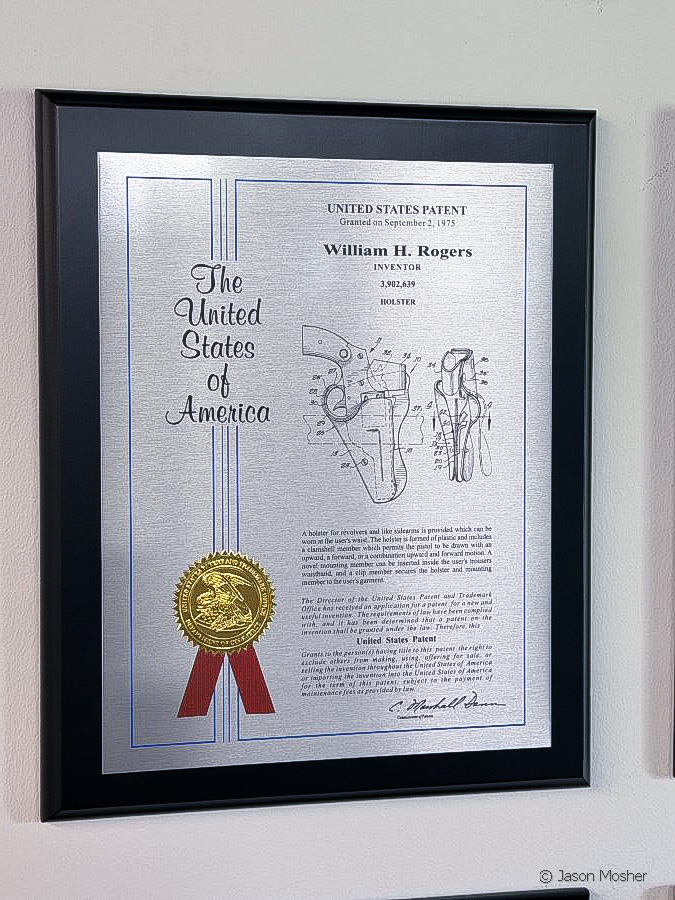
Today, the original Rogers facility in Jacksonville remains a primary hub for Safariland’s duty production line. I even saw some patents hanging on the wall with Bill Rogers’ name on them.
The Rogers Shooting School
Bill Rogers’ influence extends far beyond patent drawings and plastic molds. He also established the world-renowned Rogers Shooting School in Ellijay, Georgia.
The school is legendary among military Special Operations units, federal agencies, and SWAT teams. The curriculum focuses on fast target acquisition and reaction times. Trainees must engage small, fast-moving steel targets within fractions of a second.
This intensive training environment served as a real-world laboratory for Rogers’ holster concepts. If a mechanical lock or holster body failed during high-speed training drills, Rogers modified the design. Every holster design was refined through thousands of rapid-draw cycles under rigorous pressure.
The Lasting Legacy of Bill Rogers
Today, I think modern holsters are taken for granted. People expect superior construction, optic compatibility, and push-button mechanical retention. But these features were once radical ideas that faced strong skepticism from traditional holster makers.
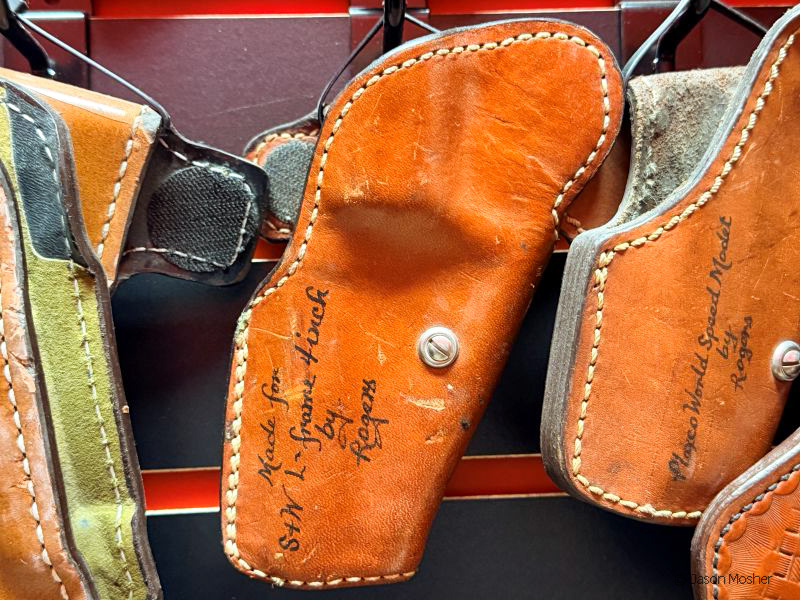
Bill Rogers proved that synthetic materials and mechanical retention were not just feasible, but essential.
I was already excited to take a tour of the Safariland holster factory. But being able to stand in Bill Rogers’ old office, see patents he filed, and meet employees who worked for him made the tour that much more memorable.