
Modern handguns have a variety of safety features that help prevent accidental discharges. These mechanical features are divided into manual and passive safeties. Manual safeties require conscious thought and action to engage and disengage, while passive safeties work whether or not you’re thinking about them.
Together, they help prevent a discharge unless the trigger is deliberately pressed, including if the pistol is dropped. In a previous article, we covered the advantages and disadvantages of manual safeties on carry guns. In this overview, we will cover each passive safety and how to inspect it for reliability.
What Is a Trigger Safety?
A trigger safety is a small lever built into the trigger that must be depressed before the trigger can move far enough to fire the gun. Iver Johnson developed a trigger safety for their Safety Hammerless revolver in the 1890s, but it was an uncommon feature until Glock popularized the concept with their Safe Action System.
Today, trigger safeties are features on most striker-fired handguns from Glock, Smith & Wesson, Springfield, and Walther, among others. But how do trigger safeties work?
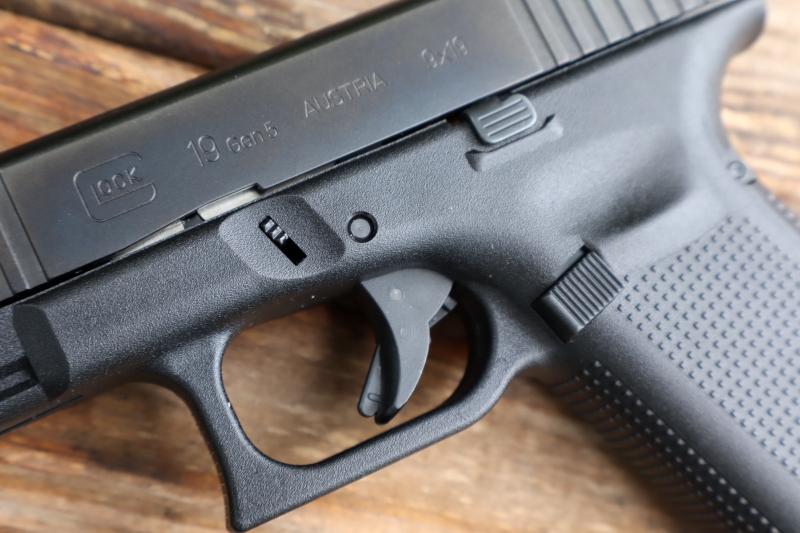
Trigger safeties consist of a trigger shoe and a spring-loaded trigger safety lever that sits within the shoe. When the action is cocked, the lever sits proud above the shoe and must be depressed for the shoe to be depressed. Only when both are depressed can the trigger unit move rearward to fire the pistol.
The mission of the trigger safety is an obvious one. The safety lever prevents the pistol from firing unless the trigger is intentionally pressed rearward. Cursory bumps to the trigger shoe alone will not do it, thus avoiding an age-old cause for unintentional discharges.
While generally reliable, the trigger units on many stock pistols are polymer-on-polymer units, and it is possible for the trigger safety blade to break. The safety bar’s return spring can also become damaged, preventing it from sitting proud when the action is cocked.
To remedy this, the trigger unit is usually removed from the frame by driving out the trigger pivot pin and lifting the trigger pivot pin and the trigger housing pin. It’s a straightforward job if you’re comfortable detail-stripping your pistol, and a quick one for an armorer if you’re not.
What Is a Grip Safety?
A grip safety is a lever in the grip that blocks the trigger from firing the gun until the shooter takes a firm firing grip. Grip safeties date back to the 1880s and have been in continuous use since then.
It started with the Smith & Wesson New Departure, introduced in 1887, which used a grip safety in the backstrap of the grip. Although it works differently from grip safeties that came afterward, the goal behind the mechanism is unchanged: prevent the press of the trigger unless the handgun is gripped and in a condition to shoot.
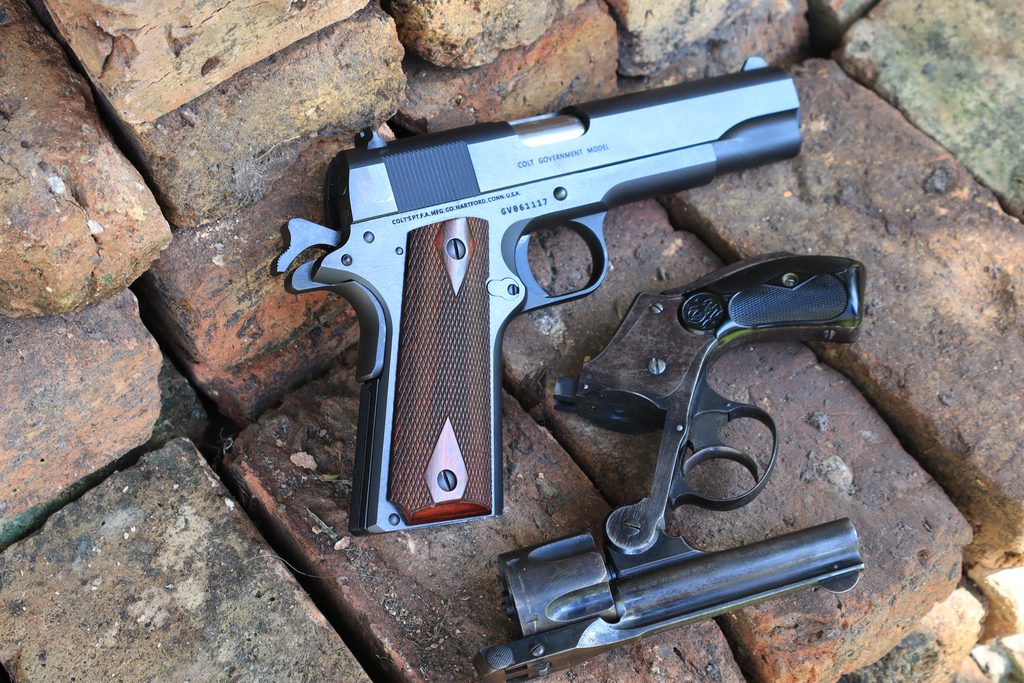
Grip safeties are most common on 1911-style handguns, where they double as a safety and a way to protect the shooter’s hand from slide and hammer bite. Outside this sphere, the grip safety is rare, save for the Springfield XD line of striker guns.
The grip safety itself rides in the backstrap of the grip, and the top of the grip safety blocks the trigger bar from slipping the hammer or striker and setting off the pistol.
Like a trigger safety, a grip safety prevents accidental discharges when the shooter is not in full command of the firearm—such as when it is riding in a holster. But all that is needed to be shooter-ready is to take a firing grip on the handgun.
Grip safeties are an excellent passive safety, but some shooters do not agree with them. Some ill-fitted grip safeties have excess gaps and burrs that dig into the shooting hand. Others, like the one on the XD, are small and can be tricky to disengage with slick hands or a weak grip.
Checking grip safety function is simple. On an unloaded handgun, release your grip on the pistol and press the trigger. If the grip safety is working, the hammer or striker will not drop. Grip the pistol and press the trigger to dry fire the pistol. Grip safeties can be changed by removing the manual safety and decompressing the mainspring housing before wrestling the grip safety off its pin. It’s very doable at the bench, but a gunsmith can do it quickly if you’d rather not.
What Is a Firing Pin Safety?
Firing pin safeties stop the forward movement of the firing pin, preventing it from striking a loaded cartridge. These generally consist of spring-loaded firing pins and firing pin blocks.
Inertia Firing Pins
The simplest form of firing pin safety is the spring-loaded inertia firing pin, used in designs like the 1911, where a minor bump to the pistol is unlikely to set it off. Most modern pistols and revolvers have a spring-loaded firing pin.
These are not absolutely foolproof, as inertia from a long drop can be enough to overpower the spring and move the firing pin. Firing pins and springs are out of sight and out of mind for the most part, but firing pin springs can generally be serviced if the firing pin becomes damaged.
Firing Pin Blocks
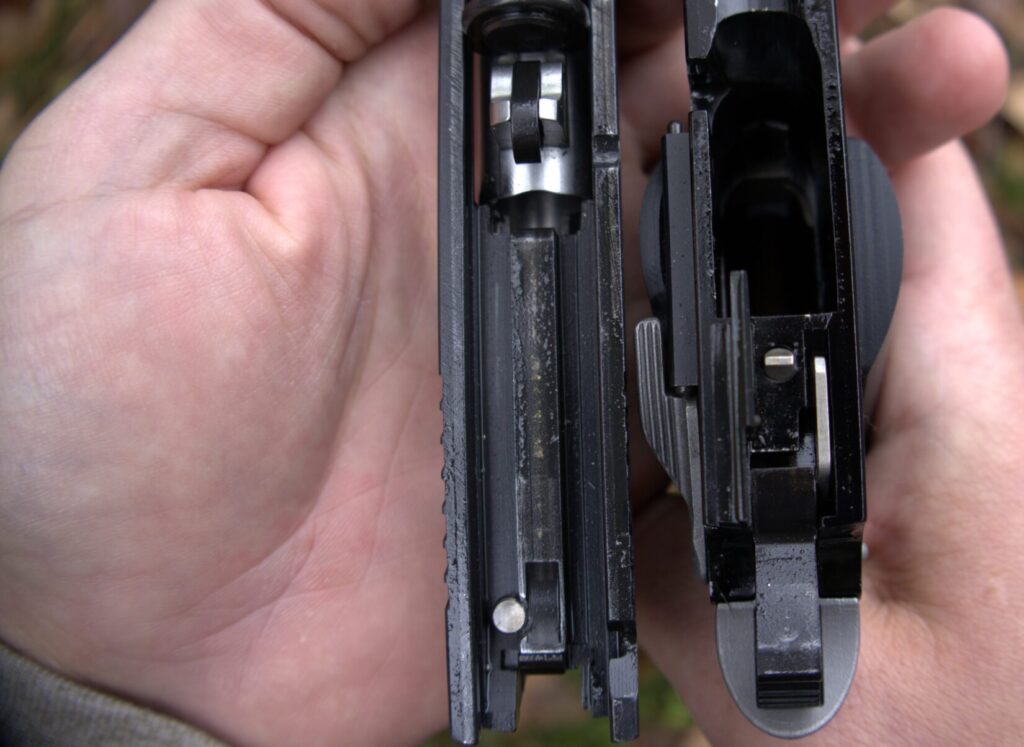
Modern firing pin safeties go beyond spring-loaded pins. On modern handguns, they usually consist of a plunger built into the slide near the sear bar with a corresponding pressure bar build into the frame and interfaced to the trigger. The trigger must be depressed for the plunger to move out of the way of the firing pin in order for it to complete its journey.
Firing pin blocks are generally serviced during the procedure where the firing pin is removed, which removes the tension on the plunger. Trigger bar disassembly may be required to service the pressure bar.
What Is a Drop Safety?
A drop safety is any feature designed to keep a handgun from firing if it’s dropped or struck hard. In most handguns, it isn’t a single part but a job shared by the mechanisms covered here.
A firing pin block physically stops the firing pin unless the trigger is pressed, so a hard impact can’t drive it into a primer. On revolvers, transfer bars and hammer blocks do the same work by keeping the hammer’s energy from reaching the firing pin. Glock pistols add a dedicated drop safety tied to the trigger bar, which Glock lists as one of the three passive safeties in its Safe Action System.
No drop safety replaces good handling. Treat any dropped gun as loaded, and if it takes a hard fall, make sure it’s inspected before you carry it again.
What Is Transfer Bar Safety?
A transfer bar safety only lets the hammer’s energy reach the firing pin when the trigger is pulled. Transfer bar safeties date well before Ruger popularized them in the 1970s with the Service Six and remodeled Blackhawk/Single Six revolvers. This type is used almost exclusively on revolvers, although some lever-action and single-shot rifles also use it.
Transfer bar safeties work as a missing link. The hammer is engineered so that it is not long enough to physically strike the firing pin to set off a cartridge. It requires a transfer bar to transfer force from the hammer to the firing pin.
When the bar is not engaged, the hammer strikes dead space. In most cases, the transfer bar is fixed to the trigger, ensuring that the trigger must be pulled in order for the firearm to discharge. Pulling the trigger causes the bar to move into place, completing the chain.
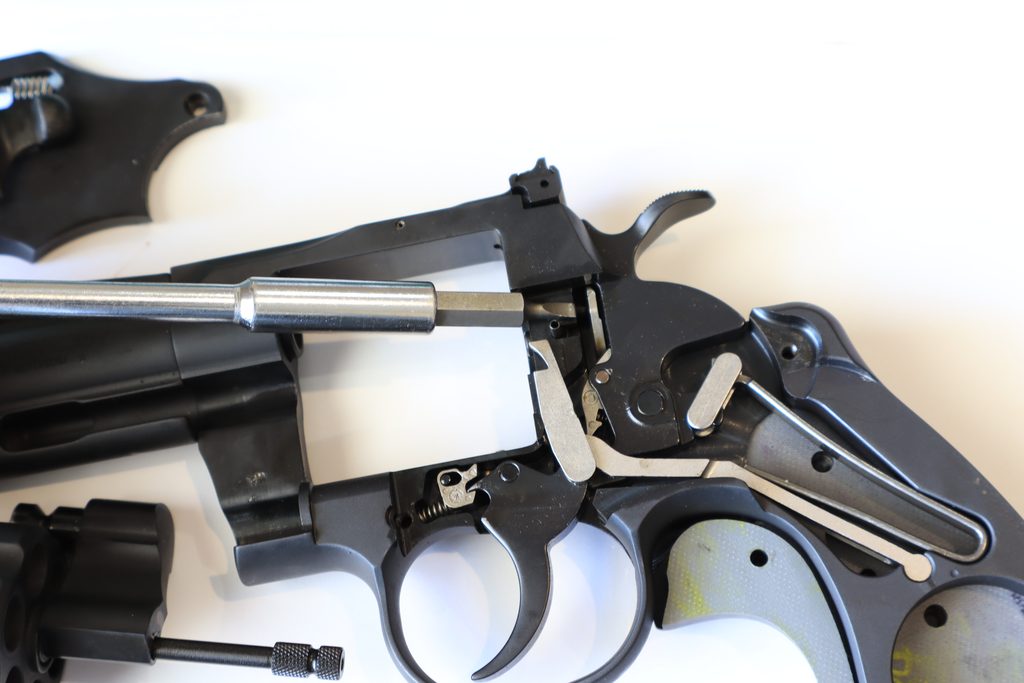
Transfer bars are solid steel construction and generally require little thought. However, a bar that is out of spec can shatter and completely disable the firearm. Some revolver aficionados collect handguns without this feature just to avoid that possibility!
What Is a Hammer Block Safety?
Transfer bars are common on revolvers, but they aren’t the only option. The other revolver safety is the hammer block safety.
Like the transfer bar, the hammer block safety is a sliding steel unit set into the frame. However, its job is entirely different. Without the transfer bar, the hammer is not long enough to contact the firing pin or set off a cartridge. In the case of a hammer block safety, the handgun either has a fixed firing pin or the hammer can reach its destination unless a block stops it.
The first hammer-block safeties were simple rebounding hammers that backed off the cylinder when the trigger was released. It was a fine system, but the rebound slides that backed off the hammers tended to be shallow. It was not a physical block.
Colt’s Positive Lock, circa 1907, was among the first hammer block safeties. The positive safety moves out of the way with the full pull of the trigger. Otherwise, the safety slides under the hammer, preventing forward movement.
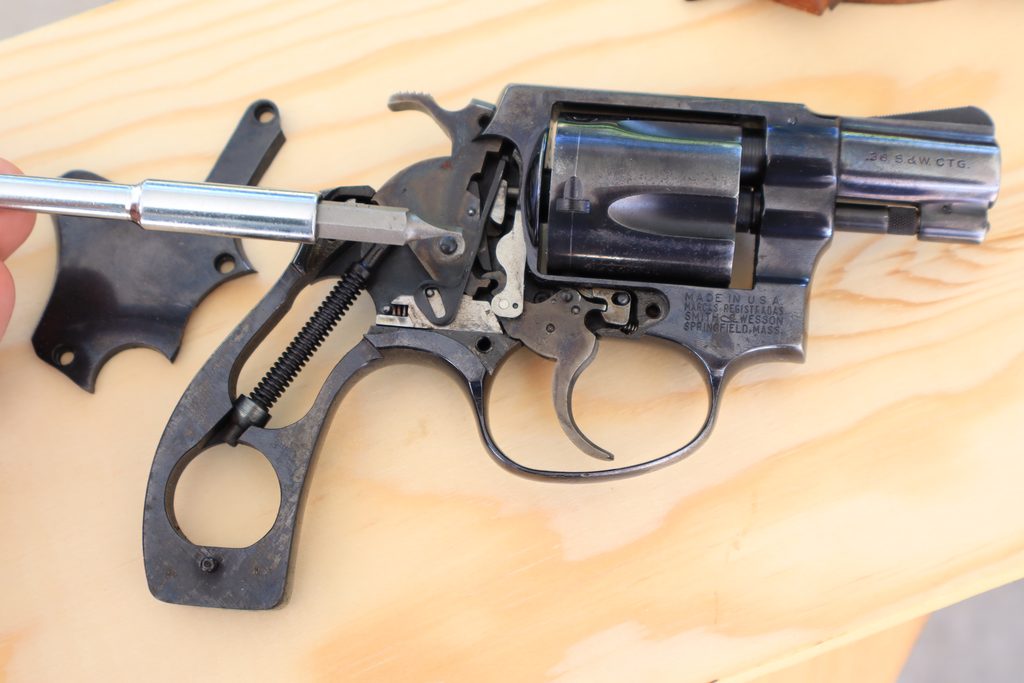
Although Colt pioneered the concept, hammer blocks are best known as a classic Smith & Wesson safety. Post-World War II Smith & Wesson revolvers and their clones like those produced by Taurus and Rossi have them.
Interestingly, some newer Taurus revolvers use transfer bar safeties while Rossi and S&W revolvers continue to use the same hammer block even if their designs use free-floating firing pins.
These safeties are serviced similarly to transfer bars by removing the action parts in the way of their travel. In the case of the Smith & Wesson pictured above, the hammer blocks can be plucked right off the action hammer and rebound slide.
The Bottom Line
Passive safeties work when your brain is not firing on all cylinders. They guard against accidental discharge and hard impacts. All that is required to deactivate a working passive safety is to take a firing grip and press the trigger. Passive safeties are also normally internal to the firearm and require only a modicum of upkeep.
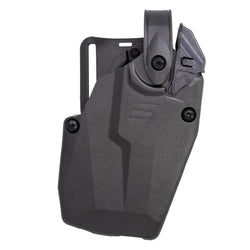
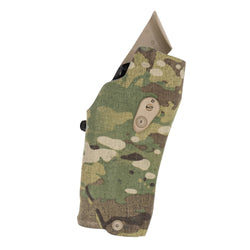
But passive safeties and drop safeties, like manual safeties, are still mechanical devices that serve as no substitute for good gun handling and upkeep. Keep in mind that a trigger safety is built to stop a bump, not a deliberate press. A stray object can press a trigger just as deliberately as a finger. A quality holster that fully covers the trigger guard is an essential component of your system.
Passive Safety Q&A
A: A passive safety works automatically, without the shooter engaging or disengaging it. Common examples are trigger safeties, grip safeties, firing pin blocks, transfer bars, and hammer blocks.
A: A bar that transfers the hammer’s energy to the firing pin only when the trigger is pulled. Without it in place, the hammer can’t reach the firing pin. Iver Johnson introduced one in its Safety Automatic revolver in 1894, and Ruger popularized the design in the 1970s.
A: Glocks have no manual safety, but they have three passive safeties—a trigger safety, a firing pin safety, and a drop safety—which Glock calls the Safe Action System.
A: That a gun is designed not to fire if it’s dropped. Firing pin blocks, transfer bars, and hammer blocks are the parts that usually handle that job.
A: Grip safeties are most common on 1911-style pistols and Springfield Armory’s XD-series pistols.