
In Part I, “The Deadly Doughnut,” we defined the problem: multiple gun-toters posting on all sides of a potential threat, combined with a spontaneous phenomenon called sympathetic fire. That toxic mix of poor positioning and lack of fire discipline can lead to Blue-on-Blue, good people killing or maiming each other.
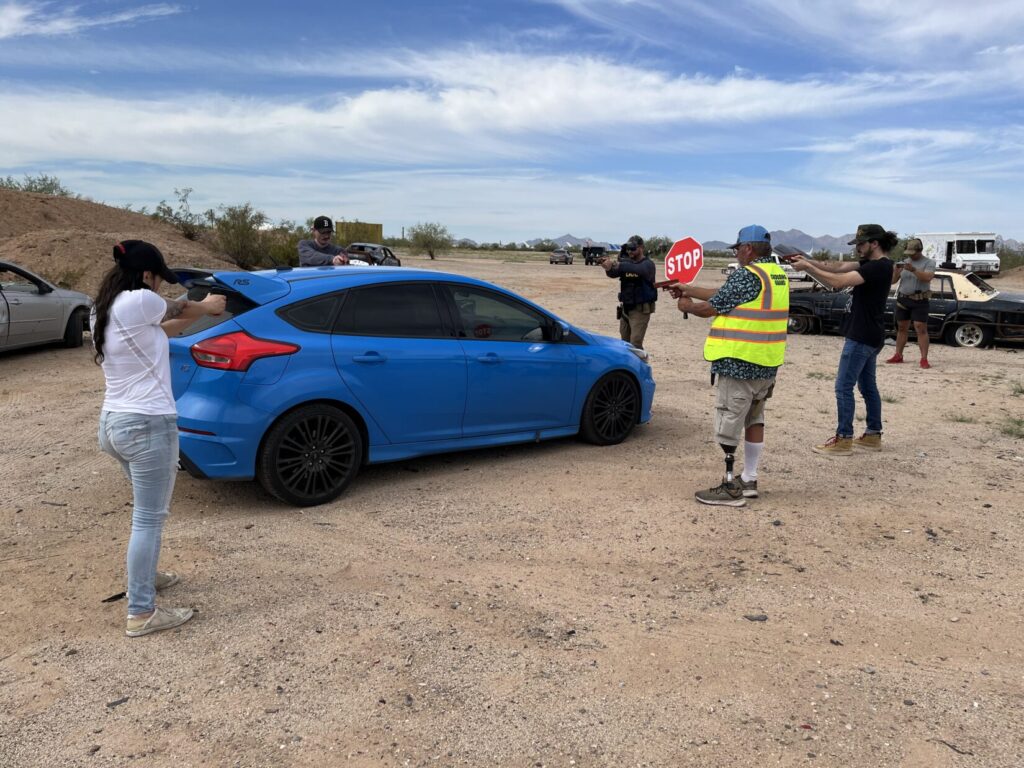
Perpendicular positioning, the “L,” is far better than a circumferential, doughnut-shaped formation. But when a potential threat is in an automobile, even the L can be problematic, because cars can be, and often are, weaponized.
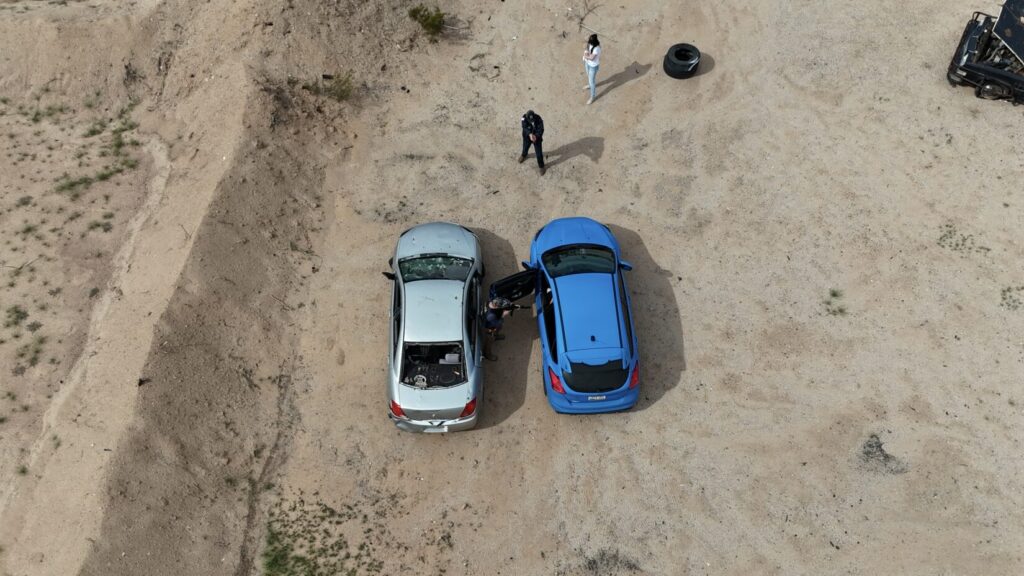
In this installment of the Blue-on-Blue Crossfire series, we’ll discuss what you can do to avoid shooting each other, or kidnapping victims in a car, while not getting run over in the process.
Scenario: A Grocery Store Parking Lot
Suppose you’ve been out shopping with your infant. Suppose also that it’s summer in Alabama, or winter in Montana, so early on in the process you start the engine to get that AC or heat cranking.
You pull junior out of the shopping cart and strap them into their car seat. You’re a responsible citizen, so after you load the groceries into your car, you push the empty cart to the corral.
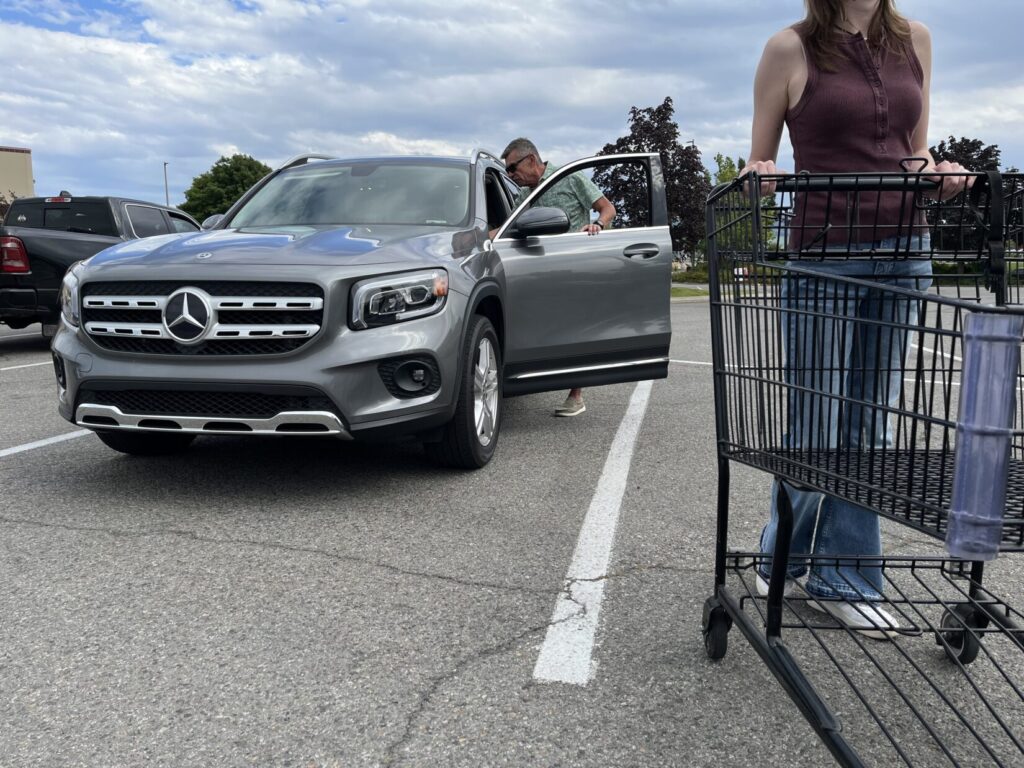
The cart corral is only about 50 feet from your car, but when you turn ’round, you see an opportunistic car thief has hopped into your driver’s seat. He’s about to back out of the parking space, with your precious child in the back seat.
Risks of the “Good Witness” Option
You could just let the carjacker leave with your child, getting a good description and remembering your license plate. The police are better prepared, with more people and better equipment (perhaps including license plate readers, drones, or a helicopter) to stop him.
The carjacker might not fail to yield, get into a high-speed chase, and roll your car with your kid in it.
But then again, he might.
He probably wouldn’t get away and harm your child.
But only probably.
Are you going to take that risk, if you have a pistol, and you’re right there, feet away? You know your child’s chances are better if you don’t let the carjacker leave the parking lot. How can you stop him without further endangering your child?
Positioning VIS-À-VIS The Car
Of course you would be willing to risk your life to save your child. But there’s little point in taking a risk that is not likely to solve your problem. Will placing your body in front of or behind the car necessarily stop the carjacker? Maybe not.
Officers get intentionally run down by suspects in cars. The jacker boosting your car with your kid in the back knows that if it comes to a contest between the bumper and your body, you will lose.
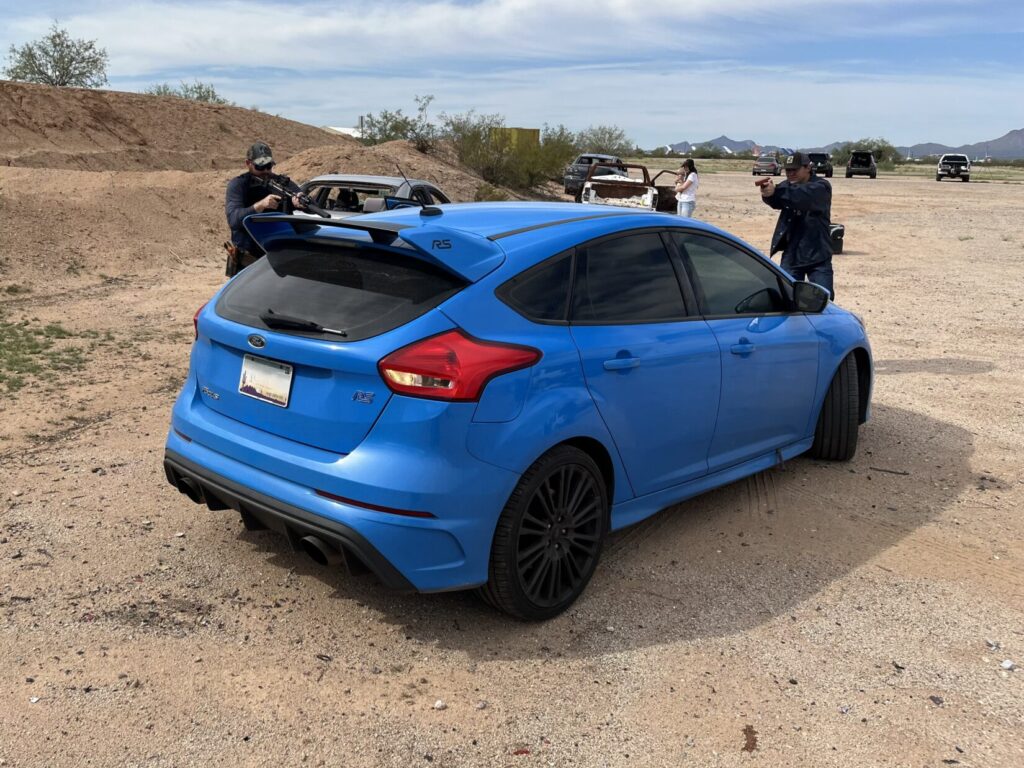
We can’t count on him (statistically, it’s almost always a male) making sound decisions. If he’s so desperate to get away from there that he’s willing to steal your car with your kid in it, he’s desperate enough to choose poorly.
You could borrow from techniques we used in law enforcement to arrest persons in cars. We call the process a Car Jump.
The What and Why of Car Jumps
If a potentially violent felon has a legitimate job, it’s safer to serve an arrest warrant when he or she is getting off work, rather than inside their home. If the suspect gets in a car, arresting officers need methods that prevent escape while not getting us run over.
Also, undercover agents (“UCs”) pretending to be bad guys often meet with suspects in cars. Conversations in cars are more private than in a restaurant or on a park bench.
Being able to look around through car windows helps the subject of the investigation to feel secure. Nobody wants the suspect to be even more paranoid than they already are. The windows also keep the UC safe, as we can see if the good guy or gal gets into trouble.
What Do You Mean, “We”?
“We,” when I was on the job, were PRTs, Primary (undercover) Rescue Teams.
I’m a bad actor, and a worse liar. I can’t even convince my wife that I’m just watching that brand-new gun on the workbench “for a friend.”
Plus, I look like a cop. My teen daughter accompanied me to a resort for a School Resource Officer conference. She slept in the first morning. When she met me in the lobby later, she said “I thought it would be easy to find you, but you’re all dumpy old guys with buzz cuts.” Crooks could see me coming a mile away.
So even though I spent the better part of two decades as a plainclothes criminal investigator, I was never a certified UC, undercover agent. I rarely even did “cameo” UC, like pretending to have a legitimate reason to be there during surveillance, although we all did occasionally. During planned UC ops, I was usually assigned to PRT.
Rescue Teams
PRT agents had two main jobs. The first was to rescue the UC if they got into trouble. The second was to keep an eye out for “counter” (countersurveillance; the bad guys have PRTs, too).
If a deal went down in a parking lot, PRT agents would be in cars not too far away, watching from different angles. When the subject was a really bad hombre with prior violent offenses, known to be armed, or a gangster in a violent organization like the Aryan Nations, our SRT, Special Response (SWAT) Team, would be armored up with rifles in a nearby van.
If the UC gave a prearranged signal, or said something like “Please don’t shoot me with that pistol” over their hot microphone, the PRT executed a Car Jump.
Approach to the Car
If you order a hostage rescue textbook from Amazon, it will tell you that the optimal approach to the car is from a blind angle, usually the rear, and that it’s best to drop a distraction device (flash-bang) onto the hood. We almost never did either of those, although our SRT occasionally did.
Like a hapless parent whose toddler is getting carjacked, we would run directly from wherever we were to the car as soon as we got the takedown signal.
HOW TO NOT GET RUN OVER
We cover officers positioned ourselves on either side of the front fender. This gave us an L pointing into the cab without either of us being where we could get run over.
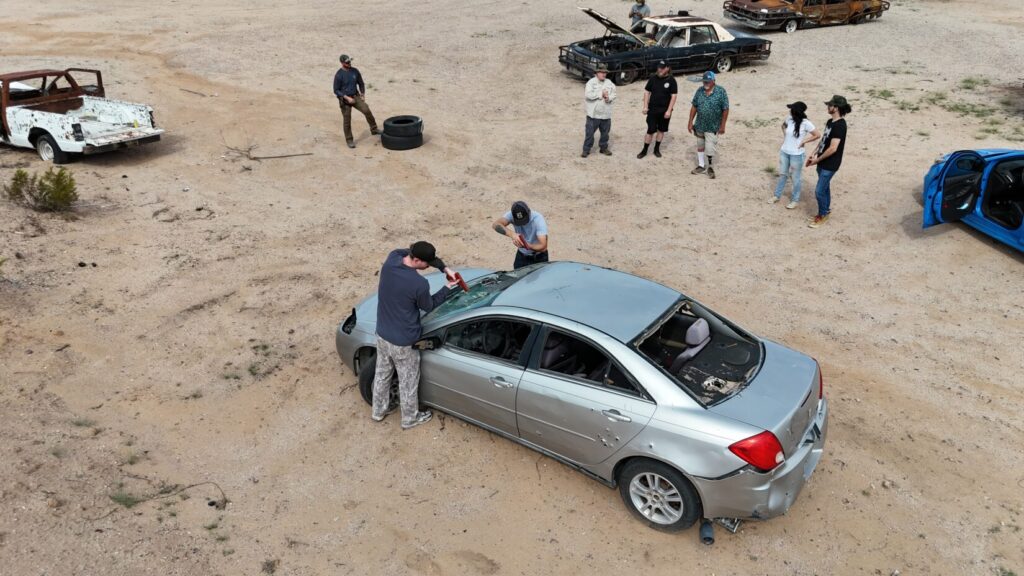
You can use similar tactics, but you’ll need to stay on your toes, because you can still get hit standing off a fender. Be prepared to jump out of the way if he turns the car into you, or tries to nail you with the door, as he drives away. I’ve been hit by mirrors twice (at traffic checkpoints), had the edge of my boot run over by tires, and been intentionally door stunned, but all of those beat being struck by a bumper, or getting run over.
HOW TO NOT Hit the Passengers
Since we had to be concerned about the UC in the car, and about agents on either side of the doors getting ready to extract the passengers, we could not point our guns horizontally through the car. Neither could you, if your kids are in the car.
Instead, you can use “plunging fire from beyond line of sight.” Let’s break that down.
PLUNGING FIRE
If you ever served a belt-fed machine gun, plunging fire meant the cone-shaped pattern of your bullets was falling to the ground from over the height of a standing soldier, or striking a steep hillside.
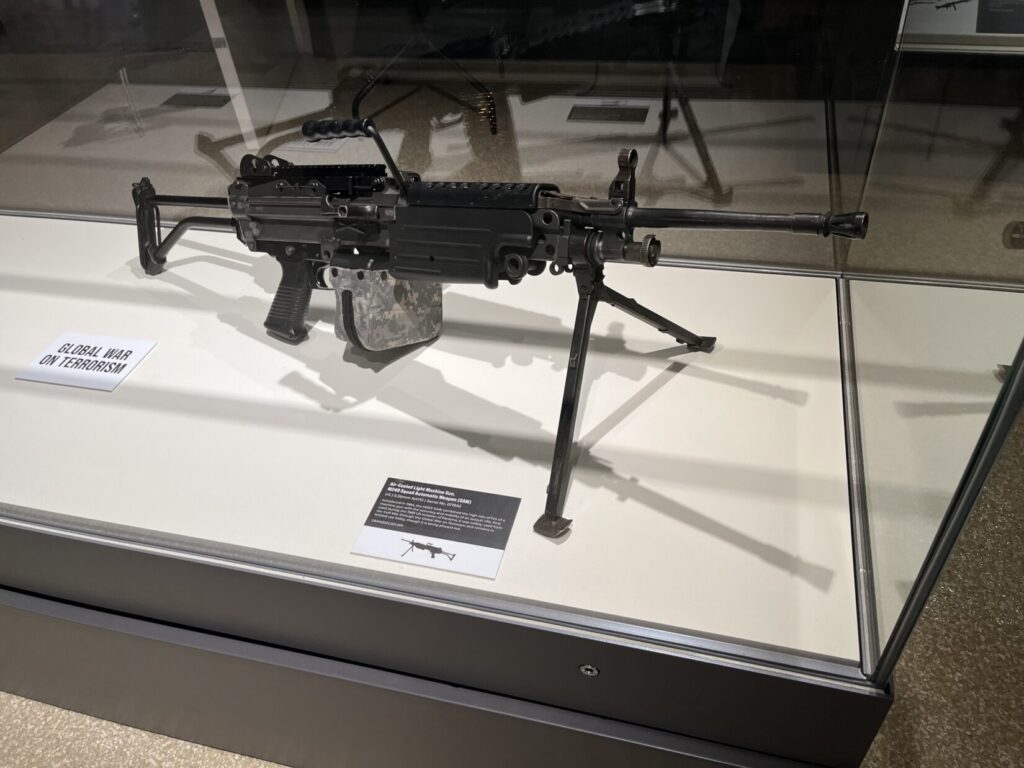
That machine gun concept of plunging fire differs slightly from how we’re defining it here. In the Car Jump context, plunging fire is delivered vertically, toward the suspect’s lap, downward through a windshield.
To cover the driver, stand off the left front fender and hold the pistol in your left hand. Wrap your right hand around the front of the grip, using a Center Axis Relock-type hold.
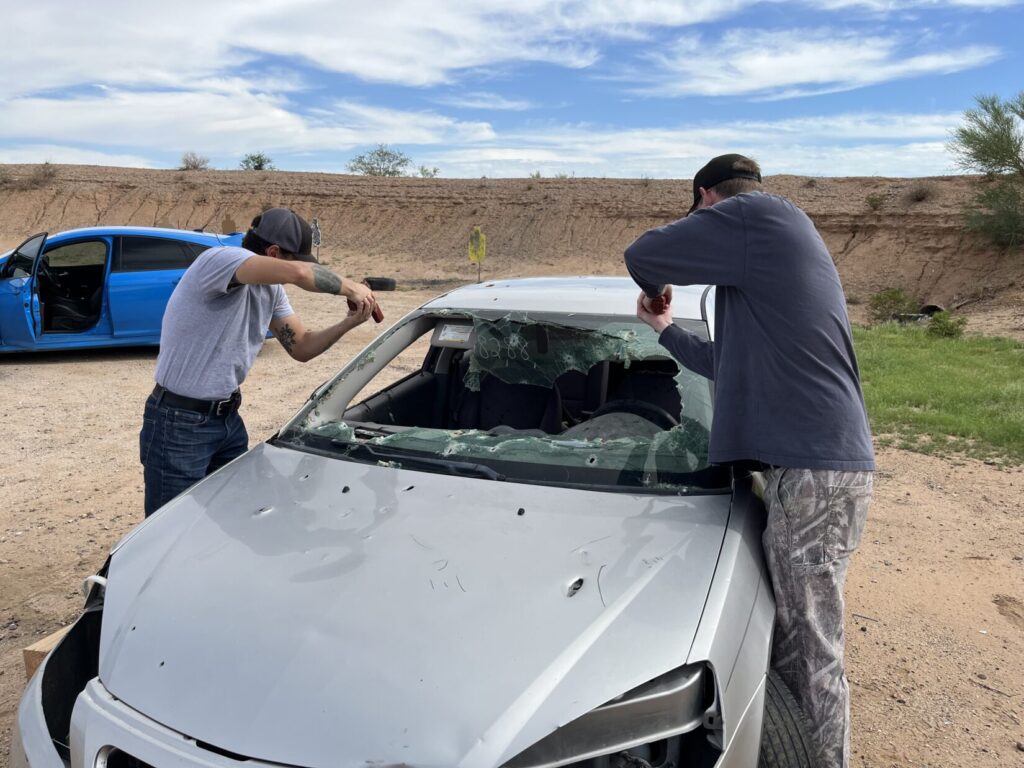
Standing beside the fender, lean a little over the hood. Hold your firearm out over the windshield and point it down at his lap.
This is a kinesthetically aimed technique. You do not look through the sights (hence “from beyond line of sight”).
Stay Off The Windshield
Although it’s tempting to slam your muzzle onto the windshield, hold your muzzle a few inches above the glass.
If the muzzle is in contact with the windshield when the gun fires, glass fragments will splash back at you. Worse, glass fragments will fan out radially inside, penetrating farther into the nether regions of the cabin (maybe as far as where your kid is, in the back seat). If your muzzle is several inches off the glass, most of the glass frags will fly in a cone-shaped pattern at the carjacker.
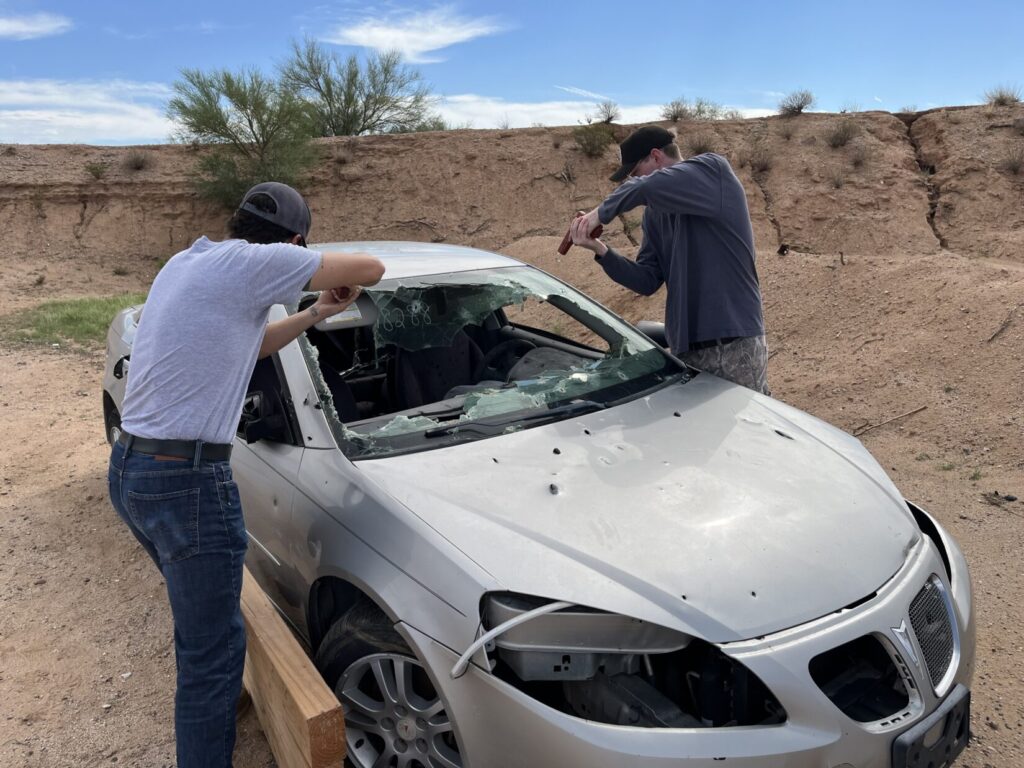
Ideally, he won’t call your bluff, and you won’t have to shoot into the car at all. But in a perfect world, he wouldn’t have tried to carjack your kid in the first place.
If you must shoot, use target-focused aiming methods. Look at where you want the bullet to go (the belt buckle, or just below that).
He Complied. Now What?
If the carjacker appears to be cooperating, tell him to put it in park, set the brake, and slowly get out of the car.
If you are a police officer or soldier, you should have teammates who can help you extract a driver or passenger from inside the cab. Those empty-hands custody and control techniques are beyond the scope of this article. What are your options if you are the lone rescuer in our civilian carjacking scenario?
It’s impossible to know the exact numbers, but something like 15 out of every 16 times an armed citizen points a gun at a perpetrator and tells them to stop doing something, the perp complies.
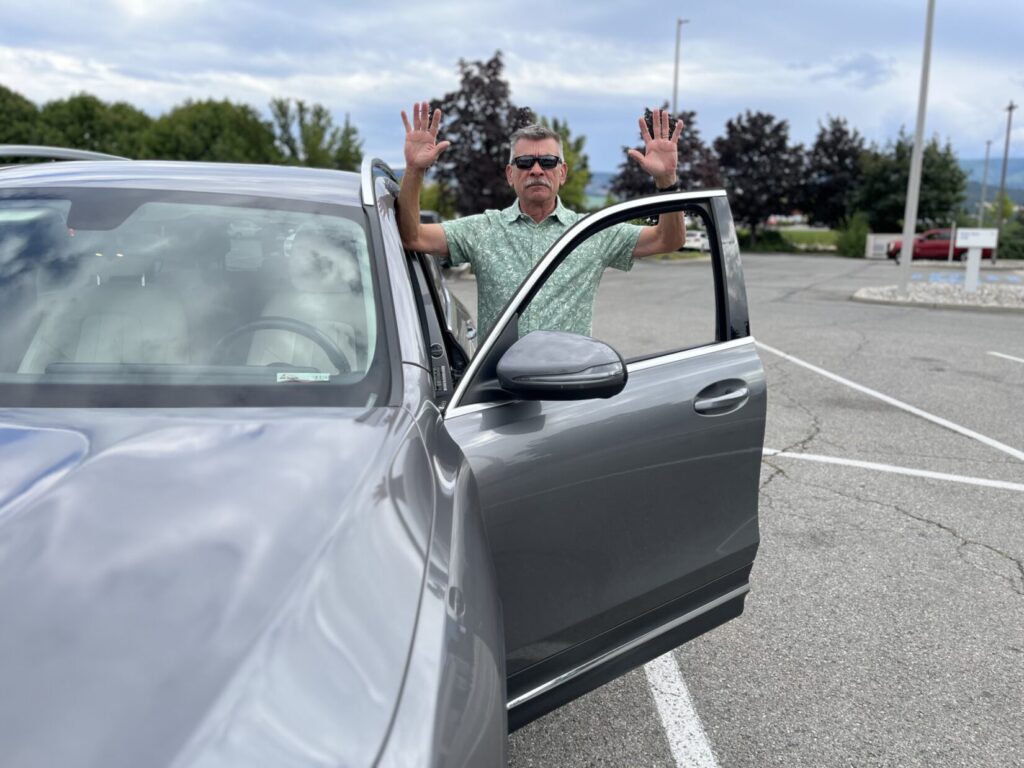
You could get all fancy, having him stick his hands out the window and open the door from the outside. But if the window is up, you’d be adding an unnecessary level of complexity by having him roll it down first. Safely rescuing a child in a car is already a complex enough set of skills, even for those who practice the requisite responses regularly. Let’s keep it as simple as possible, for you and the bad guy. He’s probably not a genius.
This is important: as he starts to exit the vehicle, tell him to “Leave! Now!” Punctuate each word of that brief sentence as a separate command.
Cornered Animals Are Dangerous
But he’s a car thief, you may be thinking. He almost kidnapped my child. He deserves to be in jail!
All true. But separate your emotions and your sense of justice from the practical, tactical realities on the ground.
You probably don’t have backup. The look on your face may be angry and/or scared. Right now, he’s trying to decide if you are going to shoot him in the back if he runs away.
Even as he appears to be complying, he’s flipping through his options in the third step of the Observe, Orient, Decide, Act cycle. Should he flee? Pull his own gun or knife? Or try to take your gun away and beat you with it?
His choice will be obvious if you give him the option of escaping with his freedom and his body intact.
Don’t worry; parking lots and nearby businesses have security cameras. His prints are on the steering wheel. We’ll catch him eventually. Your main goal right now is to rescue the youth in the car seat.
As he gets out, you can transition from the vertical to a horizontal pistol hold, maneuvering around the front of the car to keep distance and a clear line of fire, and to place an obstacle between you and him.
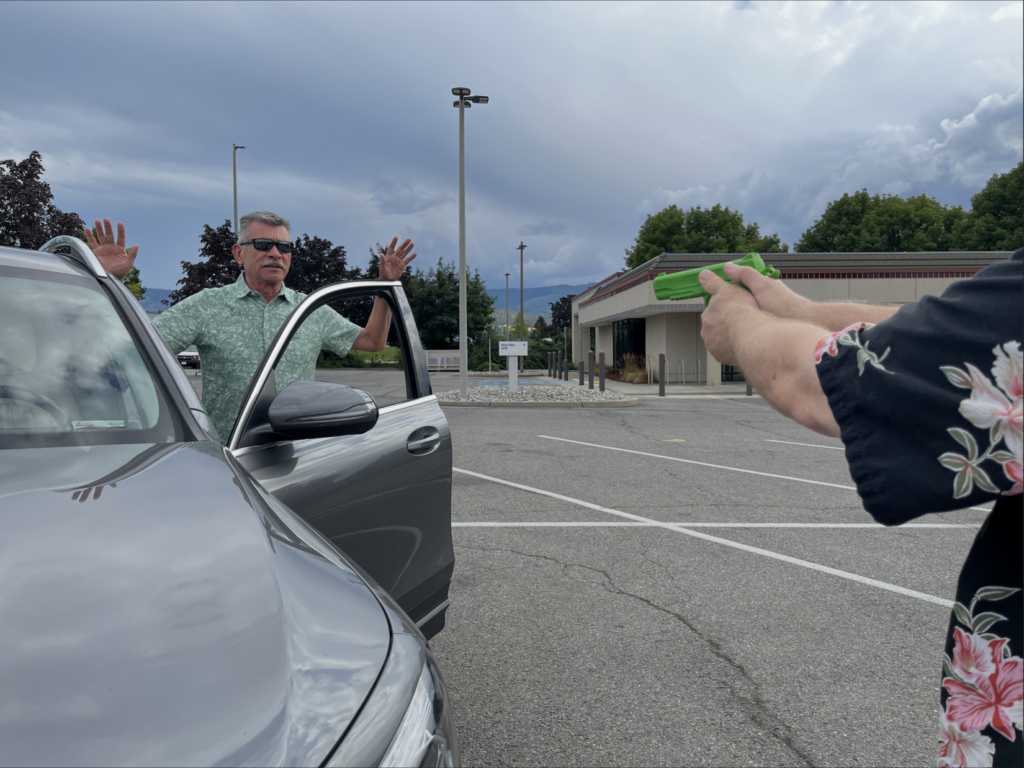
If he hesitates, repeat your command to “Leave! Now!”
Practicing Car Jumps, Dry
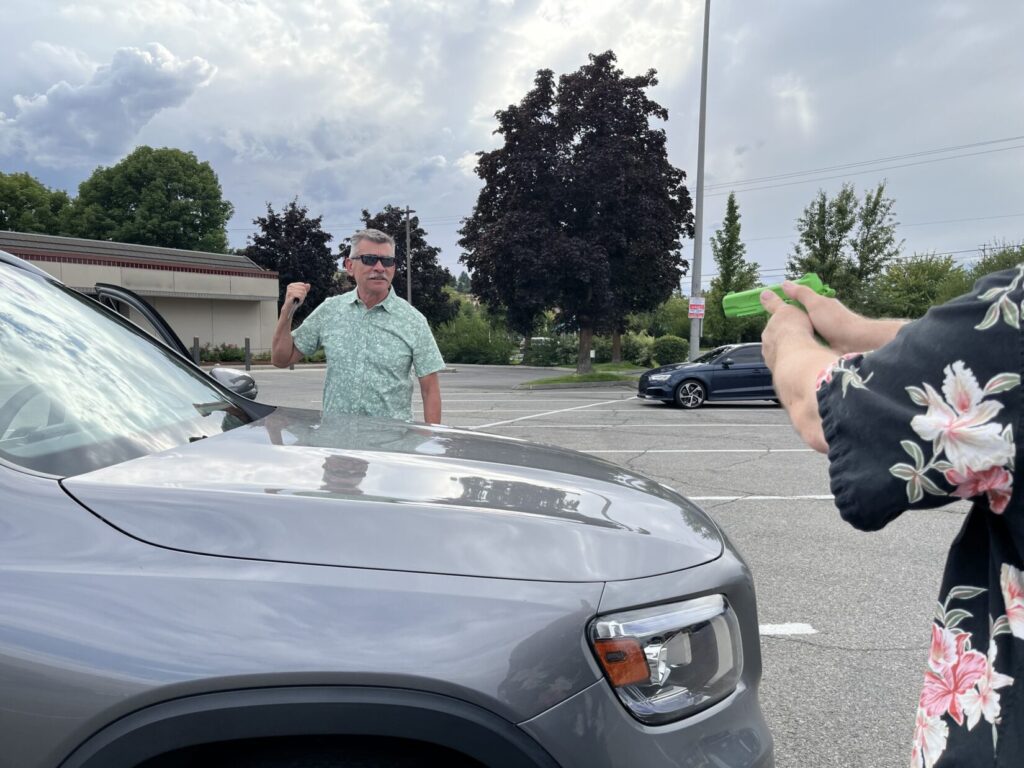
Laser training pistols with carjacker role players are the best way to practice the requisite positioning and aiming.
In any human target engagement training, it’s vital to have a robust, systematic, redundant screening system for live weapons.
The real guns and ammunition that kill cops accidentally during laser, marking cartridge, blank, or Airsoft scenario training usually creep back in after lunch, so screen again after every break.
Talk to me, goose: verbalization training
Your practice should include verbalization of commands. Most importantly, it should include what to do and say next, if the carjacker complies.
While we need to be prepared for the worst case, 99 percent of our range drills end when shots are fired. We almost never train for if they aren’t, or what to do afterward.
“The firearm skill an officer uses most iS drawing, then not firing.”
—Peter Tarley, OSI Firearms instructor on the board of IALEFI
Your training partner should let you rehearse responses to several possible suspect actions, including:
- He puts it in reverse and is about to drive away with your kid: Engage from a plunging angle.
- He complies: Tell him to put it in park, set the brake, slowly get out, and to “Leave! Now!”
- He reaches for a gun while in the driver’s seat: Engage vertically through the windshield.
- He reaches for a gun as he gets out: Engage horizontally through the window of the open door.
- He draws a knife and comes at you after exiting the vehicle: Engage horizontally over the hood.
- He runs away: Keep him covered in case he changes his mind and spins on you. Get a description and direction of travel. Simulate calling 9-1-1.
Managing the aftermath
Think about what you might say to your child after such a disorienting event. When youths are startled by a situation they’ve never experienced before, they look to adult role models for how to respond. “Well, that was exciting, wasn’t it?” would probably be better than sobbing “Oh my baby! My baby! Are you OK?!?”
Since the latter response will probably be your core inclination, it’s not a bad idea to rehearse responding calmly in the aftermath. Like any other scenario-based response to a crisis, “acting like you’ve been there” takes practice.
Raising youth to be self-reliant problem solvers, instead of freaked-out parts of the problem in crises, is almost as important as keeping them alive.
Practicing Plunging Fire, Live
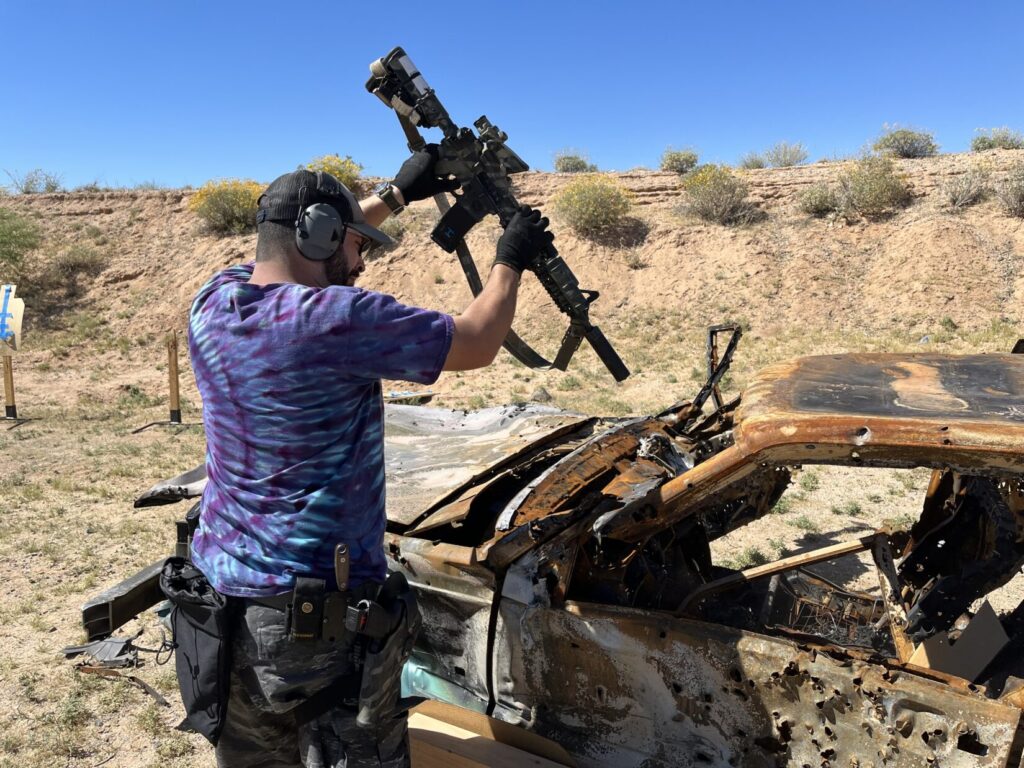
You should also practice plunging fire with real cartridges on a range, so you’ll know what it feels like before you need to control a pistol held at such an awkward angle. Your options run from complex to minimal time and effort invested.
- Ideal: It’s not cheap, but you can buy a junker car and have it towed to a “tactical” range.
- Cheaper and easier: A less expensive, less involved setup would be shooting at the seat of a chair (worn-out all-plastic lawn furniture works well) with sandbags underneath it.
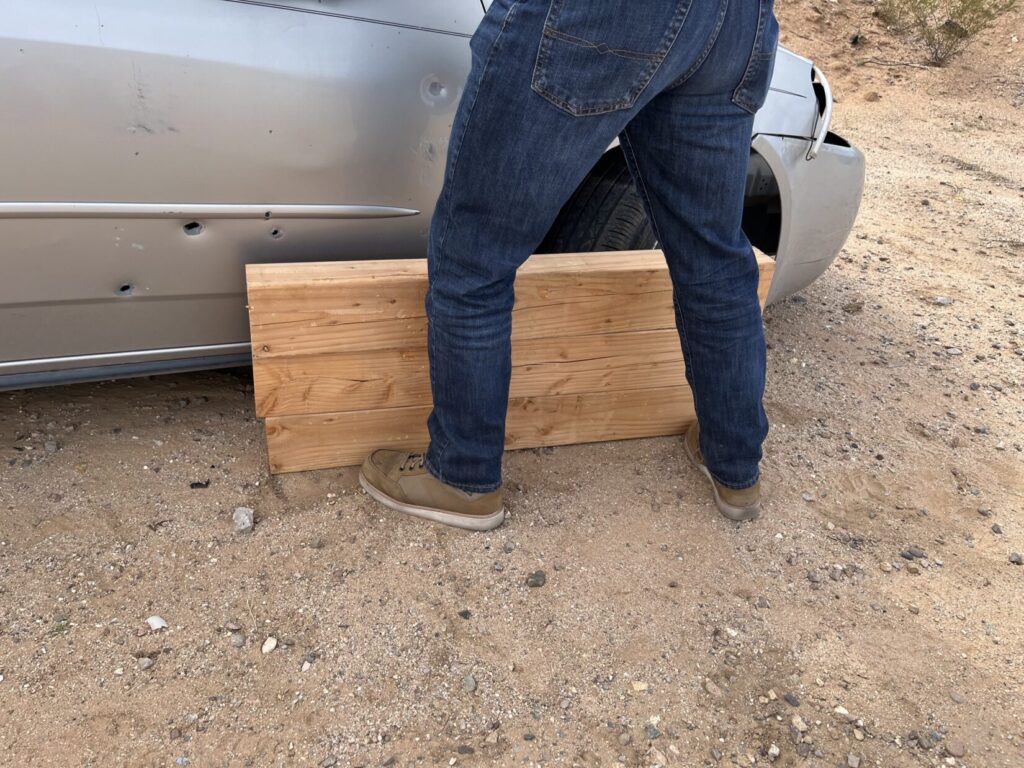
- Minimalist: If a chair and sandbags are unavailable, you can shoot into SOFT dirt from over a barrier like stacked 4-inch-by-4-inch lumber (“4x4s”) to protect your feet from ricochet.
Targets
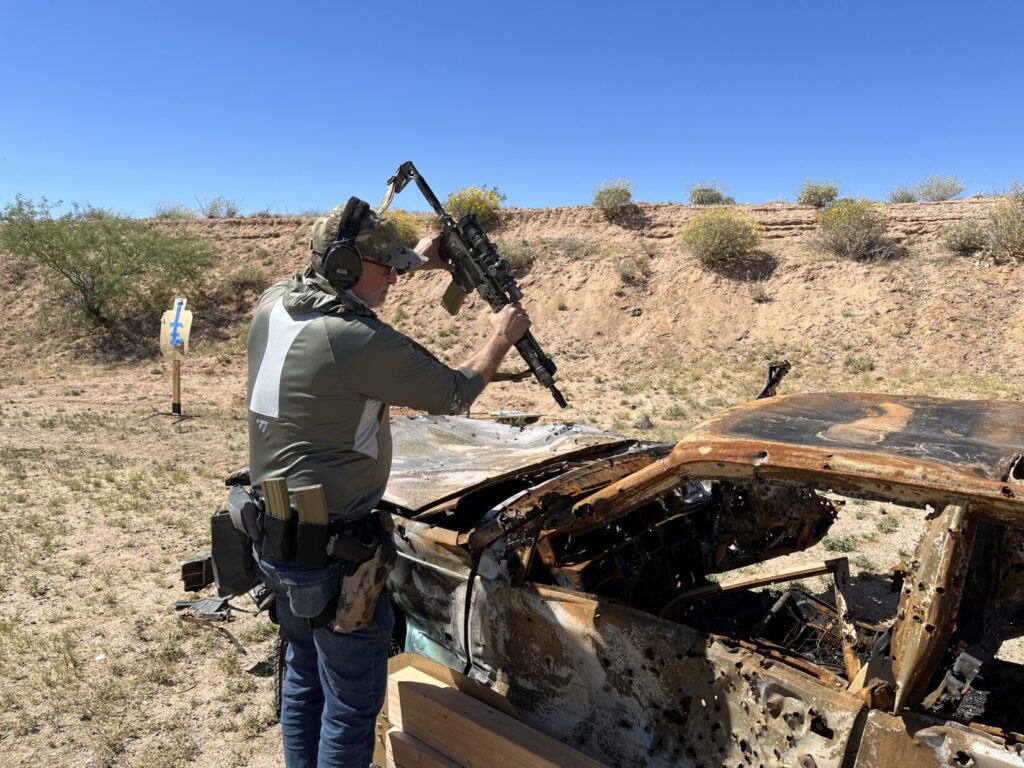
There are several shot-up (and blown-up) cars on a range I use for training. I usually just fold a cardboard IDPA or IPSC target about a third of the way from the bottom and sit it in a driver’s seat.
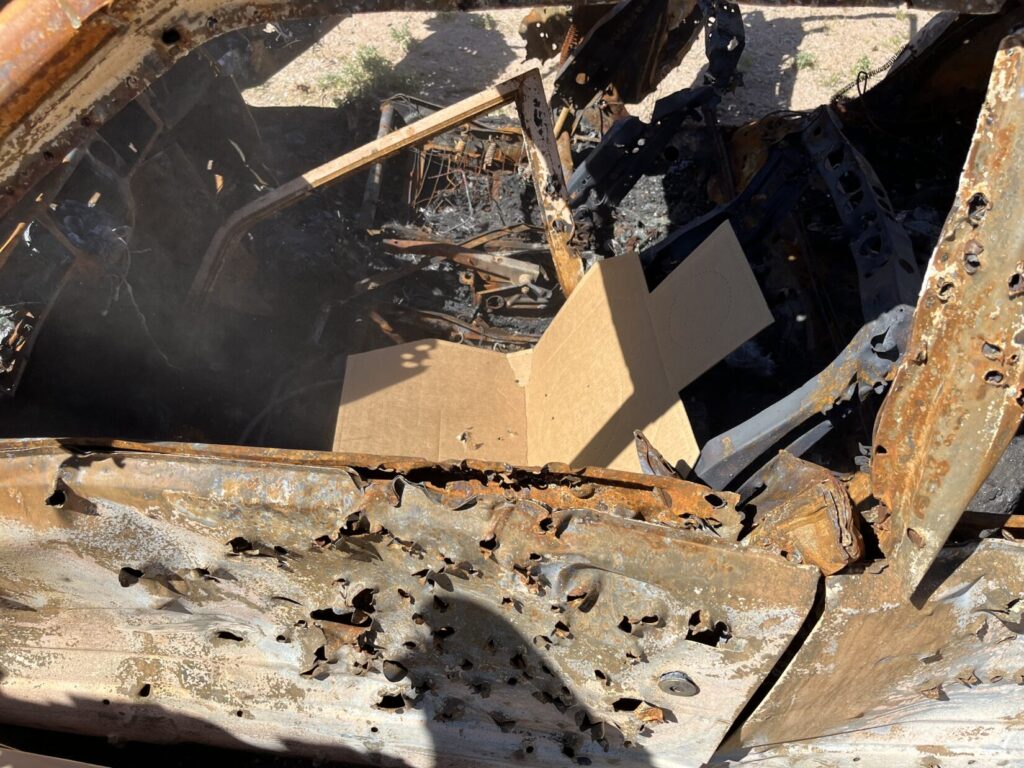
I have also used a stuffed dummy (one was no longer needed after an elaborate Halloween party). If you are going to go through the effort and expense of buying a junk car and having it towed to your range, you might want to go all the way and shoot at a three-dimensional manikin. You can stuff some old clothes with wrapping paper and sacrifice a belt that’s too short to fit anymore—I mean, uh, that “has fallen out of fashion.”
Safety: PPE
Even though you will be holding your muzzle off the glass, shooters should wear personal protective equipment (PPE): long sleeves, gloves, and wrap-around eye protection. Lab goggles are best.
Also, wear thick clothes and be careful while you’re leaning against the car. Shot-up automobiles are giant cheese graters.
Safety from Ricochet
Cars have all kinds of metal that bullets can bounce off of. You should place bullet-absorbent sandbags in the seat of the car you are shooting into.
If sandbags are not available (and even if they are), stacking 4x4s between the shooter’s feet and the car is the next best way to absorb ricochet. I’ve never pulled more than the occasional piece of bullet jacket out of a 4×4 after practicing this skill, but better safe than sorry.
Car Jumps with Long Guns
If you are an officer with a patrol rifle, or a rifle-armed entry controller at a secured facility like a nuclear power plant or military base, you can use similar methods.
With an AR/M4/M16 series rifle, you could cover the driver by holding the fore-end with your right hand, with fingers over and thumb under (a reversed grip). Wrap the fingers of your left hand behind the pistol grip. If firing becomes necessary, you would pull the trigger with your left thumb.
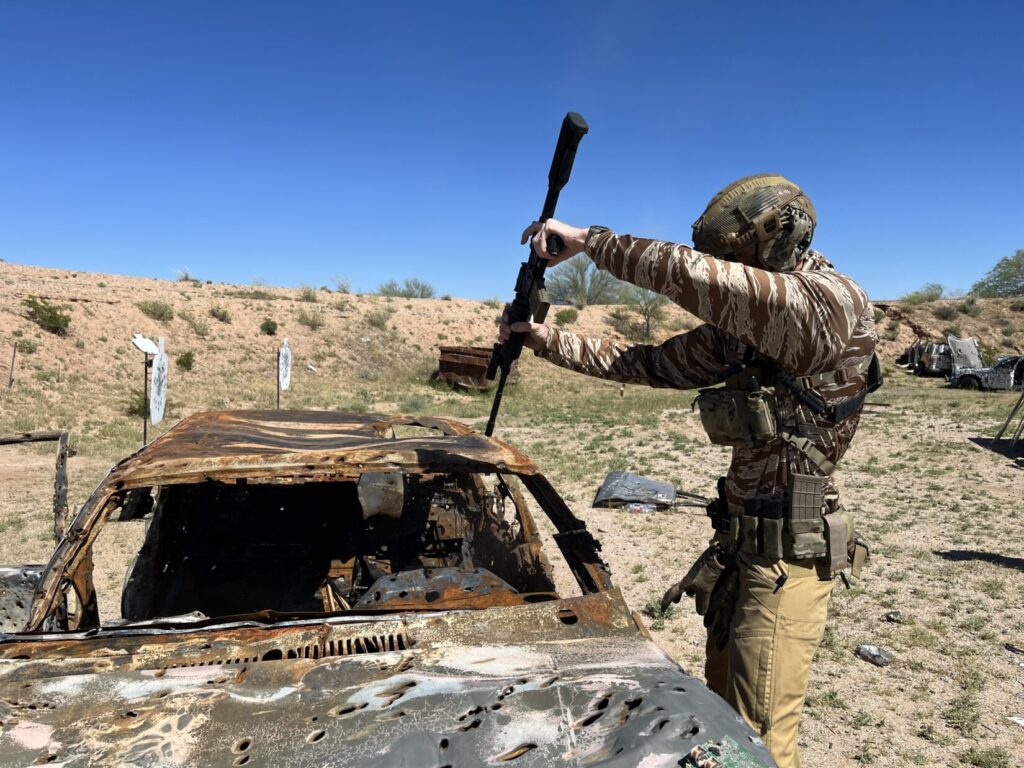
A left-side-only selector switch is awkward to manipulate in this position. You would likely need to select Semi before assuming this hold. You won’t be able to post your trigger finger up alongside the lower receiver above the trigger, so you’ll need to maintain Rule 3 compliance by perching the pad of your thumb against the magazine well, in front of the trigger.
Reality Check: When Do Cops Do This?
The car jump method described in this article is a niche technique for when the risks of letting the driver get away outweigh the risks of posting yourself by the front fender.
Some of you may be asking: if this positioning for plunging fire is so great, how come we rarely see police doing it at traffic stops?
If an officer runs a license plate and it comes back as stolen, or they have other reasons to believe the driver is dangerous, they will not approach the car at all. They’ll stay back behind cover, wait for backup, and order the driver out of the car. The technique is called a “felony stop.”
But if they have no reason (yet) to suspect the person they pulled over has done more than a traffic violation, the officer(s) will approach the car they pulled over. Often, they’ll come up from the shoulder side, rather than the road side, depending on traffic going by. Too many officers get hit at traffic stops by narcissistic idiots who won’t slow down or get over for emergency vehicles.
The pillars that hold up a car roof are lettered in alphabetical order from front to rear. The pair that frame the windshield are the A pillars. The B pillars are behind the front windows.
An officer at a traffic stop will stay behind a B pillar, where it’s safest, until they know more about the driver. Harder for the driver to shoot you if you are behind them.
Make no mistake: if you post yourself at the driver’s 10 – 11 o’clock, he could easily shoot you in the belly.
We simply could not let a suspect harm our UC. You simply cannot let anyone kidnap your children.
Other Uses for Plunging Fire
During the April 19, 2013 Watertown shootout with the Boston Marathon bombers, police officers fired over a hundred rounds horizontally through the neighborhood. Some struck occupied houses behind the bombers. Residents retreated to basements or upper floors.
The following image was taken from an upper floor of a house adjacent to the bombers.
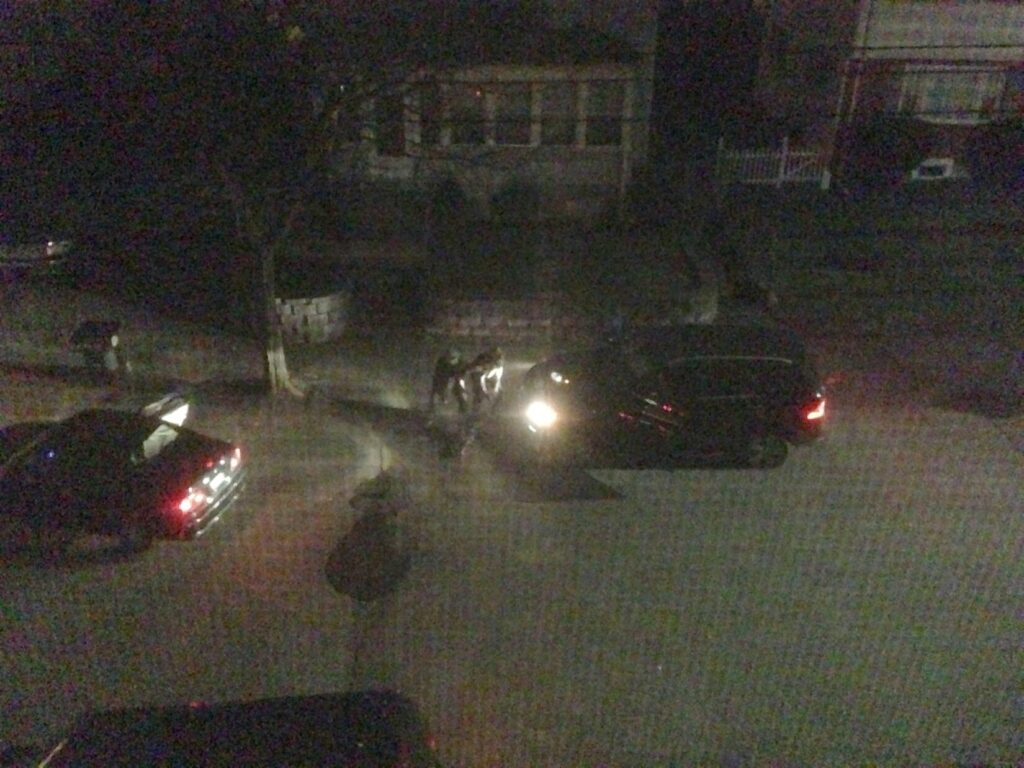
This still image is from video presented as evidence at the trial of the surviving bomber. Using the stolen SUV as cover, one tango aims his pistol at the police while the other sparks up the fuse of an IED he will hurl at the cops. The amateurs didn’t kill the lights of their car (left) or the carjacked SUV.
From this perfect flanking, and more importantly overhead, angle, what is on the other side of the terrorists? That’s right: the ground. Our planet will stop any bullet made by man.
Yes, frags can skip off of that sidewalk, but they would have been stopped by that retaining wall. This plunging angle is far better for Rule 4 compliance than any afforded at ground level.
INTERVENING TO ASSIST POLICE UNDER FIRE
Civilians need to be very circumspect when deciding to intervene in support of police.
In Arvada, Colorado, an officer responding to “officer down” mistook armed citizen Johnny Hurley for the cop killer Hurley had just shot. An honest mistake, but one that cannot be undone.
Successful, and far less unfortunate, examples of armed and unarmed citizens coming to the aid of officers in dire straits are numerous. One key to survival is loudly and repeatedly announcing that you are on their side.
The takeaway here is that plunging fire, from beside a car fender, a second-story window, or a rooftop, is one way to solve Rule 4 problems.
In the third installment of the Blue-on-Blue Crossfire series, we’ll discuss range drills that will help you build fire discipline, inoculating you against sympathetic fire.