
Part I of the Rule 4 series
Some safety practices, like trigger finger discipline or muzzle consciousness, are mostly physical. They are easy to teach, practice, and monitor, until they become habitual. Being aware of innocent bystanders behind your threat is more mental. It’s easy to talk about, but rarely practiced, and much harder to do in a dangerous situation.
Cellophane Man classroom challenges and range exercises like the Two-Deep drill are ways we can program awareness of what’s behind our threat, and lifesaving physical responses to line-of-fire issues.
This article, the first in a series focusing on Rule 4 training, explains how to use an inexpensive visual aid and a laser to teach classroom students or your family about firearms safety.
NEITHER AID NOR COMFORT TO THE ENEMY
Before we can be dangerous to our opponents, we must first be safe to our friends. If you are about to kick a door, and you shoot somebody in the stack by accident, you’ve done the enemy’s work for them.
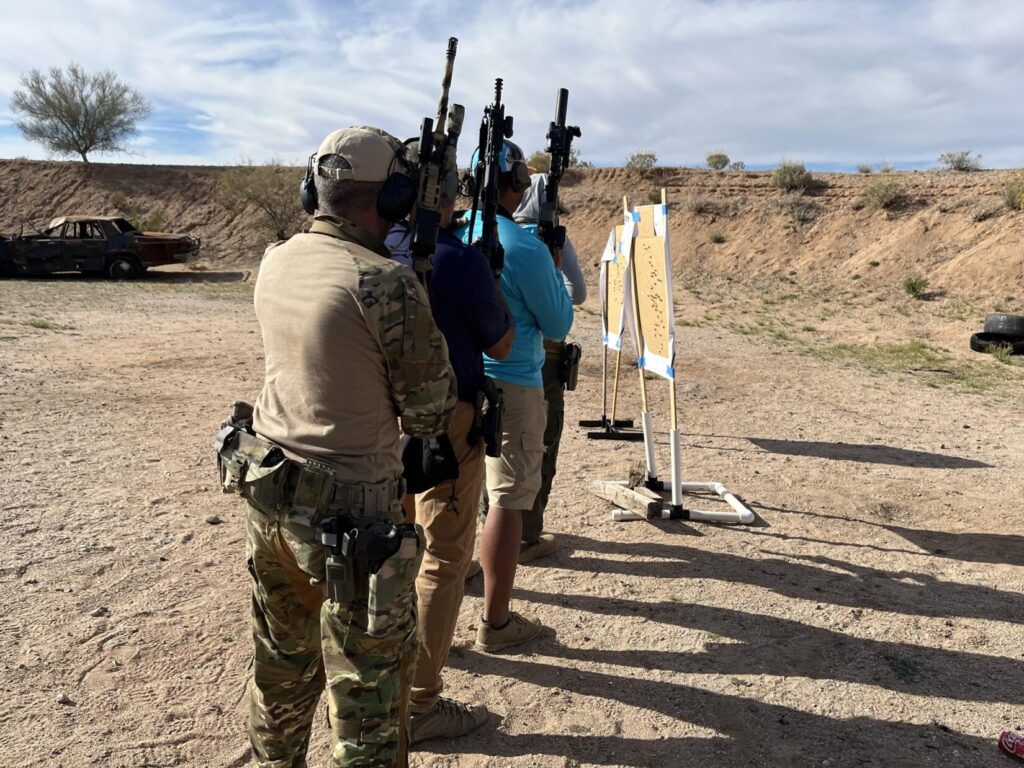
Firearms safety is first learned by memorizing a list of rules. But until the student has opportunities to actually put those rules into practice, long enough for the related habits to become reflexive, they are not truly safe handling guns.
INSTINCT VS. REFLEX
People often use the words ‘instinct’ and ‘reflex’ interchangeably, but they are not the same thing.
When you were born, your mom didn’t need to read Breathing for Dummies to you. Your system came out of the package pre-programmed to breathe when you hit the air. That’s instinct.
Reflexes, on the other hand, can be trained.
PROGRAMMING PHYSICAL REFLEXES
The easiest reflexes to train are those which largely coincide with our instincts. Squaring off to a threat with our feet farther apart and knees slightly flexed, for example, often happens instinctively when we are startled. But some essential reflexes run counter to our instincts.
Hand a kid a toy gun, and their booger hook instinctively goes to the bang switch.
But long before they graduate from infantry training, young recruits reflexively keep their fingers glued to the frame above the trigger guard. Drill instructors use Skinnerian operant conditioning (which can involve the positive reinforcement of immediate negative consequences, and often does) to ensure that trigger finger placement becomes habitual.
drop!—or not
I’m not recommending that you drop your spouse, your kids, or your friends for pushups when they are first learning about firearms. We don’t want to turn them off to guns. But you don’t need to be a genius or a Tier-One operator to get Rule 3 (Keep your finger off the trigger, up alongside the frame, until you have made a conscious decision to shoot). Even most TV actors do these days.
It may take longer for civilians who don’t handle guns on a daily basis, but with constant monitoring and gentle feedback from range safety officers and peers, muzzle consciousness and trigger finger discipline become programmed habits.
TO, THROUGH, AND BEYOND YOUR TARGET
Rule 4 states that we should know our target. We should know what (or who) it is, what is between us and our target, and what is behind our target.
Awareness of what is within range of our firearm—not only the effective range, which we can see, but also maximum range, which may be out of sight—is much more difficult to program. The first thing that fights us is our instinct-driven tunnel vision.
TUNNEL VISION RESISTS RULE 4
It’s natural to get narrowly “tunneled in” on something that may try to kill you. Your brain is pre-programmed to focus on a lethal threat, disregarding what is likely to be irrelevant to your survival.
Robbery victims often cannot recall whether the person who robbed them was tall or short, narrow or round, white, brown, black, yellow, red, or green—but they’ll never forget intricate details about the gun that was pointed at them, such as scratches in the bluing on the right side of the muzzle.
Snakes on a Porch
My front porch has a 3-foot-tall wall around it which affords a view of the yard and nearby mountains. One time, just after locking myself out of the door, I heard a buzzing noise and turned to find a rattlesnake S-coiled against that wall, pointing its shovel-shaped head at me.
I was a park ranger, and I’ve seen my share of pit vipers in the wild. But on that porch, both the snake and I felt trapped in each other’s space. Its vibrating tail was broadcasting what we in law enforcement call a challenge: back off, or else.
For a second or two, that angry reptile had my undivided attention. Beyoncé Knowles could have been in my yard behind that rattler, with a whole chorus of dancers in dazzling show costumes, and I might not have noticed them.
SURVIVAL INSTINCTS CAN BE DANGEROUS
Unless your radar is pre-programmed to stay on deep, multi-focal scan, accounting for bystanders who may be behind or even between you and a potential assailant, it is too easy for a defensive shooting to result in permanent, life-altering or life-ending damage to innocents.
What’s worse, just talking about Rule 4, or even reading about it, will not spontaneously create enough situational awareness to overcome your body’s natural tunnel vision response. It takes planning and practice.
You can practice solving line-of-fire problems in a classroom, or even your living room. You do not need to be on a range, although awareness and avoidance of bystanders can and should also be included in your live-fire practice. We’ll give you options for that in Part II.
CELLOphane MAN
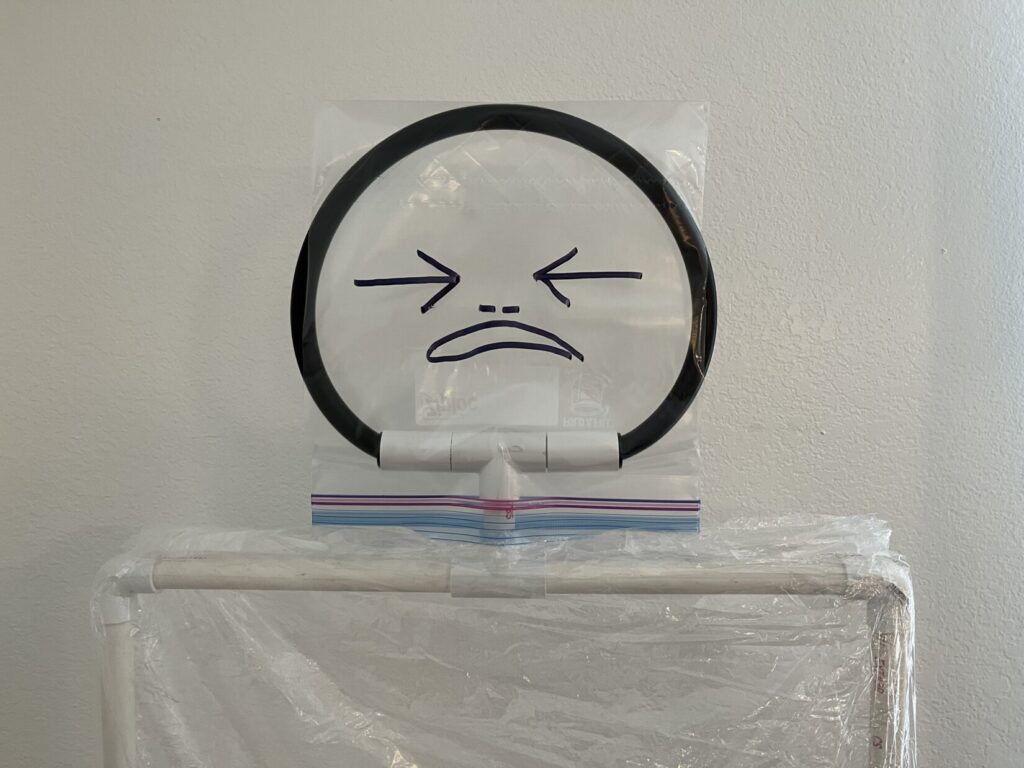
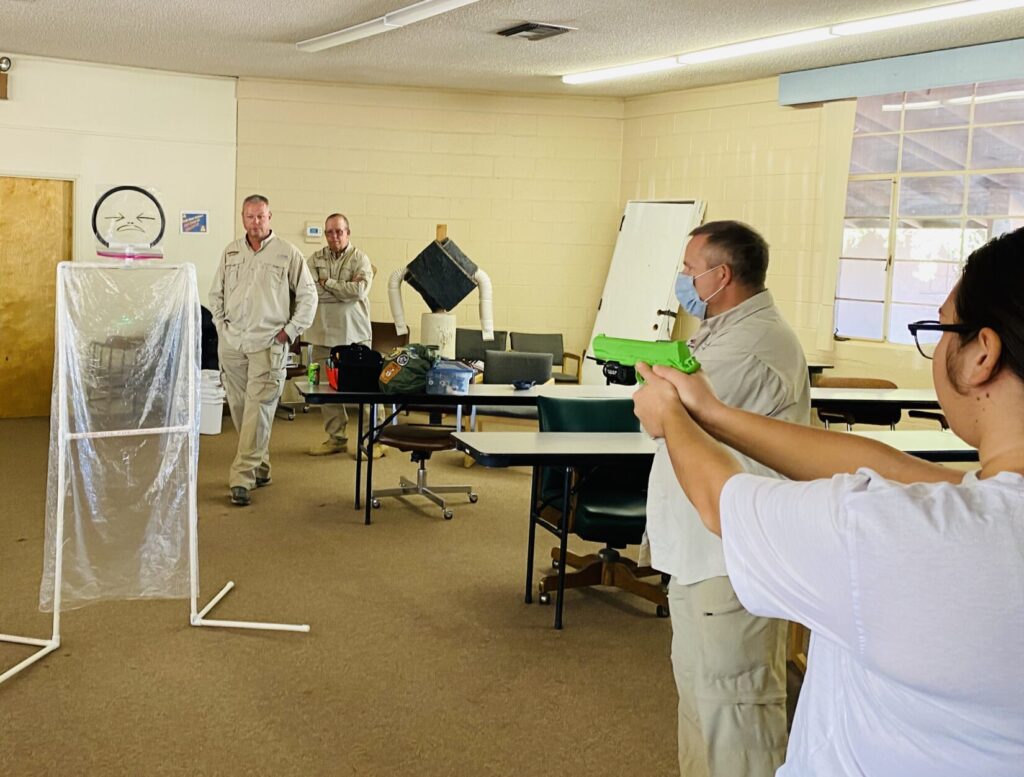
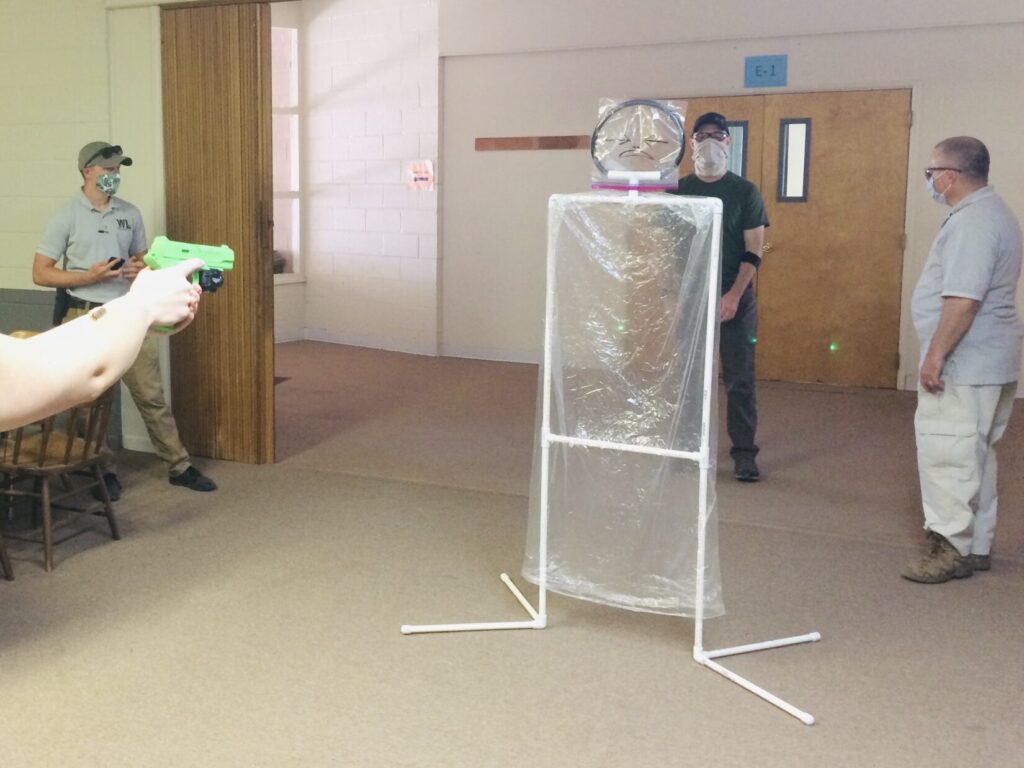
We use a training aid I call “Cellophane Man.” It’s not much more than a target frame with a dry-cleaning garment bag over it. It helps firearms students practice awareness of shoot-through (Rule 4) issues regarding bystanders. But it also illustrates a host of other important Use of Force and Safety-related concepts. I use Cello Man during my first lessons with new shooters.
Cellophane Man is made of PVC pipe, which is relatively cheap and easy to break down for storage or transport. You can assemble it without tools. The head frame is a flexible plastic hose connected in a circle to a PVC T. It has a gallon-sized Ziploc bag for a head.
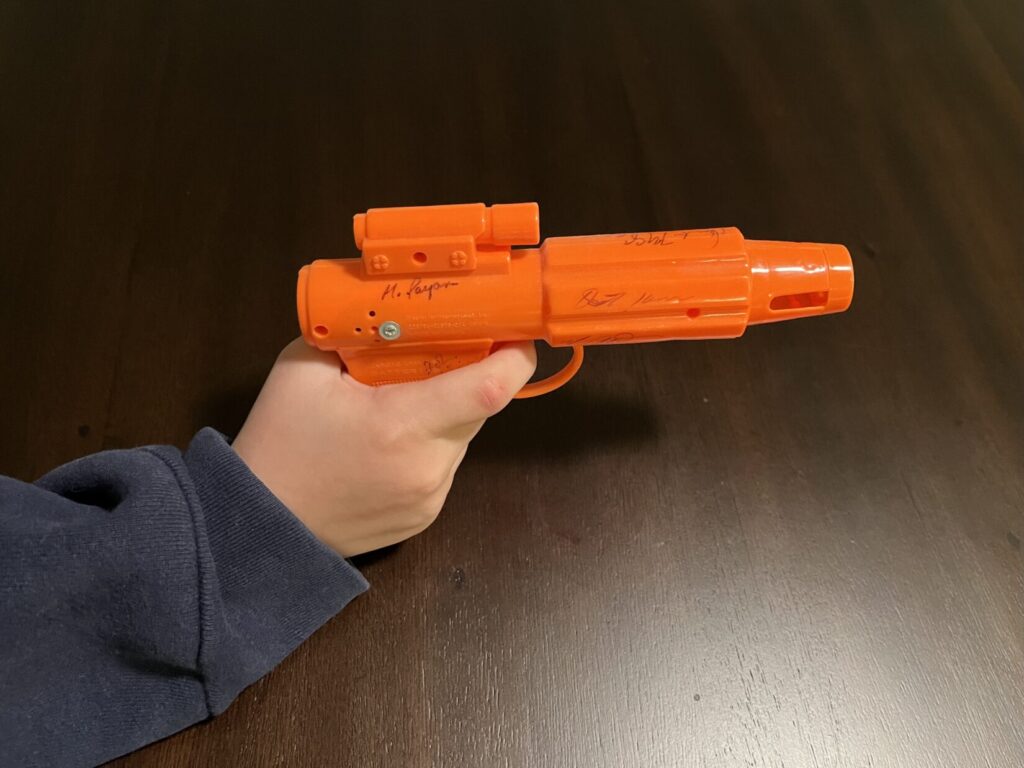
We use a laser mounted to a training gun, either a plastic replica or a demilitarized firearm. The laser could be expensive (an actual targeting laser, such as a TLR-8) or just a cheap laser pointer used by lecturers, affixed with painter’s tape.
The laser needs to have a constant-on mode. With a SIRT, you can use military boot blouser bands to take the initial slack out of the trigger, activating one of the lasers. Just remember to take it off immediately afterward, or you’ll burn out your batteries.
TARGET PRACTICE SCENARIO
Before putting the head on the cellophane-draped frame, I brief the students that in this first scenario, they are shooting on a “wildcat range” in the boonies. Their target is set up in front of some brush. They aim at the target with the laser.
I ask if the paper, cardboard, or bushes will stop a bullet. They know none of that will, any more than the laser is stopped by the cellophane.
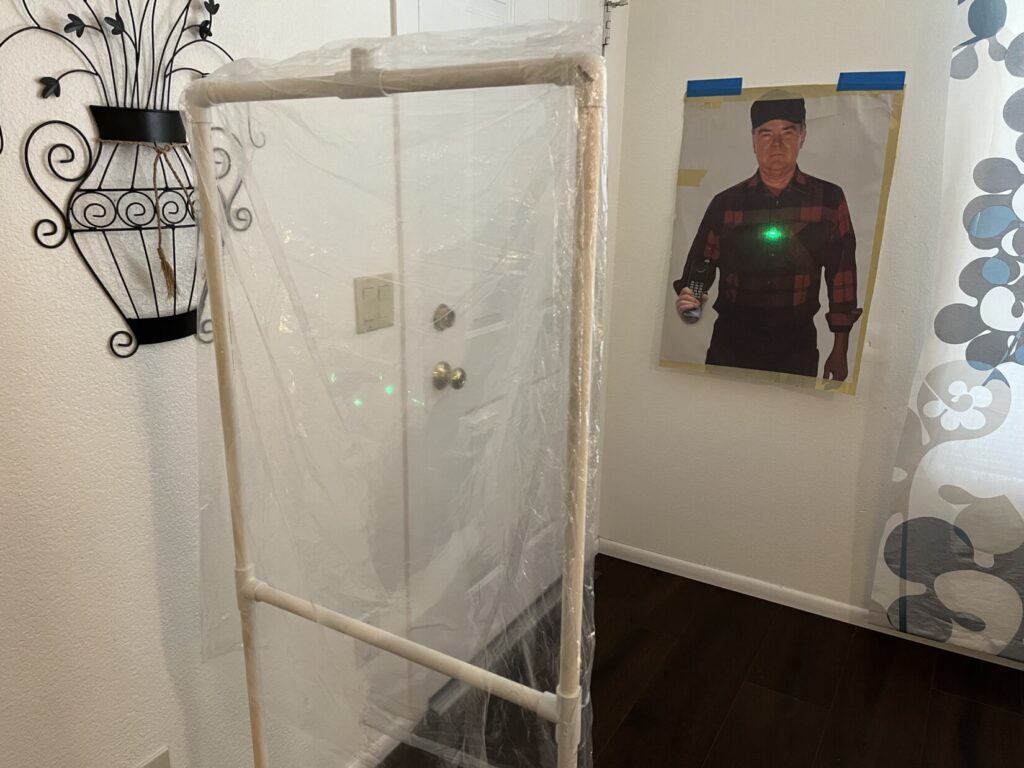
Then I set up a martial arts training manikin behind Cello Man. If you don’t have a manikin, you can use a cardboard human silhouette or an “unarmed” photographic target on the wall behind. I tell the students it represents a hiker several hundred meters away.
MAXIMUM RANGE VS. MAX EFFECTIVE
I explain that the effective range of a pistol is around 50 meters (up to a hundred or so in skilled hands), but the bullet will travel close to 2,000 meters. If you don’t stop your bullet, you can accidentally kill hikers a mile away without even knowing they are there.
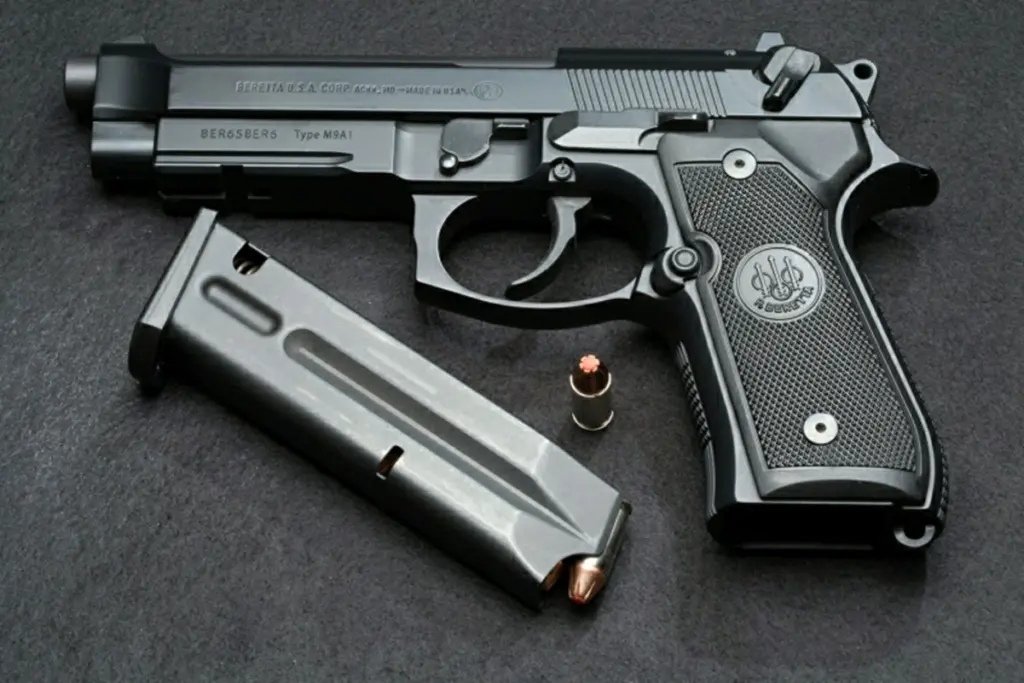
I ask the students how to solve that problem. The solution, of course, is to shoot up against something that you know will stop your bullets, such as:
- A berm
- A steep hillside (be sure you can see all of the impact area)
- A riverbank
- The side of a sand pit
- The inside of an abandoned quarry (but be cognizant of ricochet hazards)
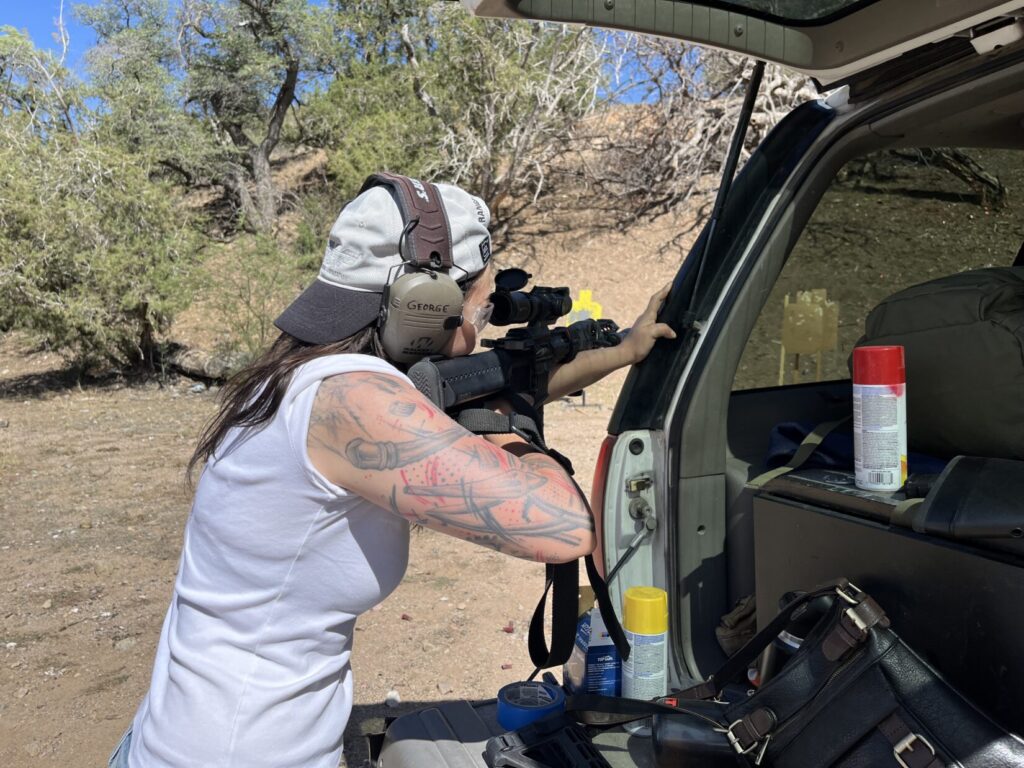
FIRST CELLO MAN USE OF FORCE CHALLENGE: RULE 2
I put Cello’s head on him, remove the hiker, and set the scene: “You are in a mall food court when you see Cello-dude, with a Kalashnikov rifle, about to shoot kids in the play zone. What do you do?”
The student usually puts the laser on Cello Man’s chest and issues a challenge like “Don’t move!” or “Drop the gun!”
That situation may or may not be a time for talking to the bad guy, but for the purposes of our safety training, I ask, “Are you violating Rule 2: (Never let your muzzle cover anything you are not willing to shoot) by pointing your gun at the person with the AK?”
The student should consider both the moral implications and the safety requirements. Eventually, they state they do not want to shoot anybody, but they are willing to shoot him if he threatens the lives of those kids. Hence, no Rule 2 violation.
Excellent answer. Rule 2, like the others, applies at all times, even in a fight.
SECOND CELLO MAN FORCE CHALLENGE: HORIZONTAL DISPLACEMENT
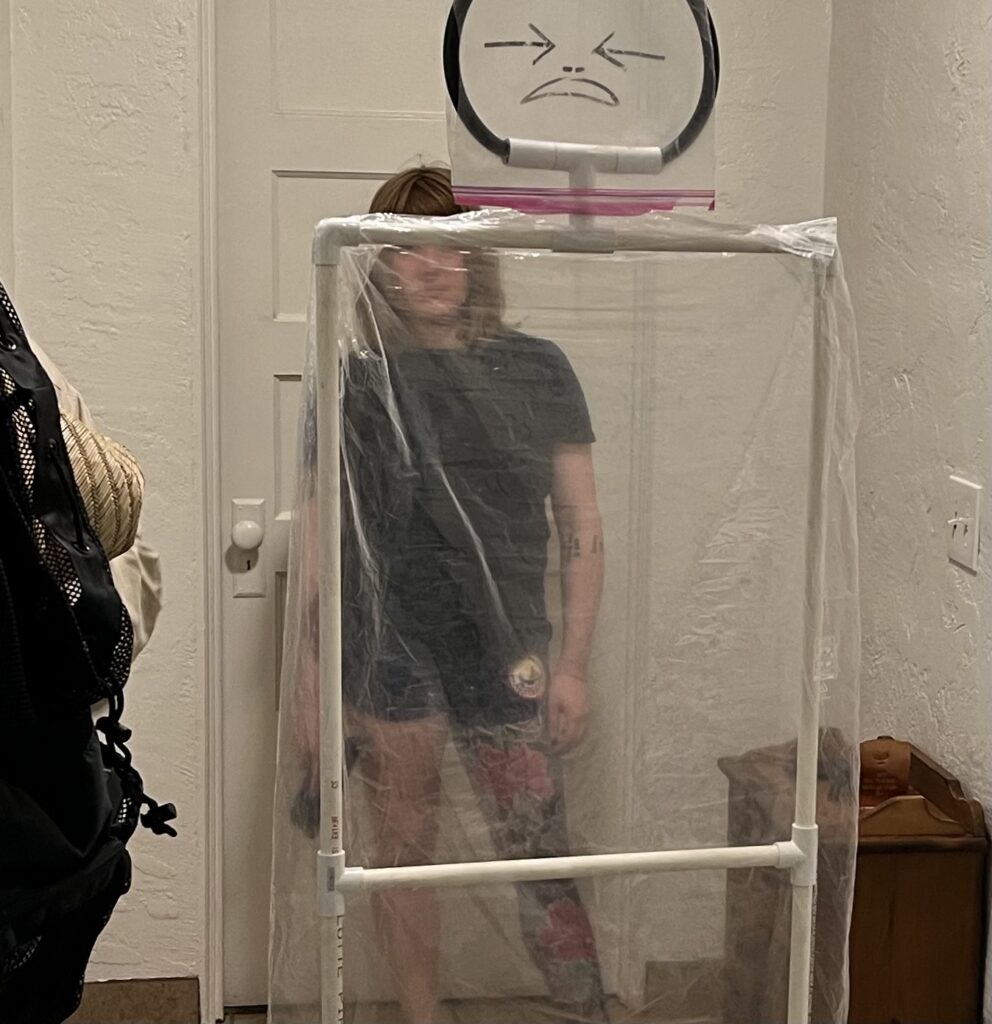
Then we place the martial arts dummy, once again, directly behind Cello Man. Same scenario, except for the bystander behind. The laser shoots right through the cellophane and onto the bystander behind, just as a real bullet might.
Your student has been programmed by TV to believe that bullets (even the small percentage that hit) do not over-penetrate through people. Witness the number of actors in the movies who use humans as bullet shields and escape unscathed.
It does not work that way in real life. If memory serves, the last bad guy I saw down from gunfire had eight or nine holes in his front, and four or five holes out his back. Every bullet that hit him was a hollow point, from a handgun.
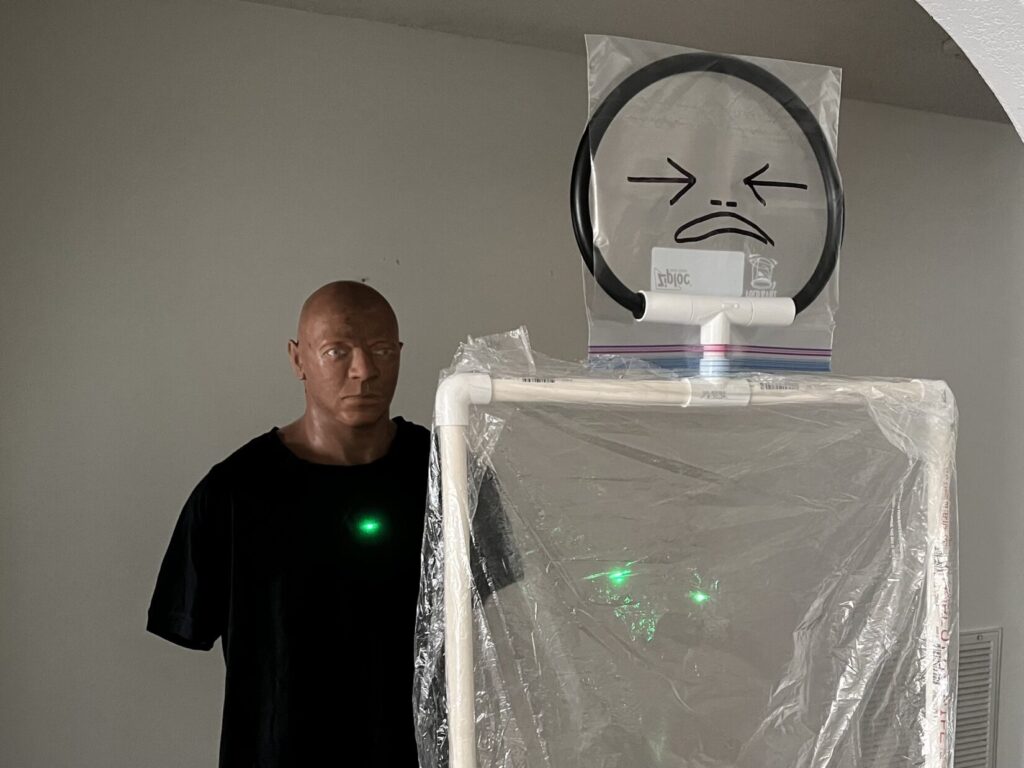
Understanding the problem leads to solutions
Seeing with their own eyes the laser punching through the cellophane and hitting what’s behind gets over-penetration across to students more clearly than a lecture alone.
We ask the students to think their way through the Rule 4 problem. They figure out that if they take a few steps left or right, they can get a clear line of fire.
That’s almost a no-brainer, but mental bandwidth may be in short supply when your mind is busy processing all the sensory inputs of your first deadly force encounter. Horizontal displacement (moving left or right) should already be a pre-programmed and pre-practiced response option to shoot-through problems in a fight.
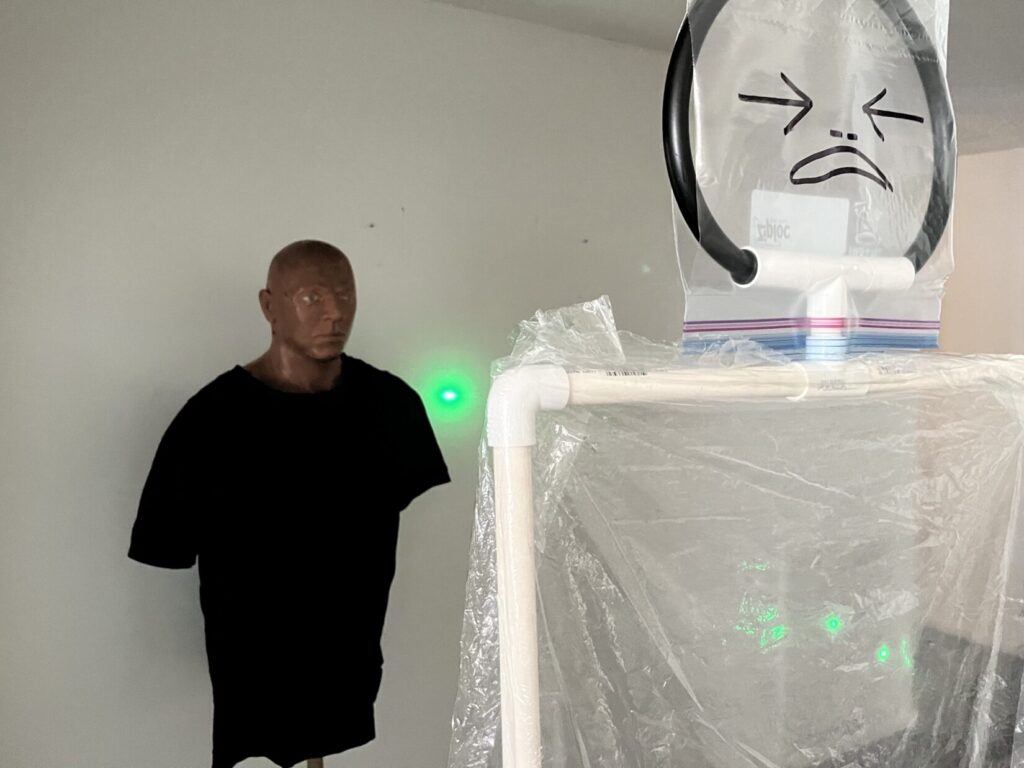
Bullets sometimes glance off of bone or otherwise change direction in a real criminal, so move a little farther than in this illustration if you have time, just to be sure.
THIRD CELLO MAN CHALLENGE: VERTICAL DISPLACEMENT
Then we add a realistic twist. We say that the student cannot move left or right, either in a narrow hallway (a typical home defense scenario), or between cars in a parking lot.
Or, there are so many bystanders running around behind that their rescuer cannot move left or right far enough fast enough. The bystanders behind don’t stay in one place long enough to solve the problem with horizontal displacement.
If you are teaching a class, and your student already has muzzle-conscious (Rule 2) habits like going to Sul programmed, you can have the other students pretend to be “sheeple,” running around behind Cello Man with their hands in the air and screaming.
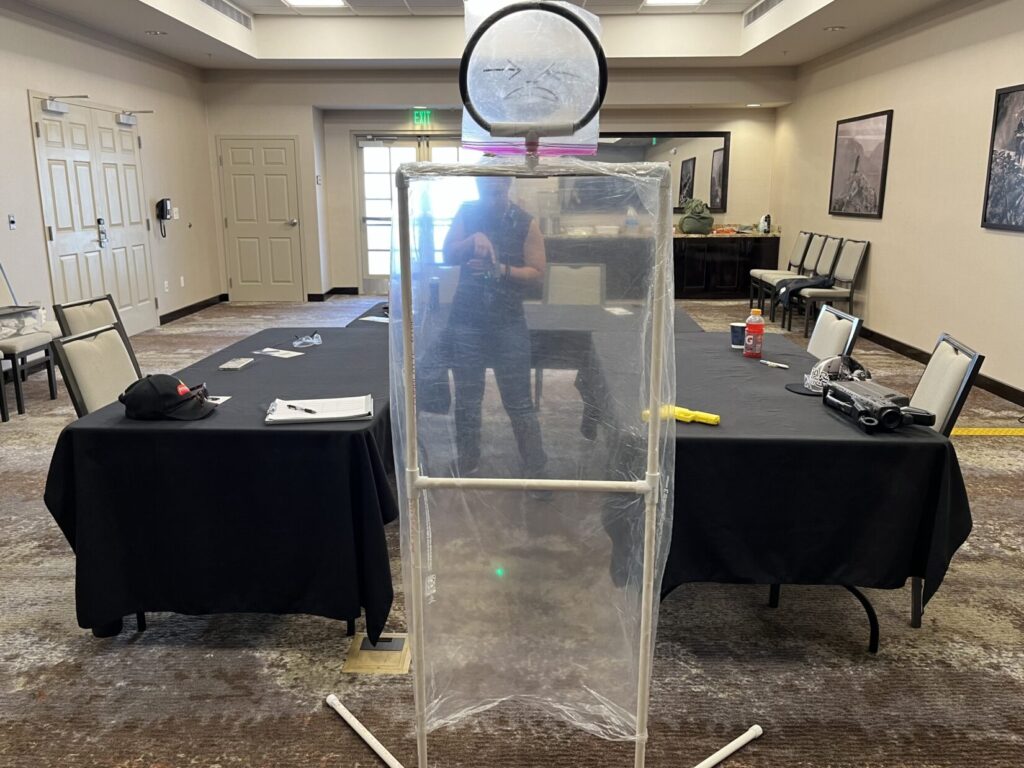
The tables in the photo above limit horizontal displacement (left or right movement to get a clear line of fire) like cars in a parking lot would. Because she knows the how and why of Sul, we can use live role players as bystanders without programming bad habits.
GIVE YOUR STUDENT TIME
This solution usually takes longer for the student to figure out. It’s important to give them the time to work their way through it, rather than just telling them the answer. That way they program the neural pathways to solve shooting problems.
If you just give them a solution, it can be mental floss–in one ear, out the other—less likely to come back to them in a time of intensified stress. Socrates may not have been programming responses to spree shooters, but his Socratic method still works.
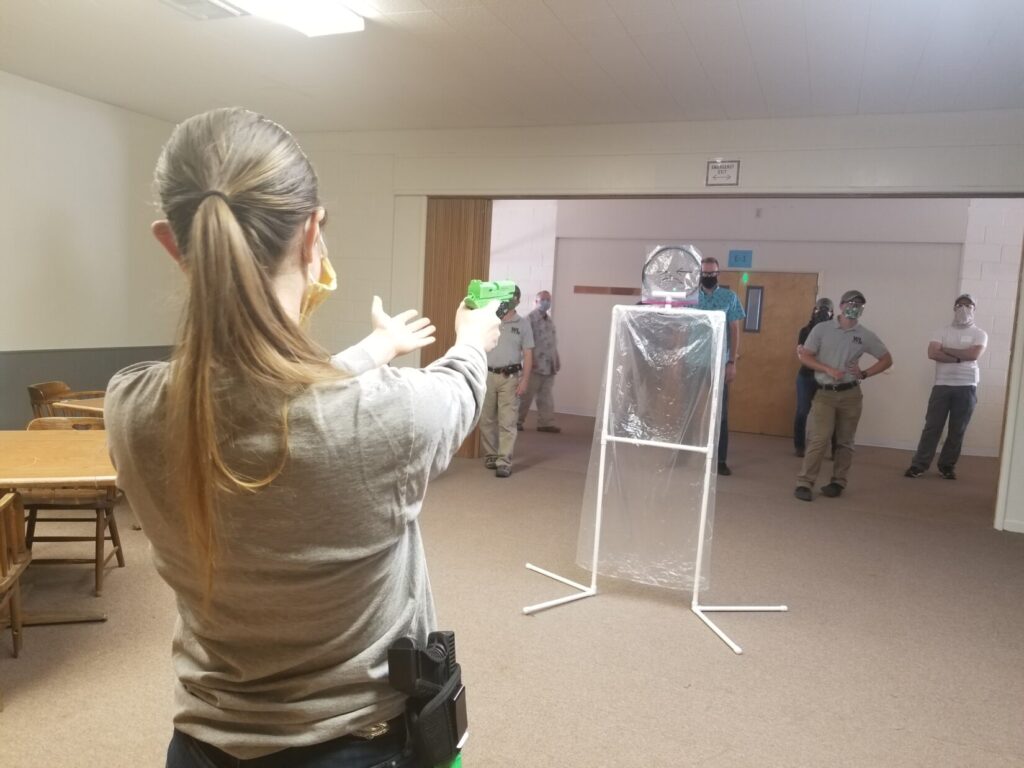
Encourage your students to think out loud. They may throw out suggestions, like “Shoot him in a knee?” I tell them I like that they are thinking, but aiming lower may be sub-optimal in a fight, since the legs are harder to hit, and may not incapacitate the assailant.
Most importantly, leg shots will not solve the line-of-fire problem. Downward angled bullets may ricochet off the floor into bystanders behind.
REALITY CHECK: USING CELLO MAN TO ADDRESS DEADLY FORCE MISCONCEPTIONS
I will not knowingly train anybody who desires to kill people. The fact that your student does not want to hurt anyone, even a person who is actively trying to kill them, speaks well of their character and should not be discounted.
Too many instructors confuse the desire to avoid maiming human beings with inability to perform unpleasant but necessary lifesaving tasks. Their well-intended but disingenuous advice is often, “If you’re not willing to drop the hammer on somebody right this second, you’ve got no business packing heat.”
While I understand what they’re trying to get at, it comes across as macho and murderous to those who have not seen the baser aspects of human behavior that a significant percentage of firearms instructors have experienced as cops and war vets.
YOUR OBLIGATION TO YOUR TRAINEES
As an instructor, either a paid professional teaching a class or a parent showing family members how to defend themselves, you have an obligation to delve into both the moral and legal ramifications of pulling that trigger.
Your students should at least think about those implications before the need arises. But you can’t make them effective users of force by ridiculing, or even appearing to ridicule, their noble reluctance to kill, even if some of their preconceived notions about fighting are naive or silly. Star Trek phasers that can be set to Stun are still science fiction.
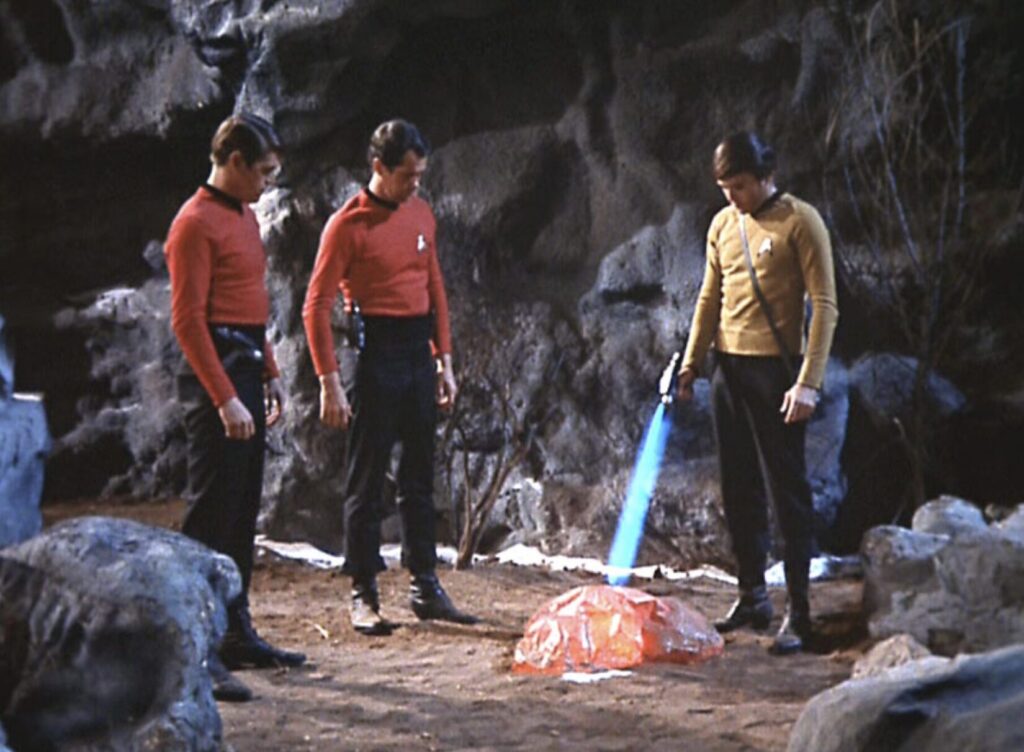
A sad limitation of firearms as defensive tools is that even though defenders shoot to stop aggression rather than to kill, all bullets are potentially fatal.
WHAT ABOUT THE LEG?
Many novices seeking a less-than-lethal solution to a lethal force problem think that shooting somebody in the leg does not constitute deadly force. We can’t fault them for thinking that. Politicians who should know better frequently imply exactly that on national television when they blather about unrealistic “solutions” to deadly force encounters.
Shooting in someone’s general direction is deadly force, regardless of where you are aiming, whether or not you hit what you aim at.
My name doesn’t have “MD” after it, but as a 7-level military medic and a three-decade EMT, I can assure you that a femoral (leg), a brachial (arm), or subclavian (shoulder) artery laceration can each kill somebody equally dead, with all the same legal and moral ramifications for the person who pulled the trigger or held the knife.
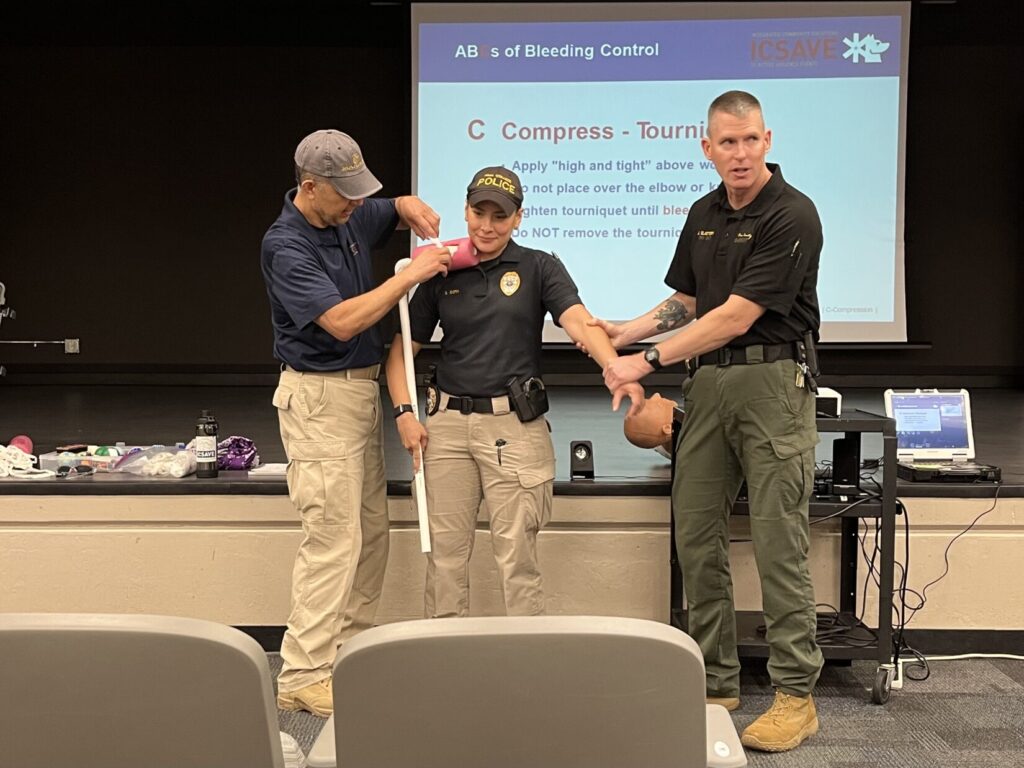
If, during your homicide trial, you say, “I didn’t want to kill him, so I shot him in the leg; I didn’t know he would bleed to death,” congratulations. You have just confessed under oath to negligent manslaughter. The good news is, you’ll be eligible for parole a few years sooner than you would for murder in the first degree.
The Cellophane Man challenges aren’t trying to scare a responsible person away from being armed. We just want them to have a realistic understanding of the weight of that responsibility. Being clear about the moral and legal ramifications, and accepting them beforehand, reduces hesitation in the moment of decision.
None of those potential future legal ramifications matter one iota to the people on the receiving end of AK fire in our scenario. The immediate threat to their survival needs to be addressed in real time. It won’t be addressed fast enough during the real deal if our nascent armed citizen hasn’t also worked through some challenging line-of-fire issues beforehand.
SOLVING THE THIRD CELLO MAN USE OF FORCE CHALLENGE
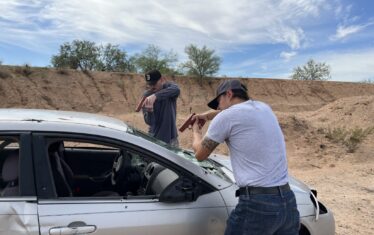
Eventually, students figure out that they can kneel and shoot upward at Cello Man’s head. They see with their own eyes that the laser representing shoot-throughs will go over the heads of the bystanders behind. The student in the photo at the top of this article is taking a kneeling headshot (notice the green dot on Cello Man’s face).
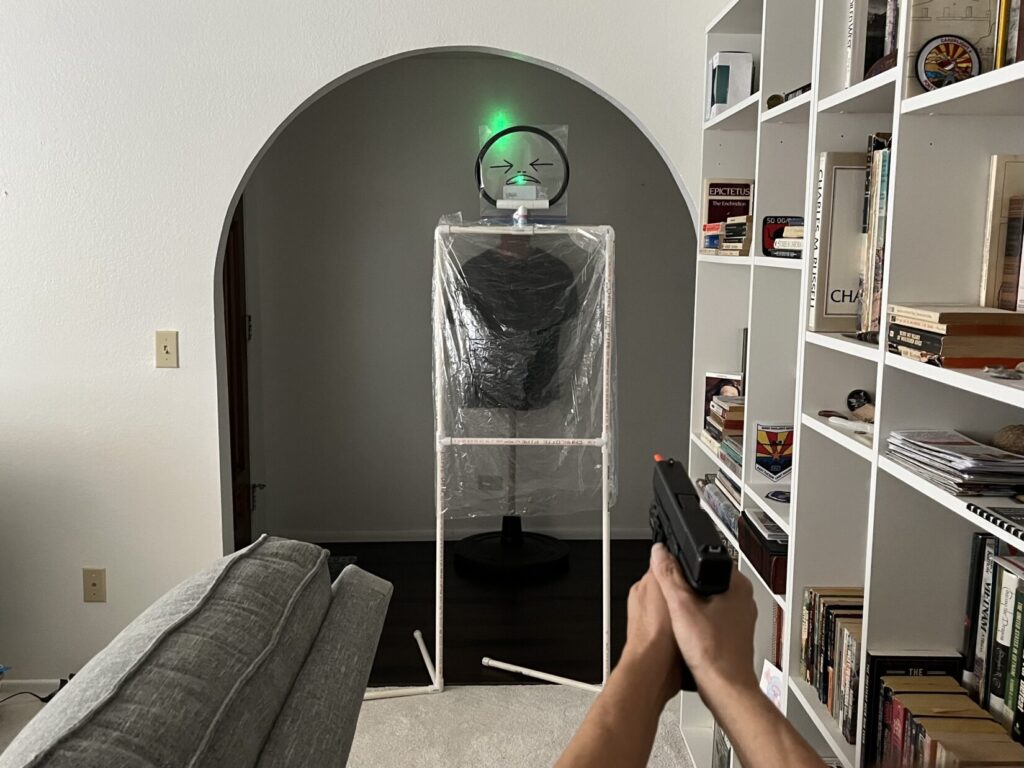
I understand a Tucson police officer did exactly that to a hostage taker with a crowd behind, outside the Park Place shopping mall. The tacti-cool phrase we use to describe it is “vertical displacement.”
Vertical displacement comes with its own set of considerations. Bullets may penetrate the floor of a multi-story house. Outdoors, lobbing bullets upward may endanger people you can’t see who are far away. In a mall, they can hit people on the upper gallery. In a rural environment or up against a windowless multi-story brick wall, kneeling headshots may be exactly the solution you need.
Do not plan on having enough time to figure these things out in a fight. That’s why quality, scenario-based training ahead of time is vitally important: so such options will already be in your toolbox. Think about angles and line of fire solutions before you get into a bullet exchange
MAKING YOUR OWN CELLOphane MAN
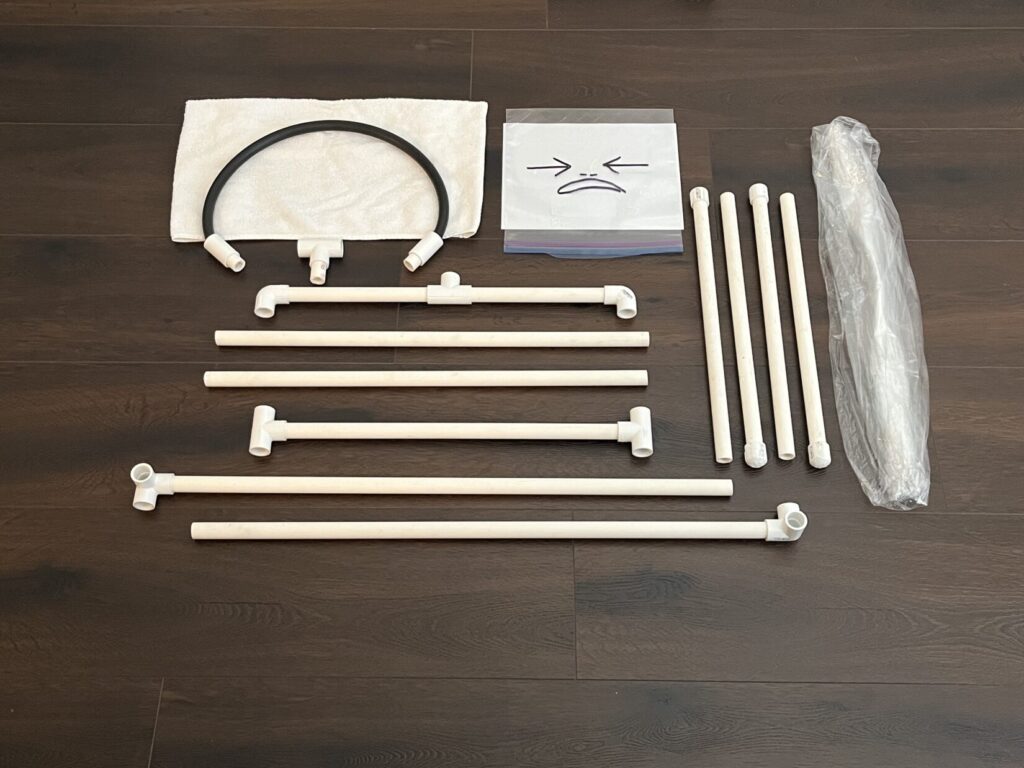
Here’s what you’ll need:
- Skin: A dry-cleaning garment bag and a gallon-sized Ziplock bag
- Head: A flexible, semi-rigid hose connector 30″ long, looped into opposite sides of a T connector. Make sure this T will interface with the T between the shoulders.
- Shoulders: Two sections of PVC 8 7/8″ long, with a T between and one 90-degree elbow on each end
- Arms: Two sections of PVC 24 1/4″ long
- Belt: One section of PVC 19″ long, with Ts on each end
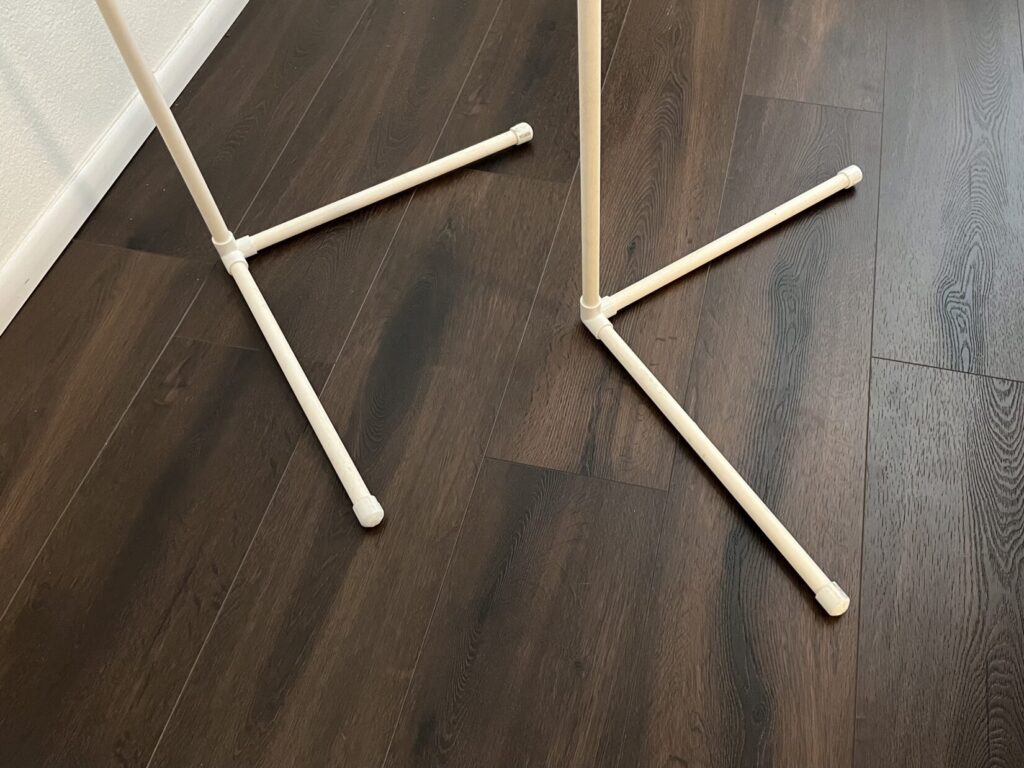
- Legs: Two sections of PVC 29 3/4″ long, with a 3-way elbow fitting on the bottom of each
- Feet: Four sections of PVC 18″ long, with an end cap on each to eliminate wobble
The arm, leg, and feet dimensions are not very critical. The width of the shoulders and belt are more important, to make it straight and to fit within the garment bag.
The feet can be set up duck-footed, pigeon-toed, as chevrons, or in any combination to fit within the available floorspace.
Learning to get clear
Another benefit of Cellophane Man is teaching non-armed members of your family about the dangers of over-penetration. Understanding your line-of-fire needs, a younger member of your family may know to move out of the way to give you a clear line of fire.
Cellophane Man has been one of my most useful training aids. Making one can be an easy afternoon project. Training with one can add years to lives.
In the next installment of this Rule 4 series, we’ll cover the Two-Deep drill, a series of live fire exercises you can use to program awareness and avoidance of innocent bystanders.