

Until recently, “going green” didn’t exactly fit with the firearms industry. Ammunition has traditionally relied on lead for one simple reason: it works. It’s dense, easy to manufacture, relatively cheap, and effective. That combination made it the default for everything from range ammo to duty rounds.
But now, the conversation is shifting a bit.
Between environmental concerns, indoor range regulations, and evolving technology, lead-free ammunition has moved from niche curiosity to a legitimate option. And not the gimmicky, unreliable stuff people remember from early attempts, either. Today’s offerings, especially from companies like BioAmmo and SIM-X, are pushing the category into territory that actually deserves attention.
But is it worth running? Let’s dig in.
Why Lead-Free Ammo?
There are two primary drivers behind the rise of lead-free ammunition: environmental impact and shooter exposure. Lead is a heavy metal, after all, and, believe it or not, is considered hazardous waste.
On the environmental side, spent lead accumulates. Outdoor ranges, hunting areas, and wetlands have come under increasing scrutiny as lead deposits build up over time, potentially poisoning wildlife and contaminating the environment. That’s especially relevant for bird hunting, where ingestion of spent shot has been a documented issue for decades.

On the shooter side, firing traditional ammo in indoor ranges releases airborne lead particles (lead dust), primarily from primers and exposed bullet bases. Modern ventilation helps, but it doesn’t eliminate exposure entirely. Exposure to lead has been tied to some cancers, reproductive issues, and a host of other health concerns, which is why some indoor ranges have started to encourage the use of lead-free ammunition.
But while the demand is real, the challenge has always been centered around performance.
Early lead-free options had a reputation for being underpowered, inconsistent, or just plain unreliable. That reputation created a bit of a stigma that, unfortunately, has stuck around a little longer than it should have. But as the technology has caught up and more options become available, the industry attitude is shifting a bit in a more positive direction.
A Small Caveat
Not all lead-free ammo is built the same.
Some “lead-free” loads simply replace the projectile, swapping lead for copper, steel, or another alternative. Others go further and remove lead from the primer as well, which is a bigger deal for air quality. Then you have companies like BioAmmo that rethink the entire shell, including the wad and hull materials, or SIM-X, which essentially throws out the traditional bullet design altogether and starts from scratch.
The more components you replace, though, the more you’re asking from the design. This, as it turns out, is where things either get real interesting or real messy, real fast.
Lucky for us, I’m a bit of a tree-hugging hippie myself (shocker, I know), and took it upon myself to test out a few of the more modern options currently on the market for the sole purpose of both reporting my findings and doing a bit of educatin’.
BioAmmo Shotgun Ammo
I’ve spent a decent amount of time behind a shotgun. I think most of us have.
I’ve shot everything from the cheap aluminum-cased Winchester SuperX to the heavy-hitters, like Hornady Black, and, like you, I definitely have my preferences. But I loaded up with 150 rounds of BioAmmo from Ammunition Depot and hit the range with an open mind and two shotguns in tow.
I’m not really sure what I was expecting, but the first 25 rounds through my beat-up Remington 870 were… boring. That sounds dismissive, but I mean, there’s just nothing to report. Recoil felt right in line with comparable field loads. Not soft, not harsh… just normal. If someone handed it to you without telling you what it was, you wouldn’t immediately clock it as anything unusual.
It just ran.
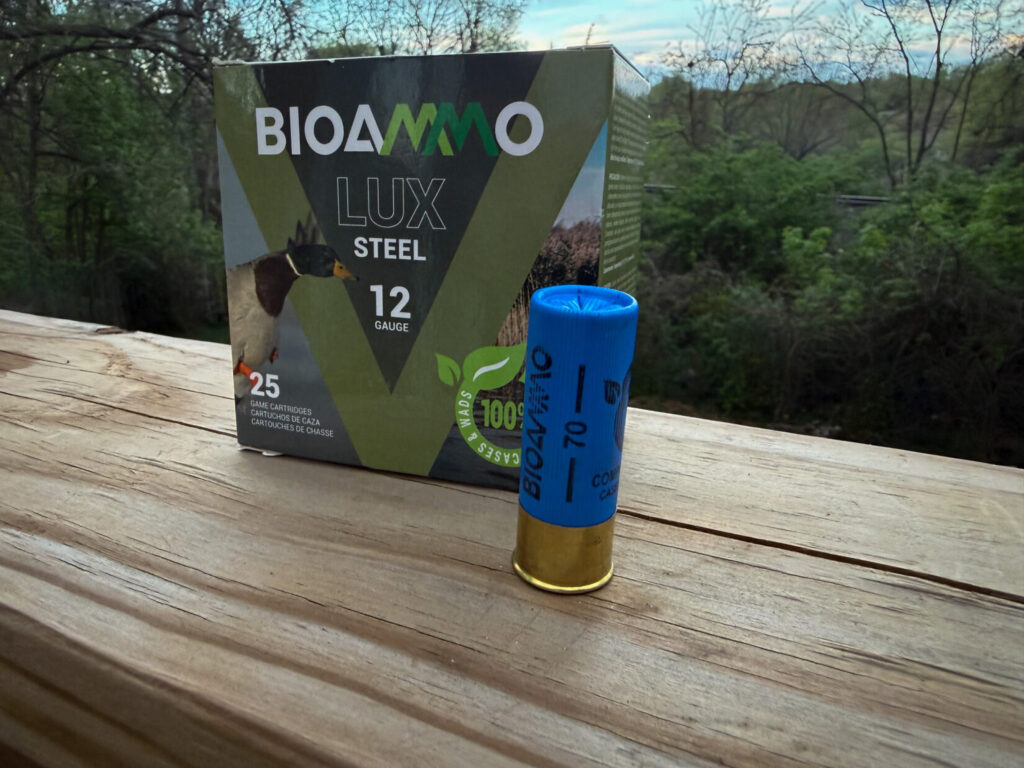
I ran a few different loads ahead of time just to see a comparison of patterns and what I was working with, and the results were consistent across the board. It patterned like a decent mid-tier steel load, which is exactly where it needs to be.
I did the same thing with a Beretta A300 semi-auto scattergun, and the result was much the same. It cycled reliably and without issue. Again, boring. Which actually surprised me, seeing as semi-autos are usually a little more persnickety with ammo. I expected to have at least one minor complaint, but I don’t have any. It goes bang and performs well.
I guess that’s all you can really ask for, right?
Well, I guess you could say the one downside is cost. It’s not the cheapest stuff on the market, and I’d venture to say it isn’t the stuff you grab by the case for a casual range day. It sits closer to premium hunting ammo than bulk target loads, and that might limit how most people use it.
There’s also the long-term question. Traditional shotshells have a proven track record. BioAmmo hasn’t been around long enough to have that same history, especially when it comes to how those biodegradable materials hold up during extended storage.
Because it’s designed to degrade naturally, does it inherently have a shorter shelf life than traditional loads? I don’t exactly have a good test for that…
Regardless, I was happy with the performance I was seeing. It wasn’t anything earth-shattering, but I certainly was not unimpressed either.
It ran as it should. Perhaps that’s the best thing about it: It’s reliable and better for the environment, thanks, in part, to the biodegradable hulls and wads.
Sim-X Handgun Ammo
SIM-X is a completely different conversation.
Instead of a traditional lead core or a fully polymer projectile, SIM-X uses a patented hybrid design featuring a synthetic core within a precision alloy full metal jacket. It’s designed to give you the benefits of frangible ammunition without the typical downsides that come with it.
On top of that, SIM-X rounds are designed to reduce collateral damage and maximize energy transfer on target, which, when compared to traditional FMJ or even some defensive loads, could be a significant advantage.
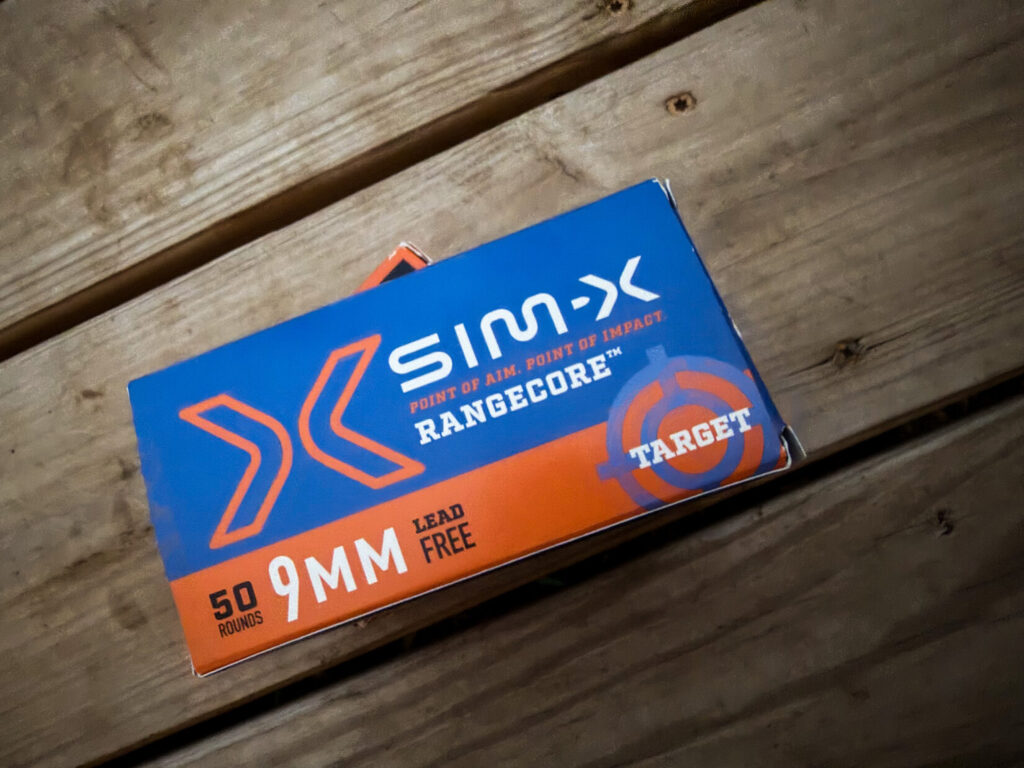
As I opened the first box of SIM-X Rangecore 9mm and took a closer in-person look at these suckers, I knew right away this wasn’t going to behave like anything I was used to. The rounds are noticeably lighter (we’re talking just 50 grains compared to traditional 115-grain or 124-grain stuff), and the recoil impulse is lighter and a bit quicker, which actually makes it pretty enjoyable to shoot during longer range sessions.
I ran it through a Springfield Echelon, a Glock 17, and a Ruger PC9 carbine to get a broader sense of how it behaved across different platforms. In every case, it went bang, cycled, and ejected as expected… but that lighter recoil was pretty noticeable.
It doesn’t feel underpowered or anything like that. Just different than standard ball ammo. But then again, it technically is different.
The Echelon and Glock 17 both ran it without any feeding or cycling issues, and the Ruger PC9 ate everything without hesitation. I figure that was worth calling out, because alternative projectile designs don’t always play nicely with every feed ramp or magazine geometry.
So far, so good.
Sim-X .45 ACP DefenseCore
I ran the .45 ACP Defensecore through a Springfield Mil-Spec 1911 and a CMMG Banshee. They are two very different systems, which, in my opinion, is a good way to expose any weaknesses. The 1911, being what it is, can be a little more particular about what it feeds, but the Defensecore ran clean.
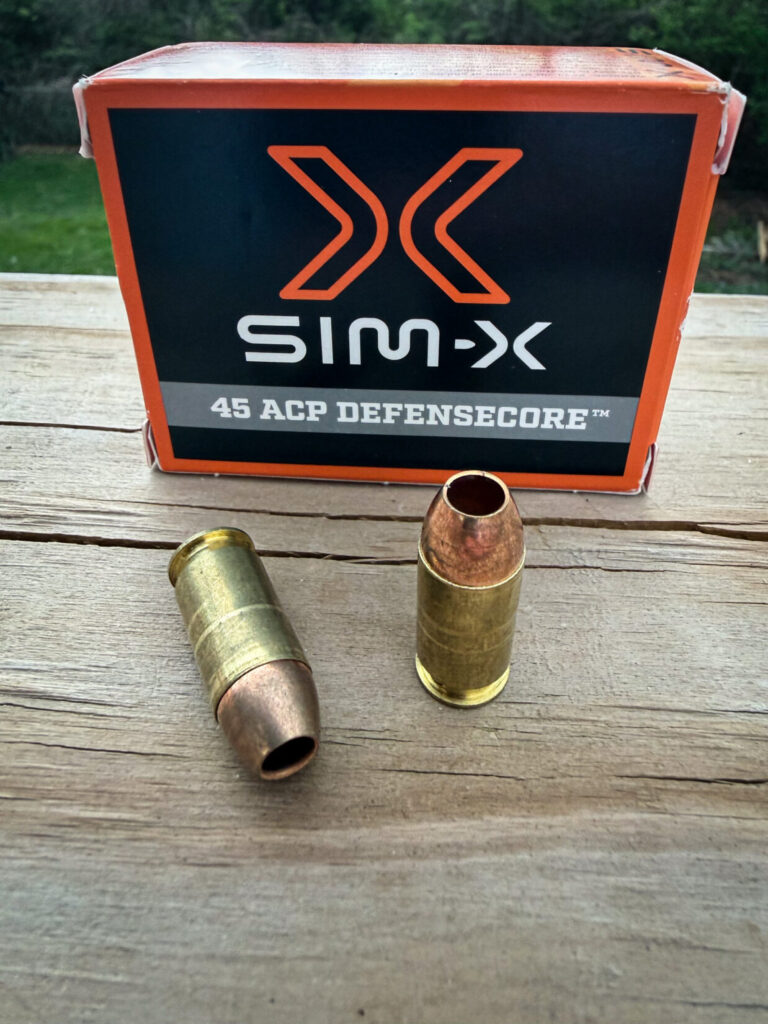
The Banshee, though, was where things got a little more interesting. I had a few failures to eject during testing. It wasn’t a constant, nagging issue, but even one is enough to notice. That said, I’m hesitant to pin that on the ammo immediately. My particular Banshee isn’t the newer fixed ejector model, and it’s seen a fair amount of use. A worn ejector spring is a very real possibility here, and the lighter, slightly different impulse of the SIM-X rounds may have just exposed that weak point.
It’s one of those situations where the ammo and the platform are both part of the equation, and you need to look at the system as a whole, so further investigation is required to determine the real culprit. Either way, since it happened, I figured I’d call it out.
Worth the Squeeze?
SIM-X ammunition, in my opinion, is a fairly reliable training and range round, but with some added benefits. Because of that synthetic core and alloy jacketed construction, you’re getting the best of both worlds, complete with a cleaner shooting experience coupled with an eco-friendly design and all the advantages of frangible-style ammunition.
That said, it’s still not a perfect one-to-one replacement for everything. And cost is still part of the equation. SIM-X sits in premium territory, and it takes a heavier toll on the ole wallet than traditional bulk ammo. So, if you’re looking for some cheap plinking ammo or bottom-shelf carry ammo, this ain’t it.
It makes more sense as a deliberate choice for the environmentally conscious shooter or to meet the lead-free requirement of a growing number of both private and public ranges.
A Place for Lead-Free Ammo
Lead-free ammo has come a long way, but like anything else, it still has plenty of room for improvement.
Cost is still the biggest barrier. You’re going to pay more, and in some cases, significantly more. That alone keeps it from being a default choice for high-volume shooting. While you may have to search a bit longer for specific loads, checking the daily updates at Ammunition Depot’s Best Ammo Deals is a practical way to track down what you need.
Availability is improving, but it’s not on par with traditional ammunition. And then there’s trust. Traditional ammunition has a track record built over generations. Lead-free options are still earning that level of confidence, especially in defensive applications.
In the end, though, lead-free ammo is a legitimate, usable option that solves real problems.
After spending time with both BioAmmo and SIM-X, the takeaway is pretty straightforward. If you’re willing to spend a little more and put in the time to understand how these loads behave in your guns, there’s real value in looking to lead-free options. Not hypothetical. Practical.
Potentially life-saving, even.