
Some old ideas never stay buried, and apparently, clip-fed rotary-barrel pistols. The KelTec PR-3AT is a gun I really wanted to love, but ultimately it will just become another weird gun in my collection.
The PR-3AT made its debut at SHOT 2026, and I’ve finally got my hands on one.
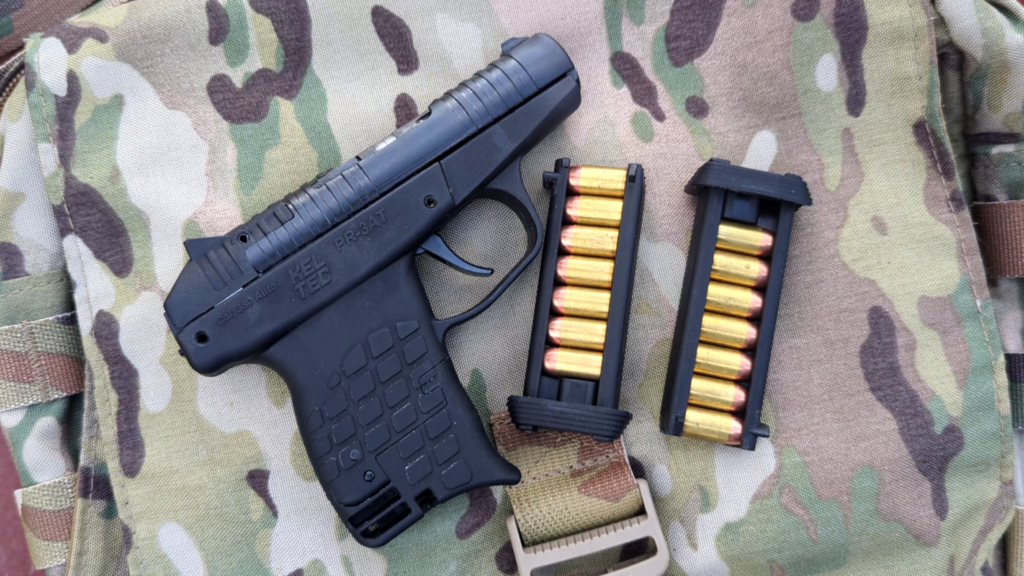
The PR-3AT from KelTec combines the PR-57 and the old-school P3AT into a pocket pistol unlike any other. It’s nothing revolutionary, but it combines a few ideas to make a fairly unique pistol.
That’s not to say George Kellgren hasn’t had a similar idea. He also owned a company called Grendel.
Grendel produced a gun called the P-10 that was also loaded with stripper clips, was also a .380, and also fell into the subcompact genre. KelTec’s latest guns have often been refined models of Grendel guns.
What Is the PR-3AT?
I like weird guns; I like them a lot, so I snatched one up as soon as it arrived at a local gun store. KelTec not only makes their guns in the USA, but they are still fairly cheap. At a street price of less than $300, the PR-3AT doesn’t break the bank.
KelTec has three basic models of this gun. Mine is what I’d call the standard model.
There is also the Defender, which integrates an optics cut for RMSc footprint red dots. Then we have the PR-3AT 10, a capacity-compliant version that’s shorter and smaller overall.
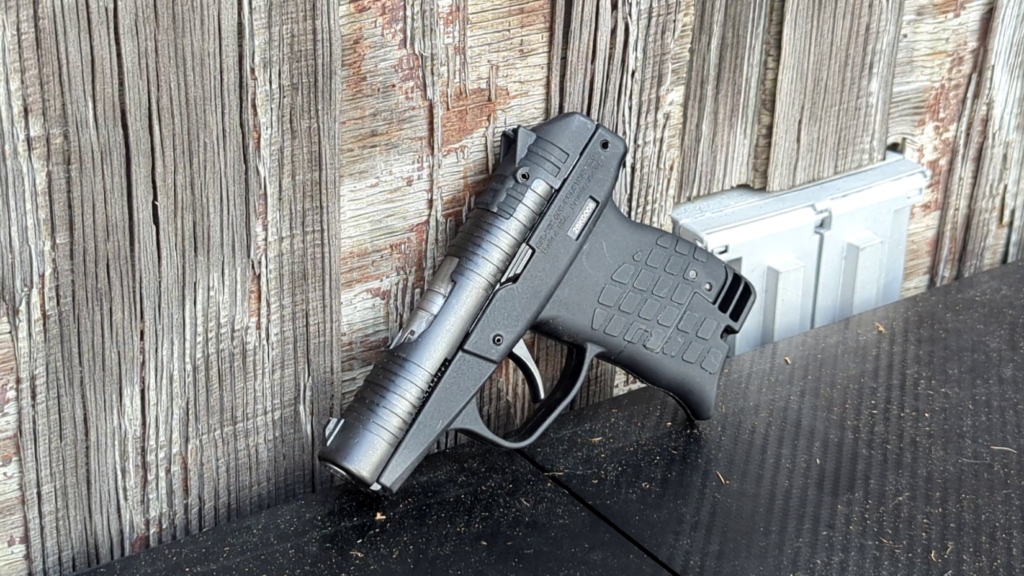
KelTec PR-3AT Specs
| Specification | PR-3AT | PR-3AT Defender | PR-3AT 10 |
|---|---|---|---|
| Caliber | .380 ACP | .380 ACP | .380 ACP |
| Capacity | 13+1 | 13+1 | 10+1 |
| Barrel length | 2.85″ | 2.85″ | 2.85″ |
| Overall length | 5.58″ | 5.58″ | 5.58″ |
| Height | 4.38″ | 4.67″ | 3.93″ |
| Width | 0.944″ | 0.944″ | 0.944″ |
| Weight (unloaded) | 9.66 oz. | 10.64 oz. | 9.38 oz. |
| Trigger pull | 4.5 lbs. | 4.5 lbs. | 4.5 lbs. |
| Optic | None | Factory-installed Viridian RFXI green dot | None |
| MSRP | $399.99 | $589.99 | $399.99 |
The Stripper Clips
The gun comes with two seven-round stripper clips with a captured press to slam the round into the internal magazine. The stripper clips are fairly cheap. A four-pack costs $12, so not bad by any means.
The stripper clips are simple, but are also made of what seems to be fairly thin polymer. I don’t have a ton of confidence they’ll last, so I’d grab a few extra.
The two features that make this gun stand out are the rotating barrel and the fixed magazine, so let’s discuss both of those features.
The Rotating Barrel
Rotating barrels are nothing new. Browning patented a rotating pistol design that was never produced, and in 1907, Steyr released a rotating-barrel pistol. The rotating barrel design never died out, but it never caught on like the simpler Browning short-recoil design.
The benefits of a rotating barrel include reduced recoil and less muzzle rise. When the gun fires, a little bit of the recoil energy rotates the barrel, which keeps it from getting to my precious hands. On full-size 9mm handguns, it’s noticeable, but never that big of a deal.
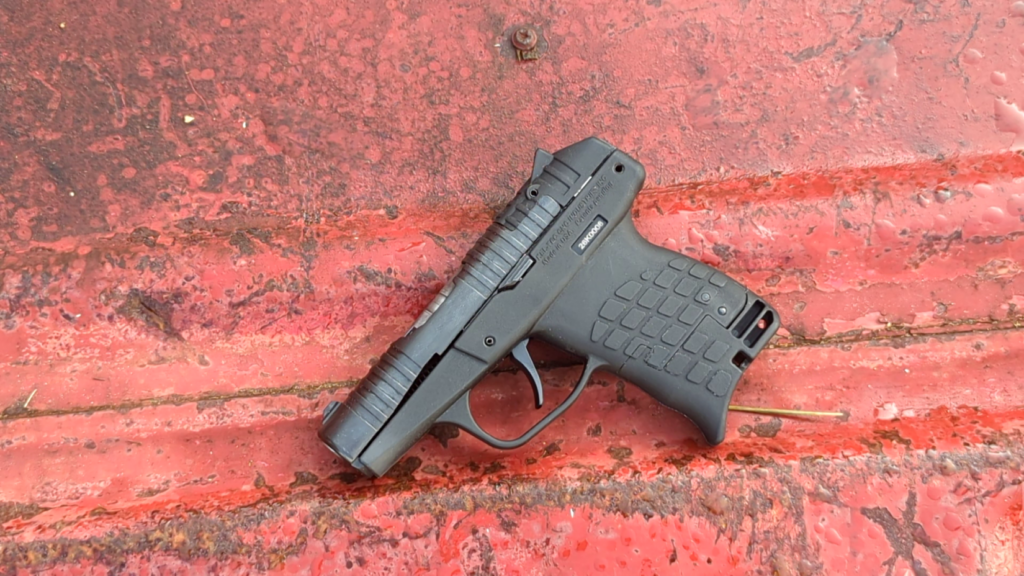
When we shrink a gun to a micro-sized design like the PR-3AT, the benefits might be a little more noticeable. In terms of muzzle rise, since the barrel isn’t tilting upward, it should create less muzzle rise.
The recoil is entirely linear and straight rearward, which again helps with muzzle rise. Underneath the barrel, we have two small recoil springs and guide rods, which seem to keep the barrel lower in the frame. It’s an interesting setup.
A Fixed Magazine Loaded by Stripper Clip
The fixed magazine has some immediate downsides, with the most obvious being how much slower it will be to reload. Slamming two clips through the top isn’t going to be nearly as fast as just replacing a magazine. How often do you carry a reload with a pocket pistol?
Do you need a reload when your gun carries 14 rounds?
John Correia of Active Self-Protection has reviewed thousands, if not tens of thousands, of defensive shootings and has never seen a civilian need to reload a handgun.
The PR-3AT packs a lot of ammo for such a small gun, which is where we see the fixed magazine’s main strength: it’s size-efficient.
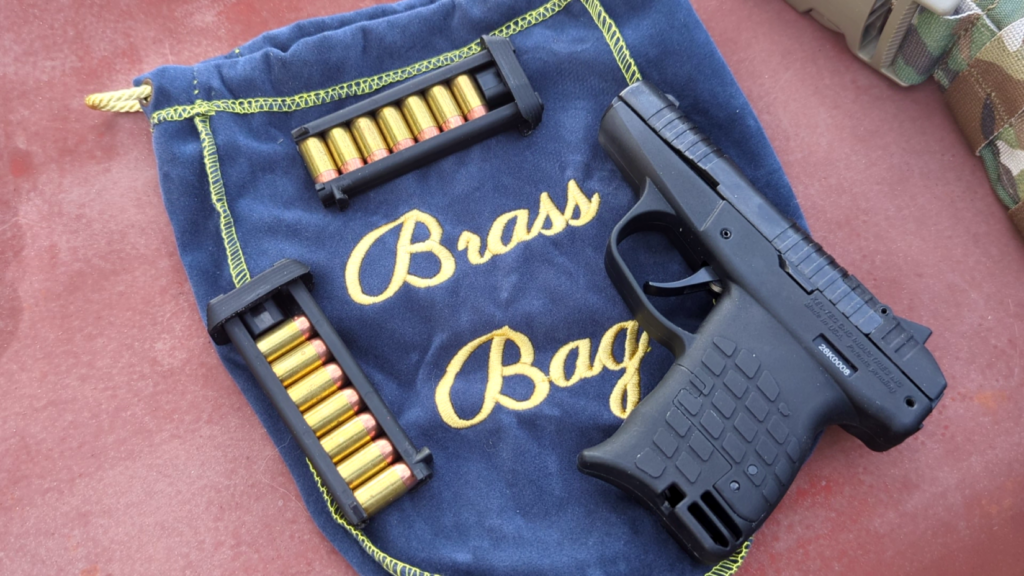
The LCP Max and S&W Bodyguard 2.0 are slightly smaller, but hold only 10 rounds while being only a fraction of an inch smaller. If you went with the PR-3AT 10, it’s almost a quarter-inch smaller than the competition.
It’s also quite light. You’re removing ounces by sacrificing the traditional removable magazine body. It’s only 9.66 ounces unloaded.
Another downside, which I found out during the shooting process, is that malfunctions are a pain to clear. Not being able to remove the magazine to clear malfunctions is a real hassle. You can lock the slide open, but you still have to fish rounds out of the chamber.
KelTec did get ahead of a potential problem with the follower or magazine spring breaking. The bottom of the gun can be removed to swap springs and followers if necessary.
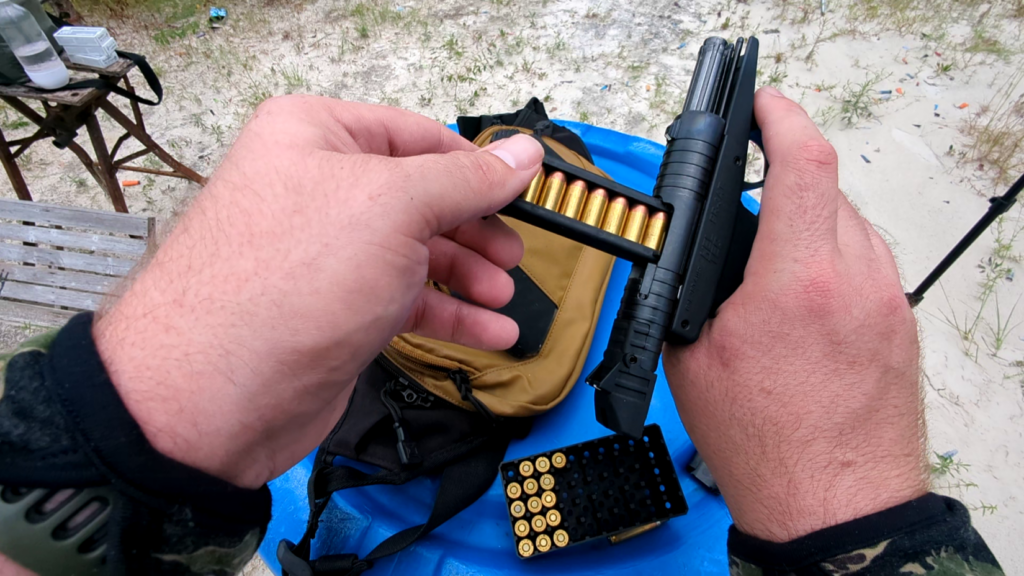
A minor downside for shooting and admin tasks is that unloading and clearing the gun isn’t exactly easy. You’ll have to manually remove each round to clear the gun. For training and range use, it’ll be a hassle.
At the Range
Recoil and Handling
I dislike pocket-sized .380s in general. When it comes to pocket pistols, I’m a .32 ACP fan. The recoil of the .380 ACP tends to be a bit much without offering a substantial ballistic benefit. Some do it better than others.
On one end, we have the Bodyguard 2.0, the king of .380 pocket guns, thanks to its relatively low recoil. On the other end, we have the LCP, the original Bodyguard .380, and the original P3AT, which have intense recoil that makes follow-up shots difficult.
So where does the PR-3AT fall? It’s not on the crap end, but it doesn’t beat the Bodyguard. The recoil is snappy, but it also weighs less than the Bodyguard 2.0. I find the grip texture on the PR-3AT lacking compared to the BG 2.0, so the gun slides a bit in your hand.
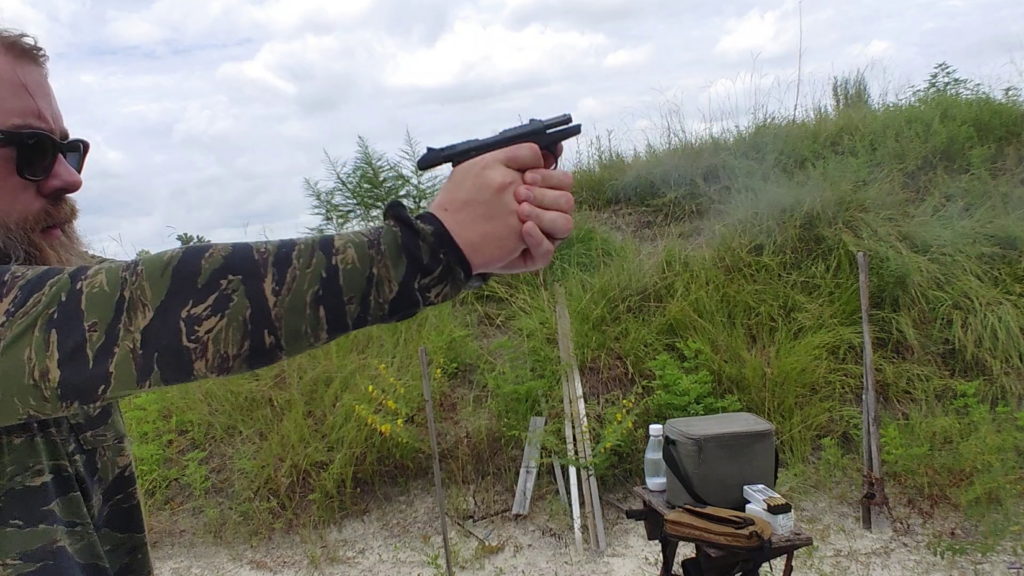
It’s August as I type this, and my hands are covered in sweat by the time the fifth shot is fired. It becomes noticeable as your gun recoils and moves around in your hand. While it doesn’t beat the Bodyguard, it doesn’t suck compared to every other micro-sized .380.
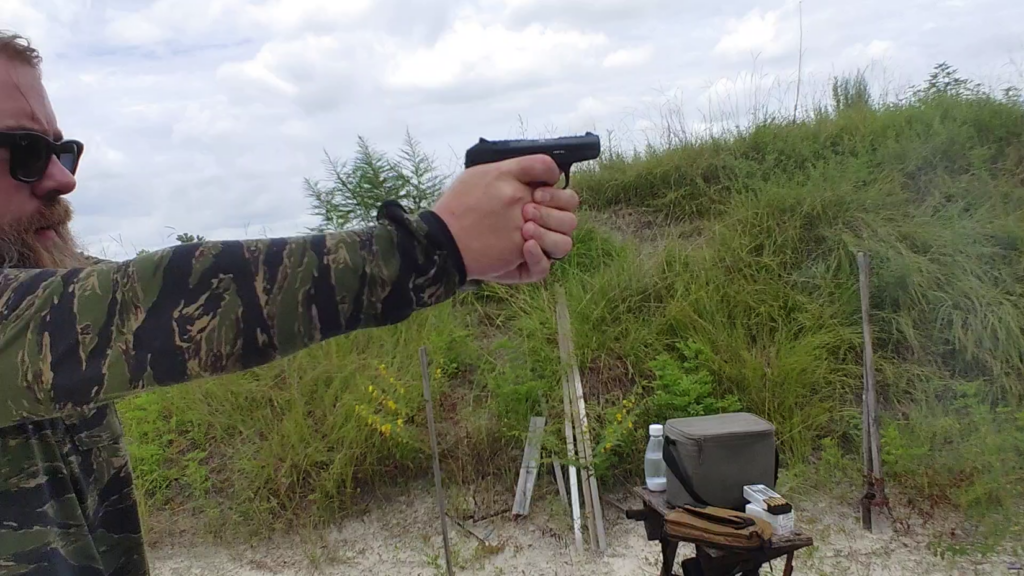
In one day, I fired 350 rounds, and my hands weren’t beat up, and I had zero slide bite. The PR-3AT doesn’t buck too much, and I was capable of a 2.77-second Bill Drill from a pre-staged pocket draw. Pre-staged, meaning my hand started on the gun in my pocket.
Every round slammed into the A-zone without an issue.
Accuracy and Sights
Let’s talk accuracy. KelTec made a really smart decision in adding fairly large, easy-to-see three-dot sights. They are easy to aim, easy to track, and fast to see from the draw.
They are fixed sights, and my gun has the slightest point of aim/point of impact POA/POI issue. It shot slightly high and slightly right. Maybe an inch at 10 yards, so it’s still plenty accurate enough for concealed carry.
At 10 yards, I could keep a full 14 rounds inside the headbox of a USPSA target.
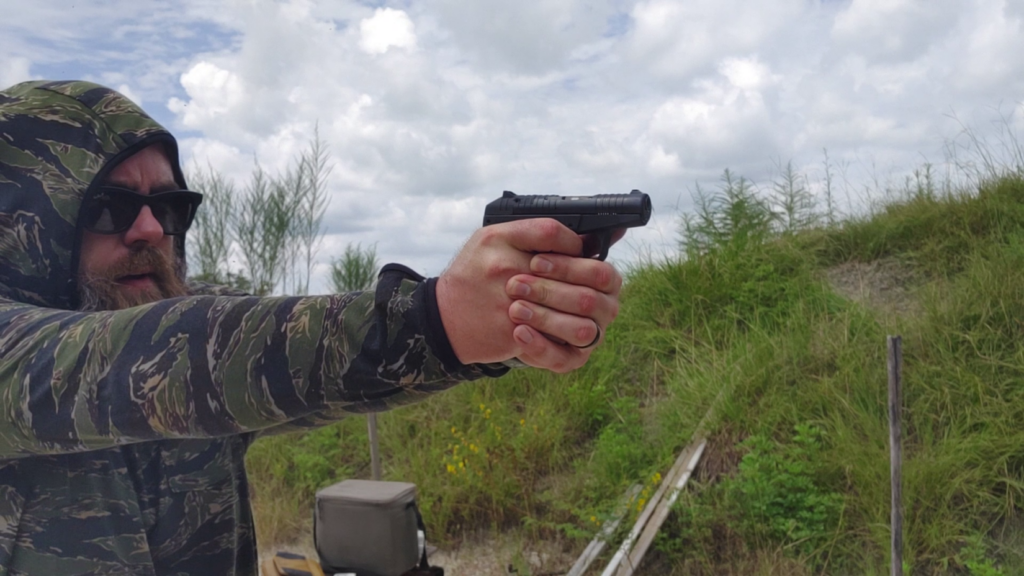
Even back to 25 yards, if I aimed at the bottom left side of a 10-inch gong, I could nail it with every shot if I took my time. When I moved to an IPSC-sized piece of steel, I didn’t have to go slow. I could land lots of shots quickly and efficiently.
The gun is a double-action-only hammer-fired design. The trigger pull is long, but surprisingly smooth and light. It’s not bad by any means, but if you like striker-fired guns, you might have some trouble with the PR-3AT trigger.
Speed and the DAO Trigger
Mastering that longer double-action trigger pull was a bit of a hassle for me. I made the mistake of riding the trigger a little too closely and attempted to pull it again before it fully reset. It only happened a couple of times.
The PR-3AT delivers some snappy recoil, but is flat-shooting. The slide snaps right back to zero, with the front sight where I want it. I had a great time shooting failure-to-stop drills, double-taps, and more Bill Drills.
I did try to run some reloads, or partial reloads, using the seven-round stripper clips. It’s quite slow, but still faster than loading a revolver.
Reliability
The PR-3AT did not meet my reliability standards. I had several failures, namely double-feeds. In the first 350 rounds, I had nine failures. Due to the fixed magazine, fixing this took time and effort. It was not fast, and I couldn’t tap-rack-bang my way through it.
It took several seconds to fix the malfunction every time it occurred. This makes it a no-go for me and concealed carry.
I also had some minor malfunctions where the slide didn’t go fully into battery. It took a little bump from my thumb to get it running again.
A Few Questions Worth Answering
The standard PR-3AT and the PR-3AT Defender hold 13+1 rounds of .380 ACP. The PR-3AT 10 holds 10+1.
Through the top, using seven-round stripper clips or one round at a time. The standard model ships with two clips, and a four-pack runs about $12.
KelTec lists the PR-3AT and PR-3AT 10 at $399.99 and the PR-3AT Defender at $589.99.
Mine wasn’t. I had nine failures in 350 rounds, mostly double-feeds, and clearing each one took several seconds because the magazine can’t be removed.
Final Thoughts on The PR-3AT: It’s Weird and Quirky
I have terrible taste in guns, and weird stuff like the PR-3AT satisfies me, even if it doesn’t run reliably enough for self-defense. The PR-3AT tries something new, but sometimes a swing is a miss. I hope KelTec can address its quirks, because it doesn’t seem like mine is the only one that doesn’t work well.
I have hope for it, but I’d still prefer a .32 ACP version.