

The Bottom Line: Despite the rise of modern LPVOs and high-end red dots, the fixed 4x Trijicon ACOG remains an industry benchmark for duty optics. Its battery-free dual illumination, fixed prism simplicity, and forged 7075-T6 aluminum housing give it unmatched structural durability and near-zero-maintenance reliability.
Each year, new optics hit the market, and some of them are downright impressive. You can purchase a quality optic today for much less than you could just a few years ago. But just like firearms, cars, tools, and just about anything else, new isn’t always better. Sometimes we prefer an old 1911 over a modern handgun, or a classic lever-action over a new semi-auto rifle. And for some, it may be a nearly 30-year-old Trijicon ACOG TA01 NSN.
It’s not just the physical gear that draws some of us to older firearms and equipment—it’s their stories, history, and reputation. While I run plenty of modern optics across my rifles and love what they bring to the table, sometimes a company designs a piece of gear that is simply hard to beat.
There is a clear reason Trijicon ACOGs remain widely used today, and that durability is exactly what we are breaking down.
The Birth of the ACOG and Early Adoption
The Trijicon ACOG (Advanced Combat Optical Gunsight) story started back in 1987 with founder Glyn Bindon, who set out with a simple mission: create bright, battery-free aiming systems. The original model was the 4×32 TA01.
In the late 1980s, scopes were mostly used on bolt-action rifles. At the time, mounting a 4x magnified optic on a service rifle was unusual to say the least. Most military commanders preferred standard iron sights for foot soldiers.
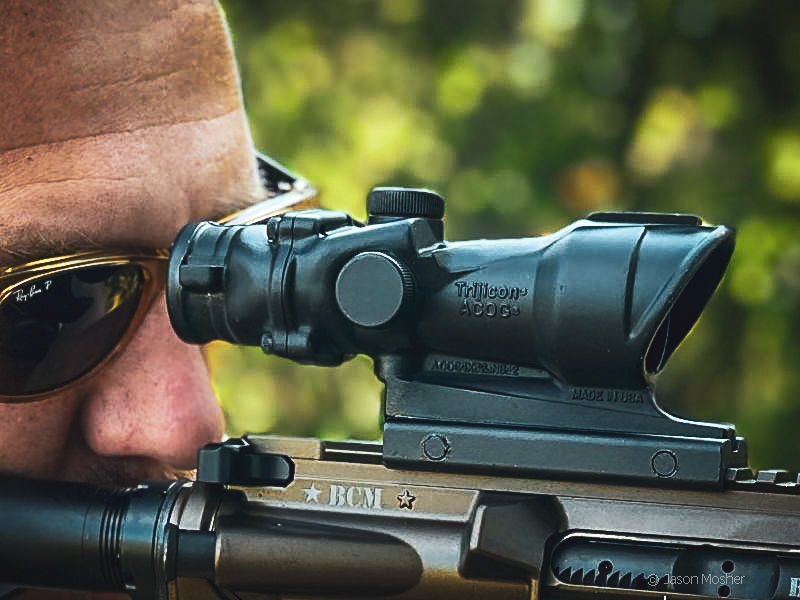
But that mindset shifted dramatically during Operation Just Cause in Panama in 1989, when U.S. Navy SEALs mounted early ACOGs on their carbines. The optics proved that you could engage enemy targets at a distance, with speed and accuracy.
Word spread quickly throughout the special operations community. By the mid-1990s, USSOCOM officially adopted the TA01NSN model.
After seeing how well SOCOM and early testing units performed with ACOGs, the U.S. Marine Corps made a huge leap. In 2005, they officially adopted a specialized 4×32 ACOG variant, TA31RCO or RCO (Rifle Combat Optic).
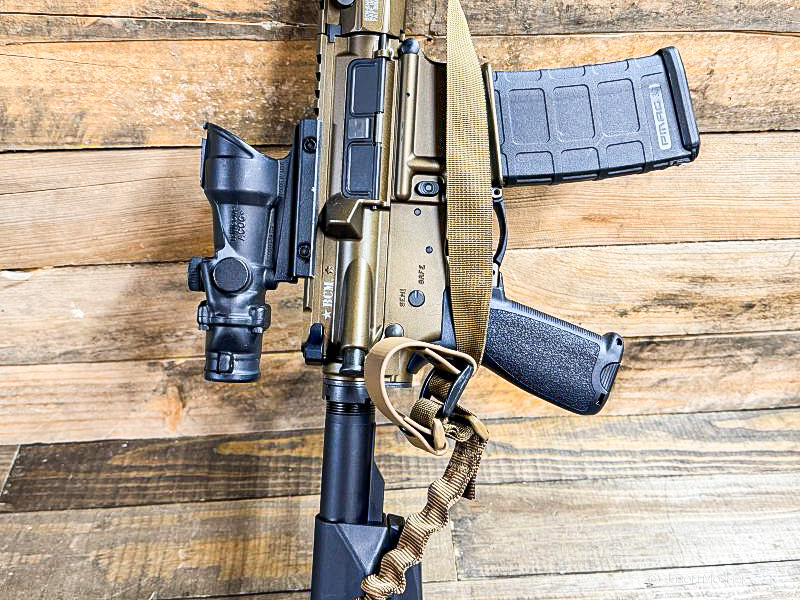
Unlike previous optical rollouts that were reserved for squad leaders or marksmen, the Marines decided to issue the ACOG to every single infantry rifleman carrying an M16A4 or M4 carbine. This was a massive shift in military doctrine, moving an entire service branch away from iron sights as the primary aiming tool.
This move to optics also made its way to the US Army, which started using an assortment of optics, including ACOG and Aimpoint.
The Bindon Aiming Concept (BAC)
Glyn Bindon pioneered a shooting method called the Bindon Aiming Concept. By shooting with both eyes open, your brain overlays the reticle onto your non-magnified field of view. You may have noticed people using tape on their optic during training. When the reticle is illuminated, this causes the brain to overlay the dot onto the downrange view of your non-aiming eye.
Using the Bindon Aiming Concept, you can still use an ACOG for close-quarter target acquisition, even though it’s a fixed 4x magnification lens. Sure, a simple red dot works better as a dedicated CQB optic, but the ACOG is capable of working at multiple distances even though it has a fixed lens.
What Makes the ACOG Practically Indestructible?
Most people who have experience with an ACOG will likely agree that its most notable feature is its extreme durability.
Simply put, the optic was engineered to survive war. People often throw around the phrase “built like a tank,” but this ACOG truly lives up to it.
| Technical Feature | Trijicon ACOG Specification | Tactical Advantage |
| Housing Material | Forged 7075-T6 Aircraft-Grade Aluminum | Maximum shock resistance against drop impacts and heavy recoil. |
| Internal Gas Seal | Dry Nitrogen Purged | Completely prevents internal fogging during severe thermal shock. |
| Optical System | Fixed 4x Prism Glass (No internal moving zoom lenses) | Eliminates mechanical points of failure common in variable optics. |
| Illumination Source | Tritium Gas & Fiber Optics (Dual-Illuminated) | 100% battery-free operation in both daylight and total darkness. |
| Fail-Safe Reticle | Etched Prism Glass | Reticle remains visible as a solid black aiming point if illumination fails. |
The housing is forged from 7075-T6 aluminum, creating an external shell capable of absorbing severe impacts. The housing is also completely sealed and purged with dry nitrogen gas. This prevents internal fogging during extreme temperature drops.
The thick glass lenses are deeply recessed within the aluminum frame to protect against direct impacts, easily handling recoil impulses ranging from standard 5.56 NATO up to heavy .50 BMG platforms.
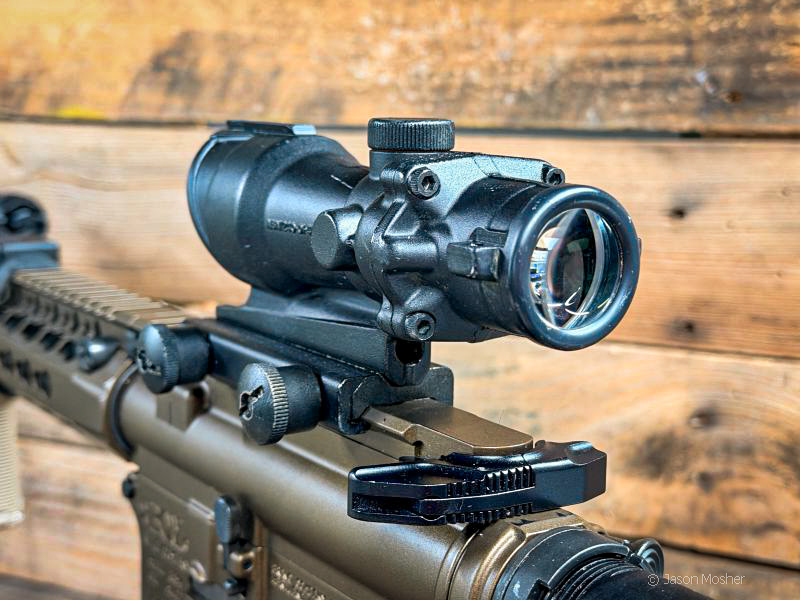
One of the reasons Trijicon used a fixed magnification in the ACOG was for durability. Variable-power scopes rely on internal moving lenses to change magnification levels. Moving parts are natural points of failure under hard impact or heavy recoil. Because the ACOG uses a fixed 4x optical prism system, there are fewer moving internal parts.
Most optics today run on battery power. While some of them can run an extremely long time on a single battery, the battery will die at some point. The ACOG uses a radioactive Tritium gas that causes the reticle to be visible during low-light operations. The Tritium gas has a half-life of about 12 years, so this is the first “failure” point to see on an ACOG. But because the reticle is etched in the glass, it remains crisp and functional even if the active illumination fades completely.
Restoring a Piece of History
The TA01NSN model sitting on my rifle is a great example of durability. With a low five-digit serial number, this optic dates back to the early era of the TA01NSN production run. When I got my hands on it, it looked like a paint project gone wrong. Previous owners had added multiple layers of rattle-can paint over the years.
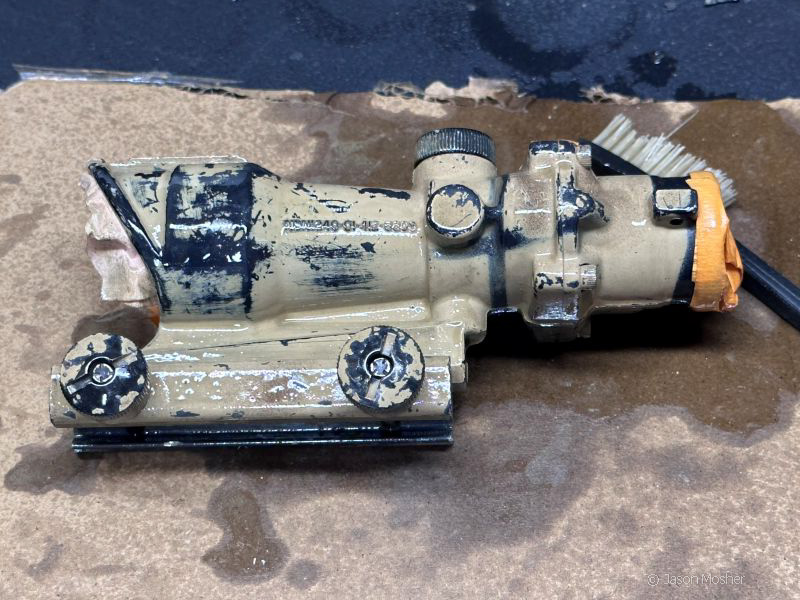
Using paint stripper, I carefully removed the caked-on layers of tan, green, and black paint. I masked off the lenses, stripped it down to the old finish, cleaned it, and applied a fresh coat of black paint.
Despite the optic being nearly 30 years old, and me scrubbing at it with a wire brush and paint stripper, it’s still in great condition.
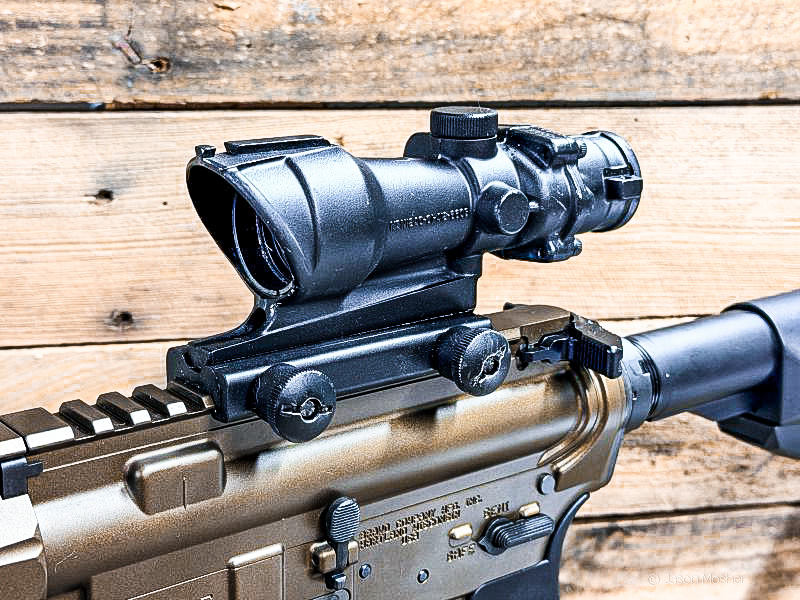
The glass is still crystal clear, though the reticle no longer illuminates in the dark. It only took me a few minutes to sight it in at 100 yards, and it’s held a zero ever since.
An old school optic that’s still relevant today
Modern optics will continue to have their place in our world. Even the military is transitioning to variable optics for flexible distance engagements. And those modern optics offer a lot of benefits over the old ones. Yet, there is something uniquely reliable about running a 30-year-old combat optic that requires zero batteries, features no internal moving zoom mechanisms, and continues to rival most modern optics today.
Common Questions About Running an ACOG
How long does the reticle stay lit in a Trijicon ACOG?
The Tritium gas inside has a half-life of about 12 years, meaning it will dim down over time in dark environments. But here’s the beauty of it: because the reticle is etched right into the glass, you still have a crisp, solid black aiming point during the day or with a weapon light—even if the Tritium is completely dead. Plus, Trijicon can replace the Tritium if you send it in.
Can you actually run a fixed 4x ACOG up close?
Yes, absolutely. By using the Bindon Aiming Concept—keeping both eyes open while you shoot—your brain blends the bright reticle from your aiming eye with the clear downrange view from your other eye. It takes a little practice, but it lets you get fast hits up close despite the 4x magnification.
What’s the main difference between an old TA01NSN and a newer TA31 RCO?
The older TA01NSN uses Tritium alone for low-light shooting and has backup iron sights mounted on top of the optic housing. The TA31 RCO added a fiber-optic light strip along the top to gather daylight for a brighter reticle, along with a Bullet Drop Compensator (BDC) reticle tailored for standard military loads.