
We don’t hear much about German-made guns in the United States. Occasionally, you’ll stumble upon a Blaser or Mauser (new manufacturer) at a gun shop, or a vintage military arm at a gun show, but that’s about it.
Actually, the only German handgun manufacturers I knew of are Korth and Spohr—both high-end revolver makers. So I was surprised when my editor asked me about STP—I’d never heard of them! Luckily, STP agreed to take part in the 2011 PROJECT and sent out one of their S.W.A.T. models for testing. I’ll say this: the stereotypes about German manufacturing and engineering are true.
To understand the history of the 2011, Staccato, and the rise of this pistol classification, check out “Party Like It’s 2011: Staccato and the 2011 Revolution,” which tells the origin story. That article lays the groundwork for what follows.
The 2011 Project is meant to give you honest opinions on this growing market. Unlike other trends that come and go, this one has staying power. Still, pistols in this class can cost thousands of dollars.
The goal here is to give you an unbiased opinion on how these models stack up and help you decide which is best for your needs and budget. You can find every pistol we’ve tested so far on the 2011 Project tag page.
Thank you to STP for providing a sample. All thoughts and opinions are my own.
WHO IS STP?
STP, short for Sport Target Pistol, is the company of German gunsmith Karl Prommersberger. He opened his own shop in Aichach, Germany, in 1988 and later took courses with American gunsmiths John Nowlin Sr. and Les Baer.
STP says that from 1998 to 2015, Prommersberger was STI’s strongest overseas partner. When that partnership ended in 2015, he made STP his own registered brand. Today, the company builds its pistols in Germany on CNC machines, backed by more than three decades of gunsmithing.
In the US, STP has a single distributor, Precision Shooting Supply in Newcastle, Wyoming. Fellow CADRE Dispatch contributor Chris Rhodes also put the STP SWAT through its paces earlier this year.
STP S.W.A.T. SPECS
| Specification | STP S.W.A.T. 5.0 HEX Optics |
|---|---|
| Model | S.W.A.T. 5.0 HEX Optics |
| Action | Single-action, hammer-fired |
| Caliber | 9mm (9×19) |
| Capacity | 17 rounds |
| Barrel | 5″ cold hammer-forged bull barrel |
| Finish | Black DLC |
| Grip | Black aluminum with hexagon-cut texture |
| Trigger | Match trigger with adjustable trigger stop |
| Sights | Fixed front; fixed rear on the optic adapter plate |
| Optics | Slide-in rear adapter plate; Holosun/Trijicon, Aimpoint ACRO, Docter, and C-More plates sold separately |
| Rail | Full-length accessory rail |
| Magazines included | 1 |
| Overall length | 8.7″ |
| Weight | 43.7 oz. |
| Price | $5,499 |
STP S.W.A.T. FEATURES
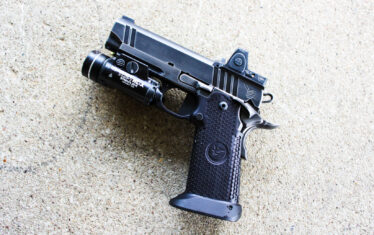
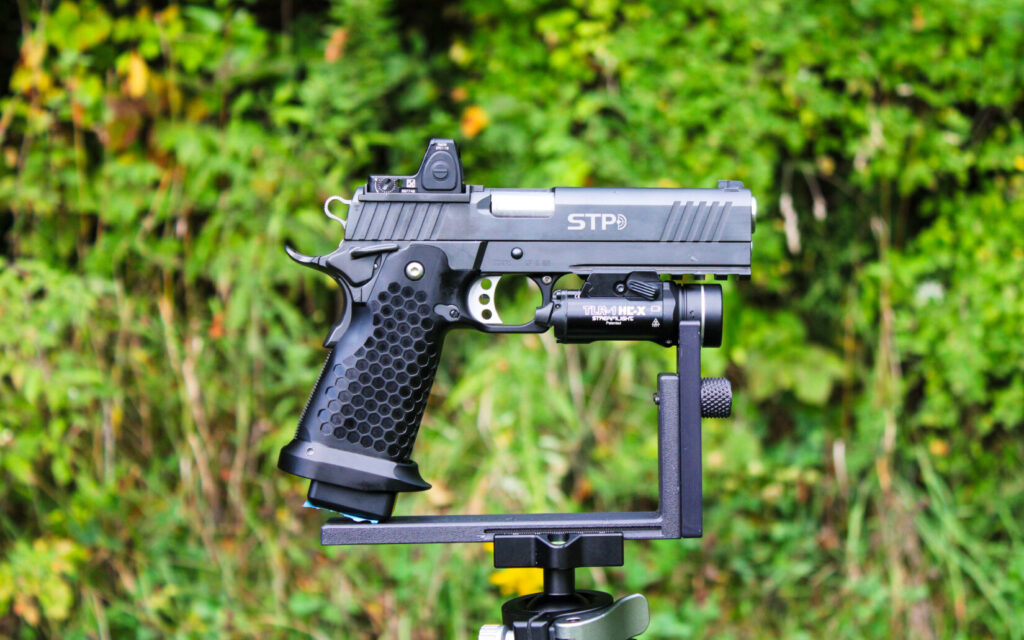
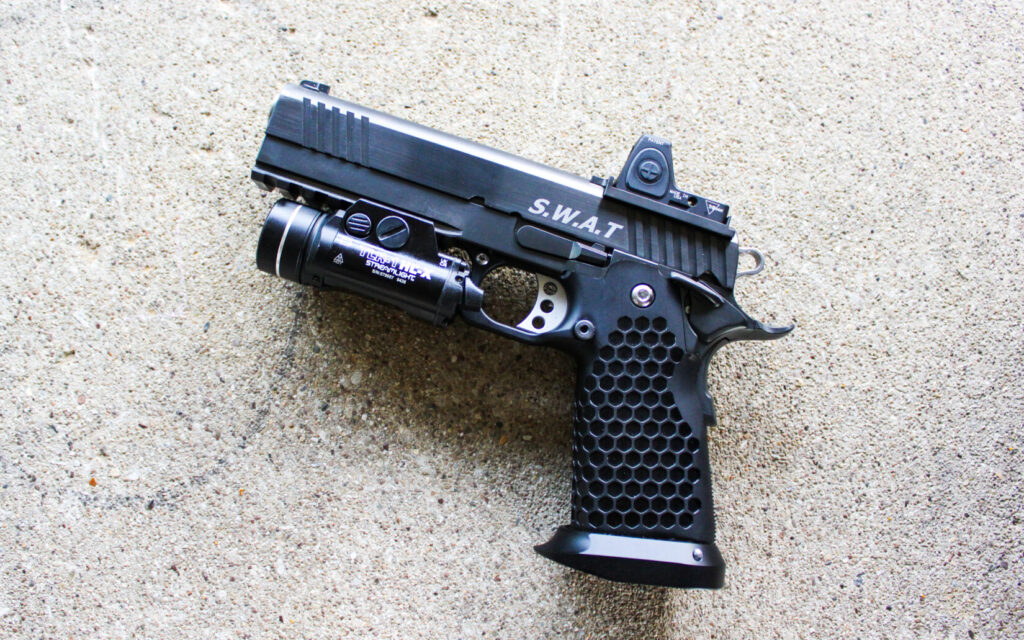
The STP S.W.A.T. 5.0 HEX Optics is STP’s tactical 2011 that combines sport-pistol features with a carry-oriented design. It’s a 9mm with a 5″ cold hammer-forged bull barrel, a black DLC finish, and a 17-round magazine.
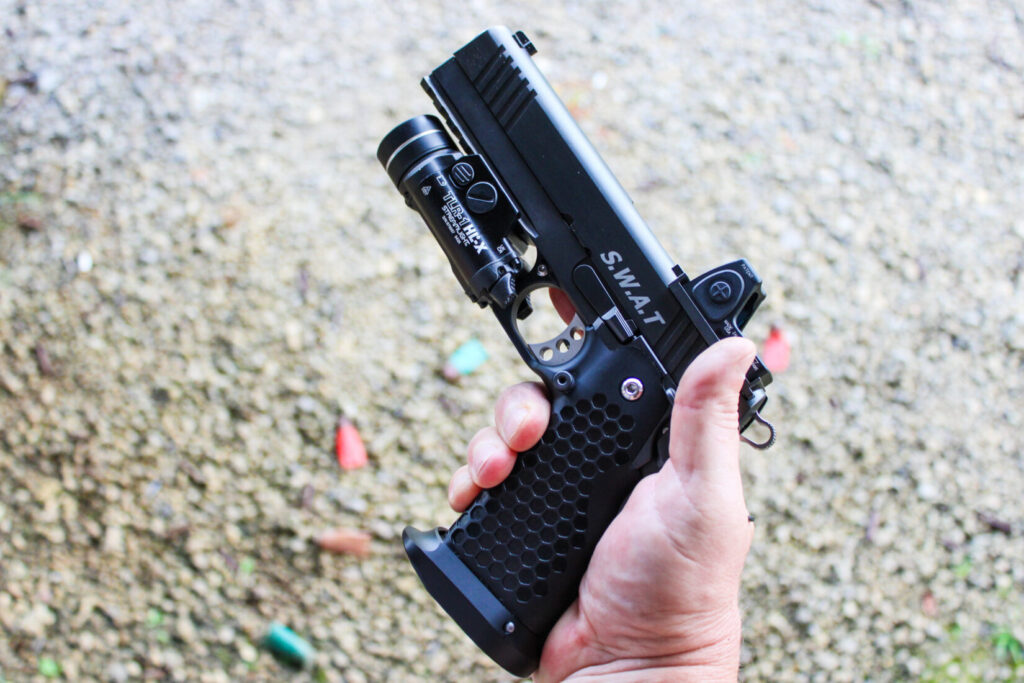
The long, solid dust cover puts weight up front, and the black aluminum grip is cut with a hexagon pattern. Both help keep the gun stable for enhanced control during rapid fire.
The optics-ready configuration uses a rear-slide interface to mount an adapter plate and comes standard with a plate that includes a fixed rear sight. Optional plates are available for Holosun/Trijicon, Aimpoint ACRO, Docter, and C-More optics. A full-length rail also allows you to add accessories such as a flashlight.
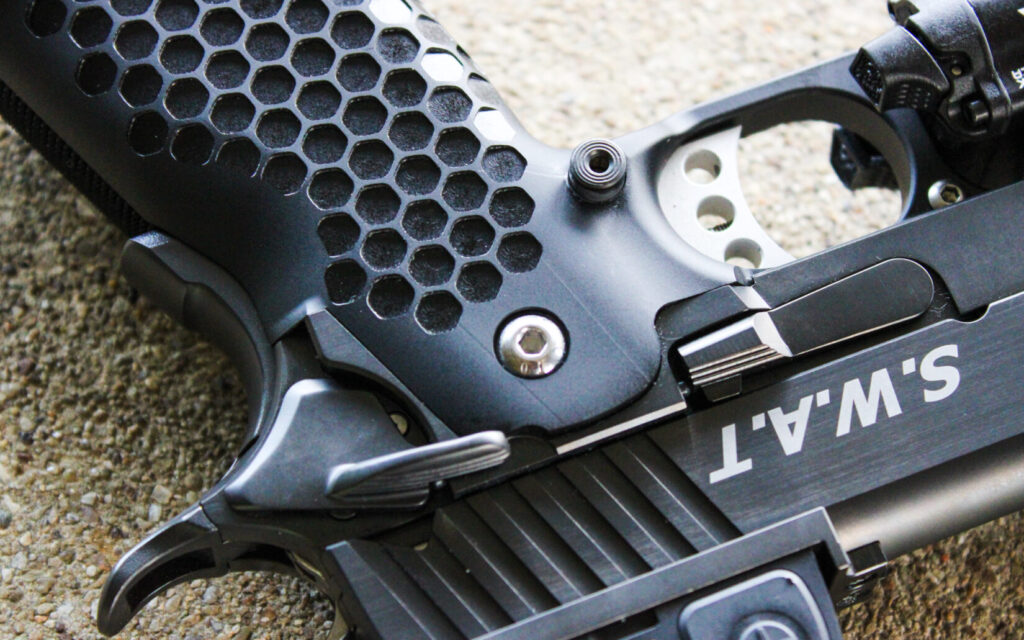
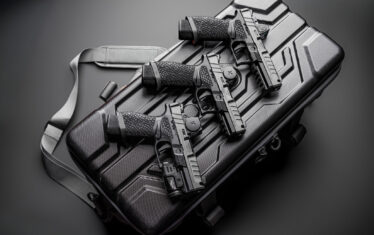
At the heart of the S.W.A.T. is STP’s match trigger with an adjustable trigger stop, designed for precise shot placement. It ships in a premium gun bag.
Setup
The Slide-In Optic Plate
The S.W.A.T. has one of the most unique optic mounting systems. First off, the plate slides in, which is the first system like it I’ve used. I can see why this is such a strong mounting method.
Traditionally, it’s the screws and recoil lugs that bear the force of the slide reciprocating. With the STP, the slide bears the brunt of the force, while two screws forward of the optic prevent the plate from sliding out. Ingenious, yes. Over-engineered, perhaps. This is German-built, after all.
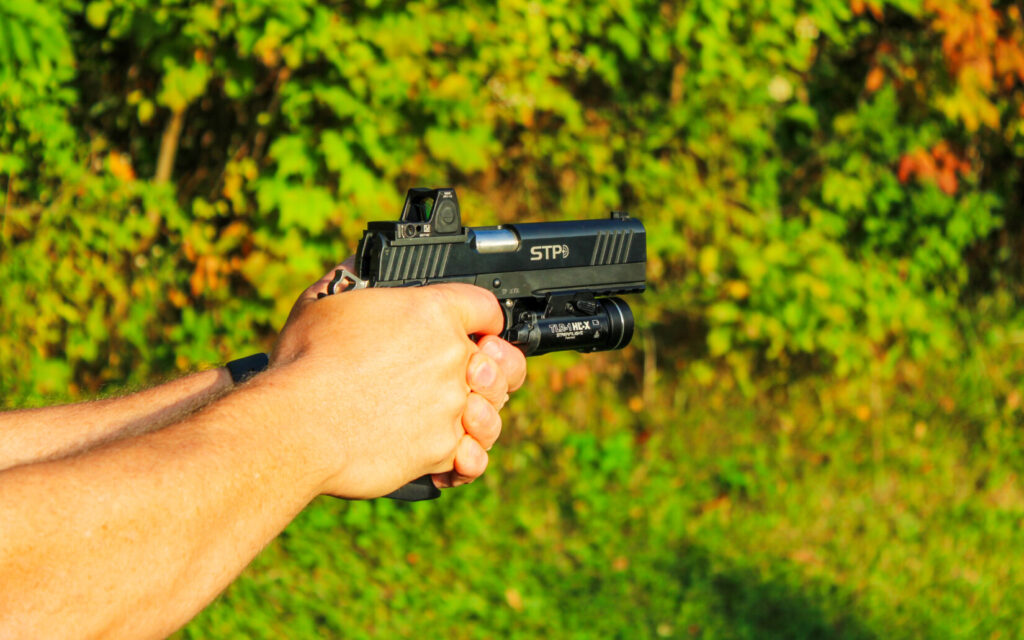
Because of the optic plate footprint limitations, I went with a Trijicon RMR that was on the Staccato C2. It’s a great pistol dot, and I’ve never had any problems with it.
I asked why DPP (Leupold DeltaPoint Pro)isn’t a footprint option. The answer: it’s not common overseas. While we see Vortex, Sig Sauer, and EOTECH all use the DPP footprint, those are American companies.
Light and Holster
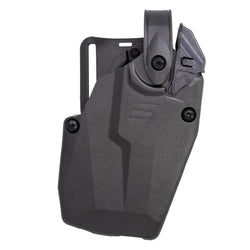
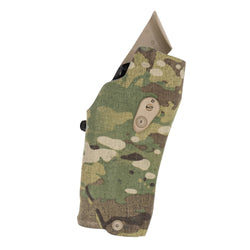
I’ve also added a Streamlight TLR-1 HL-X. As in the rest of this series, I’m running the pistol stock to keep things on an even playing field. For a holster, I’m using the Safariland 6354RDSO ALS Holster w QLS19 Fork and a mid-ride QLS Adapter. This is my go-to setup for any kind of “tactical” shooting or training.
However, as you’ll notice in the photo below, the S.W.A.T. didn’t seat in. The holster is cut for the Staccato XC 5″.
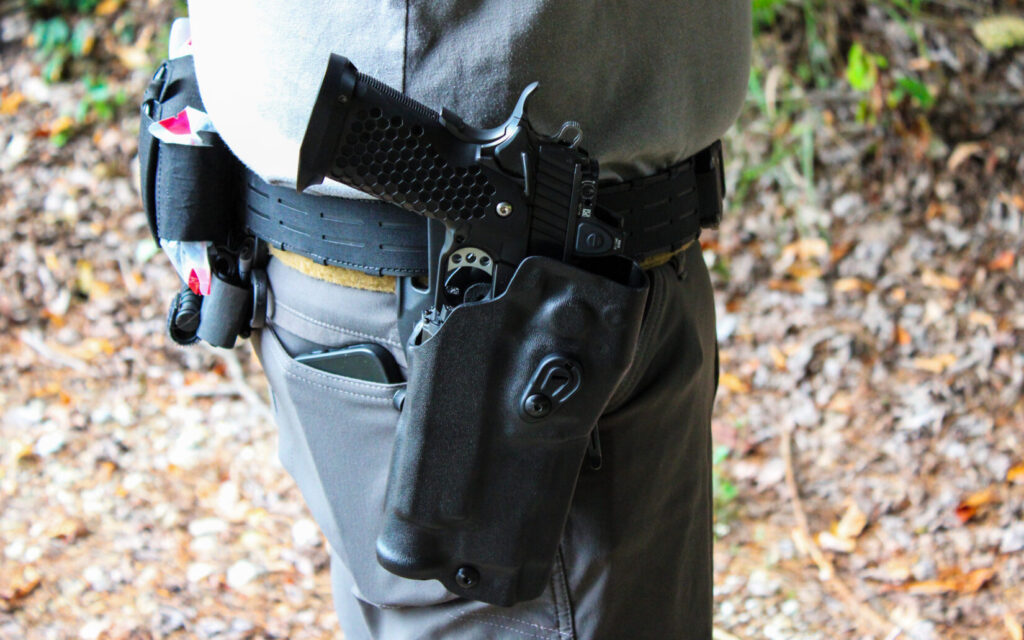
Chris Rhodes runs the same fit with his S.W.A.T., along with a Streamlight TLR-1 and a large RMR-footprint optic. His took a short break-in: a few firm insertions before it seated cleanly. Small differences in molding and how each gun is set up can make a new holster snug at first.
I didn’t give mine that break-in before testing, which is why I ran the Humbler from a bench.
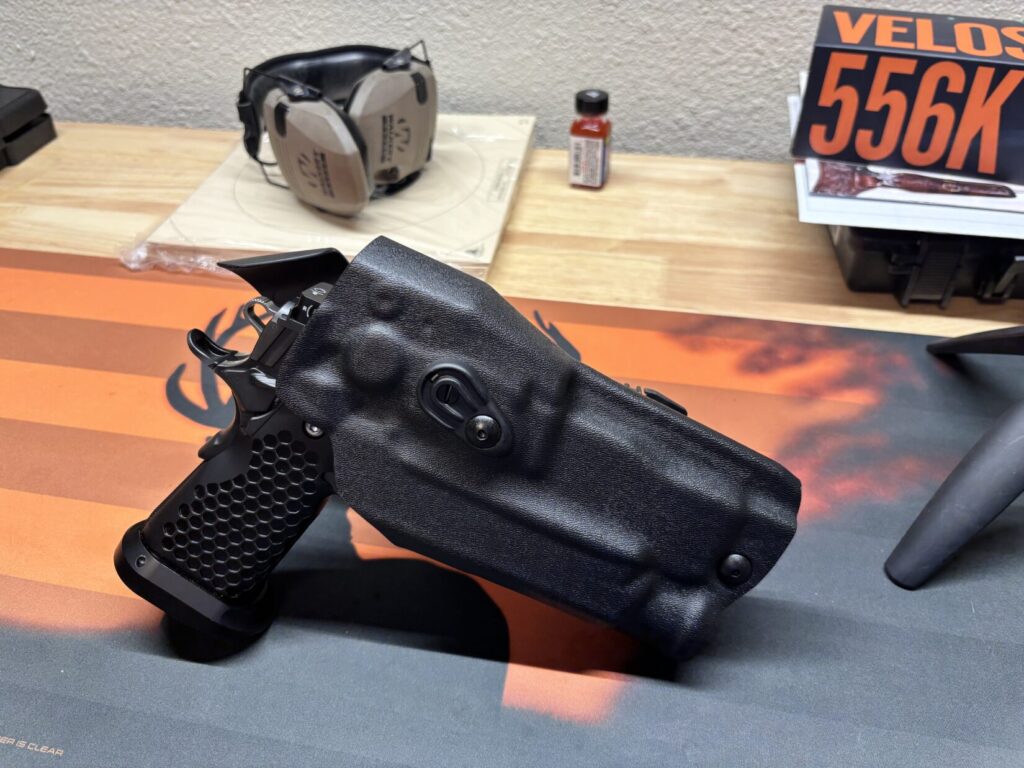
It rides on the Safariland BASELINE MOLLE Belt, which I’ve grown to like quite a bit.
Now, let’s head to the range.
At the Range
A note on ammo. All “range ammo” is Blazer Brass 115-gr FMJ (5200). For accuracy testing, I used Hornady American Gunner 115-gr XTP. I picked up all the ammo for testing from Ammunition Depot.
Let’s get into the drills and accuracy testing.
Bill Drills
Starting from low ready with the target about 7 yards away, the goal is six A-zone(ish) hits in 1.25 seconds or less.
My average time over six attempts with the STP S.W.A.T. was 1.1 seconds. First shots were at 0.31 seconds, while follow-ups hovered around 0.14 seconds.
My worst run was the first attempt at 1.31 seconds. I lost my sight, which slowed the run. After that, things really picked up. The gun’s weight keeps things flat, helping with accuracy.
Accuracy Testing
For this portion, I’m shooting off a pistol rest mounted to a tripod. This keeps things as stable as possible and really showcases the pistol’s capability.
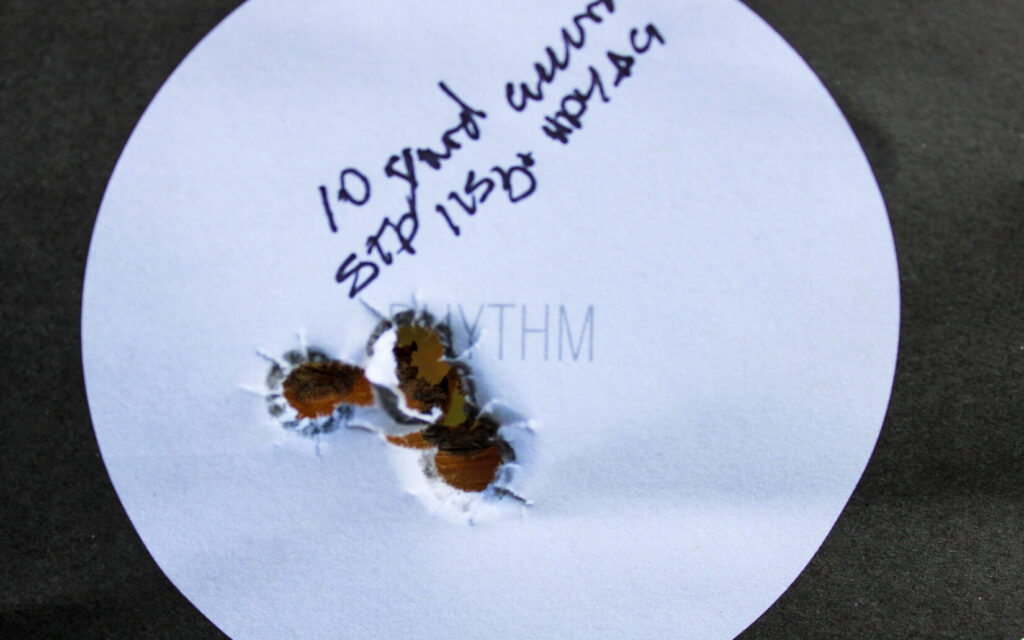
At 10 yards, the S.W.A.T. put down a ¾” center-to-center group. I’d call that good.
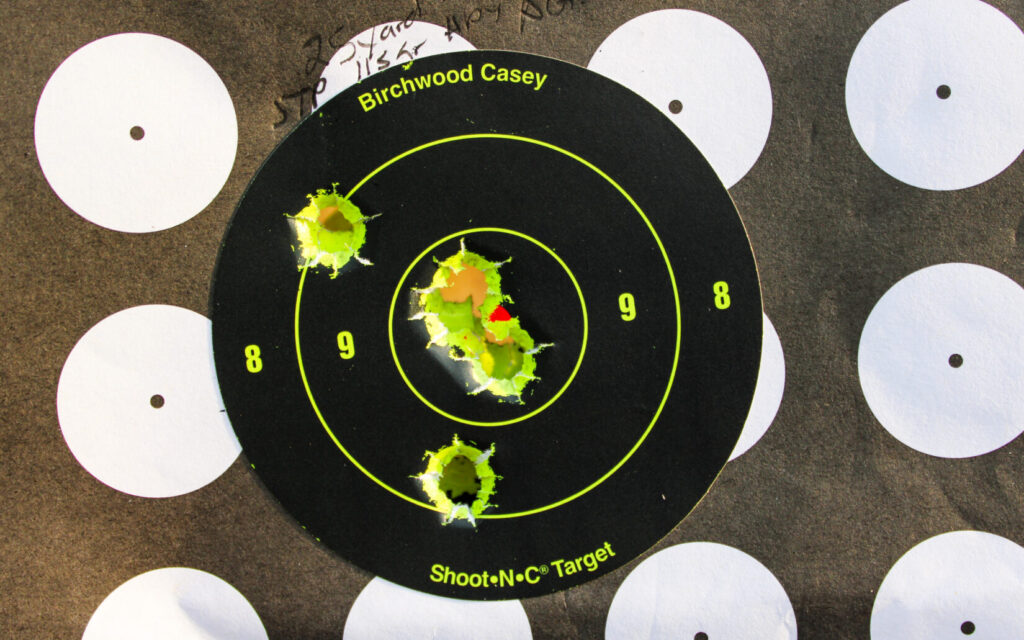
It fared just as well at 25 yards, with a group slightly over 1.5”. I was told that STPs are known for incredible accuracy. This one did not disappoint. I’m sure that, with testing different ammo, the groups would improve even more.
1-and-1 Drills
I start this drill the same way as the Bill Drill, from low ready. 1 shot fired, slide lock, reload, 1 shot. My goal is to hit a 3.25-second par time.
I have small hands, which can make shooting 2011-style pistols interesting. For this, I’d roll my strong hand to engage the magazine release, then use my support hand to hit the side release before moving back into position.
I’d definitely be more proficient with an extended magazine paddle. The weight helps manage recoil, but it did make me a little slower than I’d like. The slide release is standard size, which I find too small when trying to be fast.
My average time was right at 3.5 seconds, with a first shot of 0.41 seconds and reloads of 3.0 seconds. Of note, I had an extreme spread of 1.08 seconds. There’s potential, but maybe not the right one for me.
The Humbler
This is a good finisher I picked up from James Williamson of HK—no, it’s not the 700-round Humbler. This Humbler has a 10-second par time. Either start from the pistol holster or from a bench. Ten shots into the A-Zone, then reload and take two shots into the head A-Zone.
Since the S.W.A.T. hadn’t seated in my holster yet, I started from a bench. My time was 10.00 seconds, with two line breaks. The draw was 3.09 seconds, and the splits were 0.54 seconds. With the line breaks, you be the judge whether that’s a pass.
Sizing Up the STP S.W.A.T.
Where the S.W.A.T. Delivers
The first things you notice are the build quality and tolerances. This feels like a well-put-together firearm. With the S.W.A.T., STP went out of their way to build a more American-style pistol. That’s why it has the full rail, ambi safety, optic cut, etc.
The trigger is exceptional. Minimal travel, a distinct wall, a very crisp break, and a discernible reset—all hallmarks of a good trigger. I do like the simple styling; I’m not one for gaudy looks.
The mag release is threaded—which I like—so you can easily add an extended paddle. The magwell is another great feature and is about the perfect size for duty or competition.
Overall, this is an easy gun to shoot well.
Mixed Results Here
The grip texture is very similar to the MPA DS9-TC Hybrid. The S.W.A.T. has hexagons cut into the grip. I just don’t think I’m a fan of this style.
For one, the grip module needs to be thicker to accommodate the cutouts. The result is a thicker, heavier grip module. The texture also felt a little slick to me, even on a hot, humid day, and wasn’t as grippy as I’d prefer.
I mentioned this earlier, but I wish there was a DPP footprint plate option. I think that’s a miss.
Where It Falls Short
Availability. This is a German manufacturer that largely caters to the European market. STP’s US dealer list is growing, but for now you’re still unlikely to find one at your local gun counter. As that list grows, I think more shooters will give the S.W.A.T. a look.
It also ships with one magazine. In 2026, two should be the minimum, and three should be standard.
Zooming Out
I like the STP S.W.A.T. and what it offers. It has a strong feature set, is accurate, and performed well in tests. It’s a very shootable gun, which is about the highest compliment I can give a firearm.
Next up, we return to the United States and meet one of the most overtly American companies: Alchemy Custom Weaponry. I can’t wait to dive into it.