Old, classic guns are better than new-age guns. Change my mind.
Okay, maybe not all classics fit that mold, but the Springfield Armory M1A sure does. It’s a gun that still turns heads at the range and instills a sense of awe with each trigger pull. The M1A is a timeless wonder, owned by many, cherished by all.
But why? I mean, sure, the walnut stock is beautiful. The Garand-style action is the epitome of American wartime ingenuity. And the potent .308 Winchester chambering is more than capable of taking everything from steel targets to deer to big-game targets and bad guys.
So what is it about the M1A that makes it an All-American favorite? Let’s dive in.
Rocky beginnings
Working guns usually have one of two fates.
They either evolve into something completely different, or they slowly fade into obscurity while a bunch of old-timers sit around insisting they were better “back in the day.”
The Springfield M1A somehow avoided both.
Sure, its roots stretch back to the (mostly) infamous M14, itself an evolution of the legendary M1 Garand. That’s not exactly a small claim to fame. Being related to two of America’s most iconic military rifles is kind of like finding out your grandfather was John Wayne and your dad was Chuck Norris.
Big shoes to fill, but no pressure. Right?
The military’s relationship with the M14 was admittedly a little complicated. It arrived with tremendous expectations, served as America’s primary battle rifle for a relatively short period, and was then overshadowed by the M16 amid the changing realities of modern warfare during Vietnam.
Most rifles would’ve quietly accepted retirement.
The M14 apparently took that personally.

For decades, it kept showing back up. Designated marksmen carried them. Specialized military units carried them (even still). Every time the platform seemed destined for museum status, somebody dusted one off and put it back to work when they needed to reach farther and hit harder, all while taking 40 different kinds of abuse and still running strong.
The M14 was a legend, both on the battlefield and off. Some loved it, some hated it, but everyone knew it. And to civilians, it became much more than a passing interest.
So, it should be no surprise that Springfield Armory eventually introduced the semi-automatic M1A, specifically for the civvie market.
The rest, as they say, is history. And yet, that’s not really why we’re here.
Because if history alone made rifles relevant, we’d all be standing around arguing over Trapdoors and rolling blocks.
The M1A remains relevant because it still continues to solve the world’s problems, from slapping terrorists around a bit to protecting the American rancher’s cattle from farm predators and everything in between.
The Rifle That Refuses to Quit
One of the reasons the M1A has remained so popular is that nobody seems entirely sure what category it belongs in.
Is it a hunting rifle? Absolutely. Is it a battle rifle? Uh, without question. Is it a ranch rifle? I mean, didn’t we already cover this?
You get my point, yeah?
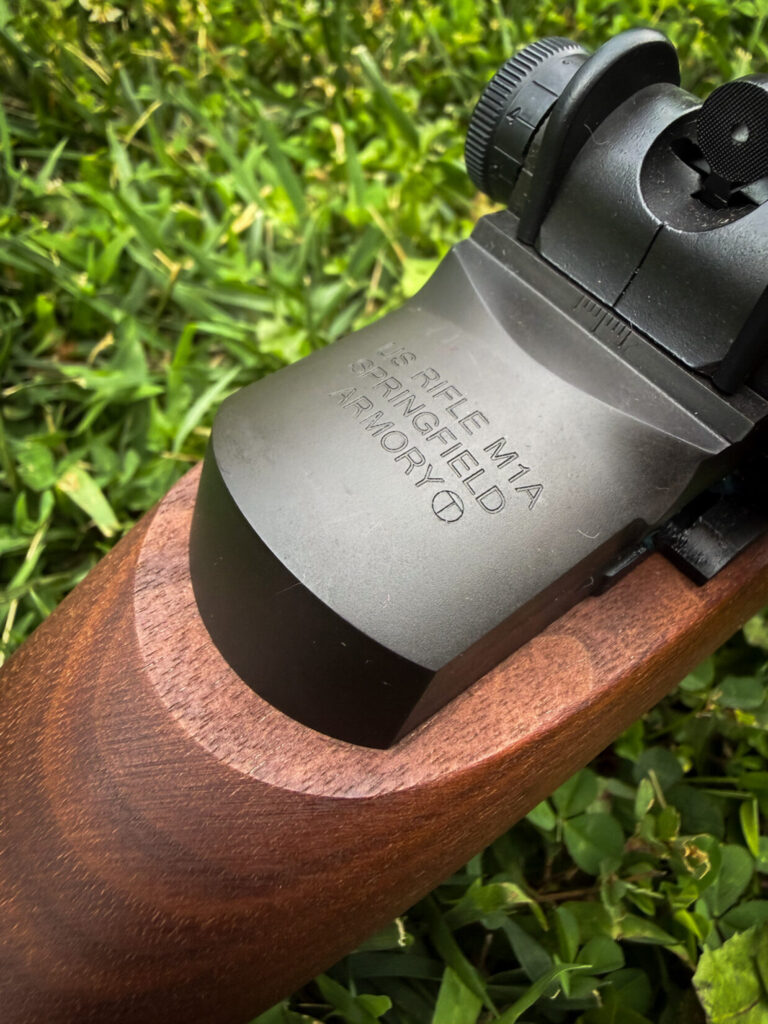
The M1A has spent decades stubbornly refusing to fit neatly into a single box. Most rifles have a primary purpose. The M1A seems perfectly content wearing several hats at once.
A lot of that comes down to its .308 Winchester/7.62x51mm NATO chambering.
.308 Winchester
Much like firearm trends, cartridges rise to prominence and disappear faster than social media influencers. Every few years, somebody claims they’ve finally invented the round that will dethrone everything that came before it (looking at you, 6.5mm).
Then there’s the .308 Winchester, which is like Walt Kowalski (Clint Eastwood) in Gran Torino. It just kinda hangs out and keeps doing .308 Winchester things, quietly minding its own business until some young kid on the block needs to be kicked down a few notches.
Apparently, the only metaphors I know are somehow related to action and/or comedy flicks. But I think you know what I mean.
The beauty of the .308 lies in its versatility. It hits hard enough while remaining manageable enough for most shooters to actually enjoy using. That’s a balance many cartridges strive for, and few truly achieve.
And because the cartridge is so versatile, the rifle chambered for it becomes equally versatile and utilitarian.
The M1A as a Ranch Rifle
I don’t own a ranch.
My coupla-acres lawn occasionally tries to die if I look at it wrong, so let’s not pretend I’m out there moving cattle at sunrise.
But I’ve spent enough time around rural property owners to understand what they value in a rifle. They don’t want a safe queen, nor do they want something that’s only useful under very specific circumstances.
They want a rifle that can handle whatever weird backcountry problem decides to show up that day.
The M1A seems to fit that mold without much fuss.

Maybe you’re carrying the rifle because coyotes have been getting a little too comfortable, or for you Texas, Oklahoma, or Arkansas folks, a sounder of feral hogs has decided your property looks inviting.
The M1A wants blood, and if you feed it and maintain it, it’s a do-all gun that’ll outlast every one of us here.
At somewhere around 9lbs empty, it’s not the lightest option available. I’ll give you that, sure.
But most ranch rifles spend more time riding in trucks, UTVs, tractors, and scabbards than they do hanging from slings during twenty-mile patrols.
Weight matters. I’m not discounting that. It just matters a lot less than Reddit trolls sometimes pretend it does.
Traditional Meets Practical
One of the things I appreciate most about the M1A is that it doesn’t feel like a hunting rifle that was adapted from a tactical rifle.
Nor does it feel like a tactical rifle pretending to be a hunting rifle.
It simply feels like a rifle.
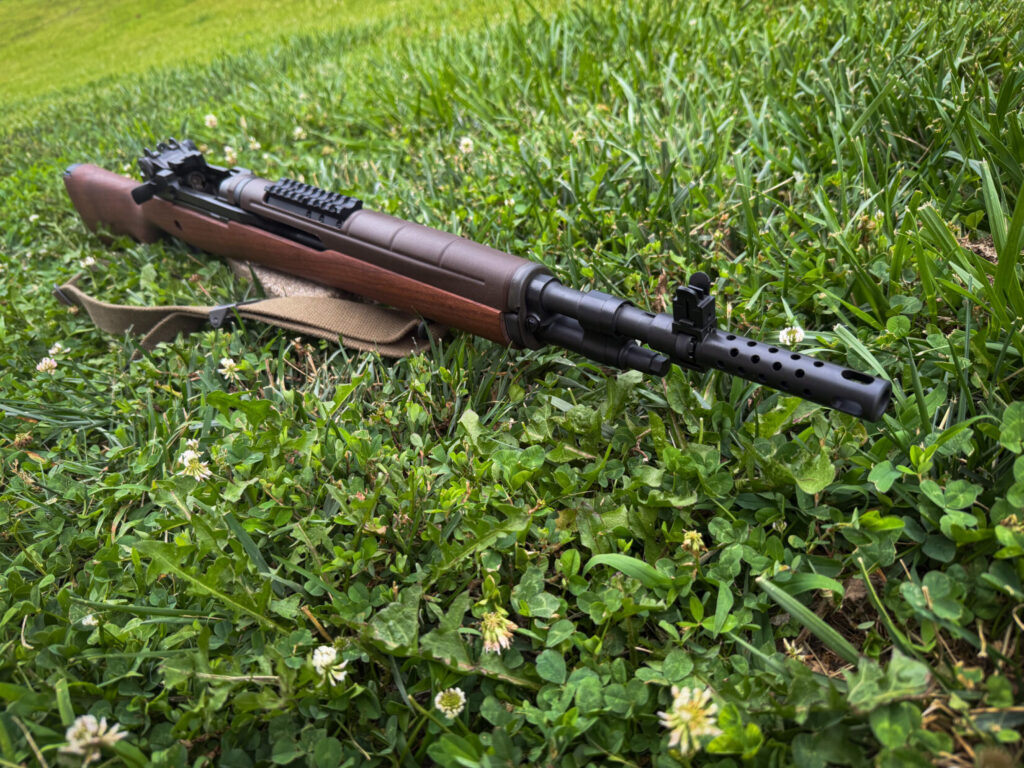
The traditional walnut stock (or synthetic, if that’s your thing) design points naturally. The controls are straightforward. The sights are excellent. And the Garand-style action allows for fast and accurate follow-up shots.
It’s sexy and practical. At the end of the day, it’s just a good rifle doing rifle things. And honestly, there’s something refreshing about that.
The Battle Rifle Legacy
Eventually, every M1A conversation circles back to the same topic: Battle rifles.
And for good reason, I suppose. The M1A is one of the last widely available examples of what many people consider a true battle rifle.
But what exactly is a battle rifle?
The term gets thrown around a lot, and in my opinion, the concept is a bit watered down these days.
But, generally speaking, a battle rifle is a full-powered, semi-automatic rifle chambered in a cartridge capable of reaching well beyond the effective range of intermediate rounds.
In plain English, it’s a rifle capable of acting as a service weapon in the event of all-out war and national defense. The M1A, being that it is a derivative of an actual service weapon, checks those boxes without breaking a sweat.
While modern rifle design has largely shifted toward lighter platforms and intermediate cartridges, there’s still something appealing about a rifle that was designed around authority rather than efficiency.
The M1A doesn’t ask permission, firing a proven .30-caliber projectile with considerable enthusiasm and attitude, similar to that of the late R. Lee Ermey.
Why It Still Matters
Modern AR-platform rifles are phenomenal. It would be a ridiculous waste of time to convince you otherwise.
But don’t think for a second that the platform diminishes what the M1A brings to the table.
It offers a completely different shooting experience. The action feels different. The balance feels different. The recoil impulse feels different.
The entire rifle looks and feels mechanical in a way that’s increasingly rare. It’s not better, nor is it worse. It’s just…different. But its value depends entirely on where you live.
For someone in a suburban neighborhood, there are probably better options. There are definitely shorter and lighter options, without a doubt.
But for rural property owners, homesteaders, ranchers, and folks responsible for protecting larger areas, the firepower and lineage of the M1A are a lot easier to appreciate.
Context matters, I suppose. That is to say that while the M1A isn’t the answer to every application, it’s a pretty compelling contender for a lot of ’em.
The Closest Thing to a One-Rifle Collection
Every gun owner has played this game.
If you could only have one rifle, what would it be?
It’s a terrible game. I hate it. And yet I’ve probably participated in it a hundred times.
The answer changes depending on the day, the weather, and whether I’ve recently purchased something new and exciting. Still, the M1A consistently makes the shortlist. Why? Because it does almost everything well. Plain and simple.
No Delusion
That said, I’m not living under some delusion that it’s a “perfect” rifle. Far from it.
It’s heavier than many modern alternatives. Parts can be expensive, optics mounting requires varying levels of patience and creativity, and keeping it fed with a steady diet of quality .308 loads isn’t getting any cheaper.
But if the goal is owning one rifle capable of handling an impressive range of tasks, the M1A deserves serious consideration.
Why People Keep Coming Back
The funny thing about the M1A is that most people don’t buy one because it makes the most logical sense. If pure efficiency were the only consideration, we’d all drive beige sedans, eat nutritional paste, and stay in line.
Life doesn’t work that way, nor should it.
People gravitate toward things they enjoy. And the M1A is incredibly enjoyable.
There’s a certain satisfaction that comes from running the action, and there’s a certain charm to wood and steel in a world increasingly dominated by polymer and aluminum.
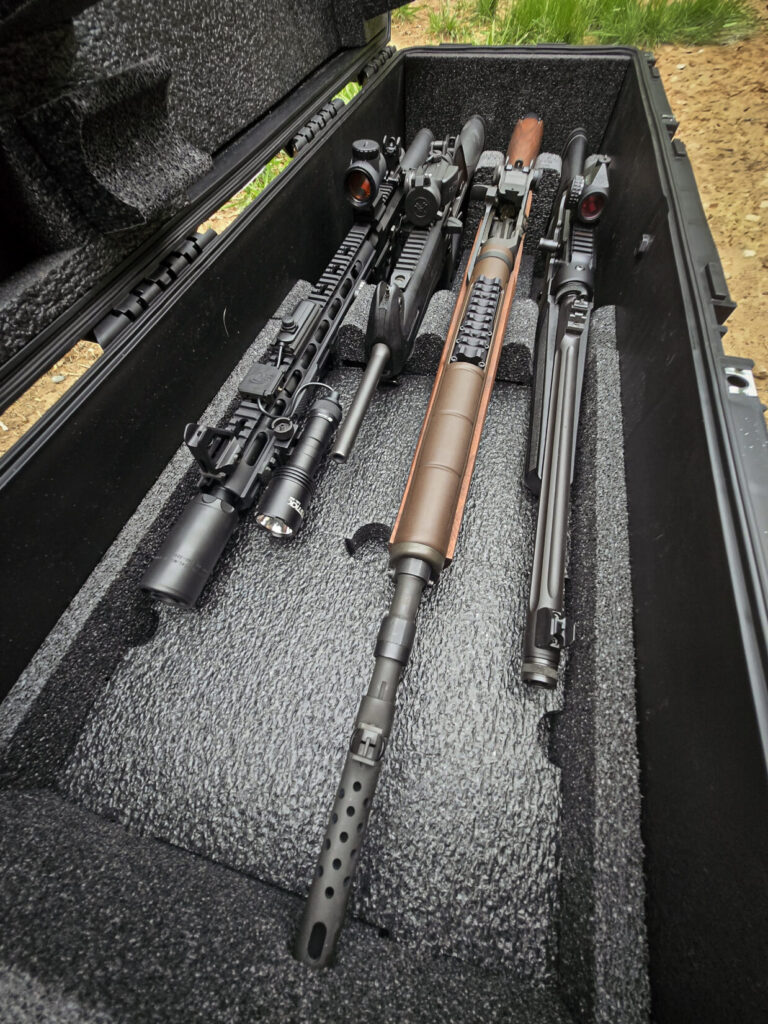
The M1A has character. Not every rifle does.
That’s probably the simplest way to put it.
Final Thoughts
Given all the options of the modern firearms market, the Springfield M1A should’ve faded off into the distance a long time ago.
At least on paper. Let’s face it, it’s an old design.
It’s heavier than many modern rifles. It’s less modular than the latest tactical wonder gun that’s currently dominating guntuber channels and wannabe influencer feeds.
And yet, here we are. Decades later, people are still buying them up in droves, despite their ever-increasing price tag.
The M1A has endured the test of time because it’s capable. It’s a master of versatility. Perhaps that’s all we really need to say.