Have you ever been in a perilous situation before? You know, the kind of situation that makes your life flash before your eyes? Just about everyone has at some point.
My grandma used to use the phrase “made my heart stop” when she was describing something like this.
Well, if you have ever been scared, alarmed, spooked, or anything else to this degree, you know the feeling. Your breath suddenly becomes uncontrollable, your fingers feel numb, and your face goes pale. And your brain… well, your brain just kind of goes bonkers.
This is why people often have trouble making decisions or reacting when something like this happens. We have all heard the saying “froze like a deer in the headlights.”

Visualization Is Muscle Memory for Your Brain
There are several things that can help us when it comes to reacting during a situation like this. Of course, training is among the most important because it creates muscle memory.
But another thing that helps is visualization. This is often overlooked, and, for many, unheard of. Put simply, visualization is deciding what you’ll do before you need to do it.
In a way, visualization is like muscle memory for your brain. When we perform constant repetitions, our body repeats those repetitions without our brain needing to make a specific command to do so. We often call these “habits” as well.
When you visualize something specific, it acts as pre-loaded software in your brain. When an event happens similar to what you have visualized, your brain follows that visualization somewhat like a map.
Why Mental Rehearsal Works
Let’s use drawing and firing a handgun as an example. Vividly imagine drawing your firearm from its holster and finding your sight picture. When you do this, your brain activates many of the same areas as it does when you are physically on the range.
By repeatedly firing these neurons in a specific sequence, you are strengthening the synaptic connections associated with that action. That ability to change and strengthen connections is called neuroplasticity.
This process creates a cognitive map that your subconscious can access during a crisis. Instead of the brain scrambling to find a brand-new solution while under fire, it simply “downloads” the pre-existing blueprint — the one you have already practiced a thousand times in your mind. This reduces the cognitive load during an incident, allowing you to remain oriented.
During a training class for high-risk warrant operations, the instructor talked a great deal about this. He found that when an officer visualized what they would do in a specific incident, they performed better than if they did not use visualization.
Why Do Athletes Visualize?
If you look at the world’s most elite performers, from Olympic downhill skiers to Formula 1 drivers, you will often see them sitting with their eyes closed, twitching their hands and shifting their weight. They are performing a “mental lap.”
During the 2026 Winter Olympics, I noticed multiple athletes doing this. Some are more subtle than others, but it’s there. They use visualization to “slow down” time, ensuring that when the light turns green or the starting pistol fires, they are simply following a script they have already perfected.

In a defensive context, we are the athletes of the “worst-case scenario.”
Visualization and the OODA Loop
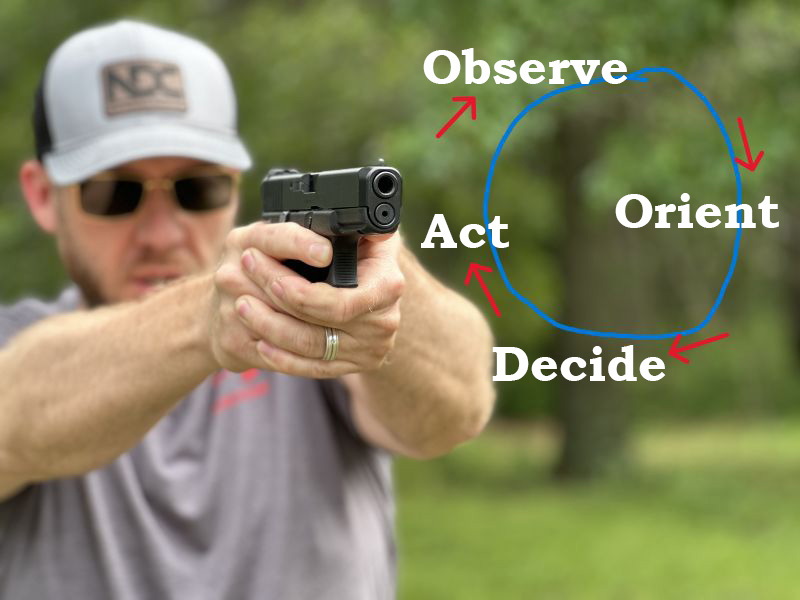
You’ve probably heard of the OODA Loop (Observe, Orient, Decide, Act). Visualization does its work in the middle two steps.
When you have visualized a specific threat, such as an ambush at a gas pump, you have already completed the “Orient” and “Decide” phases of the loop long before the event occurs. When the actual threat happens, your brain recognizes the pattern immediately. You aren’t “deciding” what to do; you are simply “acting” on a decision you have already made.
This leads to faster reaction times because you have eliminated the “freeze” response often caused by cognitive overload.
Fear is also less likely to take over. You have already thought about this type of incident, so your brain doesn’t react the same way.
You move with more determination and clarity because there is no doubt in your mind about the required course of action. This decisiveness is often the deciding factor on the outcome of an incident.
Visualizing Is Not the Same as Meditating
When someone says the word “visualize,” you probably see Yoda or Bruce Lee sitting with their eyes closed in deep thought. And I’m not saying there is anything wrong with picking a quiet time to concentrate on visualization, but it doesn’t always have to be that intense or time consuming. In fact, you may have already done this before and not realized it.
When I go to a restaurant, or any place with a lot of people in one room, the first thing I do is look for doors. As I sit down, I start to think about what I would do if someone started shooting.
I even think about where a shooter would likely enter or retreat. This is a habit I’ve developed from my time in law enforcement, but it works for anyone the same.
When you imagine an incident taking place and how you would react if it does, you are three steps ahead. As I go about my day, I run quick little scenarios in my mind.

Most of the time, this is only a few seconds of thought, but that’s often all it takes. If you want to dedicate time just to visualize something more specific, your reactions and response will be even better.
Make Up Your Mind Before You Need To
In its simplest form, visualization is making up your mind on what to do, before you need to do it, before something has even taken place. Creating this habit can improve your training, making you better at a sport or any other activity, and it can save your life.