

The SIG MCX lineup was SIG’s answer to the question: What’s the next great rifle? It’s certainly seen success with numerous adoptions by military and police forces worldwide, including the MCX Spear by the United States military. Today I have a newer incarnation of the MCX, the SIG MCX Spear LT.
The MCX has a wide range of models. Much like the AR series, the MCX is inherently modular.
The Spear LT is the light version, representing the 5.56, .300 Blackout, and 7.62x39mm models. It’s the intermediate-caliber carbine in the MCX family.
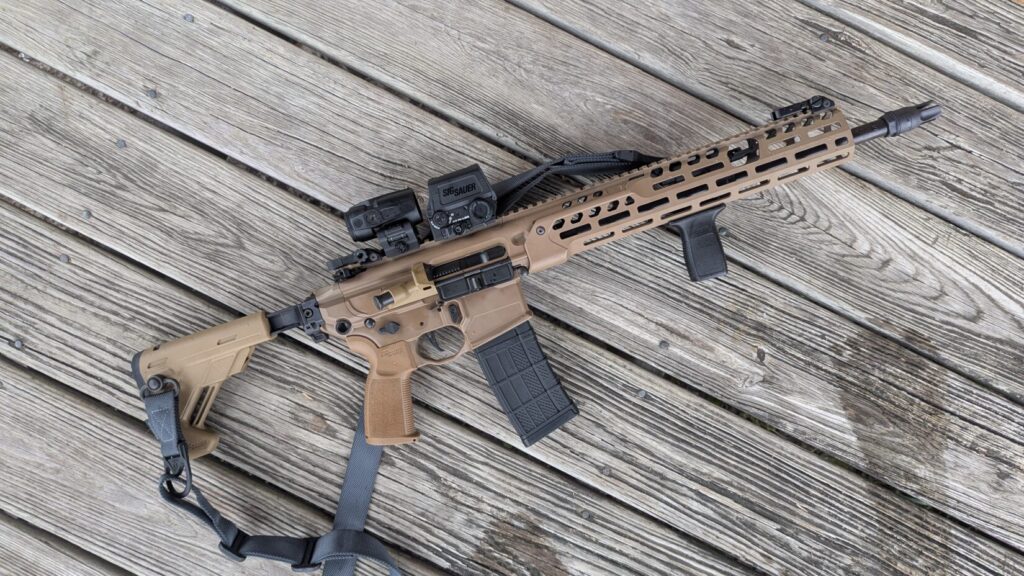
The MCX in my possession is the standard rifle variant with a 16-inch barrel in 5.56. I’ve been greasing the wheel a fair bit with the MCX, including a CQB class with Rick Hogg of War Hogg Tactical, which ate 500 rounds of Ammunition Depot’s own remanufactured 5.56, on top of my typical testing, which ate another 250 rounds of various ammo types.
Inside the MCX: The Short-Stroke Gas Piston
The MCX differs from the AR-15 in a few ways, but most notably through its short-stroke gas piston system. The benefits of the short-stroke gas piston are often debatable when compared to a modern tunable AR-15.
It’s true you can get most of the performance of a short-stroke piston from a high-quality, modern AR-15.
The real advantage of getting the MCX and similar systems is the simplicity. I don’t have to tune the gas system with the buffer for a specific type of load. I can just load up whatever I want, shoot, and get the benefits of a tuned AR.
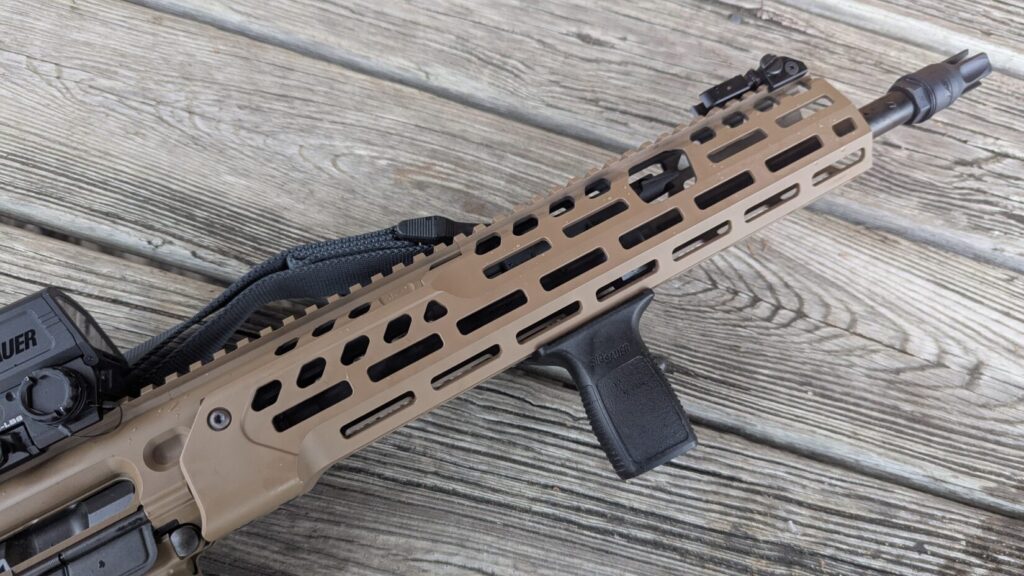
Those benefits include better short-barrel performance. Sure, the MK 18 proved the ultra-short AR can work, but I can get the same performance without dumping a ton of gas into the system.
This means lighter recoil when we get to shorter barrels. When used with a suppressor, especially on a short barrel, it’s less likely to have gas blowback into the face with a non-flow-through suppressor.
Short-stroke gas piston systems run cleaner and cooler. If this were a select-fire rifle and we were magazine dumping, the MCX would run well and likely have a higher round count before cook-offs began.
Beyond the Short-Stroke Gas Piston
The MCX isn’t a one-trick pony; it builds on the best features of the AR and pushes them further. The ergonomics of the AR are undeniable, and with the MCX, those controls are now completely ambidextrous, giving options on both sides for a magazine release, bolt lock/release, and safety.
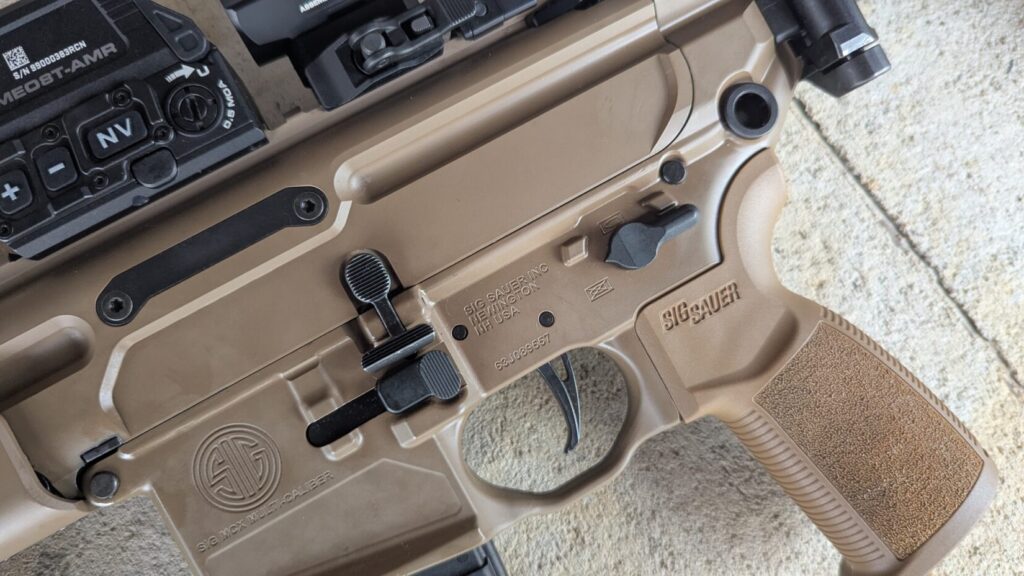
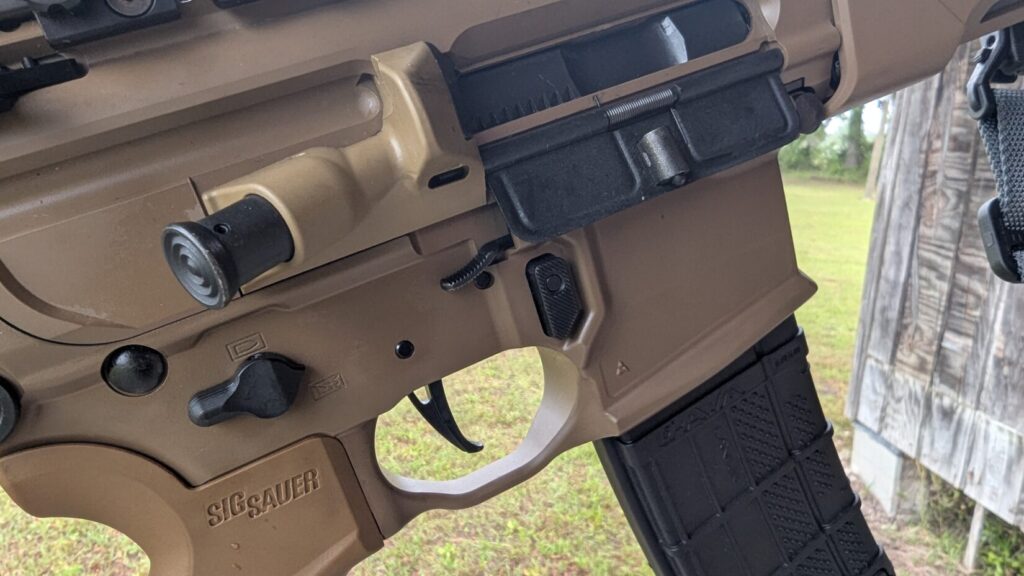
The charging handle is all AR, and quite large and easy to use. One of the big advantages of the short-stroke gas piston and the MCX is the removal of the receiver extension. That makes room for a folding stock, which also allows you to adjust your length of pull.
The MCX takes modularity to a different level. You can swap barrels quickly and easily, allowing you to customize the rifle to different barrel lengths and calibers.
The MCX also comes with a free-floating M-LOK rail, a SIG suppressor-ready QD muzzle device, and a pile of integrated QD sling points. From top to bottom, the MCX Spear LT is an extremely modern rifle.
| Specification | SIG MCX Spear LT (16" Rifle) |
|---|---|
| Caliber | 5.56 NATO |
| Operating System | Short-stroke gas piston, adjustable gas |
| Barrel Length | 16 inches |
| Twist Rate | 1:7 |
| Barrel Thread | 1/2-28, tapered shoulder |
| Muzzle Device | SIG QD suppressor-ready flash hider |
| Handguard | M-LOK |
| Stock | Folding, telescoping |
| Folded Length | 26.5 inches |
| Controls | Fully ambidextrous |
Shooting the MCX
The optic on top is the SIG Romeo8T-AMR with a 3X magnifier. I zeroed at 50 yards with 55-grain.
Since the 55-grain stuff tends to be the cheapest, it allows me to get the literal best bang for my buck. With the optic zeroed at a typical 50/200-yard zero, I hit the ground running.

First things first: how is the accuracy? With the 55-grain remanufactured ammo, I achieved 2.7- to 3-inch five-shot groups at 100 yards — not bad for the cheap stuff.
With some of SIG’s own match-grade ammo, I shrank that group to about 1.6 inches. The trigger is a bit heavy, at around eight pounds, making it more of a duty trigger than a match trigger, though it remains smooth.
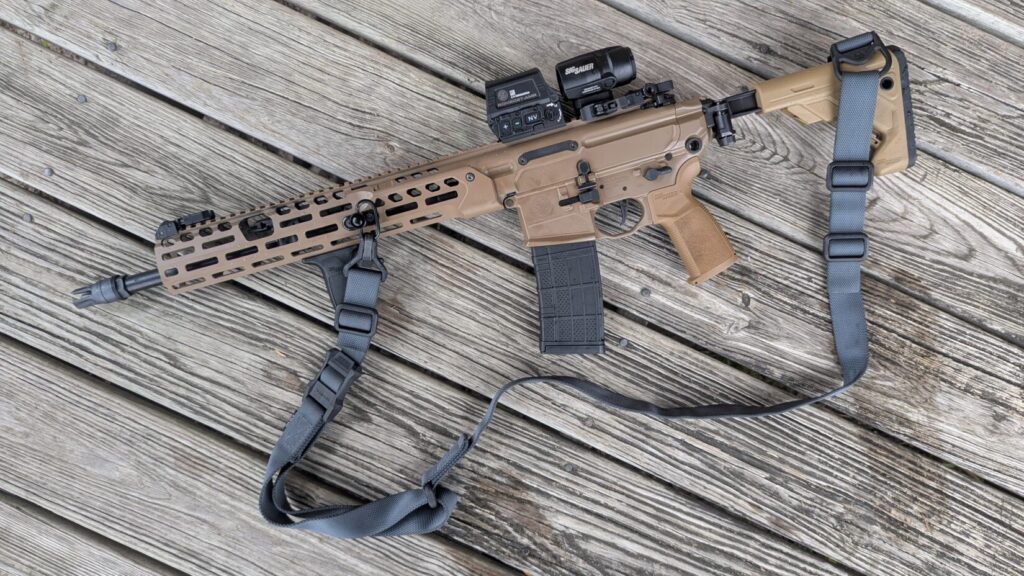
Out to 200 yards, with a supported position, I was able to consistently hit 10-inch gongs. Moving to the IPSC target, I could get most of my shots into the steel from an offhand standing position.
In a rested position, it was too easy to make those shots. That ended the slow fire; beyond that, it was all speed.
Going Fast
Rick Hogg’s CQB class was a great way to send a lot of lead downrange. Over two days, I shot 500 rounds in a ton of different drills focused on speed and accuracy.
In those two days, I learned that the MCX is quite reliable. I had a single malfunction that required me to mortar the gun, but it appeared to be a rim issue on the round itself.

I was able to drive the rifle fast and shoot straight and quickly. As long as I remembered my height over bore, I put my shots right where I wanted them.
The MCX has low recoil and is easy to control. Muzzle rise was low, and the gun was exceptionally controllable throughout longer strings of fire.
The dot barely moved between shots, making it easy to land repeated, accurate hits. You can feel the movement of the short-stroke gas piston; it chunks back and forth, but it didn’t seem to detract from my shooting.
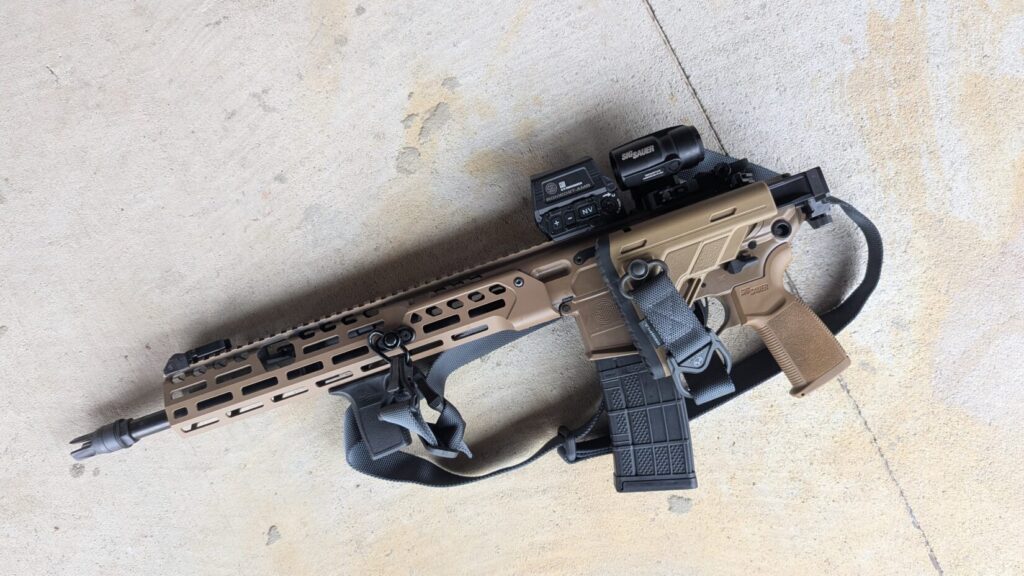
The MCX’s ergonomics were a standout, though there was a small learning curve to use the receiver-positioned bolt release.
The Downsides
That’s the good, but it isn’t all gravy. The gun is front-heavy, and when paired with the minimalist stock, it feels unbalanced.
After an eight-hour day of shooting, that minimalist stock leaves you feeling exhausted and a bit beat up. I never thought a 5.56 rifle would leave my shoulder feeling sore.
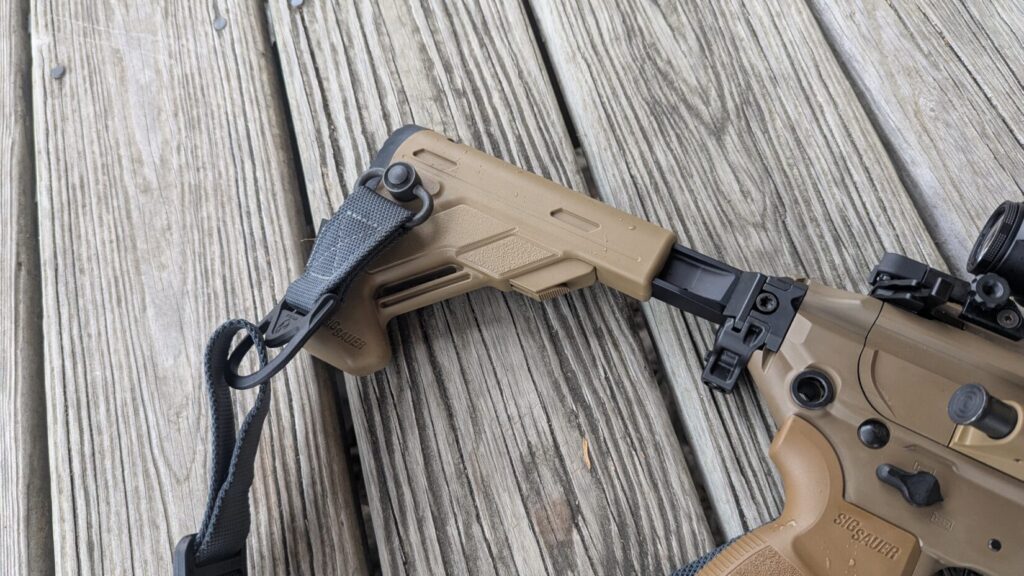
The MCX — Best and Brightest
The MCX Spear LT is a fantastic rifle overall. It’s ergonomic, accurate, and mostly easy to shoot. There is no free lunch, but I’m impressed by the MCX. If I were going to purchase an MCX in 2026, I would go with a braced pistol or SBR variant, where they’re legal.
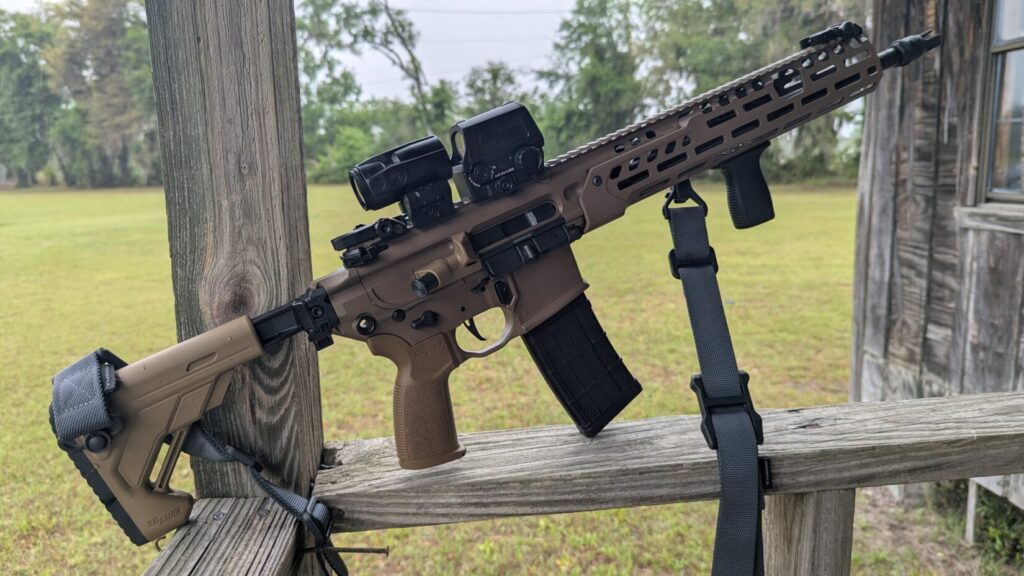
The full-sized 16-inch model doesn’t take full advantage of the short-stroke gas piston system. Shorter guns are going to be less front-heavy with the shorter barrels and handguards. The minimalist folding stock also makes a little more sense on an SBR or a braced pistol.
The MCX shoots fast, shoots straight, and offers a lot of premium features at a premium price point. It’s easy to see why it’s become a favorite of special operations.