

The 22 Winchester Magnum Rimfire, otherwise known as the .22 Magnum, was developed as a varmint rifle cartridge. In spite of its small size, it has since developed a reputation for performance out of lightweight handguns designed for personal protection. After over a decade of carry with the .22 Mag, I write to agree and disagree. Here is why the .22 Magnum could be the ticket and why you might look at other options.
What Is The .22 Magnum Meant For?
The .22 Long Rifle cartridge is perhaps the most popular of them all, but popularity does not mean perfection. For years, ammo makers have been trying to make .22 rimfire better. .22 rounds are not particularly powerful, and they use a heeled bullet that picks up debris and damage.
The .22 Winchester Rimfire of 1890 improved on power and used a modern jacketed bullet. But in the 1930s, high-velocity .22 LR ammunition effectively made that round obsolete. Winchester tried again in 1959 with the .22 Winchester Magnum Rimfire, otherwise known as the .22 Magnum.
The .22 Magnum, like the others that came before, was marketed as a varmint rifle cartridge. It used a longer case than the .22 WRF and kept a 45 grain jacketed bullet. But with velocities of over 1,800 feet per second, the cartridge exceeded its predecessor by 400 feet per second. It was also faster than the typical high velocity .22 LR cartridge, which boasted velocities of about 1,200 feet per second. The translation was a flatter trajectory, greater range, and more power.
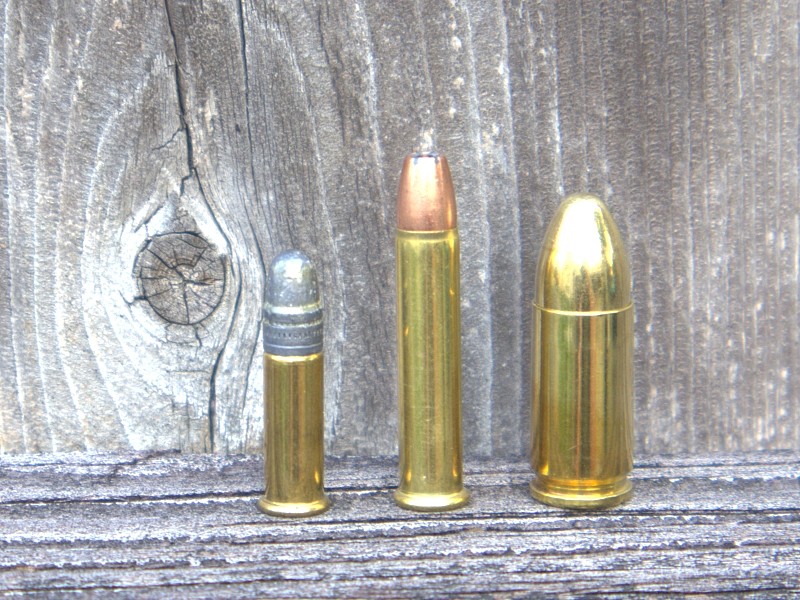
Just as quickly after its introduction, the .22 Mag was chambered in handguns. These included the S&W Model 48 and the Ruger Single Six. For the handgun hunter, the velocities were lower, but the Magnum still had a firm edge over the old .22 LR.
Snubnose revolvers like the S&W Model 51 and Charter Arms Pathfinder circa 1970 pushed the .22 WMR into the realm of concealed carry and personal defense.
22 Magnum for Personal Protection
The .22 Magnum is an excellent varmint round, but it could not put a dent into the long-term popularity of the .22 LR. The possible exception is as a dedicated carry caliber in a lightweight platform. The .22 Magnum is a popular offering in small revolvers like the S&W Airweight and Ruger LCR, as well as in hideout guns like the NAA Mini revolver and Bond Arms derringer.
The round has even made the jump to larger semi-automatic pistols like the KelTec PMR-30, S&W M&P 22 Magnum, and Walther WMP. The common denominator is a lightweight handgun that boasts the low recoil of a rimfire round with additional performance that exceeds .22 LR and is on par with some centerfire rounds.
Pros of the .22 Magnum
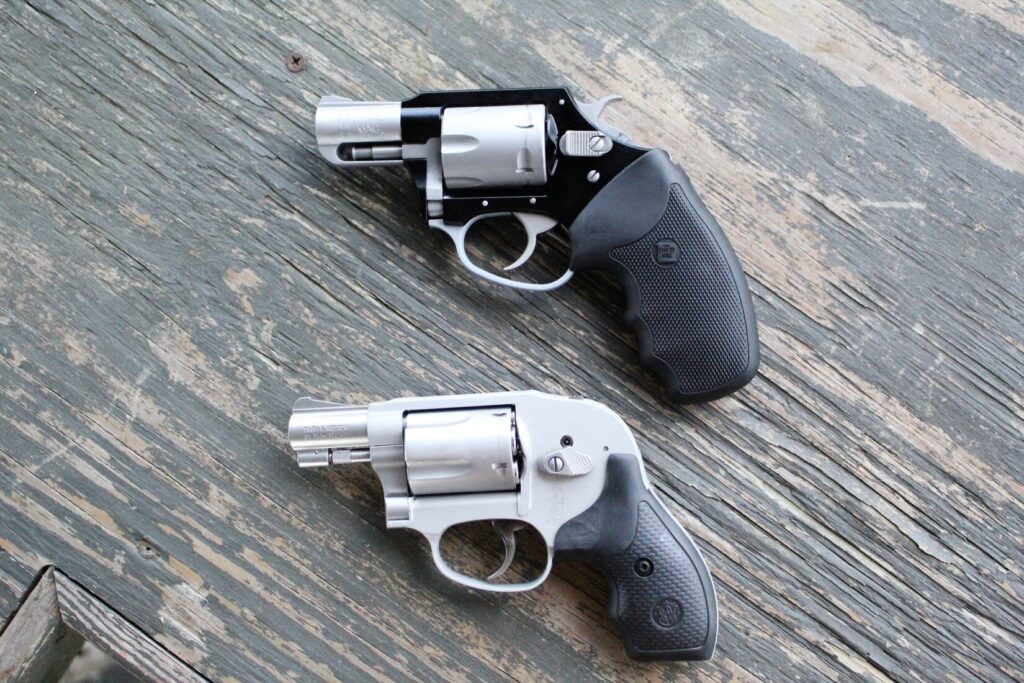
On the whole, the .22 Magnum boasts greater power than .22 LR but affords greater capacity and lower recoil over centerfire pistol rounds.
Capacity
In a revolver platform, the .22 Magnum’s smaller profile allows for a few extra rounds in the handgun over conventional centerfire rounds like 9mm or .38 Special. But the slightly higher pressure of the .22 Mag tends to decrease capacity over a comparable handgun chambered in .22 LR.
For example, the Ruger LCR in .22 Magnum holds six rounds, but the .22 LR version holds eight. The original .38 Special model holds five. Interestingly, the few semi-automatic pistols in .22 Magnum are engineered with magazines that hold 15-30 rounds, where .22 LR pistols tend to hold less.
Low Recoil
From a shooting perspective, the .22 Magnum has more in common with the .22 LR. Recoil, even in a lightweight handgun, is minimal. Centerfire pistol rounds from .32 S&W Long on up have more muzzle rise.
Penetrating Power
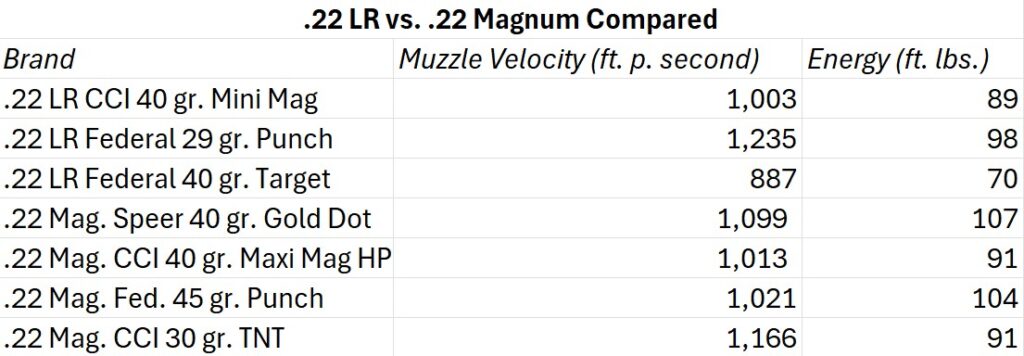
Power is a concern when dropping down to a rimfire cartridge. In rifles and in handguns with conventional barrel lengths of four inches or more, the .22 Magnum commands a premium. Even out of short-barreled handguns, the Magnum generally holds an edge. This velocity chart, taken with 2-inch barreled revolvers with readings from 10 feet away, shows this, but also reveals that numbers can effectively lie.

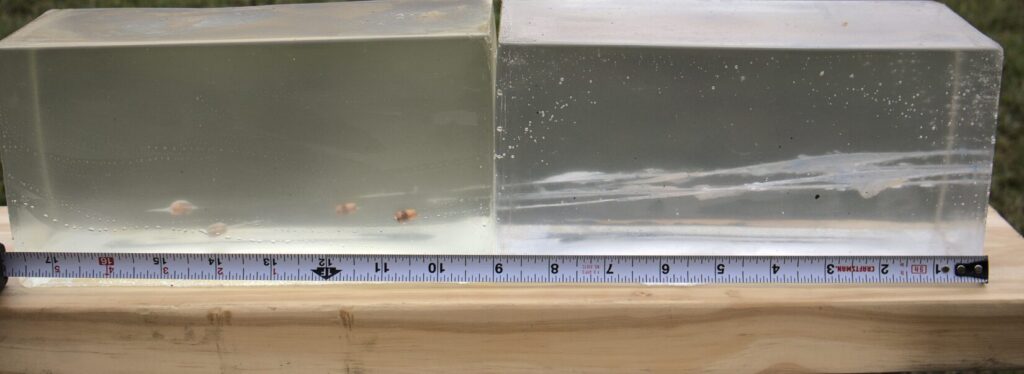
Standard rifle loads used in .22 Magnum handguns can achieve 12-15 inches of penetration in gelatin medium. This is comparable to some centerfire loads, although the bullets themselves start off small and usually fail to expand. Modern defensive .22 Magnum loads trade expansion for penetration, and still often fail in that category. Still, the velocity premium ensures a few more inches of penetration over conventional .22 LR loads.
Cons of the .22 Magnum
The problems related to the .22 Magnum are lumped into three categories: power, reliability, and cost.
Unrealized Power
Although most .22 Magnum rounds will boast slightly higher energy numbers than .22 LR, as well as more nominal penetration, there is some overlap. .22 LR loads like the Federal Punch and CCI Stinger achieve comparable levels of penetration. If you pick the worst kind of .22 Magnum and put it against the best the .22 LR has to offer, you can end up in a dead heat or an inverse.
Ammo Reliability
The higher pressure associated with the .22 Magnum can also affect reliability. 40 grain and 50 grain rifle loads work well, while 30 grain varmint loads like the Hornady V-Max and CCI TNT can overwork the thin walls of the brass cases and lead to cylinder binding.
Reliability is also affected by its rimfire ignition. .22 Magnum handguns, like their .22 LR counterparts, tend to have heavier hammer springs than their centerfire counterparts. This allows for a harder hammer smack and greater reliability when hitting the primed rim to set off the round. In a semi-auto, this is inconsequential. But in a conventional revolver, the result is a heavier trigger pull over the same model of revolver in .32 or .38.
The rimfire ignition itself is also a potential issue. Rimfire ignition is not as reliable as centerfire, and .22 LR ammo is known for duds and underpowered rounds. This is particularly true with cheap bulk pack ammunition.
On the surface, .22 Magnum ammunition appears to be better made with jacketed bullets and packaging in small containers. But the longer cases are more fragile and harder to prime. Although nominally more reliable than .22 LR, my own experience in recent years has produced more dud rounds with .22 Magnum ammo than quality .22 LR selections.
Cost
No matter which round you choose, the possibility of a dud round is always there. Given that possibility, the cost of .22 Magnum ammunition can feel unjustified. .22 LR ammunition can be forgiven at times in exchange for dirt-cheap ammo for practice. The .22 Magnum is more expensive than .22 LR, although less so than centerfire ammo. But given the benefits and drawbacks of the Magnum, the cost may not be justified.
.22 Magnum for Personal Defense: Overrated and Undervalued?
Although some dismiss rimfire cartridges outright for personal protection, the .22 Magnum has been described by some trainers and gun writers as an underrated cartridge that offers very low recoil with surprising penetrating power. While these features are true, it is less so than in decades past. By playing up its virtues, the downsides tend to go unannounced. The right .22 Magnum handgun can be the solution for the right person, but it is neither worthless nor a magic bullet.