So, derringers. A topic not really covered today. The question is, why in 2026? Do derringers, especially the two-barreled over/under style you might be familiar with, make for a practical firearm or just a fun range toy?
The answer isn’t simple and requires some nuanced thought. At first glance, it may be easy to dismiss these guns. They hold only two rounds, are awkward to maneuver, and are also awkward to carry. That might be an automatic no for many people (okay, I’m not doing a good job hyping them up). And there’s a lot of merit to that sentiment.
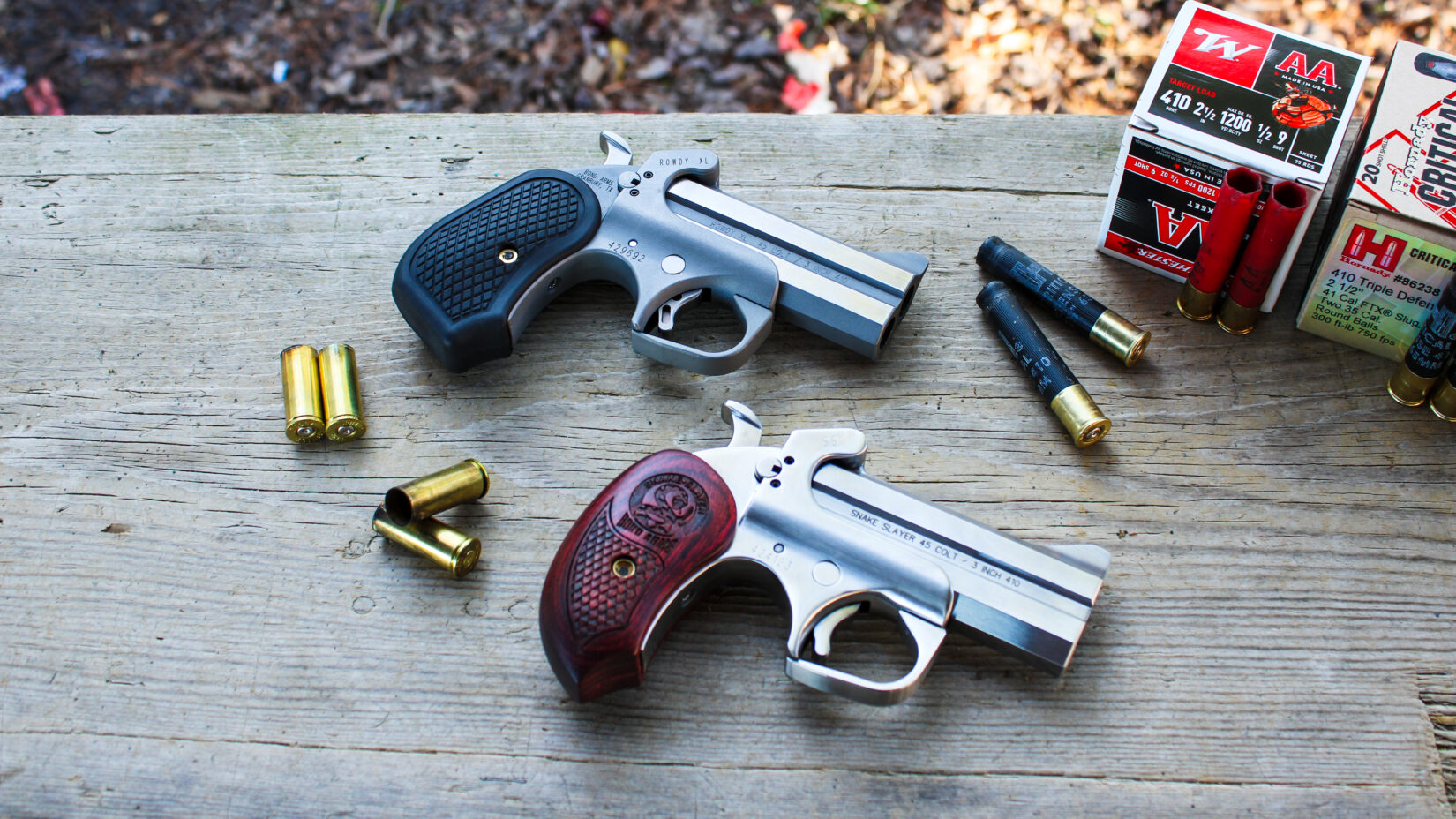
But (there’s always a but), that might be short-sighted. I argue there is a place for these as a defensive arm. So, in this article, let’s look at the Bond Arms Snake Slayer and Rowdy XL, and see where these fall in and if they may have a place in your arsenal.
**Thank you to Bond Arms for providing these for review. All thoughts and opinions are my own.**
WHO IS BOND ARMS?
Founded in 1995 in Granbury, Texas, Bond Arms has made a unique mark in the firearm industry by updating one of the oldest still-in-use handgun designs—the derringer.
The company was founded when tool-and-die maker Greg Bond aimed to improve a platform that had seen little significant change since the 1800s. His approach combined traditional styling with modern engineering, incorporating features like a trigger guard, retractable firing pins, a rebounding hammer, and a cross-bolt safety—innovations that helped bring the small pistol into the modern era.
Over time, Bond Arms became the largest manufacturer of derringer-style pistols in the firearms industry. With a modular design, the company’s handguns let users swap barrels and calibers—from .22 LR and 9mm to powerful options like .45 Colt/.410 and .45-70 Government—while interchangeable grips allow shooters to customize the pistol’s size and feel.
Today, the company’s identity remains tied to its rugged, American-made derringers—small, powerful handguns that blend Old West heritage with modern manufacturing and a distinctly Texas approach to personal defense.
Sounds like a solid origin story, right?
Bond Arms in the MOVIES?
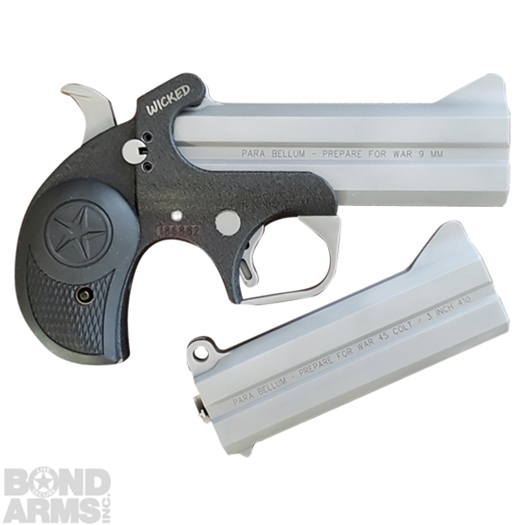
Bond Arms derringers also carry a bit of cinematic pedigree. In John Wick: Chapter 3 – Parabellum, John Wick uses a Bond Arms Texas Defender chambered in 9×19mm during the opening sequence. The doctor treating him hands over the pistol and instructs Wick to shoot him in a non-fatal way to make it appear as though they fought. Wick obliges, grazing the doctor before continuing his escape.
To commemorate the film, Bond Arms released a limited-edition Wicked 9mm, with only 1,000 produced. (Maybe I can convince them to bring it back?).
MY EXPERIENCE WITH BOND Arms
Okay, I probably have more hands-on experience with these than most people do. When I worked in retail, we sold Bond Arms derringers. The company I worked for carried a wide variety of its models, and we did well with them. This shows there is a market for them. And we didn’t just sell them in the traditional .45 Colt/.410 setup, but in a variety of calibers as well. Men and women of all ages found them appealing.
So, I dealt with them often. I can also say, from memory, that I cannot recall anyone returning one due to poor quality (only when their spouse didn’t approve the purchase). Based on that experience and conversations with the people at Bond Arms during that time, they stand behind their product.
But why the popularity? The allure, I argue, is twofold: simplicity and American-Made. Derringers are, by nature, simple firearms. Perhaps simpler than that of a revolver. And they are made in the heart of Texas. Bond Arms is very proud of its roots and leans into them with many of its marketing campaigns. People like that. It’s appealing.
SPECS
Now that we’ve covered the background on Bond Arms and my experience with the company, let’s talk about the models at hand. First, here are the specs and features.
- Model(s): Snake Slayer (BASS), Rowdy XL
- Action: Single Action, Rebounding Hammer, Single Action, Rebounding Hammer
- Safety: Cross Bolt Safety, Cross Bolt Safety
- Grip: Rosewood, B6 Resin
- Frame: Stainless Steel, Stainless Steel (rough finish)
- Caliber: 45 Colt/410 (3”), 45 Colt/410 (3”)
- Capacity: 2, 2
- Sights: Iron Sights, Iron Sights
- Trigger Pull Weight: 7 lbs., 7 lbs.
- Barrel Length: 3.5”, 3.5”
- Overall Length: 5.5”, 6”
- Height: 4.31”, 4.37”
- Weight: 22 oz., 22 oz.
- Price: $603, $349
FEATURES
The Snake Slayer and Rowdy XL are compact pistols that combine old-school simplicity with modern engineering.
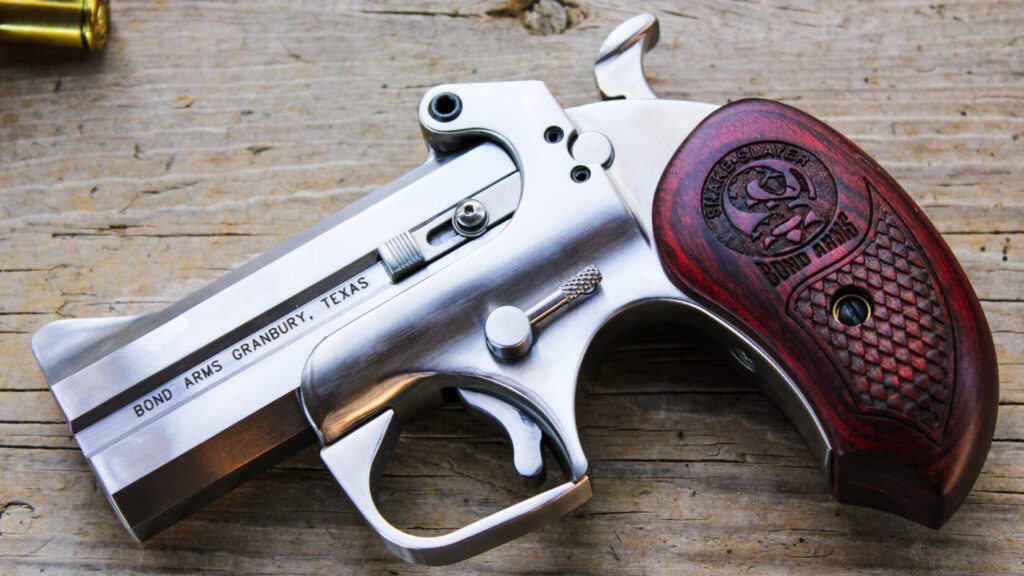
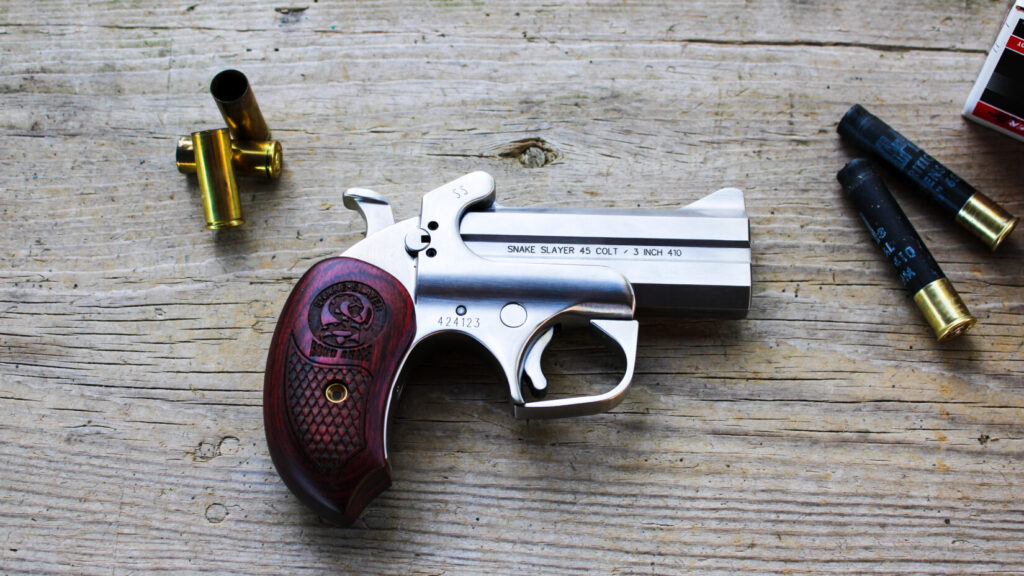
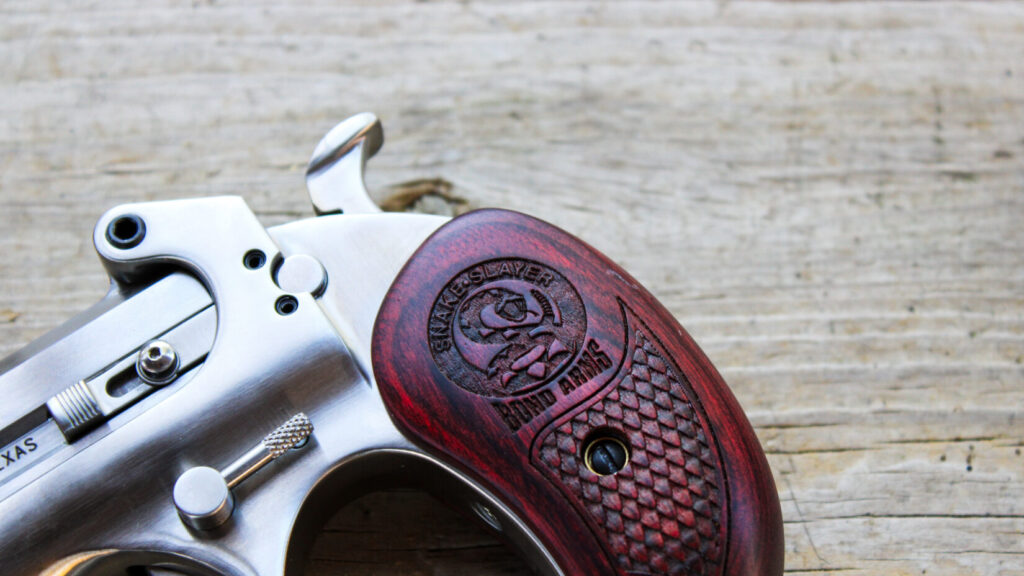
Built on the company’s stainless steel “Hand Cannon” frame, the Snake Slayer is one of Bond Arms’ most popular models, designed as a trail-ready defensive handgun for hikers, campers, and anglers. The two-shot, single-action pistol features a 3.5-inch barrel, extended rosewood grips, and the ability to chamber either .357 Mag/38 Spl or .45 LC/.410 by swapping barrels.
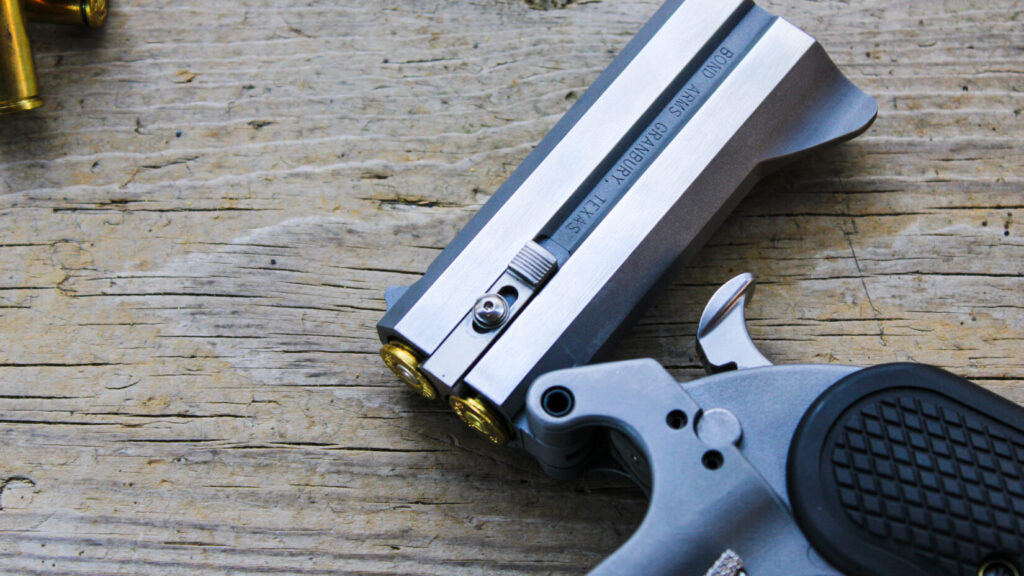
Despite its compact (ish) size—just 5.5 inches long and 22 ounces—the Snake Slayer offers a full range of safety and reliability features. These include an automatic spent casing extractor, a patented rebounding hammer, retracting firing pins, a cross-bolt safety, and a spring-loaded, cammed locking lever. Fixed sights with a front blade and a rear notch complete the package.
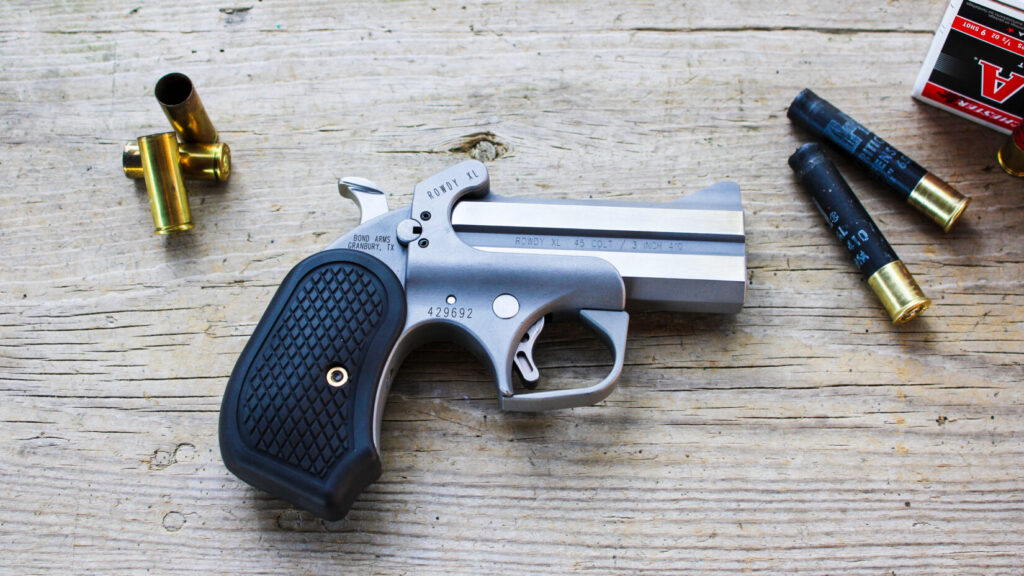
The Rowdy XL adopts a slightly different approach, building upon the company’s Rough Series Rowdy platform. Chambered in .45 LC/.410, this two-shot derringer features a slightly larger 3.5-inch barrel (compared to the standard Rowdy) to enhance controllability while maintaining the same compact, powerful profile.
The stainless steel frame features a rough texture and is paired with extended B6 resin grips with a smooth backstrap for a more secure hold during recoil. Like the Snake Slayer, the Rowdy XL uses a single-action trigger with a 7-pound pull, fixed sights, and a trigger guard, while staying compact (ish)—measuring 6 inches long and weighing around 22 ounces.
SHOOTING EXPERIENCE
With all that said, how do they shoot? Surprisingly manageable—that was my first takeaway after firing a few rounds. Derringers are known for sharp recoil and limited accuracy, and considering the compact size and chamberings here, that assumption isn’t unreasonable.
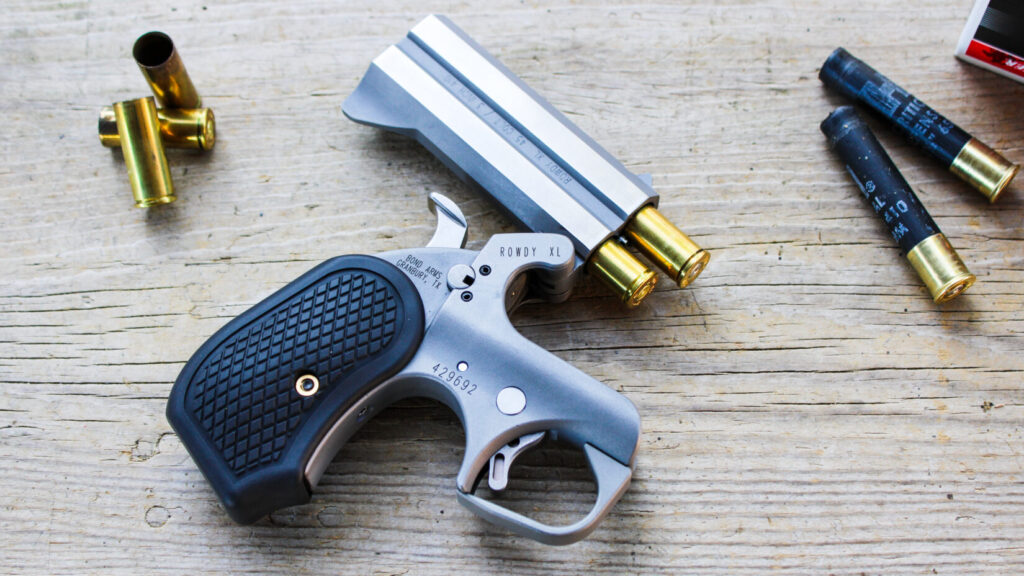
In practice, both pistols were manageable, though the Rowdy XL was noticeably more comfortable. The B6 resin grip provides a slightly more relaxed angle and a better grip, making it easier to control the gun in the hand.
The Snake Slayer’s rosewood grip, by comparison, sits a bit more vertical. It works well enough, but the Rowdy XL’s shape makes the gun feel more manageable, especially when using heavier loads.
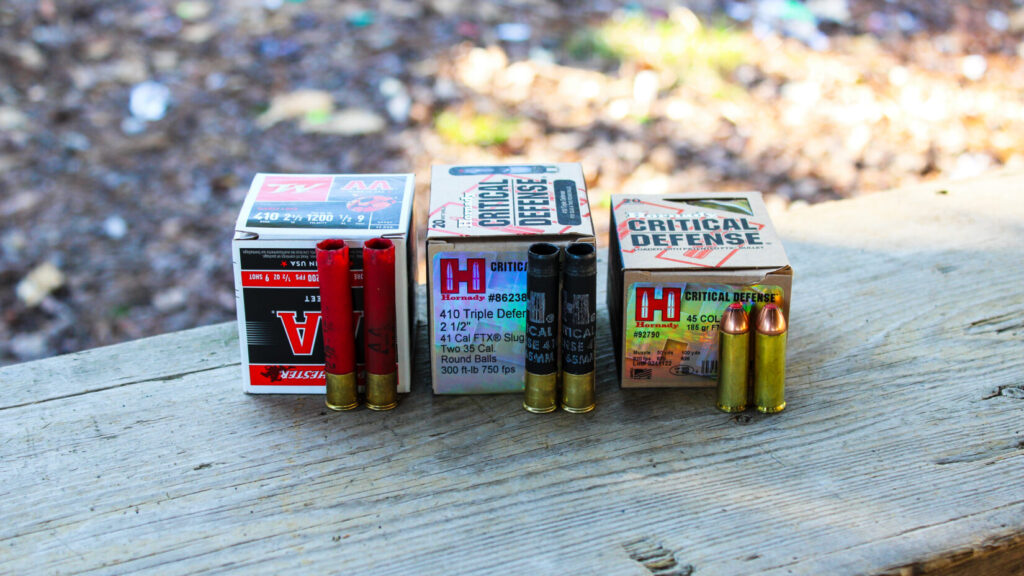
On one range trip, I shot a load of Hornady .45 Colt Critical Defense and two shotgun loads. .410 birdshot was mild and easy to shoot, while Hornady’s Critical Defense .410 load carried a sharper punch. That extra recoil is exactly where the Rowdy XL’s grip design really shines, keeping the gun controllable and comfortable.
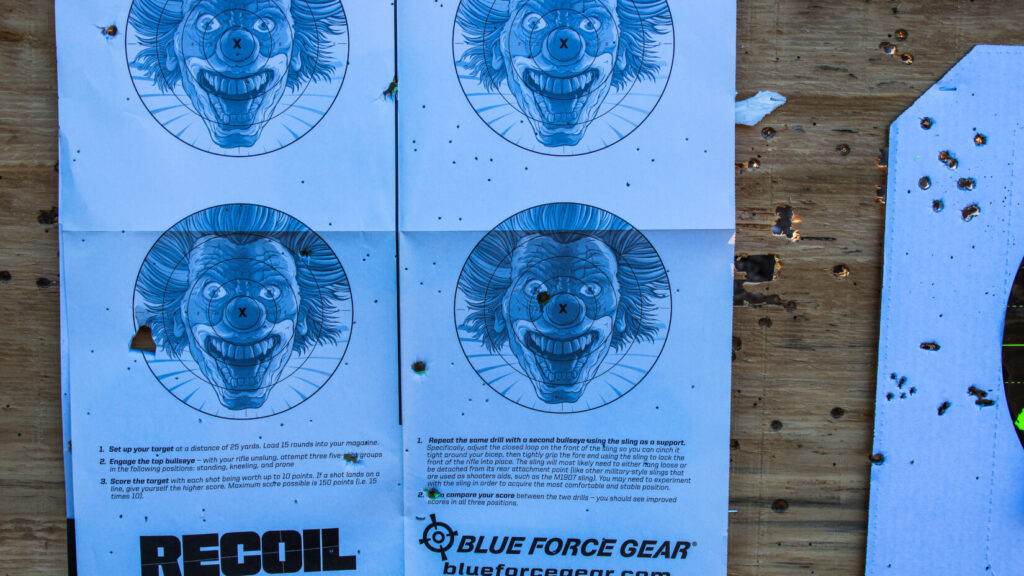
In total, I went through a couple of boxes of Hornady .45 Colt and about half a box of .410 loads. That may not seem like much, but with a two-shot derringer, it adds up fast. Most of the shooting happened between 5 and 10 yards, which is exactly where these pistols are meant to be used. The platform’s accuracy was reasonable. These aren’t bullseye guns, nor do they aim to be.
PROS AND CONS
The sights are functional, but they could be improved. I’d prefer a thinner front post with a deeper rear notch. I know these pistols are meant for close-range use, but even then, better sights would help.
The manual of arms is straightforward. Cock the hammer, fire, then engage the locking lever to open the action for extraction and reload. A cross-bolt safety enables a cocked-and-locked carry if desired. The trigger pull, however, is on the heavier side at about seven pounds. Personally, I’d prefer something closer to five. Whether that’s feasible without affecting the retracting firing pins and rebounding hammer system is another question altogether.
SO, WHO’S THIS FOR?
So, back to that original question: why in 2026?
This isn’t an everyday carry firearm, at least for most people. But I believe its use case is for someone in the field, someone who owns property, camps, hikes, or keeps it as a secondary weapon in a vehicle.
The versatility of .410 and 45 Colt is impressive. For rural areas, this works well for pest and nuisance control, especially for groundhogs, snakes, and other vermin. On the other hand, the rounds’ versatility makes sense when camping or hiking, where threats are more likely to slither or be on four legs. That same versatility can be maintained by keeping it in your vehicle.
I also appreciate the ability to switch barrels. Changing calibers to best suit different tasks with the derringer makes sense (9mm with sankeshot, anyone?). Really, it’s hard to ignore the utilitarian role this pistol fills.
Additionally, there are SASS (Single Action Shooting Society) competitors—who Bond Arms sponsors—and other cowboy-action shooting groups that hold side or backup matches that use these derringers.
Finally, there are ban states. People in states with limited access to firearms will still be able to obtain Bond Arms derringers. Two shots of Hornady Critical Defense .410 will solve a lot of problems.
ZOOMING OUT
So, after spending time with them, does a Bond Arms derringer make sense for you? In the right context, absolutely. These pistols aren’t for everyone, but there are practical roles where they fit well—whether as a compact trail gun, a backup option, or simply a unique piece to enjoy at the range.
That’s part of the appeal. In the United States, firearms ownership isn’t just about pure practicality. Sometimes it’s about craftsmanship, heritage, and owning something that simply brings you a bit of joy. If carrying an American-made derringer loaded with .45 Colt in a leather holster sounds like your kind of thing, there’s nothing wrong with leaning into that.
And that’s really where Bond Arms stands out. These pistols are built in Texas using American steel and assembled by American workers. At a time when many firearms are imported from places like Turkey or Brazil, something is reassuring about a handgun that’s designed, built, and finished right here at home.
For more stories, head over to the Cadre Dispatch.