
The rapid proliferation of small unmanned aircraft systems (sUAS) has created operational challenges for infantry units across multiple theaters. The conflict in Ukraine has demonstrated that small drones are now routinely used for reconnaissance, attack, and precision munitions delivery. Many of these systems employ fiber‑optic control links or autonomous modes, reducing the effectiveness of radio‑frequency (RF) jamming and other non‑kinetic countermeasures.
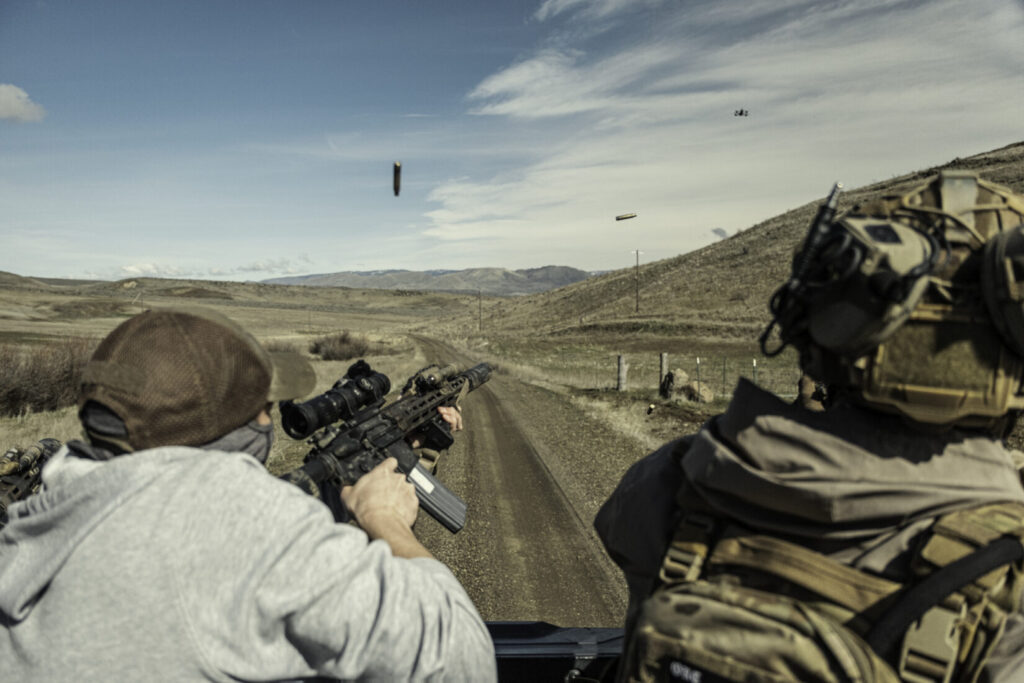
Drone Round from Drone Round Defense is a rifle‑caliber, multi‑projectile cartridge designed to provide a kinetic counter‑unmanned aircraft systems (C‑UAS) capability using existing 5.56×45 NATO and 7.62×51 platforms. It requires no platform modifications, no additional equipment, and no reliance on the electromagnetic spectrum.

engineered specifically to defeat small aerial threats. (Drone Round Defense)
System Description
Ammunition Design
Drone Round uses a controlled‑dispersion, multi‑projectile configuration to increase hit probability against small aerial targets at short and medium ranges.
Caliber Options
5.56×45 NATO
- K Variant: 8‑projectile load, effective to ~50 m
- L Variant: 5‑projectile load, effective to ~100 m
7.62×51 NATO
- In development; expected effective range 300+ m
Key Characteristics
- Muzzle velocity: ~2,200 fps
- Compatible with standard magazines and belt‑fed systems
- No changes to action cycling
- Suppressor‑compatible
- Designed for radio‑controlled, fiber‑optic, fixed‑wing, rotary‑wing, and surveillance UAS
Operational Role
Drone Round is intended as a last‑line kinetic defense within a layered C‑UAS architecture. It addresses several operational gaps:
- Non‑RF‑dependent: Effective against drones that cannot be jammed.
- Immediate availability: Uses existing rifles, magazines, and training.
- Higher velocity vs. 12‑gauge: Reduces lead time and increases first‑round effectiveness.
- Low logistical burden: No power source, no spectrum management, no additional equipment.
Manufacturing and Compliance
Drone Round Defense reports that all production is fully U.S.-based, supported by a vertically integrated manufacturing structure that includes Freedom Munitions, Unlimited Ammo, and Ammo Load. This integration allows the company to control the entire production process—from component fabrication to loading, quality assurance, and final assembly—within a single domestic supply chain.
According to the manufacturer, current capacity supports the production of up to 350 million rounds per year, enabling large‑scale fulfillment for defense requirements. All ammunition is produced in accordance with SAAMI, ISO, and MIL‑SPEC standards, with NATO certification pending.
U.S. Military Engagement
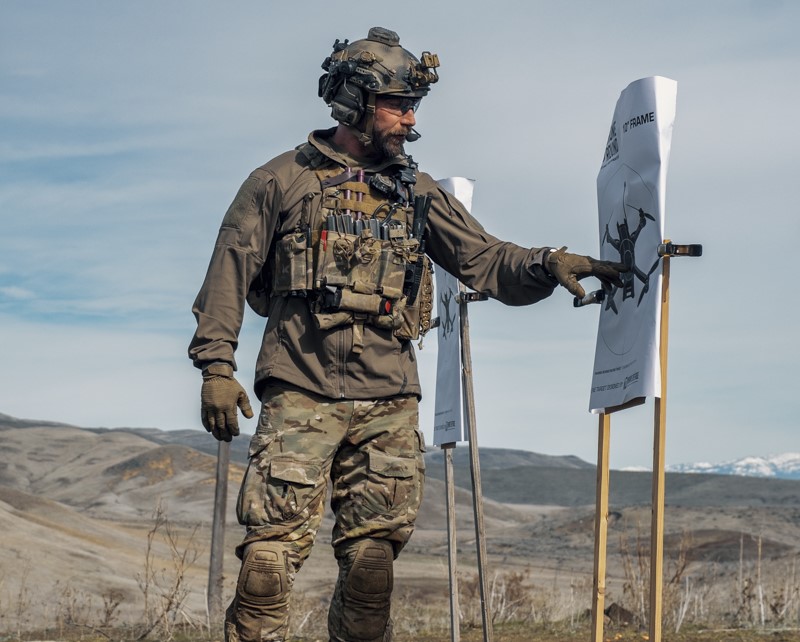
Drone Round has been demonstrated with multiple U.S. military and defense innovation organizations, including Army and Special Operations stakeholders, as part of ongoing evaluations of tactical‑level C‑UAS solutions. Demonstrations are limited to qualified government and military entities.
Comparison Matrix: Drone Round vs. Other Counter‑UAS Categories
C‑UAS Capability Comparison
| Capability Area | Drone Round | RF Jamming Systems | Directed‑Energy Systems | 12‑Gauge Kinetic Ammunition |
|---|---|---|---|---|
| Effectiveness vs. Fiber‑Optic / Non‑RF Drones | Yes | No | Yes | Yes |
| Equipment Requirements | Uses existing rifles | Dedicated jammer hardware | Specialized DE platform | Shotgun platform |
| Training Burden | Low | Moderate | High | Moderate |
| Power / Spectrum Requirements | None | Requires power & spectrum | High power demand | None |
| Effective Range | 50–300+ m | 100–1,000+ m | 100–1,000+ m | 20–40 m |
| Hit Probability on Fast sUAS | High | Variable | High (LOS dependent) | Moderate |
| Collateral Risk | Controlled dispersion | Low | Low | Higher |
| Environmental Limitations | Minimal | RF‑dense environments | Weather & obscurants | Minimal |
| Cost per Engagement | Low | Medium–High | High | Medium |
| Sustainment | High | Limited by power | Limited by power/cooling | Moderate |
| Infantry Integration | High | Low–Moderate | Low | Moderate |

Law Enforcement Applications and Legal Considerations
Potential Law‑Enforcement Applications
Although Drone Round was developed for military use, domestic law‑enforcement agencies increasingly encounter sUAS (small Unmanned Aircraft Systems) threats. Potential applications include:
- Critical Infrastructure Protection: Unauthorized surveillance or hazardous payloads near sensitive facilities.
- Major Public Events: Mitigating drone threats during large gatherings or VIP movements.
- Border and Corrections Enforcement: Countering drones used for smuggling contraband.
- Tactical Operations: Addressing drones during high‑risk warrant service or barricade situations.
Legal and Regulatory Framework
Law enforcement use of kinetic C‑UAS tools is governed by a strict federal legal framework that sharply limits when and how drones may be disrupted or disabled. Under federal law, unmanned aircraft systems are classified as “aircraft,” and damaging or destroying them without proper authority is prohibited.
Specifically, 18 U.S.C. § 32 makes it a federal offense to damage, destroy, or disable any aircraft, and the FAA defines unmanned aircraft as “aircraft” under 49 U.S.C. § 40102, placing drones squarely within this protection. As a result, state and local law enforcement agencies cannot independently authorize drone interdiction, regardless of the threat posed.
The Federal Aviation Administration maintains exclusive authority over the National Airspace System, meaning that any action to disrupt or disable a drone must be coordinated with federal authorities. Only a limited number of federal agencies currently possess statutory counter‑UAS authority, including the Department of Homeland Security and the Department of Justice under 6 U.S.C. § 124n, and the Department of Defense under 10 U.S.C. § 130i. These authorities allow specific federal entities to detect, track, identify, and, when necessary, mitigate or disable unmanned aircraft.
The U.S. Secret Service exercises counter‑UAS authority through the same statutory framework when operating under the DOJ. No state or local agency holds independent mitigation authority, though 6 U.S.C. § 124n allows limited participation by state, local, Tribal, and territorial agencies when operating under federal direction and meeting statutory training requirements.
Even when federal authorization is present, any kinetic engagement must adhere to established use‑of‑force standards and public‑safety requirements. Agencies must consider bystander safety, urban density, local firearm‑discharge restrictions, and the potential for collateral damage.
State and local regulations may impose additional constraints on firearm use, airspace operations, and drone‑related enforcement activities. Taken together, these legal requirements mean that while kinetic counter‑UAS tools may offer operational value, their deployment in domestic law‑enforcement contexts remains highly restricted under current U.S. law.
Practical Implications for Law Enforcement
While kinetic C‑UAS tools may offer operational benefits in certain high‑risk scenarios, their use by domestic law enforcement agencies remains significantly constrained by federal law. Any agency considering such capabilities would require explicit federal authorization, clearly defined rules of engagement, and specialized training to ensure safe and lawful employment.
Coordination with aviation authorities would also be essential, given the regulatory framework governing U.S. airspace and the classification of drones as aircraft. As the sUAS threat landscape continues to evolve, future legislative changes may influence how kinetic C-UAS tools are integrated into domestic public‑safety operations, but under current law, their use remains highly restricted.
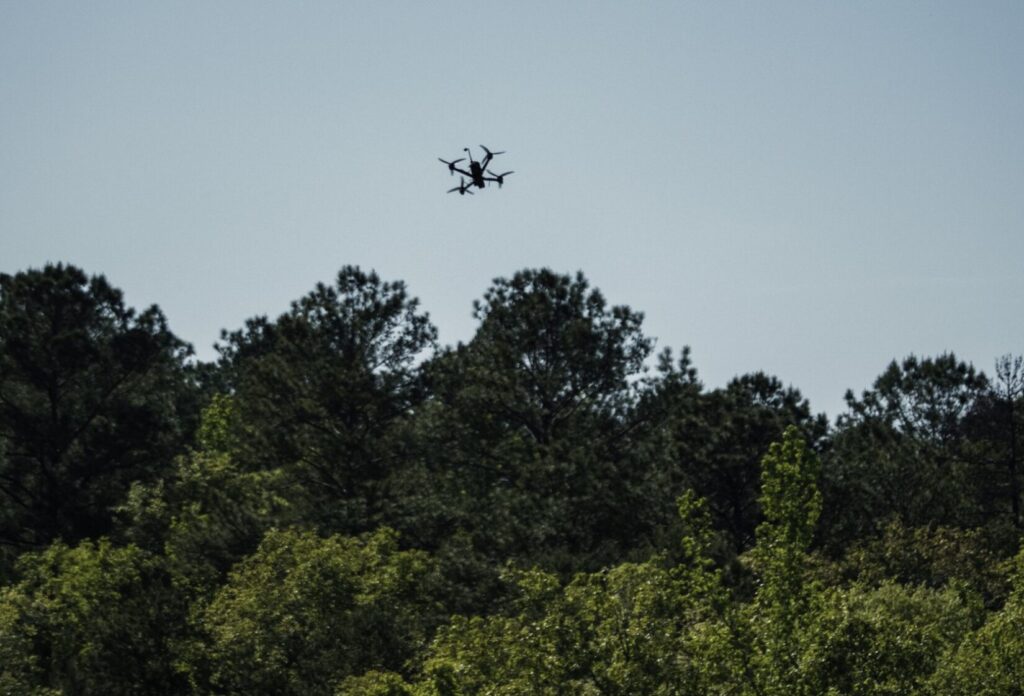
A Powerus Matrix 7 FPV drone flies above the treeline during the 42nd Annual Army Best Ranger Competition. Rangers were tasked with engaging reactive targets before neutralizing a drone threat in their lanes using the Drone Round 556-L counter-drone munition. (Drone Round Defense)
Conclusion
As sUAS continue to evolve and proliferate across global conflict zones, the need for scalable, operator‑level countermeasures has become increasingly urgent. Drone Round offers a rifle‑caliber kinetic option that integrates directly into existing infantry weapons and training, providing a practical means of engaging aerial threats that cannot be addressed through RF‑based or power‑dependent systems.
While it does not replace broader C‑UAS architectures, it fills a critical gap at the tactical edge by enabling individual personnel to counter fast‑moving drones with the equipment already in their hands.
For government and military organizations seeking to expand layered defenses against sUAS, Drone Round represents a fielded, domestically manufactured capability designed to meet immediate operational requirements.