
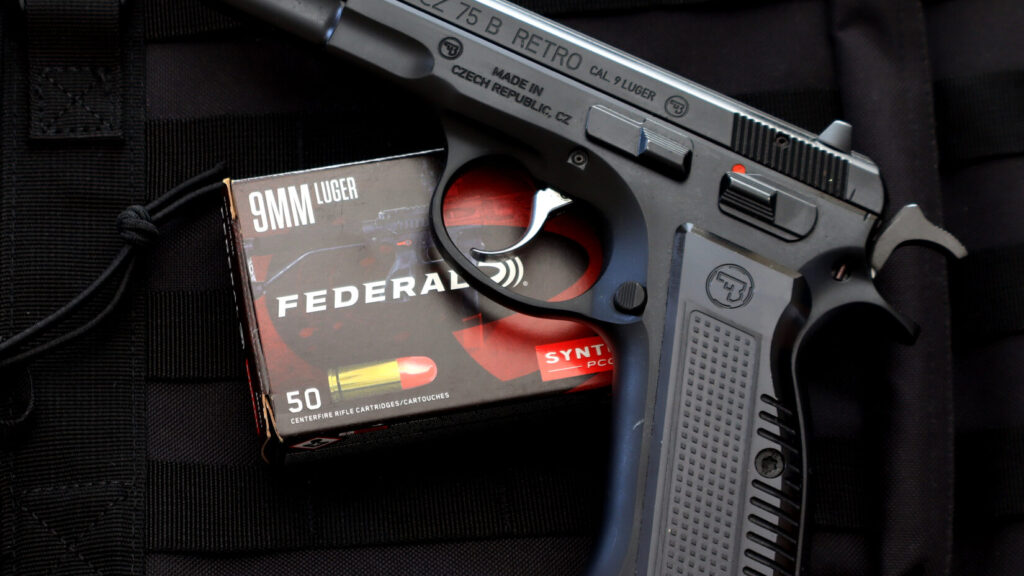
If you go to your local gun shop and buy a 9mm pistol along with a box of ammunition, chances are the word Luger will be stamped on both. Never mind the fact that the manufacturer of both gun and ammo is not Luger.
The branding denotes the design of Georg Luger, who mainstreamed the automatic pistol and gave us the 9mm Luger — of which we still use today. This is the story of Georg Luger and his Luger pistol, how he fought for the pistol in a revolver world, and why his name still creates countertop confusion.
Who Was Georg Luger?
Georg Luger was a firearm designer who created the iconic 9mm Luger cartridge as well as the first semi-auto pistol to achieve both military and commercial success, simply called—the Luger.
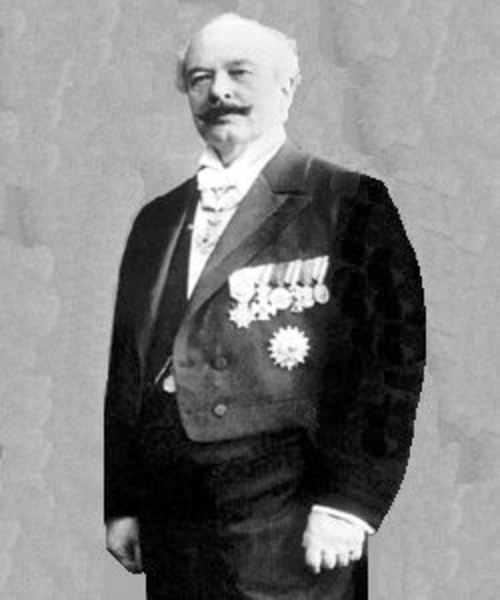
Although his pistol is synonymous with Germany during its militaristic height, Georg Luger was born in the Austrian Tyrol near the Italian border in March 1849. His father was an academic and his mother, a homemaker.
After a brief stint to study business in Vienna, he joined the reserves of Austro-Hungarian Army in 1867. His interest in gun design began while he was serving as an instructor at the Military Firearm School, but after his discharge from active service in 1873, he worked as an accountant.
From Borchardt’s Pistol to the Luger
In the 1870s, smokeless powder had yet to be invented, but the cartridge era was on. While repeating rifles like the Winchester lever action held some cachet, the world sought to increase the capacity of their single-shot bolt-action and falling-block rifles.
The world was not focused on new handguns just yet, but chance encounters and the interconnection of technology would define the future. Before Luger would collaborate with and usurp Borchardt, he was drawn into gun design by Ferdinand Mannlicher.
Mannlicher and Luger’s Chance Encounter
In the magazine capacity race, the Kropatschek tubular magazine as used in the Mauser 1871/84 and Model 1886 Lebel would prevail initially. However, the first box magazine concepts were coming into vogue, pioneered by the famed Austrian designer Ferdinand Mannlicher. In 1875, Luger had a chance encounter with Mannlicher, and the pair collaborated on what would become Mannlicher’s clip-loading magazine system as seen on the Steyr M1895 rifles.
This one-off encounter encouraged Luger to take up arms design in lieu of accounting. Finally, in 1891, Luger was hired by the great German arms firm, Ludwig Loewe & Co, where he would collaborate with another great arms designer of the age, Hugo Borchardt.
Enter Hugo Borchardt
Borchardt emigrated to the United States as a teen and navigated an arms industry riddled with patent inertia and brand territoriality. He started out with early cartridge revolvers in the 1860s during Smith & Wesson’s monopoly on the Rollin White Patent before moving to Winchester in the 1870s. While there, he helped develop a competing revolver to Colt’s Single Action before Winchester and Colt agreed to stay in their respective spheres.
Finally, he went to work with the waning Sharps Rifle Company. While there, he patented a hammerless single-shot rifle that became the short-lived Sharps-Borchardt rifle. After prototyping a bolt-action rifle from James Paris Lee, Sharps went under, and Borchardt returned to Germany in 1883.
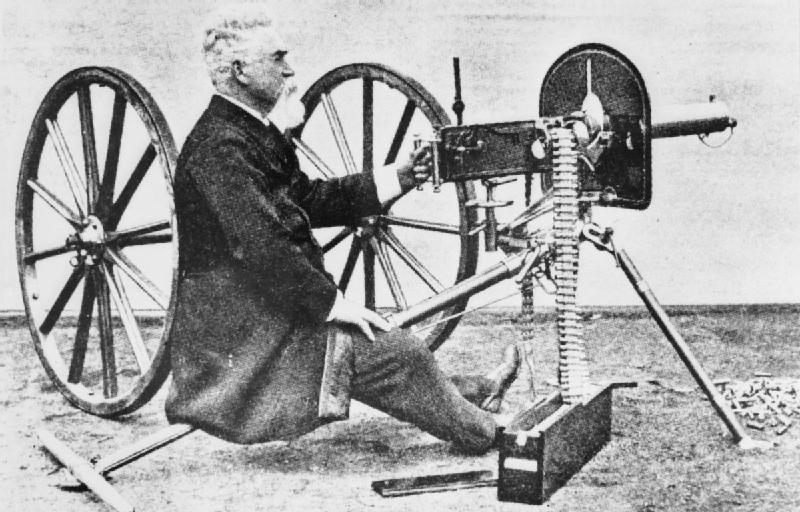
The following year, Hiram Maxim developed the Maxim machine gun, which used a toggle-lock action and a moving barrel to harness recoil to load the gun automatically.
In 1886, the French developed smokeless powder and all the world looked to develop new rifles and new heavy weapons to take advantage of it. Borchardt, armed with a patent for a detachable magazine, saw a demonstration of the Maxim in 1889 and saw the potential to use the same concept to create a self-loading pistol.
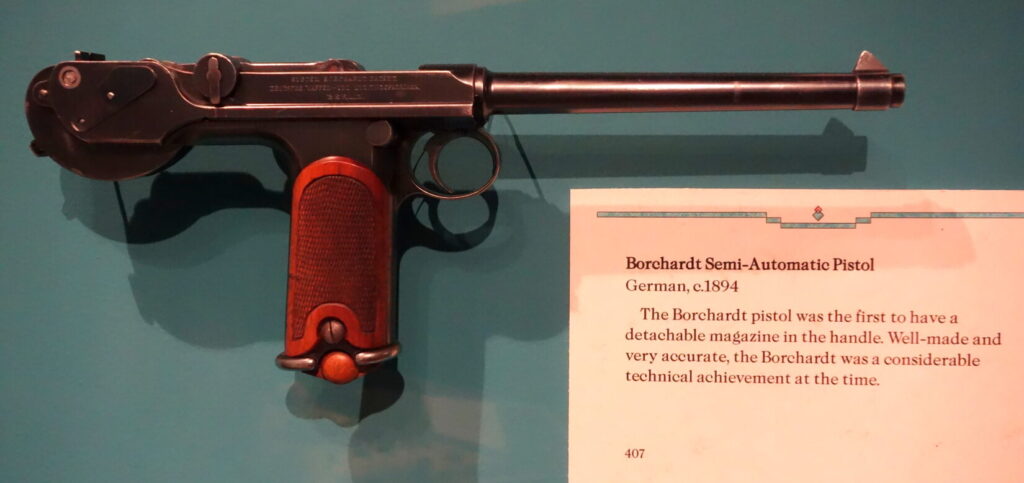
Although the exact date of initial production and Borchardt’s initial affiliation with Ludwig Loewe are debated, the first patent for what would be the Borchardt C.93 was filed in September 1893. It was the first viable semi-automatic pistol, and Georg Luger’s claim lay not in the initial design but in the cartridge—both 7.65 Borchardt. The 7.65 Borchardt was a .30-caliber bottlenecked rimless cartridge designed for smokeless powder at high velocities.
Luger Reworks the C.93
The cartridge would change little, but the C.93 would be subject to a number of tweaks as it was field-tested in Germany, Britain, and the USA from 1894 to 1897. In that interim, other newer and simpler auto pistols like the Mauser C.96 and Bergmann began to eclipse the C.93. Borchardt was content with his design, but the management at Ludwig Loewe was not.
After Ludwig Loewe consolidated into DWM in 1897, Georg Luger was given the task of improving the design. In doing so, he made it his own.
The toggle-lock action, housed outside the pistol, was moved inside. The grip was changed to become more ergonomic, parts were simplified, and the 7.65 Borchardt cartridge was made shorter to become the 7.65 Parabellum.
The Parabellum term derives from the DWM motto: “Si vis pacem, para bellum.” Translated literally: “If you seek peace, prepare for war.”
First-Hand Impressions
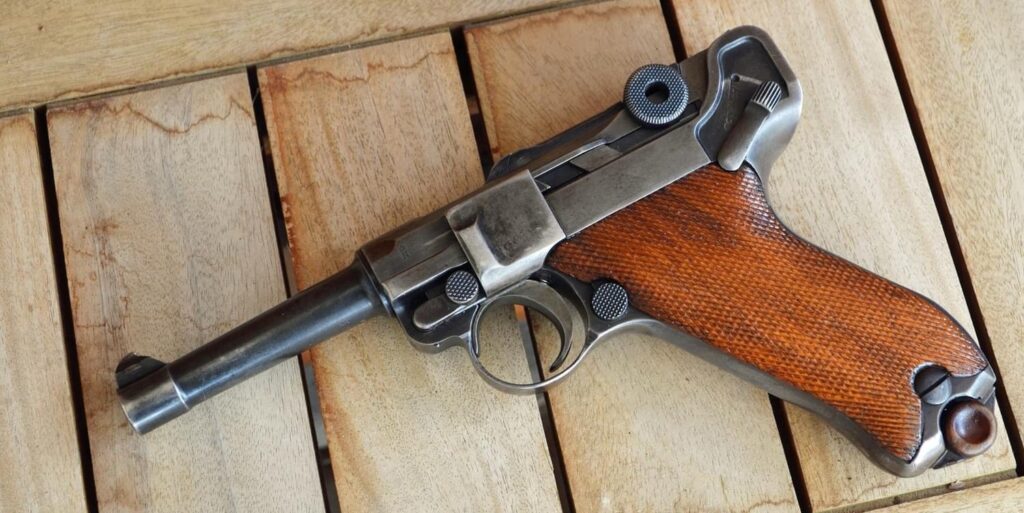
Getting behind any Luger pistol is an experience to remember, as it is equal parts foreign and familiar. My experience came from an early commercial pre-P.08 Luger in .30 caliber similar to the one pictured above, save for the inclusion of a grip safety.
Contrary to its vintage and appearance, the Luger is a striker-fired handgun, although heavier than the ones we have today thanks to its all-steel construction.
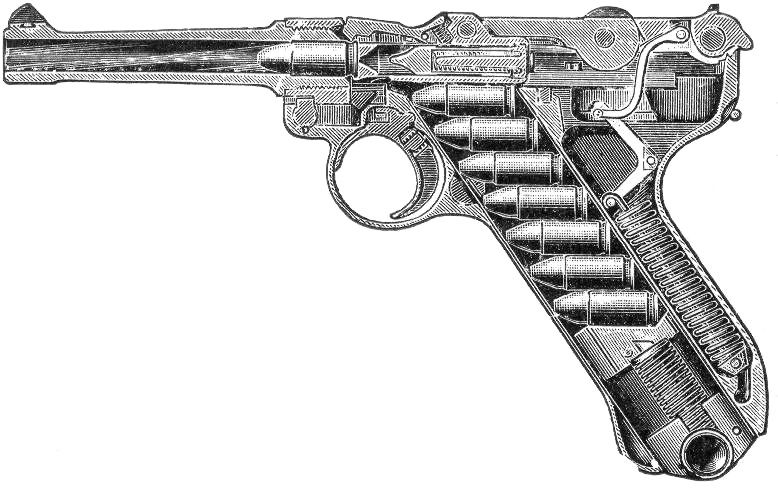
Mechanically, the barrel moves rearward with the upper frame like modern locked-breech handguns. However, instead of having a slide to do the work, the exposed barrel cams to unlock a toggle lock that scissors upward into the line of sight.
The lock snaps forward, stripping a round from the magazine and driving it into the chamber. It is easy to tell when you are out of ammunition as the toggle sticks straight up as a reminder.
The Luger has a manual safety that works similarly to that of a double-action pistol like a Beretta or Walther, rather than a 1911. Pushing down on the safety with the thumb renders the pistol inoperable. Pushing up readies the pistol to fire.
The magazine release is a familiar push-button design that was seldom used at the time but would become the de facto release we have today. Of course, it releases a conventional steel detachable magazine.
That, in itself, is unremarkable today, but in 1900, it was not the default it is now. Other pistols like the C.96 and later Steyr M1912 had a fixed magazine and loaded with stripper clips, not unlike a military rifle of the day.
In hand, the Luger points like a finger thanks to its weight-saving tapered barrel and long-copied grip angle. The 55-degree grip angle would later be copied on handguns like the Type 14 Nambu and the Ruger Standard.
It is a stark departure from the near-perpendicular grip of the Borchardt, but it is more extreme than the 18-22 degrees as seen on modern 1911 and Glock handguns. Interestingly, the original 1911 service pistol’s grip was deepened with the A1 to more closely mimic that of the Luger.
The combination of an all-steel construction and steeper grip angle makes the Luger a commanding gun to shoot. Recoil with the .30 Luger was mild, although the high-velocity cartridge produced plenty of blast. It is easy to believe reports from the 1890s that the old Borchardt and .30 Luger were fast and easy to shoot, though the smaller bullet does not necessarily inspire confidence if you are used to larger rounds.
The only bug with this early Luger is the grip safety, which required a deliberate press to disengage. Small wonder that this was nixed when the German Army adopted the pistol as the P.0F8.
How Georg Luger Created the 9mm Luger Cartridge
The 7.65 Luger was ready by 1899 and trialed in Austria, Germany, and the United States. In 1900, the Swiss adopted the Luger, making it the first semi-auto pistol adopted for military service.
In other trials, the Luger proved reliable, but the light and fast .30 Luger cartridge proved to be too new of a concept in a world where bigger cartridges were better. Germany was hesitant to move off its ungainly but powerful .44 caliber Reichsrevolver and the United States was coming off high-profile failures of its .38 Colt service cartridge in the Philippine-American War.
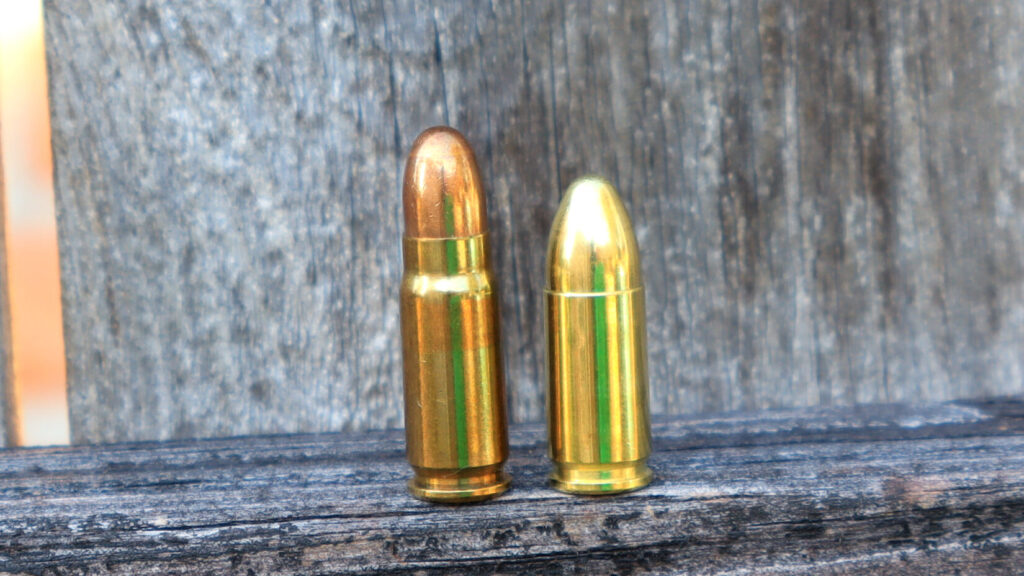
Luger responded quickly and efficiently. The 7.65 Luger’s cartridge case was expanded to a tapered case to retain its reliable feeding characteristics but the mouth was flared to accept a .355-inch, 124 grain 9mm bullet.
The case was also shortened slightly to 19mm instead of 21mm. In 1902, the 9mm Luger (also called the 9×19 or 9mm Parabellum) was in production.
In 1904, the German Navy adopted the 9mm Luger pistol with a longer six-inch barrel, grip safety, and tangent sights. Concurrently, the United States trialed the pistol, but in the aftermath of the flawed Thompson-LaGarde Tests, it was decided that a .45 caliber cartridge would be best. In 1906, Luger and DWM would produce two test guns in .45 ACP, but went on to drop out of the trials to pursue German adoption.
In 1908, the German Army adopted the 4-inch-barreled 9mm Luger pistol sans grip safety as the P.08 Luger service pistol.
The P.08 Luger In Service: WWI to WWII
In an era where technology changed year by year, it is hard to digest the fact that the P.08 Luger was one of the last of the first-generation of automatic pistols. Browning’s slide-action designs arrived concurrently with the first Lugers but would not become true service pistols until after the P.08 gained widespread acceptance. And acceptance, the Luger got.
Beyond Swiss and German adoption, the Luger was adopted by Portugal, the Netherlands, and Bulgaria. In this hemisphere, Brazil and Bolivia, keen to keep up with German military trends, did the same. In most armies, however, the officer class was expected to equip itself, and the Luger became the trendy arm to have from Italy to Czarist Russia to the warlords of China.
These powers would field Lugers during both world wars and dozens of small conflicts in the Interwar period, but the Luger is forever tied to Germany. The P.08 served Imperial Germany well, but DWM and the royal arsenal at Erfurt could not produce enough of them. Scads of .32-caliber pistols were authorized for issue, but the primary alternative pistol in 9mm Luger was the Mauser C. 96—an equally iconic, though more dated design.
The use of the P.08 in the First World War is overshadowed as the Luger became the archetypical Nazi handgun of the Second World War. But by then, the Luger had been supplanted by the simpler Walther P.38 in 1938 and existing Luger production at Mauser and Heinrich Kriegkoff was suspended in 1943.
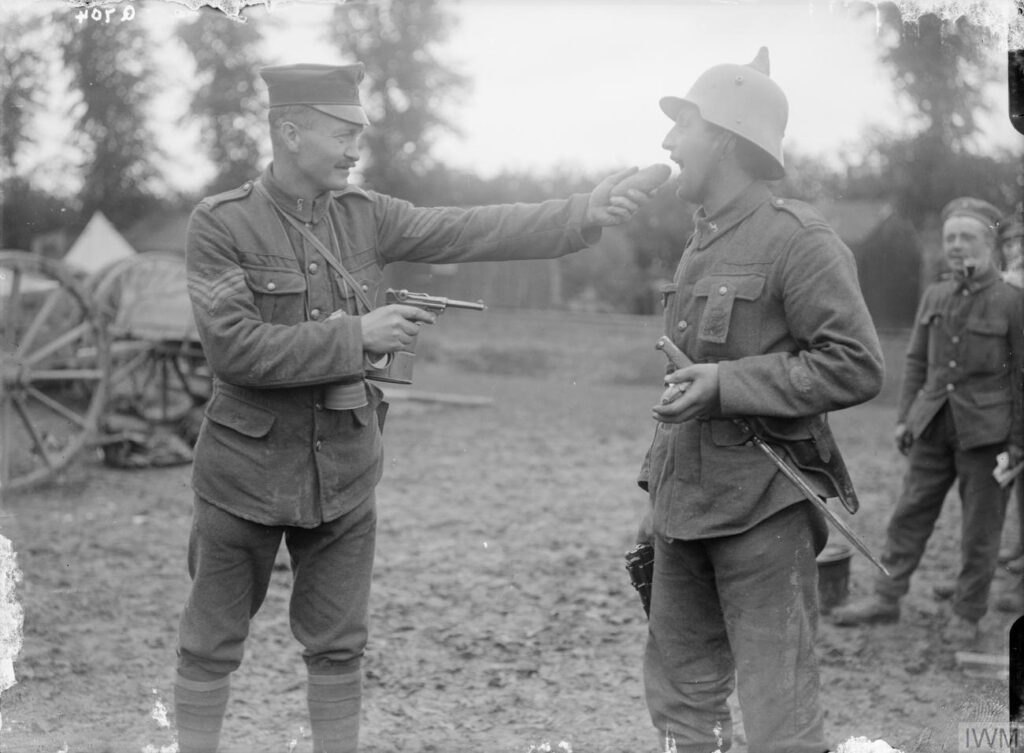
Luger production was briefly restarted post-war on both sides of a divided Germany. The Swiss would continue limited production in Bern until the mid 1980s, but the Swiss Luger itself was phased out in service beginning in 1949 with the adoption of the Sig P210. In spite of its obsolescence, the Luger continued to pop up in hot spots of the Cold War and even the Global War on Terror.
Georg Luger would not live to see his design tainted by its affiliation with the Nazis or its subsequent iconography in the stuff of films and television.
Luger suffered the loss of his second-born son in the First World War and the end of his career at DWM with the Armistice. He would spend most of his remaining years successfully suing for royalties in court. He died in 1923 at the age of 74.
Why is Luger’s Name Still On Your Ammo?
The name Luger in 9mm Luger is not only a nod to the man who created it, but a way to differentiate it from the rest of the crowd, just like the Luger pistol did well over 100 years ago.
The Luger pistol had a long life for a first-generation pistol, but the 9mm Luger cartridge would grow from a German curiosity to the world-standard pistol cartridge. This was, in large part, due to the proliferation of the round in both world wars and the success of pistols like the Luger, Browning Hi Power, and SIG P210.
The 9mm Luger cartridge itself was more powerful than similar 9mm rounds like 9×18 Makarov and 9×17 Short (.380), as well as the previously popular .32 ACP. But the cartridge’s milder recoil and the ability to fit more of them in a magazine made it more attractive than large bore rounds like .45 ACP at the other end of the handgun cartridge spectrum.
There’s more to the 9mm story than Luger’s cartridge. For a few lesser-known 9mms, check out 9 Types of 9mm You Probably Didn’t Know Existed.
A Few Quick Answers on the Luger
Georg Luger designed the 9mm Luger cartridge for his Luger pistol. Today, the cartridge is universally used, and the name Luger differentiates it from other 9mm cartridges, then and now.
Yes, they are identical cartridges and names used to describe the same round.
Georg Luger designed the Luger pistol as refinement of the earlier C.93 Borchardt pistol.
No. German production of the Luger was suspended in 1943. Switzerland continued to produce Luger pistols until 1986.