
This series is about ways to avoid Blue-on-Blue. Part I is about how poor positioning causes crossfire issues, and explains the phenomenon of contagious, or “sympathetic,” fire. Parts II and III will offer solutions.
There’s nothing friendly About Friendly Fire
There’s a direct correlation between the lethality of your tools and the price of your mistakes. It’s an old expression, but true: there’s nothing friendly about “friendly” fire.
According to Clint Smith, the percentages of Blue-on-Blue deaths caused by friendly fire have been trending up, not down, in every war since the mid-20th Century. The fratricide of Pat Tillman in Afghanistan, in April of 2004, made headlines because after 9/11, Tillman had walked away from a lucrative contract with the Arizona Cardinals to become a US Army Ranger.
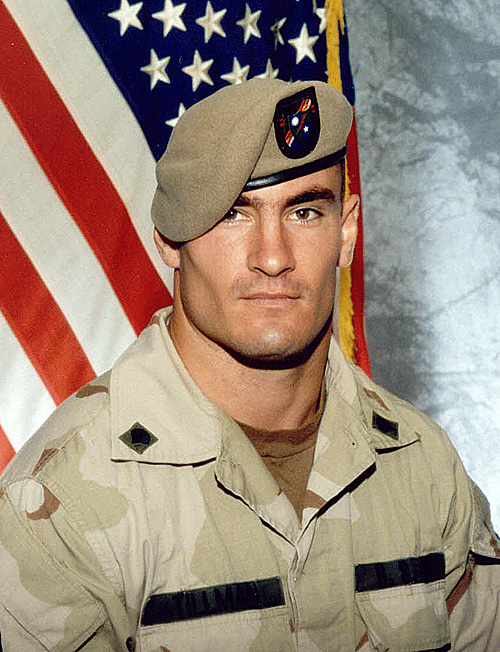
But Tillman was far from the only soldier killed by friendly fire. Nor was he the first.
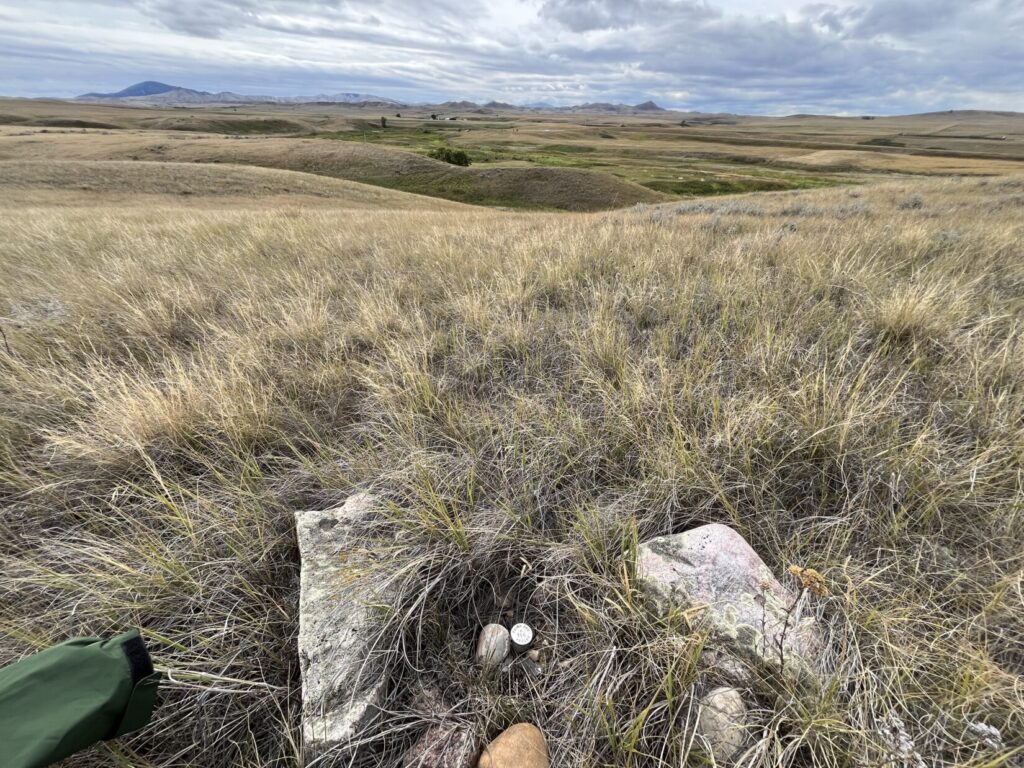
A bad mistake was made by Husishusis Kute during this sun’s [September 30, 1877] fighting. Three brave warriors, Koyehkown, Kowwaspo, and Peopeo Ipsewahk [Lone Bird] were in a washout southeast of camp. They were too far toward the enemy line. Husishusis thought them enemy Indians and killed them all. He had a magazine rifle and was a good shot. With every shot he would say, “I got one!” or “I got him!” Lean Elk [Poker Joe] was also killed by mistake. A Nez Perce saw him across a small canyon, mistook him for one of the enemies, and shot him. Four good warriors killed by friends through mistake.
–Yellow Wolf of the Nimiipuu [Nez Perce], interviewed by L.V. McWhorter
Blue-on-Blue happens all too often in law enforcement, too. New York PD’s SOP-9 datasets include statistics on officers who were killed on duty. During the period covered by the original SOP-9 study, more than 10 percent were shot by fellow officers, often when they were responding in plain clothes. There are lessons in there for concealed carriers.
The Deadly Doughnut: When Circles Turn Deadly
The “Deadly Doughnut” is a naturally occurring phenomenon. It’s a formation assumed by hounds surrounding a raccoon, angry crowds, and law enforcement officers at the conclusion of a pursuit. But just because something happens organically doesn’t mean it’s good for you. Uranium and arsenic occur naturally too.
Here’s an example of how the Doughnut might happen to you.
Tragedy at a School Crossing
Say you’re dropping your kids off at school when a drunk driver (or an idiot texting while driving, or a spree killer) in a Ford Escape plows through a group of children. He drags one kid under the car until he hits a nearby power pole.
You and several others run over there to help. While some are contemplating how to rescue the child under the chassis, you check on the driver. You see that he’s grabbing the gear selector and about to put it in reverse, which would back over the youth again.
The window is up. The door is locked. He’s ignoring your loud commands to place it in park and turn off the engine. A responsibly armed citizen, you present your firearm and order him not to move.
Then you remember that you live in Texas.
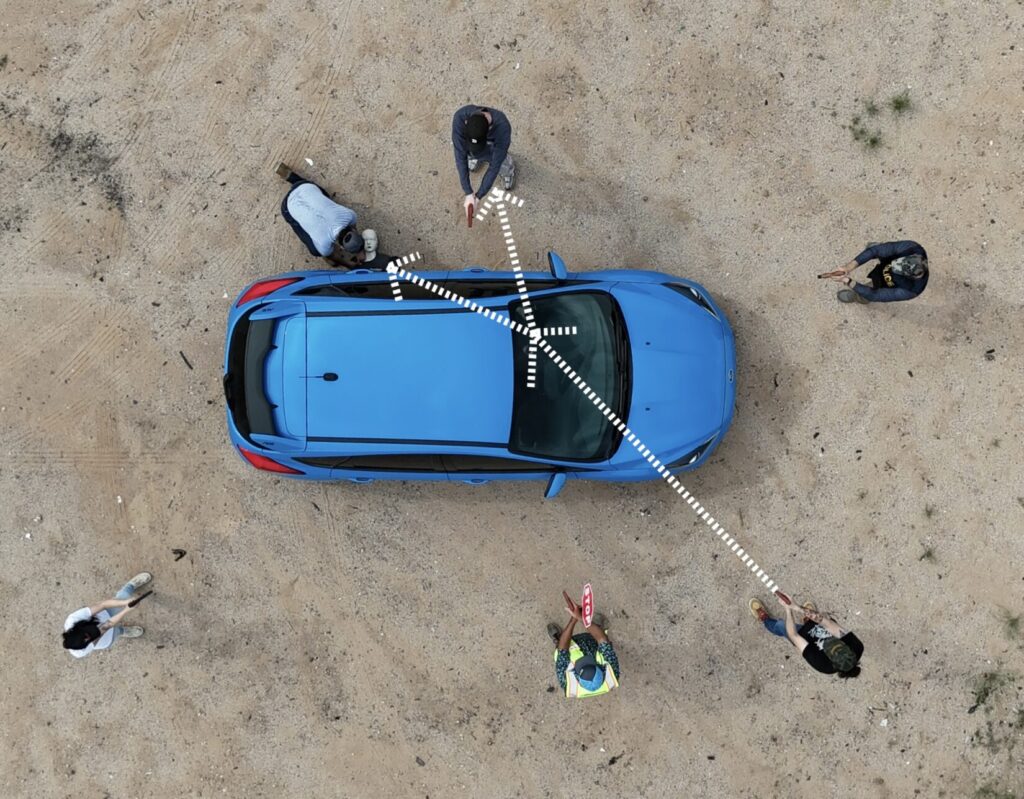
Glancing up, you realize that two other parents, a school resource officer, and the retired cop crossing guard are also pointing guns at him—from all around the vehicle.
This scenario is about positioning, not about when you’re legally justified to draw. That depends on your state’s laws.
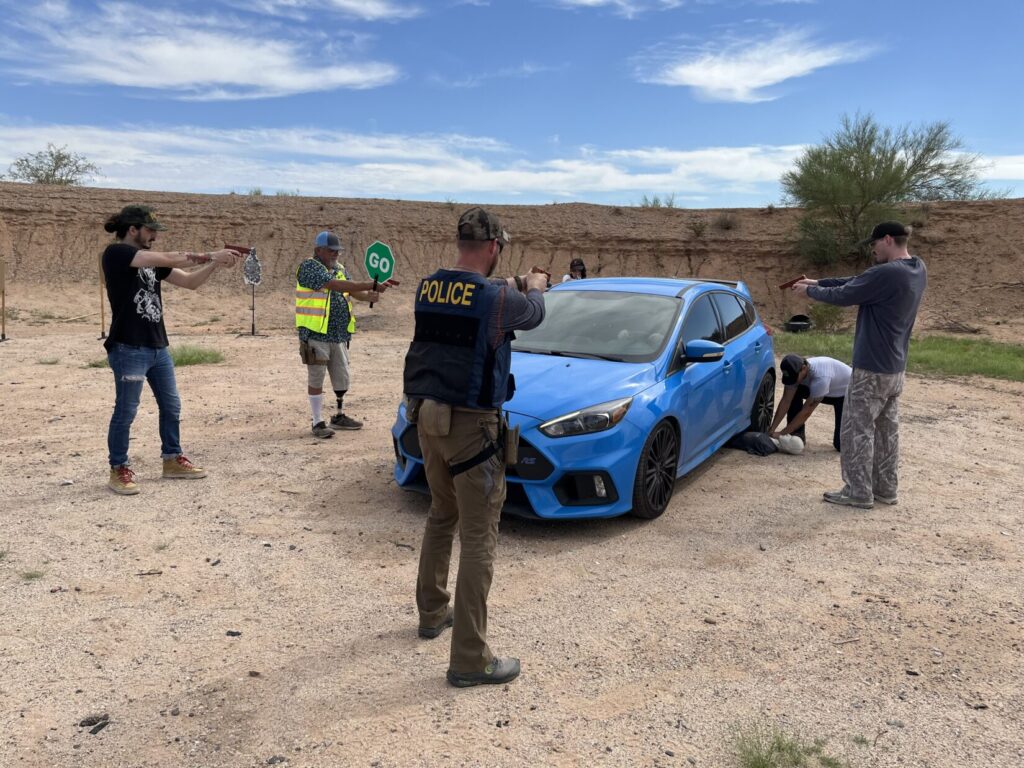
We call this circular formation “the Deadly Doughnut.” You may be four pounds of trigger pressure away from a sympathetic fire with crossfire incident, which gets several of you shot by each other.
Sympathetic Fire: How One Shot Becomes Many
Sympathetic fire also occurs naturally. It is known by many names: contagious fire, sympathetic shooting, synchronous fire, and contagion shooting, among others.
If you and a group of armed teammates are pointing guns at someone in a tense situation, it only takes one bang to set off a fusillade. We trust our partners and squadmates with our very lives, so we trust that if they felt a need to shoot, they must’ve had a darned good reason—even if we didn’t see it ourselves.
When sympathetic fire occurs, the decision to fire is not premeditated. It’s more like the way people jump when startled.
The shooting of Amadou Diallo, on February 4, 1999, was a tragic example.
Diallo paid too high a price for us to ignore those lessons. They’re important enough to rate their own article, already being drafted.
Crossfire in Watertown
Here, we’ll address a far less tragic case of sympathetic fire: the perforation of the Slip Away II, at the conclusion of the hunt for the second Boston Marathon bomber.
Backstory: The Boston Marathon Bombing
For those of you who don’t remember, two siblings put bombs near the finish line of the Boston Marathon on April 15, 2013. They placed one of their bombs directly behind Martin Richard, the 8-year-old boy they subsequently murdered. The bombing killed two others, and injured hundreds, tearing limbs off of at least a dozen people.
Afterward, the terrorists murdered MIT Officer Sean Collier to steal his pistol. They couldn’t figure out how to get it out of his retention holster. Those rank amateurs panicked and fled without it. They carjacked and kidnapped a young man to steal his SUV for their planned death spree in New York’s Times Square.
The Laurel Street shootout
When the police caught up with them on Laurel Street in Watertown, Mass., a firefight ensued. The tango with the gun wounded and nearly killed Officer Richard Donohue. Lacking Officer Collier’s pistol, the second terrorist hurled bombs at the police. BPD Sgt. Dennis “DJ” Simmonds died a year later from complications of traumatic brain injury.
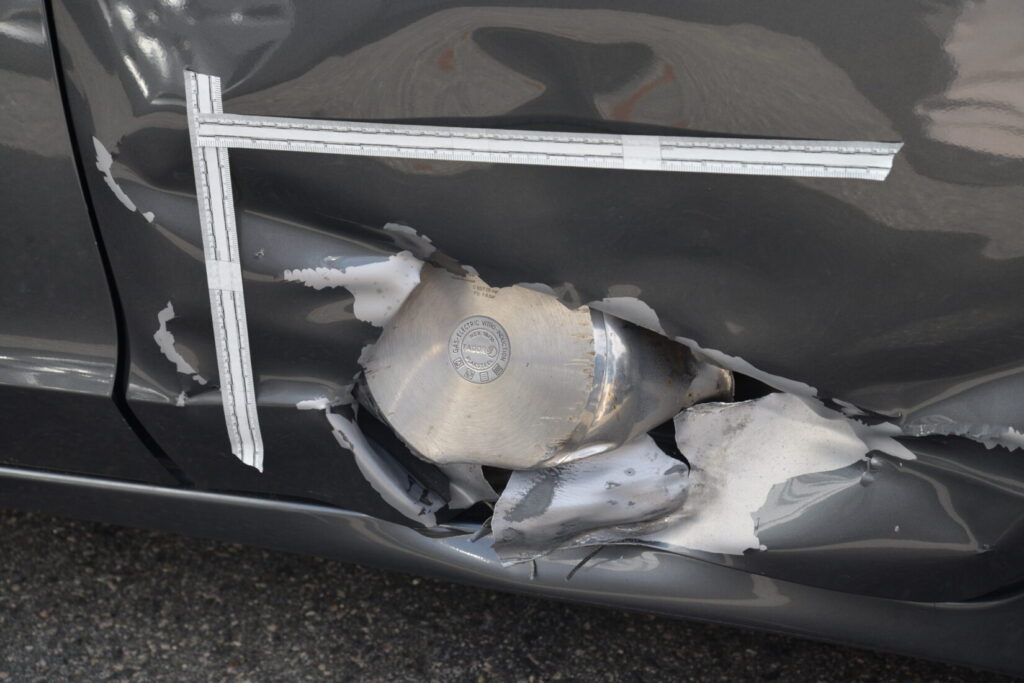
When the police were cuffing the shooter, the second terrorist attempted to run them all down with a car. He only succeeded in running over, dragging, and killing his accomplice. Though injured, he escaped from the scene.
As he drove away, officers on opposite sides of the street fired at him—and each other. That inwardly pointing, H-shaped formation was like two halves of the Doughnut pulled apart and squished flat, with just as much potential for deadly Blue-on-Blue as a circular formation.
The Ensuing Manhunt
Every cop in America, and many overseas, wished they could put cuffs on that second terrorist. I know I did. But I was west of the Mississippi (and the Pecos, and the Rio Grande). In the 12 hours that followed the Watertown shootout, over 2,500 officers and agents responded to the area. It seemed like every local, county, state, and federal cop in New England was hunting for him.
A significant portion of the Boston Metro area and suburbs was locked down. SWAT teams and ad hoc task forces searched door to door. Anyone remotely suspicious found themselves surrounded by rings of officers, sometimes three-deep, with guns out. The Deadly Doughnut struck again, over and over.
On April 19, 2013, when the residents were finally let out of their homes, David Henneberry noticed a cut cover strap on his boat, the Slip Away II, in his yard at 67 Franklin Street in Watertown. He found blood, and the semi-conscious, wounded terrorist inside.
Everybody Wants to Touch The Magic
Officers within radio range converged on the Slip Away II from all sides. Many had been working that manhunt for 36 hours straight. Sleep deprivation does more to affect judgment and coordination than a pair of tequila shots.
As one Joint Terrorism Task Force (JTTF) officer explained the response, “Everybody wants to touch the magic.” Some officers wisely and humbly manned the outer cordon, the outside of the Doughnut, keeping reporters at bay. Many on the hole side of the Doughnut pointed guns at the boat—and each other.
When ordered out of the boat, the tango used some type of pole to lift the cover. An officer on a nearby rooftop mistook that for a weapon, firing a shot. A few seconds later, after 125 more hits from sympathetic fire, the Slip Away II was no longer seaworthy.
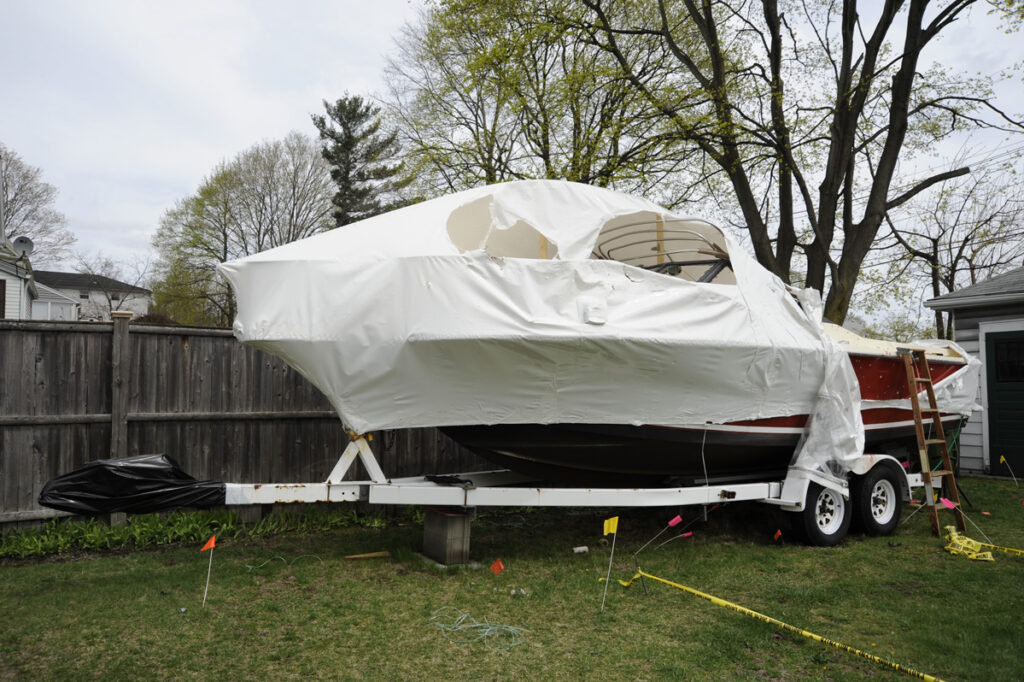
As far as I’m aware, none of the officers surrounding the boat were hit. Most of that was sheer luck, although some of the fire was directed downward from a higher rooftop angle. We’ll discuss that option later in Part II, “Plunging Fire.”
The L: A Safer Way to Hold a Suspect
If you must direct your fire horizontally, it’s good to position yourselves on two adjacent sides of the suspect, roughly perpendicular to each other (“the L”), rather than all sides (the Doughnut). (I’ve covered the L in a different context in Defeating the Covert Accomplice: Part II.)
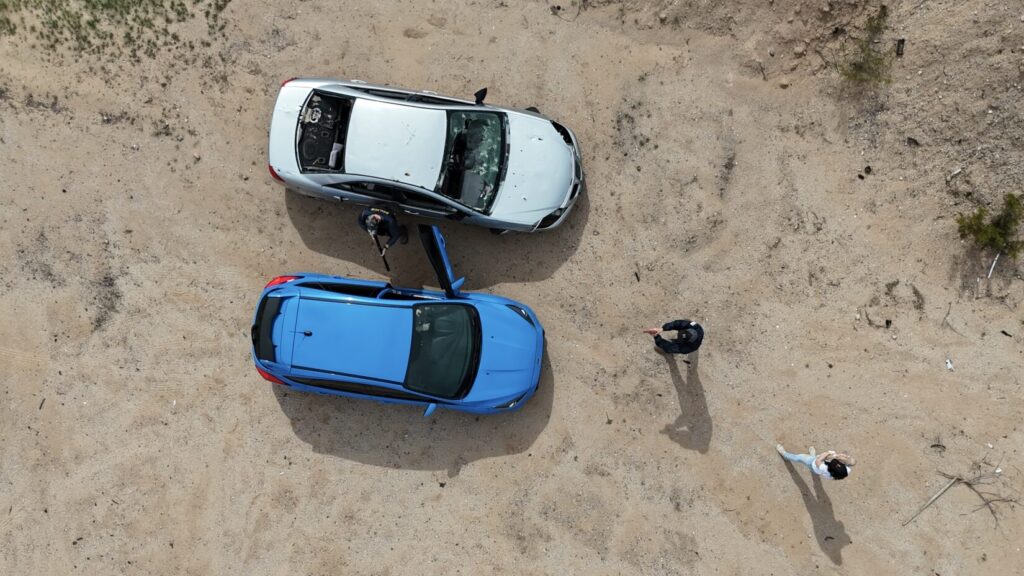
Remember our school crossing scenario? If the suspect is in a car, that unfortunately means one of you may end up behind or in front of it. Here’s an example.
A shooting in Maryvale
In September of 2002, ATF Special Agent Scott Sweetow and his team served search and arrest warrants on a very bad hombre, an armed drug dealer who’d been selling hand grenades (real fragmentation grenades), stolen high explosives, cocaine, and methamphetamines.
The suspect jumped out a second-story window. An epic, Hollywood-worthy foot chase through the Maryvale neighborhood of west Phoenix ensued.
In the parking lot of a nearby apartment complex, the suspect carjacked a woman who was pulling her baby out of a car seat. He’d just jumped behind the wheel when two agents caught up with him.
Sweetow’s partner caught up first and stood in front of the car, facing away from the apartments. She was pointing her gun at the perp horizontally through the windshield, yelling “Don’t do anything stupid!” or words to that effect.
The engine was running. Sweetow positioned himself beside the open driver’s door, ordering him to get his hands off the wheel, put them in the air, and to step out of the car.
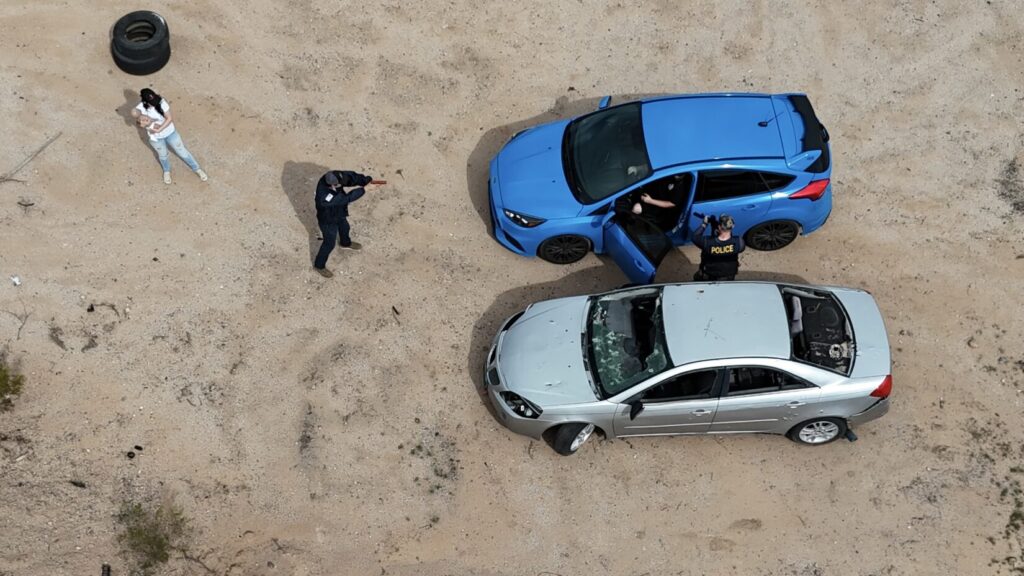
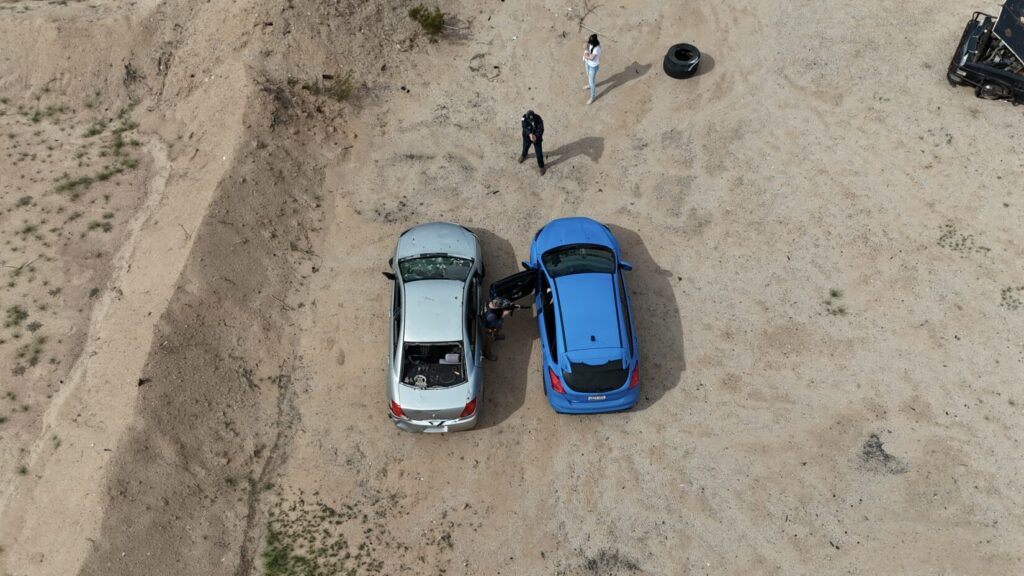
Unlike the Deadly Doughnut, they were in the classic L formation. Zero crossfire issues, and neither agent was pointing their firearm toward the apartment complex.
Like the other three Universal Caveats of Firearms Safety, Rule 4 applies at all times, even at the conclusion of a foot pursuit.
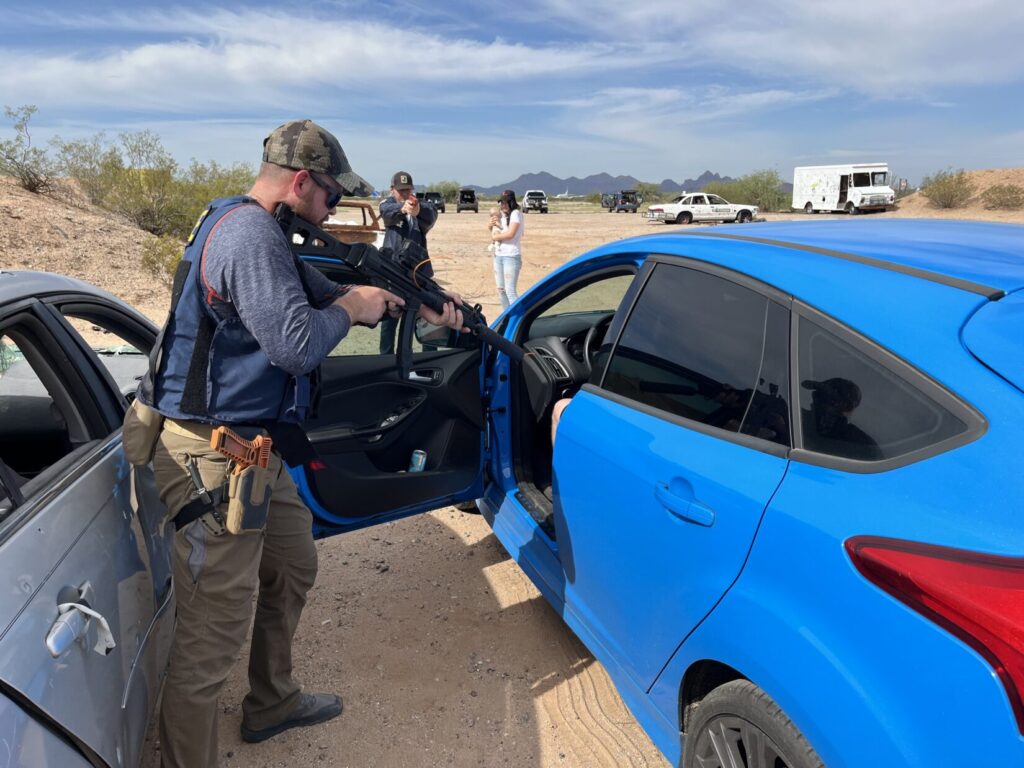
That was the good news. The bad news was, Sweetow had very little room to maneuver. He was hemmed in on three sides: the carjacked vehicle in front of him, the open car door to his left, and the car in the next parking space behind him.
The Dealer’s Bad Decision
In Fort Collins, Colorado, my wife and I once saw a woman get run over when she stepped out of a car she’d put in reverse instead of park. The door knocked her down and dragged over her. I was about 20 feet away. I jumped in, put it in park, and pulled the handbrake before going to her aid.
In Maryvale, Arizona, Special Agent Sweetow barely avoided a similar fate when the armed dealer popped it into reverse and burned rubber. The dealer cut the wheel to the left toward Sweetow as he backed up, limiting Sweetow’s ability to escape around the back end of the parked car behind him.
Sweetow got off a burst or two from his MP5 while dancing “the Beirut two-step” to get out of the way of the door. The dealer escaped with a grazing 9mm hit to the neck.
The dealer abandoned the shot-up car, still running, on active railroad tracks a few blocks away. A SWAT team later took him down in San Diego.
“BUT THE OFFICER PUT HIMSELF IN THAT POSITION”
Some armchair quarterbacks repeatedly insist that force could have been avoided if officers had not positioned themselves in harm’s way.
I have spent much of my adult life teaching law enforcers how to minimize risk to ourselves, bystanders, and suspects. We certainly want to be smart about it. But risk cannot be avoided when suspects resist arrest or respond violently to being field interviewed.
Law enforcement officers are duty-bound to prevent escape and to arrest suspects. They can’t just say, “This guy doesn’t want to go back to jail. Something bad may happen if we try to arrest him. Let’s go get a doughnut instead. Please feel free to continue victimizing others, sir.”
WHOSE FAULT IS IT?
Blaming law enforcement officers for enforcing laws enacted by legislators you elected is about as ignorant and entitled as when the hippies blamed Vietnam vets for foreign policy.
Saying a use-of-force incident is the officer’s fault for being within range of the bad guy’s weapon, whether that weapon is a gun, a knife, bare hands, or an automobile, is like saying that if you get T-boned in an intersection by a drunk who crosses against a red light, it’s your fault for driving to work.
CARS ARE FREEDOM, BUT IT’S NOT ABSOLUTE
Many countries restrict travel by their citizens. Automobiles embody the freedom Americans enjoy, to go where they want to go, and to do what they please.
That freedom ends when it impinges upon the lives of others. Striking people with your car is not a constitutionally protected civil liberty.
Even at slow speed, an automobile can crush, maim, and kill a human being. Mas Ayoob pointed out that if every officer in your department fired every weapon at their disposal at the exact same time, the sum of all those bullets in motion wouldn’t come near to the kinetic energy of a moving automobile.
It doesn’t matter if the pedestrian is in front of, or behind, the car. It doesn’t matter if that person is a child chasing a ball into the street, a staggering drug addict, a jaywalker, or a police officer deploying stop sticks. The responsibility to avoid striking pedestrians absolutely rests on the driver, just as the responsibility for the final resting place of every bullet launched rests on the operator of a firearm.
What You Can Do
While you cannot reasonably be blamed for another person’s bad choices, don’t give them an opportunity to hurt you if you are not duty-bound to stop them.
If you are on foot and you must approach someone in a vehicle, try to avoid positioning yourself behind or in front of a car, if you can do so without crossfire. There is a major exception:
If someone in a car threatens you with a gun, running to the rear of the car can be a good default. That makes you harder to hit. But don’t plan on staying there.
While you’re looking for an alternate escape route and/or getting your own gun out to shoot back, keep a hand on the car so you can feel if it comes your way. That will also leave your prints on the car, which can help us nab him later.
In Part II of the Blue-on-Blue Crossfire series, we’ll discuss how rotating your L 45 degrees, positioning yourselves on either side of the fenders, and aiming downward from beyond line of sight can prevent both crossfire issues and getting run over.
Note on Sources
“There I was” details of the Maryvale incident were relayed to me by Special Agent Sweetow.
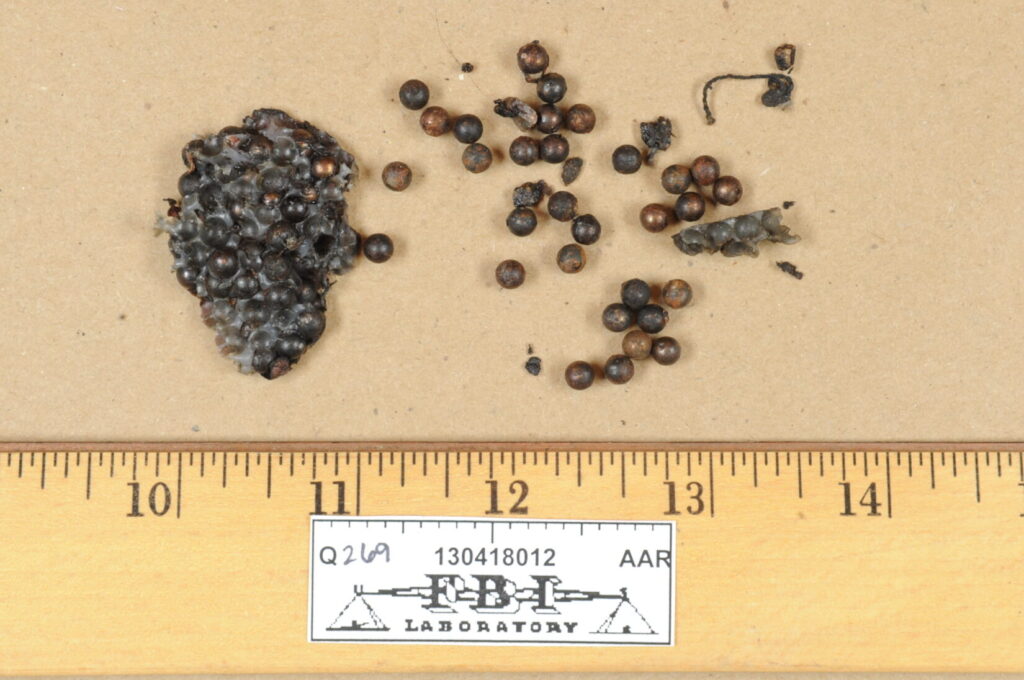
Evidence photos from the trial of the second Boston Marathon bomber (federal district of Massachusetts case 13-cr-10200) are publicly posted on a Department of Justice website.
As a task force officer assigned to an FBI JTTF, I attended a briefing by investigators of the Boston Marathon Bombing. The details in this article did not come from that briefing, nor from classified sources. None reveal investigative techniques which are not common knowledge. The two main sources I referenced were:
- Why Was Boston Strong? Lessons from the Boston Marathon Bombing, a report published by the Harvard Kennedy School Program on Crisis Leadership in April of 2014, and
- After Action Report for the Response to the 2013 Boston Marathon Bombings, produced by a consortium of Massachusetts state and local agencies, assisted by the TriData Division of Systems Planning Corporation, released in December of 2014. It’s posted on the Resources page of ICSAVE.org. If you can’t open it, contact info@ICSAVE.org for permission to view it.
I did tell you one tidbit from that briefing that, if it isn’t common knowledge, should be. I hadn’t heard it before, but it’s so true: “Everybody wants to touch the magic.”
That seared itself into my mind, because it succinctly explained much that I have observed in my lifetime. It applies across a wide range of human endeavors, not just military or law enforcement service.
If you elect to intervene in a potentially dangerous situation, make sure you do so in a smart way, and for the right reasons, not just because we all want to touch the magic.