
Part II of the Rule 4 series
In Part I of this series, “Cellophane Man,” we discussed the need for hands-on practice of firearms safety rules. Rule 4, being sure of your target and what might be behind it, is one of the most difficult to observe in a fight, yet perhaps the least practiced in the classroom or on the range. The Cello Man is more than a visual aid. It provides an opportunity for students to practice solving line-of-fire problems.
This installment of the Rule 4 series, “The Two-Deep Drill,” provides you with live-fire exercises that can help you and your students to become constantly aware of what might be behind your threat. They can also make re-positioning to get a clear line of fire reflexive.
THE PEOPLE BY THE FOOD TRUCKS
When Denver PD officers confronted an armed man on July 17, 2022, he reached for a gun. They fired back. Two of the officers had positioned themselves to have a clear line of fire behind the suspect, if worst came to worst.
A third officer stood where a crowd of about 50 food truck patrons were on the other side of the suspect. That officer fired two shots, striking several bystanders (Katie Langford, “Bystanders Wounded in Denver OIS Receive Nearly $20M in Damages,” The Denver Post, October 23, 2025).
LET’S TAKE IT AT FACE VALUE
None of the enforcement actions I’ve been involved in went down exactly the way they came out in the news media later. I’m not baggin’ on journalists. If you’re reading this, that makes me a journalist of sorts. But the reporters are almost never right there when it is happening. I was not in Denver on July 17, 2022, either, but Langford’s article mostly corroborates what I’ve read elsewhere about that shooting. Let’s evaluate that incident as it was reported for educational purposes.
That officer is probably a decent person. He had been trained at an academy. He had been through other street encounters, but I doubt he had ever felt compelled to pull a trigger before. It doesn’t happen for real as often as it does on TV.
IT TAKES A BELIEVER
I was not that officer, seeing what he saw. I don’t know what was going through his mind. But I’m guessing he was not a believer. Most people, even cops, aren’t believers, though many think they are. Believers truly, deeply, down in their core, believe that deadly force might one day really be necessary, and that today could very well be that day.
Bet he does now. After your first shooting, firefights seem a lot more real.
Previously, when he had pointed a gun at somebody and ordered them to do something, they did it. If he thought the encounter might come to actual shooting, he would, if at all possible, have positioned himself where there wasn’t a crowd behind the suspect.
If things went down too fast for him to be in a good position before the fight, he should have held his fire until he got into a good position, with a clear line of fire behind the armed suspect.
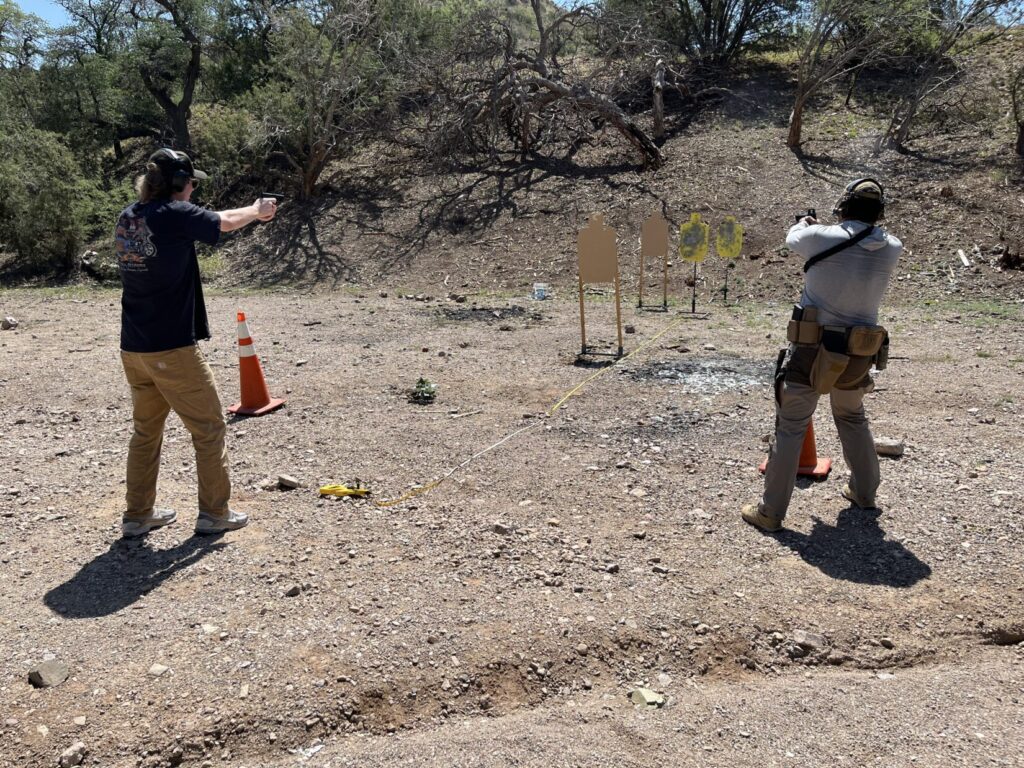
Maybe that Denver officer just got too tunneled in on the threat, and didn’t even notice what was behind.
Which is why we have Cellophane Man and the Two-Deep drill. Before any potential confrontation, and during any actual confrontation, you need to account for what’s behind your threat. The Two-Deep drill programs that.
SETTING UP THE two-deep DRILL
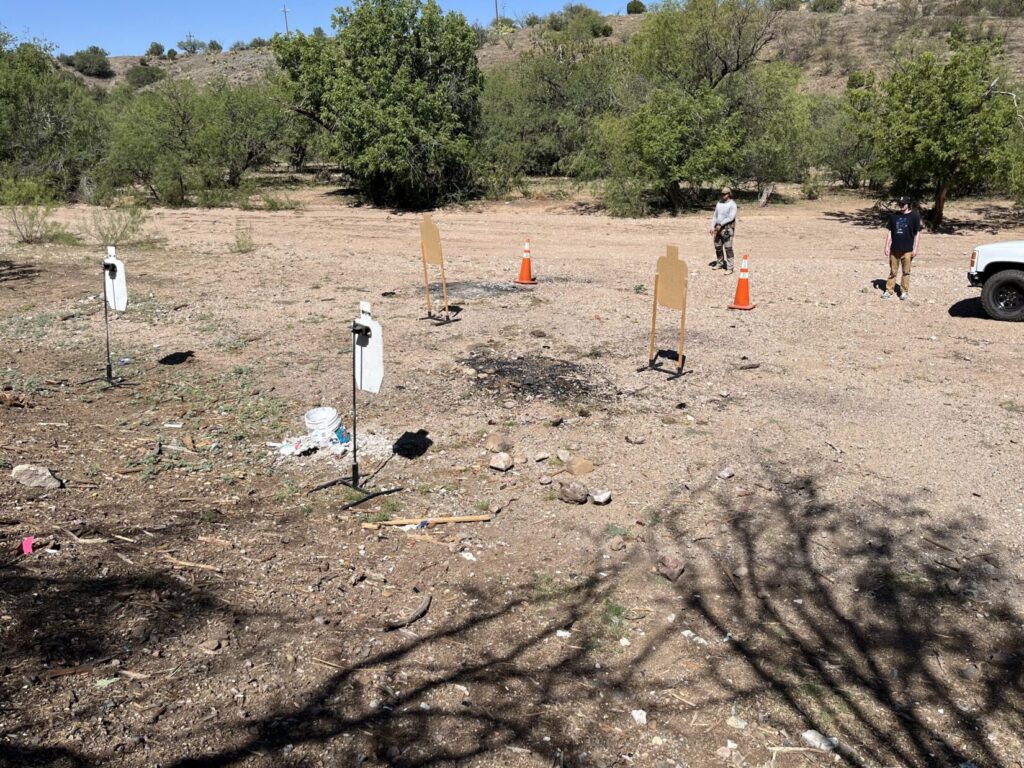
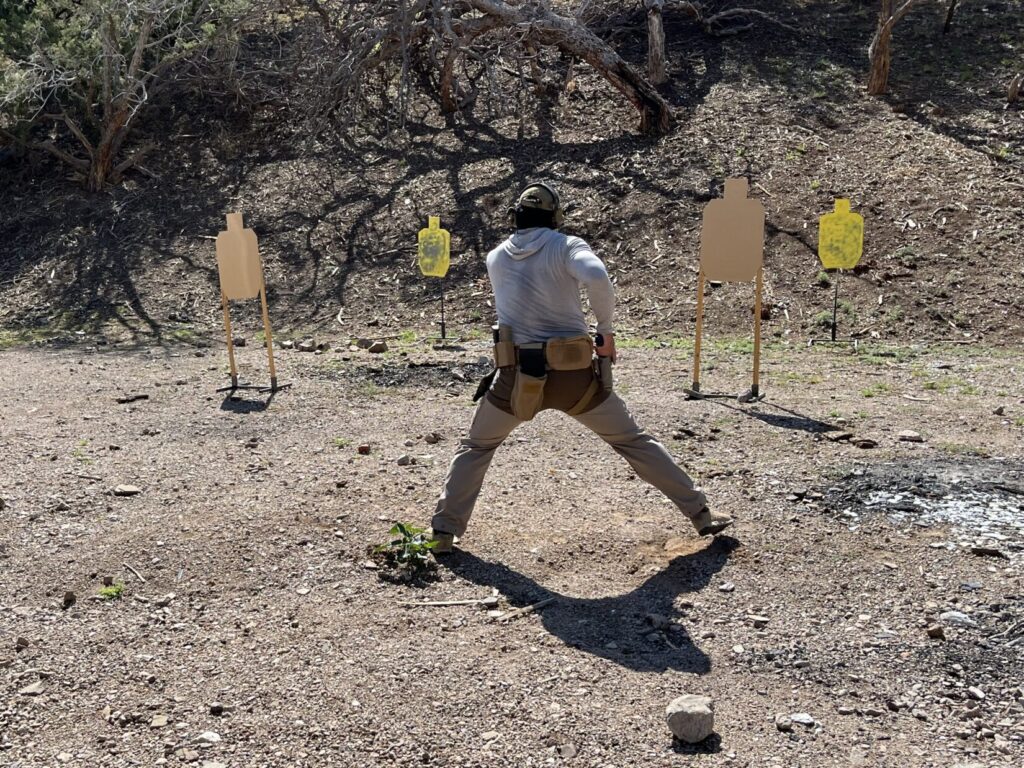
This series of live-fire drills is dirt-simple and easy to set up, but it does require a range that will allow each shooter to move left or right a few steps.
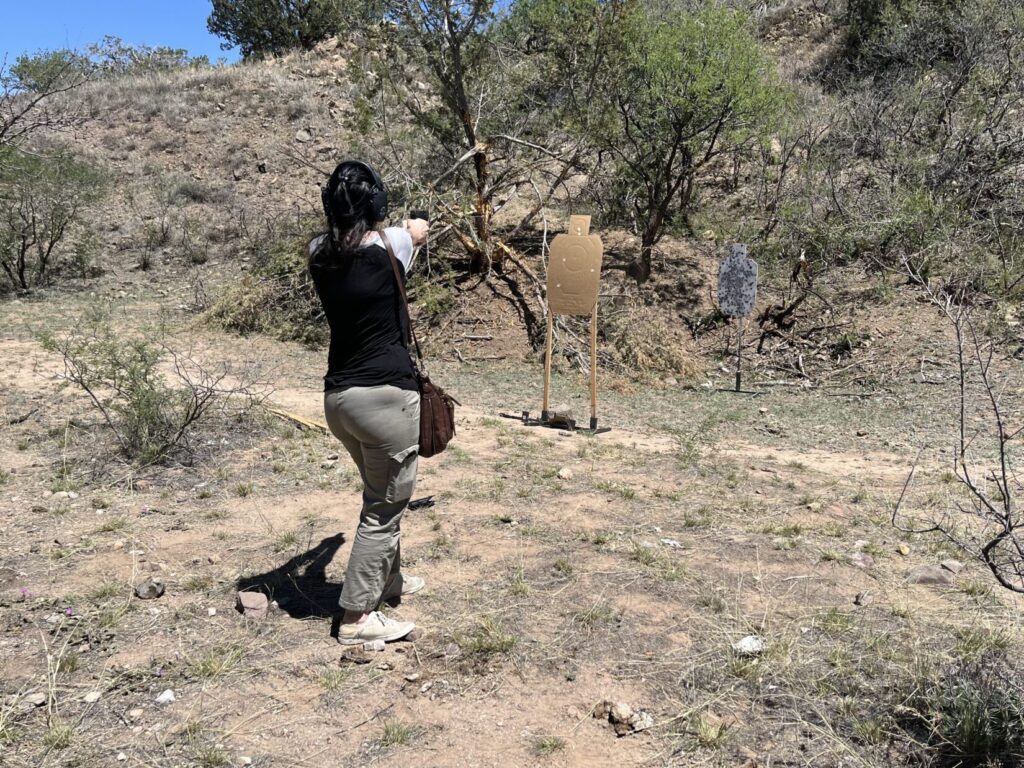
For each handgun student, place a steel target at 10 meters from the firing line (we don’t want to be banging steel closer than that without frangible ammo). Place a cardboard target at about 5 meters, directly in front of it.
If you don’t have steel, or want the rear target to be closer, the back target can be cardboard or paper as well (see TWO-DEEP FOR LONG GUNS below). But steel gives immediate feedback.
RUNNING THE TWO-DEEP DRILL
Have each student start directly in front of their close target, so that the far target is behind it.
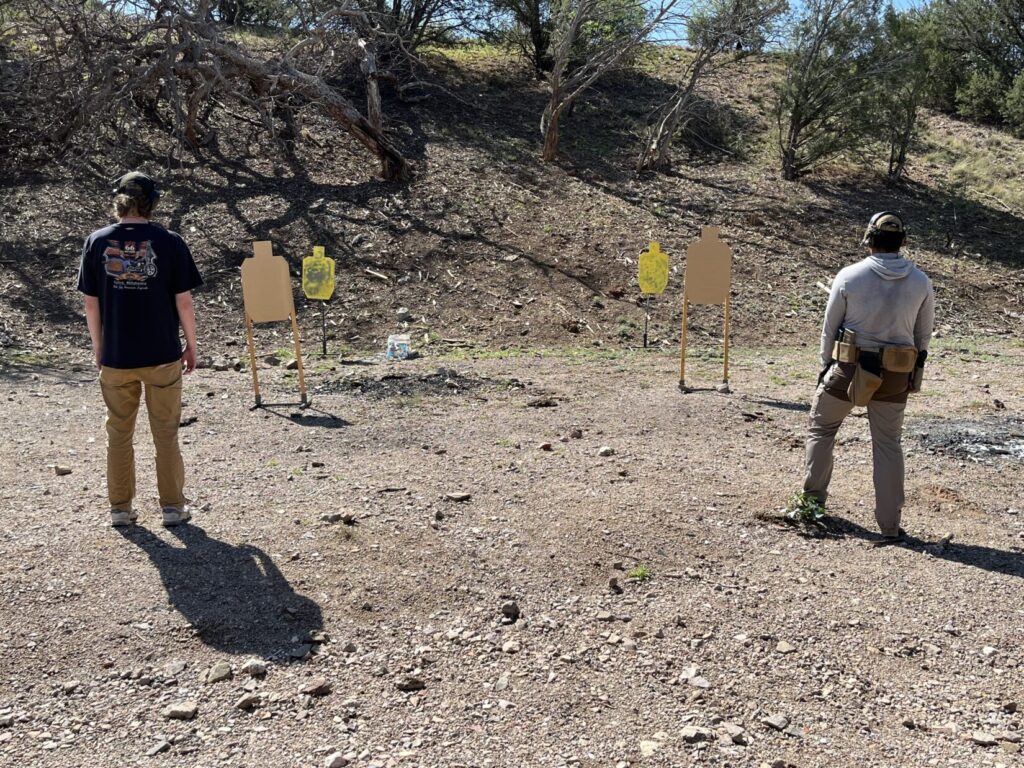
In each iteration of the drill, we shoot only one of the two targets. The other represents an innocent bystander.
Students alternate moving left or right. Instructors announce ahead of time which direction they will be moving.
ECHOING COMMANDS
The instructor says “Moving right. Nod and read back.” The shooters nod their heads, announcing they are ready, and repeat back “Moving right.” These are preparatory commands, not commands of execution.
In a fight, echoing comms gives your partner feedback that you got the message. It’s never a bad idea, and a good thing to practice. Gunfights can be painfully noisy (people often experience auditory exclusion, but I did not during my few experiences on the two-way range).
Before a potential fight, say you are preparing to engage a home invader who is just outside your bedroom door, or you are about to serve a warrant, you may need to whisper. But after the fight starts, you’ll have to yell, and even that might not get the message through. If bullets are flying, the time for stealth has passed.
Verbalization is under-practiced on the range. Talk to each other. You can bump into each other like Keystone Cops if you’re moving and lack coordination.
DESIGNATING WHICH TARGET IS THE THREAT
The command of execution will be either “Front!” or “Rear!”
“Rear!” indicates the back target is the bad guy. The students step in the pre-designated direction, far enough to get a clear line of fire around the cardboard “bystander” in front, and shoot the far target.
“Front” means they need to step in the designated direction to shoot the closest target. If they hear a “Ding!” off the steel behind, they didn’t step far enough.
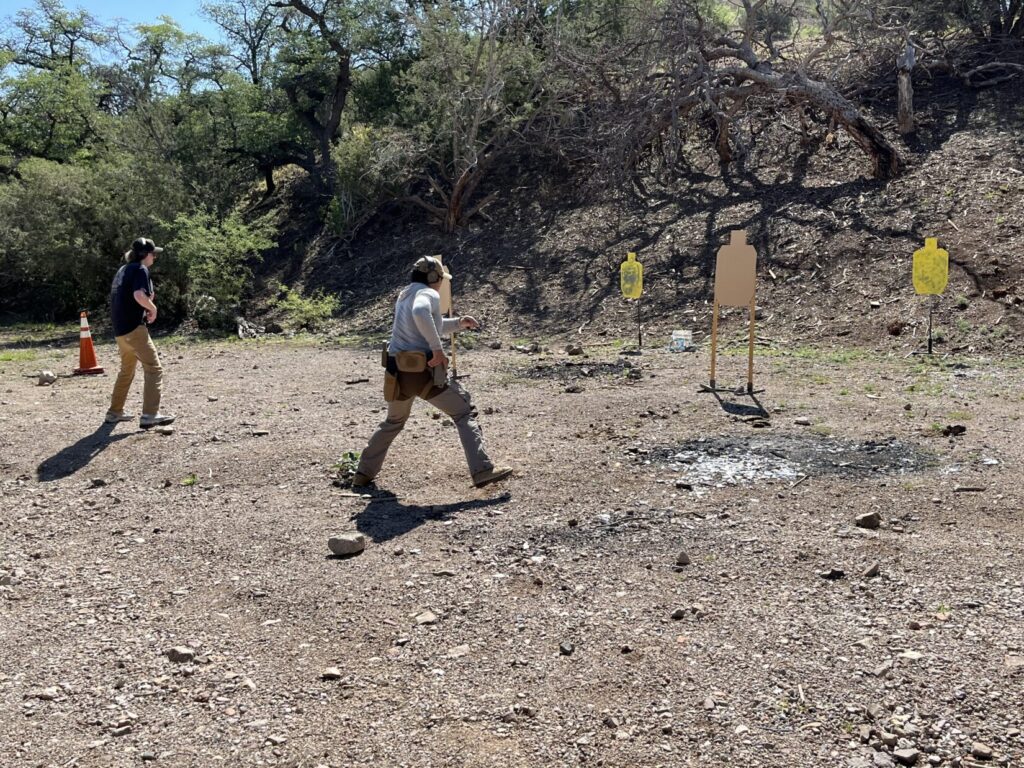
This drill is not about moving, per se. It’s about being aware of bystanders in front of or behind your threat. Moving to get a clear line of fire is how we deal with what our awareness tells us.
The goal of our practice, and it is a lofty one, is to make that awareness constant, and its responses reflexive.
You should mix up the front and rear targets at random. It’s OK, for example, to call out “Front!” two or three times in a row; likewise with “Rear!” But the left and right movement is alternated regularly every time, minimizing collisions between your students.
Terrain and crowds limit MOVEMENT
In real life, the direction you move may be dictated by terrain. If a wall or car is to your left, you will have to move right, and that won’t take up too much brainpower. If there is a crowd to the left of the subject, moving right is not an option, as it would put them in your line of fire.
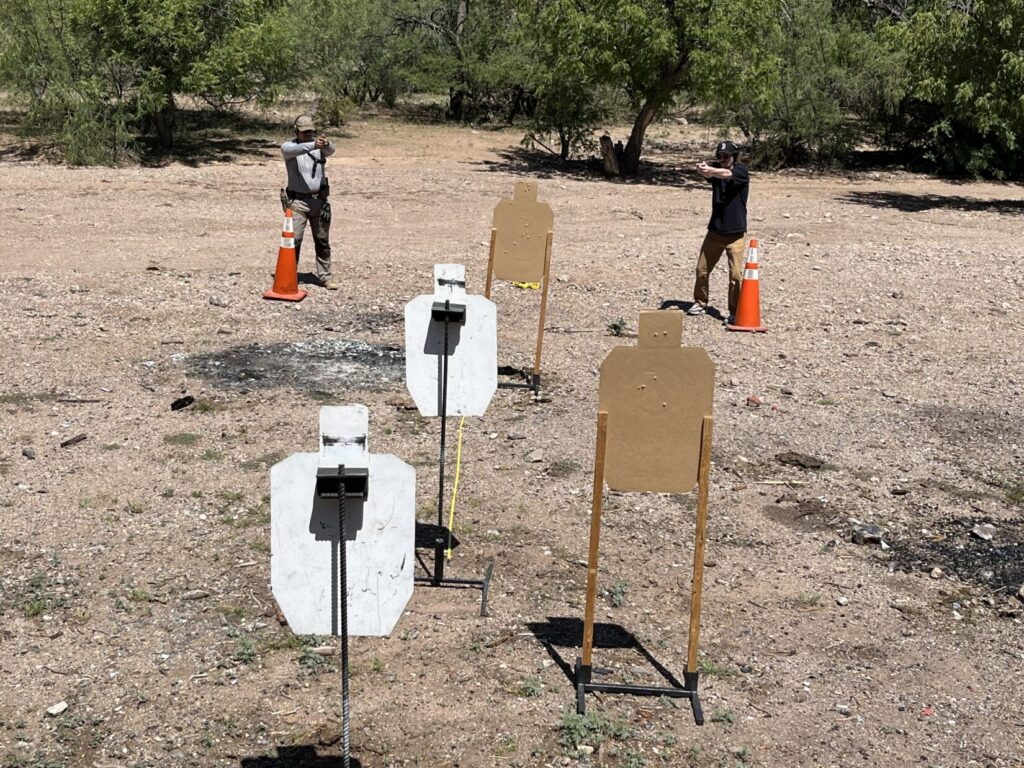
Students can move forward at an oblique angle if the threat is the rear target and the range berm will stop slightly angled bullets. If your range requires that all bullets go straight up and down range, you can offset the targets at an angle and move left or right till you are uprange of the designated threat.
Moving on a forward oblique toward distant threats puts more bystanders behind you, like Elisjsha Dicken did in the Greenwood Park Mall.
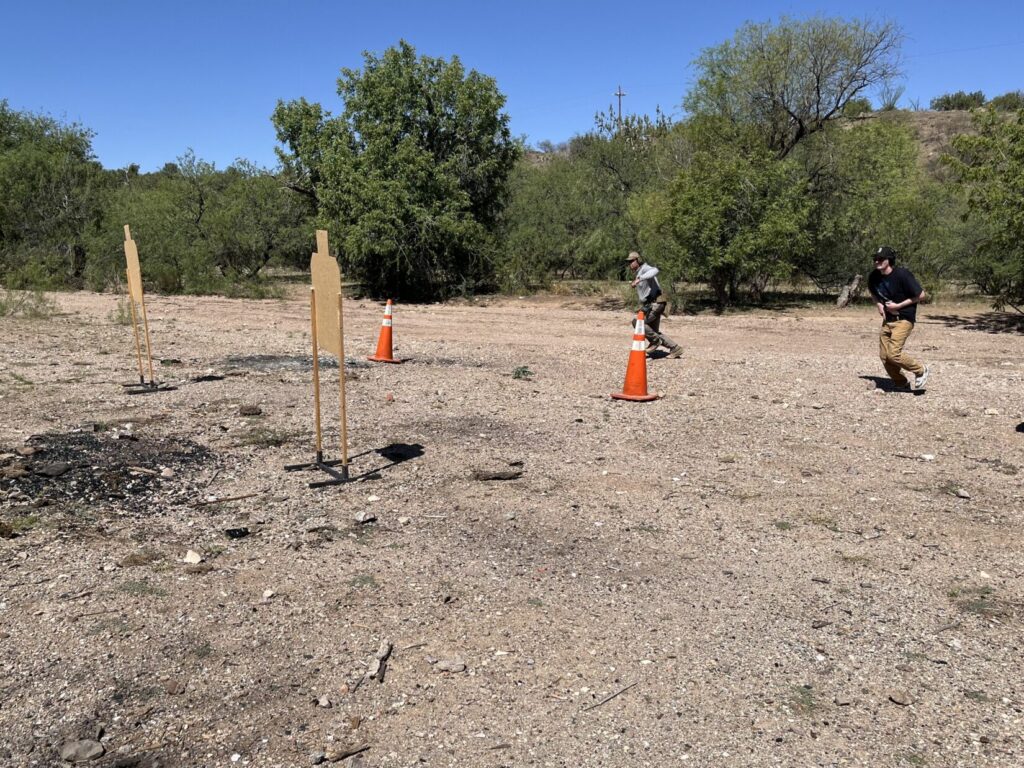
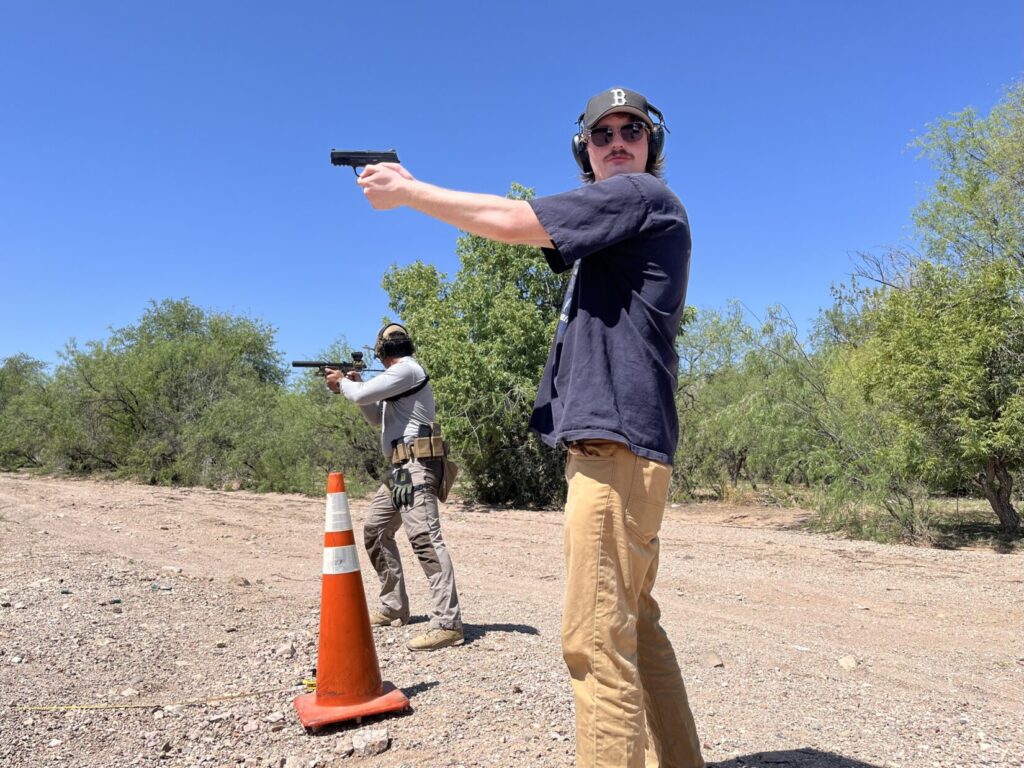
If students are moving on forward obliques, you should designate a forward limit of advance (for example, a traffic cone, or the edge of a concrete pad) so nobody gets too far ahead of other students on the left and right. Don’t shoot toward each other or get closer than 10 meters from the steel.
After engaging the designated target, look around—really look—to make sure you are safe before reholstering. Always step back to the original starting spot to reset before the next iteration of the drill.
MAKING TWO-DEEP MORE CHALLENGING
If your students find a fixed number of shots each time too easy, you can mix that up as well.
- “Head shot, front!”
- “Four shots, rear!”
- “Two shots, rear!”
- “Failure drill, front!”
With newer shooters, you can start with guns out in a ready position. With more experienced shooters, you can start in the holster, under concealment. Stepping far enough to get a clear line of fire should give them just enough time to present from under concealment and fire.
A common error is drawing, then moving. You can draw while moving, but start moving first. Trying to start doing both at once inevitably slows your movement off the X. Whether or not there are bystanders, if you are the target of an attack, moving off the X first can buy you time to draw as you continue to move. If you stand in one place, draw, and then move, you will get shot, stabbed, or bludgeoned.
KNEELING HEADSHOT BACKSTOP CONSIDERATIONS
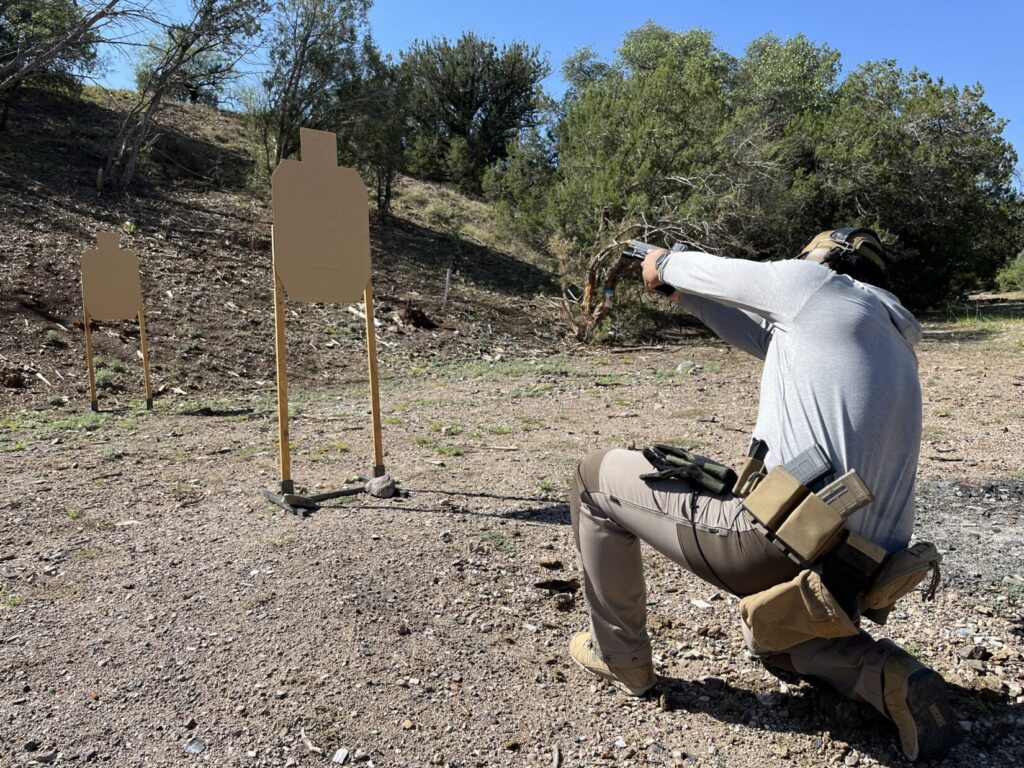
In Part I of this series, “Cellophane Man,” we discussed vertical displacement such as kneeling headshots. Vertical displacement is an option when terrain limits left and right movement. Examples would be in a hallway, narrow alley, or between cars in a parking lot.
For the Two-Deep drill, the command could be “Kneeling headshot, front!”—if, and only if, you are at a range where kneeling headshots will not fling bullets over the backstop or into overhead baffles.
IMPACT RANGES
Impact ranges do not rely on a backstop. They have enough real estate for the bullet’s flight to simply peter out and succumb to gravity. For example, the range fan at Davis-Monthan Air Force Base is 4000 meters deep. An M16A2 fired at optimum trajectory will lob a 5.56mm 3600 meters. That leaves DMAFB with a 400-meter safety buffer in case of haboob-force tailwinds.
To count as an impact range for pistols only, you would need a range fan at least 2 km (over a mile) deep.
It’s not really an impact range unless it is surrounded by a fence with signs stating “WARNING: IMPACT AREA. DO NOT ENTER.” Impact ranges are becoming less and less common as housing developments cover the land, but there are still a few around, mostly on military posts.
Kneeling headshots are safe on an impact range, as long as there are no low-flying aircraft.
Three deep
If your students have mastered the above challenges, you can add another target to the cue. It can be any combination of steel or cardboard as long as the closest steel is 10 meters away. The commands would then be “Close!” “Middle!” or “Far!”
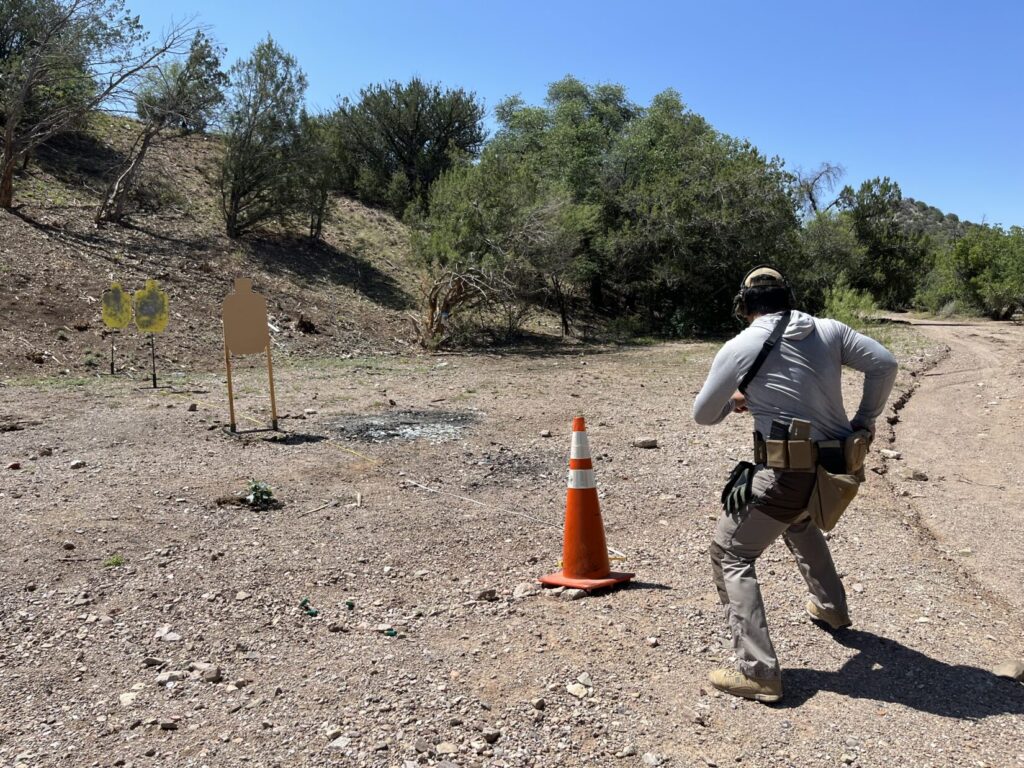
TWO-DEEP FOR LONG GUNS
If you are shooting narrow, fast bullets from a long gun (rifle or carbine), you will either need frangible ammo or to use cardboard for both targets.
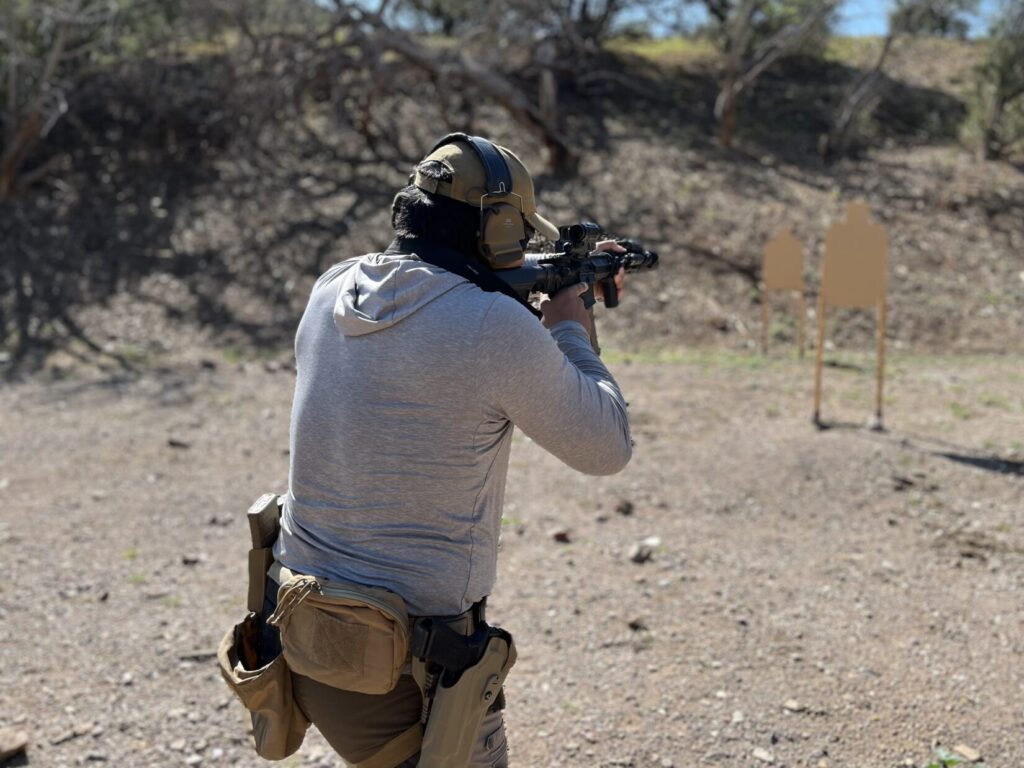
The steel rear, cardboard front target array we use for pistols also works with birdshot from a shotgun. But cardboard lasts longer against pistols. Lead buckshot is probably safe against steel at 10 meters; with plated buckshot, 25 meters is a better minimum. You can use two steel targets for a shotgun shooter. If you do, they should be at 10 meters (close) and 15 (far).
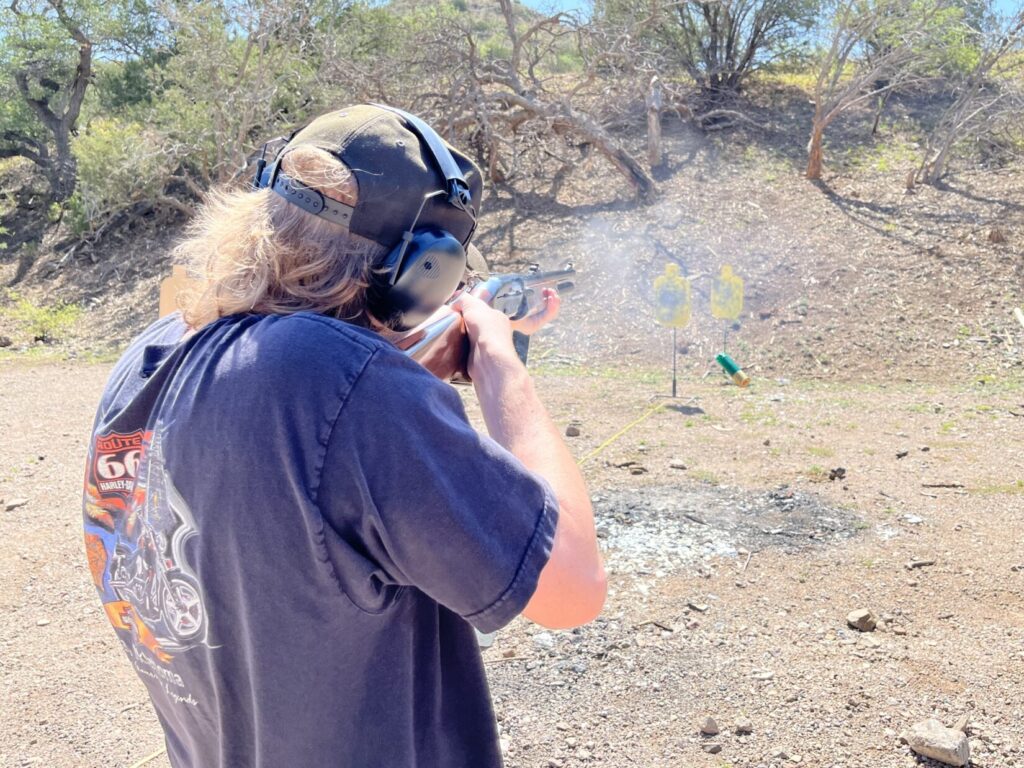
Because a shotgun pattern may be 10 inches wide at 10 meters, you’ll need to step just a little farther laterally to ensure a clear line of fire.
WARNING: Do not shoot shotgun slugs at steel for this drill. 25 meters is too close for slugs. Unless they are “reduced recoil,” 12 gauge slugs at less than 80 meters or so will eventually bow your steel, making it concave and less safe. If both targets are cardboard, slugs are fine.
STEEL TARGETS AND RIFLE BULLETS
Even if your steel is “rifle rated,” the splashback from lead-core rifle bullets can be dangerous at less than 50 meters. Your steel will get pitted if you bang it with rifle at less than 100 meters, or at any range with a bullet that hits faster than 2850 feet per second. Pitted steel is less safe.
Double-check those mags to ensure you’re not punching your steel at any distance with M855 green-tip 5.56x45mm, or black-tipped AP 7.62x51mm (NATO) or 7.62x63mm (.30-06 Springfield). Much of the older surplus ComBlock ammo, 7.62x39mm and 5.45×39.5mm, has an armor-piercing component that could pit your steel or bounce back at you.
A deep way of training
Two- (or Three-) Deep is not a drill. It’s a training philosophy.
Career law enforcers and action shooting competitors often lose sight of the reality that most people are good, most of the time. Criminals swim in an ocean of law-abiding citizens.
Any monkey can spray bullets in a general direction. When we need a specific application of force on a specific subject, and only that subject, we need an armed professional.
Notice I did not say someone in an armed profession. Not all who pack heat for pay are pros, and not all armed professionals get paid for the protection they provide daily for their fellow citizens.
If you are an armed professional, your target arrays should have depth as well as breadth. They should include a high percentage of no-shoots. Your range exercises should require you to think about Rule 4 issues until you automatically consider Rule 4 in every potential confrontation.